


Key takeaways
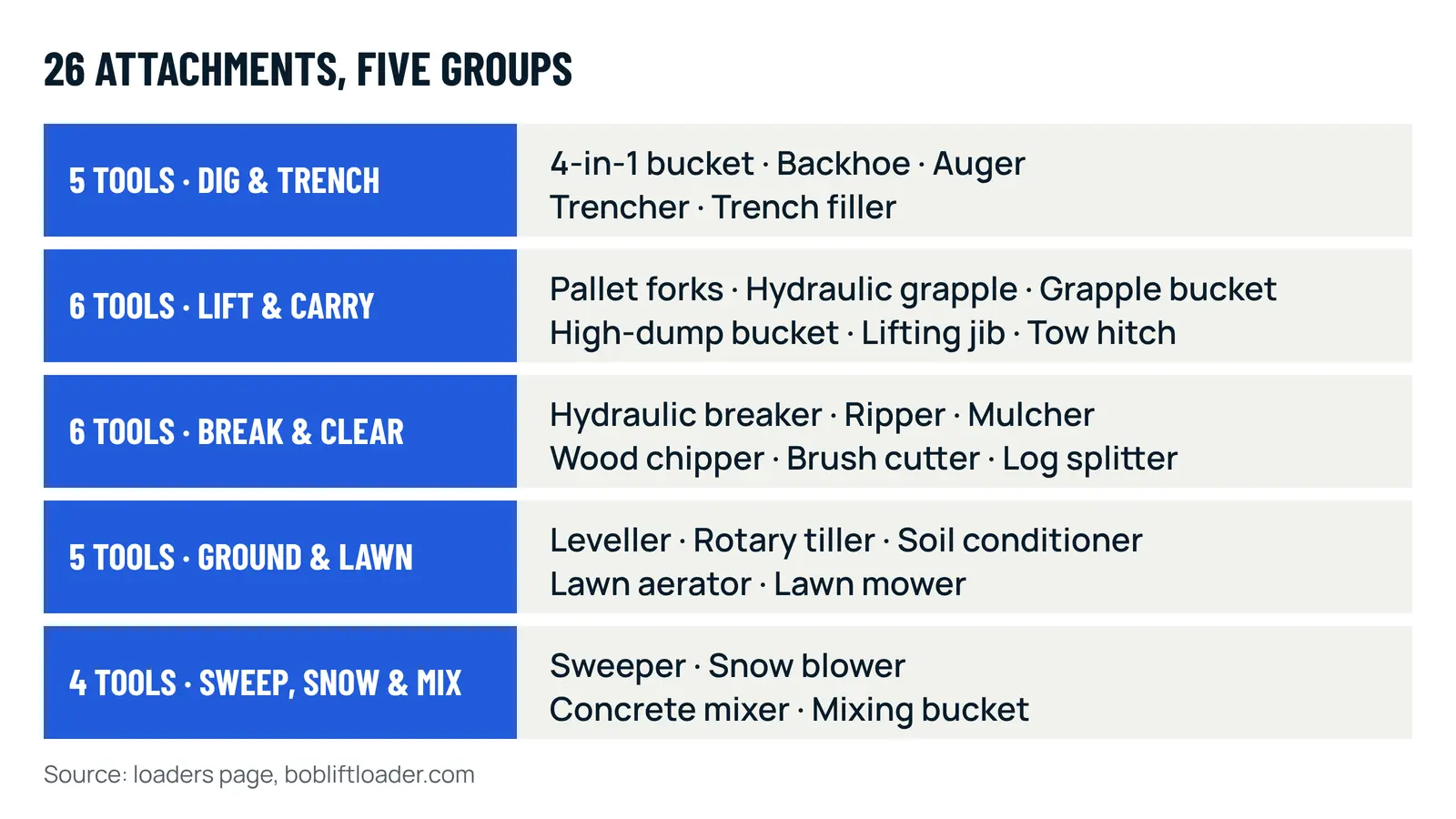
- BOB-LIFT lists 26 mini skid steer attachments in five groups: 5 for digging and trenching, 6 for lifting and carrying, 6 for breaking and clearing, 5 for ground and lawn work, and 4 for sweeping, snow and mixing.
- Every tool mounts on the quick-attach plate. Tools with moving parts also run from the auxiliary hydraulic lines.
- Hydraulic pressure runs from 16 MPa on the seated models to 20 MPa on the BL-T1000-H. Flow differs from model to model, so we confirm each match when we quote.
- Rated loads run from 200 kg (441 lb) to 500 kg (1,102 lb). The rated load limits what a fork, grapple or bucket should carry.
- On 8 of our 9 loaders the standard bucket is wider than the body, so measure your narrowest opening against the widest tool, not the machine.
What attachments can a mini skid steer run?
A mini skid steer can run 26 different tools on our range, from a 4-in-1 bucket to a snow blower. Each tool mounts on a quick-attach plate on the front of the lift arms. Powered tools also connect to auxiliary hydraulic lines. The bucket comes off and a fork, auger or sweeper goes on in minutes.
The quick-attach plate carries the weight and takes the push. The auxiliary lines carry oil from the loader’s pump to the tool. That oil drives a motor in an auger, a trencher, a sweeper or a mulcher, or a cylinder in a grapple or a breaker. Fixed tools, such as pallet forks, the leveller, the lifting jib and the tow hitch, need the plate only.

The full list sits in five groups on our mini skid steer loaders page. The groups follow the work: dig, lift, break, finish the ground, then sweep and mix. The sections below take each group in turn, with what each tool does and where it fits.

Dig and trench attachments
Five attachments dig and trench: the 4-in-1 bucket, backhoe, auger, trencher and trench filler. Together they cover a small groundworks job from the first hole to the backfill.
- 4-in-1 bucket: dig, grab, level and doze. The front of the bucket opens and closes like a jaw, so one tool loads, clamps awkward pieces, spreads and pushes.
- Backhoe: small excavations and pits. It turns the loader into a compact digger for drainage pits, footings and service pits.
- Auger: holes for posts and planting. Fencing, decking posts, signs and tree planting are the usual jobs.
- Trencher: narrow trenches for cables and pipes. A chain cuts a slot instead of a wide ditch, so less spoil comes out and less goes back in.
- Trench filler: backfill trenches after the pipe is in. It pushes the spoil heap back into the trench along its length.
For hole depths, trench planning and which loader suits each tool, see our guide to mini skid steer auger and trencher attachments. For pits and footings, our mini skid steer backhoe attachment guide compares it with a mini excavator.
Three of them, the backhoe, trencher and trench filler, are the range page’s picks for “Alongside bigger machines”: footings, trenches, backfill and clean-up on small sites. Our site preparation application points to four loaders rated 250–500 kg.
Lift and carry attachments
Six attachments lift and carry: pallet forks, hydraulic grapple, grapple bucket, high-dump bucket, lifting jib and tow hitch. They turn the loader into a small materials handler. The rated load of your loader, 200–500 kg on our range, is the figure to plan around.
- Pallet forks: pallets, bagged cement and bales. Check the full pallet weight against the rated load before you lift.
- Hydraulic grapple: straw, branches and loose debris. Curved tines close over material a bucket would spill.
- Grapple bucket: rubble, logs and awkward loads. A bucket floor with a clamp above holds mixed loads in place.
- High-dump bucket: tip loads into tall trucks and hoppers. It is built to tip higher than a standard bucket; our loaders’ published maximum dumping heights run from 1,340 to 1,826 mm.
- Lifting jib: lift and place with a chain or sling. It places items a bucket or fork cannot hold.
- Tow hitch: move trailers around the site. Short moves in a yard, not road towing.
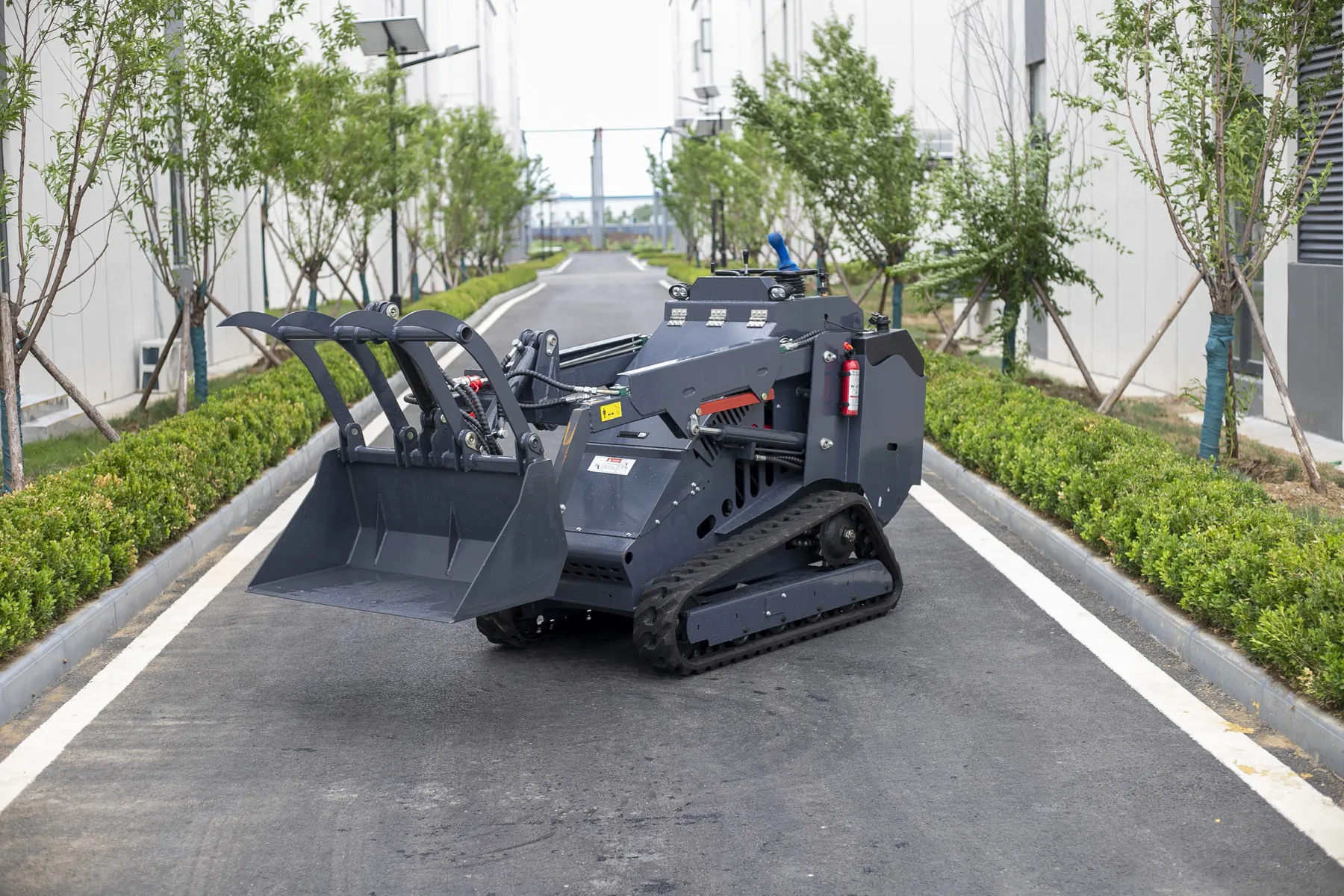
Forks and grapples suit yards, warehouses, farms and barns. Our loaders are narrow enough for greenhouse aisles and livestock sheds, where they clean out, move feed and carry bales.
For when to choose the grapple bucket or the hydraulic grapple, and how much a loader can lift with one, see our mini skid steer grapple guide.
Break and clear attachments
Six attachments break and clear: hydraulic breaker, ripper, mulcher, wood chipper, brush cutter and log splitter. These tools open hard ground and clear overgrown land before the real work starts.
- Hydraulic breaker: concrete, paving and frozen ground. It is the core tool for renovation and patch repairs, indoors and on streets.
- Ripper: loosen compacted soil and roots. Tines drag through hard ground so a bucket can then dig it.
- Mulcher: clear scrub and small trees. A rotor shreds growth where it stands.
- Wood chipper: chip branches and prunings on the spot. No need to carry cut branches off site.
- Brush cutter: cut back overgrown ground. It suits long grass, bramble and weeds over a large area.
- Log splitter: split firewood on the spot. Useful on farms, estates and tree work.
Rotating tools such as the mulcher, wood chipper and brush cutter depend most on hydraulic flow, so ask us to confirm the match for your model before you order. To choose between them, see our guide to the mini skid steer brush cutter, mulcher and wood chipper. Our mini skid steer breaker guide covers breaking concrete safely, and our stump grinder guide covers removing the stumps left after clearing.
Ground and lawn attachments
Five attachments prepare and care for the ground: leveller, rotary tiller, soil conditioner, lawn aerator and lawn mower. On rubber tracks, a mini loader spreads its weight on lawns and soft soil, which suits this finishing work.
- Leveller: grade and spread loose material. A steel frame drags soil or gravel flat. Our skid steer land leveler guide covers grading a yard step by step.
- Rotary tiller: turn soil for beds and planting.
- Soil conditioner: prepare a seed bed in one pass. It breaks up and levels the surface as it goes.
- Lawn aerator: open up compacted turf. A spiked drum pierces the surface so air and water get in.
- Lawn mower: mow large areas of grass.
Our landscaping application page starts from width: the narrowest loader, the BL-T360-H, is 930 mm (36.6 in) wide with its 906 mm bucket fitted. For gardens, the range page pairs the auger, leveller, rotary tiller and hydraulic grapple.
For which loader fits through a garden gate and which attachment does each garden job, see our mini skid steer for landscaping guide. To choose between the rotary tiller and the soil conditioner, see our mini skid steer tiller vs soil conditioner guide.
Sweep, snow and mix attachments
Four attachments sweep, clear snow and mix: sweeper, snow blower, concrete mixer and mixing bucket. Sweepers and snow blowers keep yards, roads and paths open. The two mixers make small batches of concrete where they are needed. Our mini skid steer snow removal guide explains when to use the sweeper, the snow blower or a bucket on snow.
- Sweeper: yards, roads and light snow. A rotating brush clears dust, debris and slush.
- Snow blower: clear paths and drives. An auger feeds snow to a chute that throws it to one side.
- Concrete mixer: mix small batches on site. A drum turns on the front of the loader.
- Mixing bucket: mix and pour in one attachment. It mixes in the bucket, then pours where you place it.

For streets and public spaces, the range page pairs the hydraulic breaker, sweeper and snow blower. The loader works on footpaths, lanes and housing estates without closing the road.
How to match an attachment to your loader
Match three things: hydraulics, rated load and width. Our loaders run at 16 to 20 MPa (160–200 bar), carry a rated load of 200 to 500 kg, and are 930 to 1,090 mm wide across the body. Hydraulic flow differs from model to model, so not every attachment suits every loader. We confirm the match when we quote your machine.
Hydraulics: pressure and flow
Pressure decides how much force a cylinder or motor can produce. Flow decides how fast it moves: how quickly an auger turns or a sweeper brush spins. A tool built for more flow than the loader gives will run slowly. A tool built for less may need its flow limited. That is why we match tools to each model, rather than publish one list for all nine.
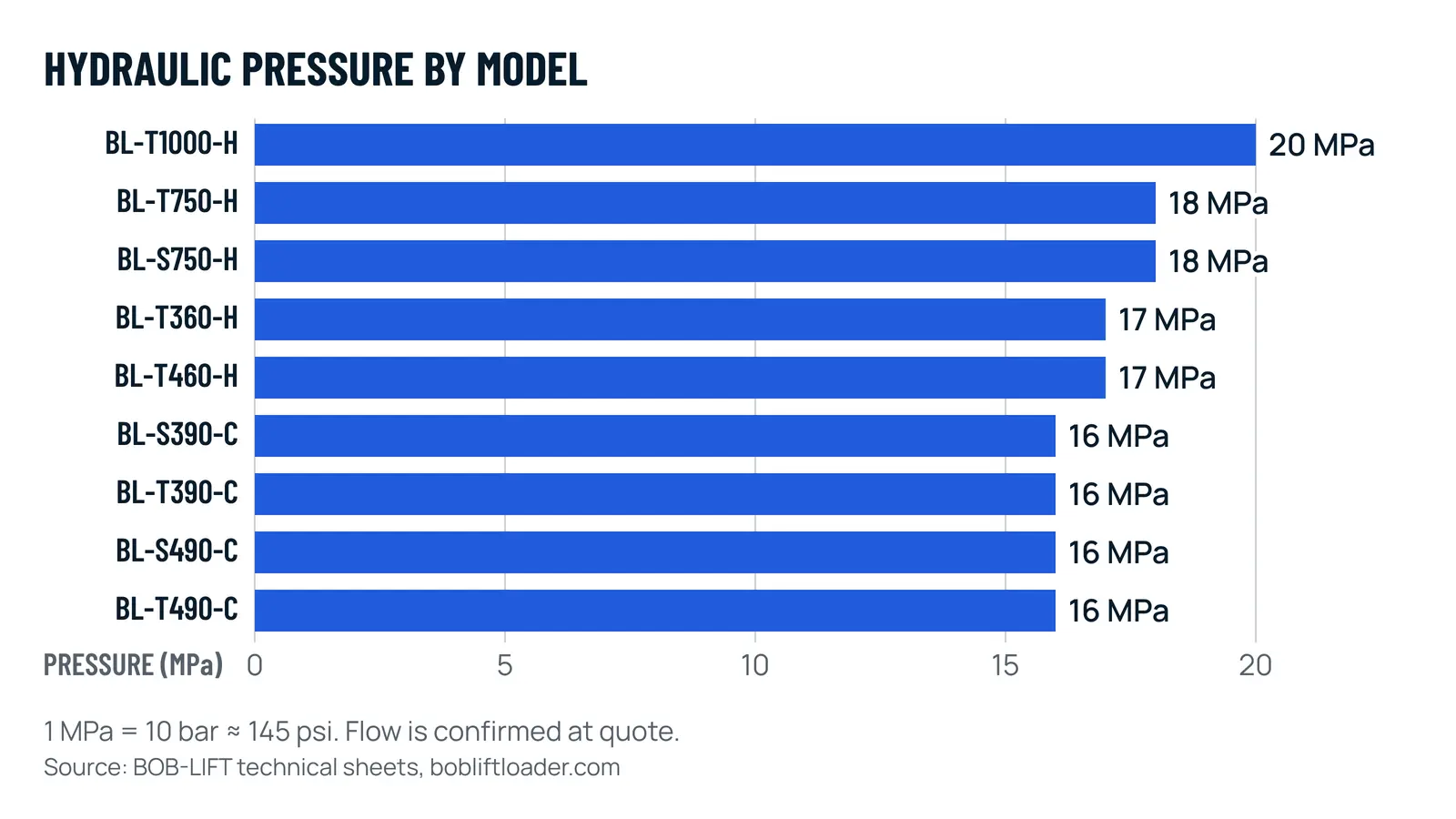
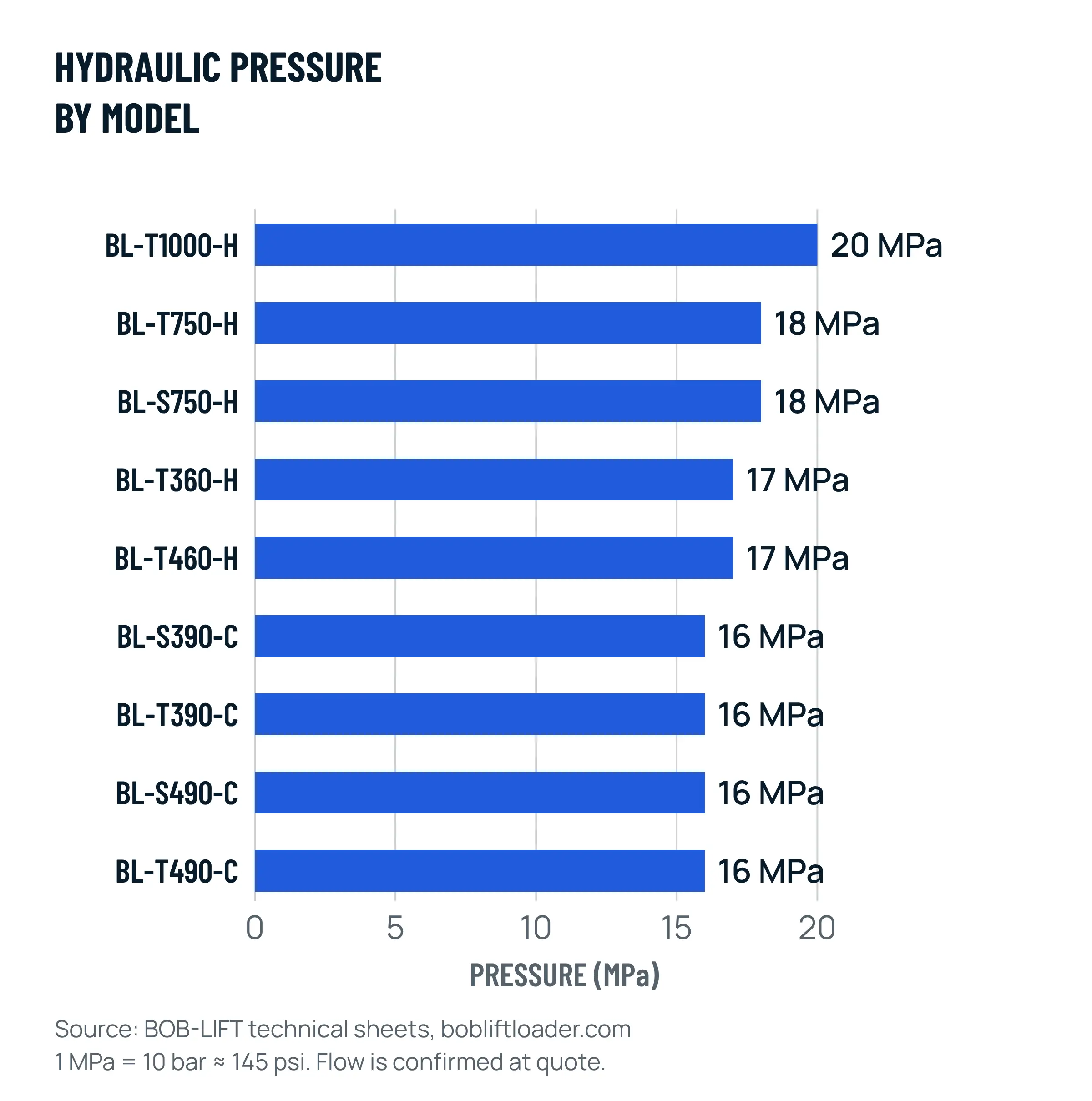
The BL-S750-H lists two piston pumps and one gear pump. The other sheets do not list pump types. Engine power matters too, because the engine drives the pump: listed engine power runs from 7.6 kW (BL-T360-H, BL-T390-C, BL-S390-C) to 18.6 kW (BL-T750-H, BL-S750-H).
Rated load and attachment weight
The rated load is the working limit, and a heavier tool leaves less of it for the load. ISO 14397-1, the international standard for calculating a loader’s rated operating capacity, covers buckets and forks. Its scope notes that some attachments can exceed the normal operating capacity and may need restricted operation, such as lower speed or limited lift height. The BSI summary of ISO 14397-1 says to follow the attachment maker’s instructions in those cases. Our article on how rated operating capacity is set explains the rule in more detail.
Width: the tool, not just the body
The tool is often the widest part of the machine. On 8 of our 9 loaders the standard bucket is wider than the body. Only the BL-T360-H keeps its 906 mm bucket inside its 930 mm body. Our mini skid steer bucket size chart lists each standard bucket’s capacity and the weight of a full load.
| Model | Hydraulic pressure | Rated load | Body width | Bucket width |
|---|---|---|---|---|
| BL-T360-H | 17 MPa | 200 kg | 930 mm | 906 mm |
| BL-T460-H | 17 MPa | 300 kg | 1,090 mm | 1,100 mm |
| BL-T750-H | 18 MPa | 410 kg | 985 mm | 1,270 mm |
| BL-S750-H | 18 MPa | 400 kg | 985 mm | 1,270 mm |
| BL-T1000-H | 20 MPa | 500 kg | 960 mm | 1,240 mm |
| BL-S390-C | 16 MPa | 260 kg | 959 mm | 1,050 mm |
| BL-T390-C | 16 MPa | 250 kg | 955 mm | 1,050 mm |
| BL-S490-C | 16 MPa | 250 kg | 1,089 mm | 1,150 mm |
| BL-T490-C | 16 MPa | 250 kg | 1,089 mm | 1,150 mm |
Attachment widths vary by tool, so give us your narrowest opening when you ask for a quote. Our guide to mini skid steer weight and dimensions covers gates, trailers and lift heights.
Which attachments to buy first
Buy for your main job first: our loaders page pairs each of six work settings with three or four attachments.
| Where it works | Starter attachments | Typical jobs |
|---|---|---|
| Renovation and indoor work | Hydraulic breaker, 4-in-1 bucket, grapple bucket | Break out floors, clear rubble and move materials in buildings, basements and car parks |
| Gardens and landscaping | Auger, leveller, rotary tiller, hydraulic grapple | Dig planting holes, level beds, turn soil, gather cuttings |
| Farms, greenhouses and barns | 4-in-1 bucket, pallet forks, hydraulic grapple | Clean out, move feed, carry bales in aisles and sheds |
| Streets and public spaces | Hydraulic breaker, sweeper, snow blower | Patch repairs, drain clearing and snow on footpaths and lanes |
| Yards and warehouses | Pallet forks, grapple bucket, sweeper | Move pallets, clear scrap and offcuts in narrow aisles |
| Alongside bigger machines | Backhoe, trencher, trench filler | Footings, trenches, backfill and clean-up on small sites |
Six tools appear in two settings each: the hydraulic breaker, 4-in-1 bucket, grapple bucket, hydraulic grapple, pallet forks and sweeper. If your work is mixed, start with the ones that match your two main jobs. Add powered tools, such as the auger, breaker or sweeper, once you know your loader’s flow.
The operator position matters for attachment work too. Stand-on models suit frequent on-and-off work, such as fencing with an auger. Seated models suit longer shifts, such as a day of sweeping. Our comparison of stand-on vs seated mini skid steers goes through the choice.
If you are still choosing the machine itself, start with our nine mini skid steer models.
Frequently asked questions
Do mini skid steer attachments fit other brands’ loaders?
Not always. The current international standard for skid steer attachment coupling is ISO 24410:2020, the second edition, which sets dimensions for the attachment mounting frame and gives separate width figures for narrow skid steer loaders. Mini loader plates still differ in width and interface dimensions from one maker to another, so mini skid loader attachments from one maker may not fit another’s machine. Our mini skid steer quick attach plate guide lists the six measurements to check before you buy. Our attachments are quoted with a BOB-LIFT loader and matched to its plate and hydraulics, so check any other machine’s plate and hydraulics with its own maker before you buy.
Which attachments need auxiliary hydraulics?
Any tool with a motor or cylinder needs them: auger, trencher, breaker, mulcher, sweeper, snow blower, mixers, grapples and the 4-in-1 bucket. Fixed tools such as pallet forks, the leveller, the lifting jib and the tow hitch mount on the plate alone.
How quickly can I change attachments?
In minutes. The bucket comes off the quick-attach plate, the next tool goes on, and powered tools connect to the auxiliary couplers.
Can attachments ship in the same container as the loader?
Ask us when you order. Our container figures (about 6 of most loaders in a 20GP) assume the standard bucket and no attachments. Attachments change the loading plan, and we confirm the final plan against your actual order before you buy. Container figures for every model are on our buying and support page.
Does a heavy attachment reduce what the loader can carry?
Yes. A tool heavier than the standard bucket leaves less of the rated load, 200–500 kg on our range, for the material. Follow the attachment’s instructions on speed and lift height.
Choosing your set
Start with the job, then the loader, then the tools. Tell us your narrowest opening, your heaviest load and the ground you work on. We will suggest a model and quote the attachments matched to its hydraulics. Compare all nine models on our mini skid steer loaders page, or contact our team with your list.