


Key takeaways
- A mini skid steer stump grinder is a toothed cutting wheel on an arm that mounts on the loader’s quick-attach plate. It chips the stump away below ground instead of pulling it out, so the roots stay in the soil and the lawn around it stays mostly intact.
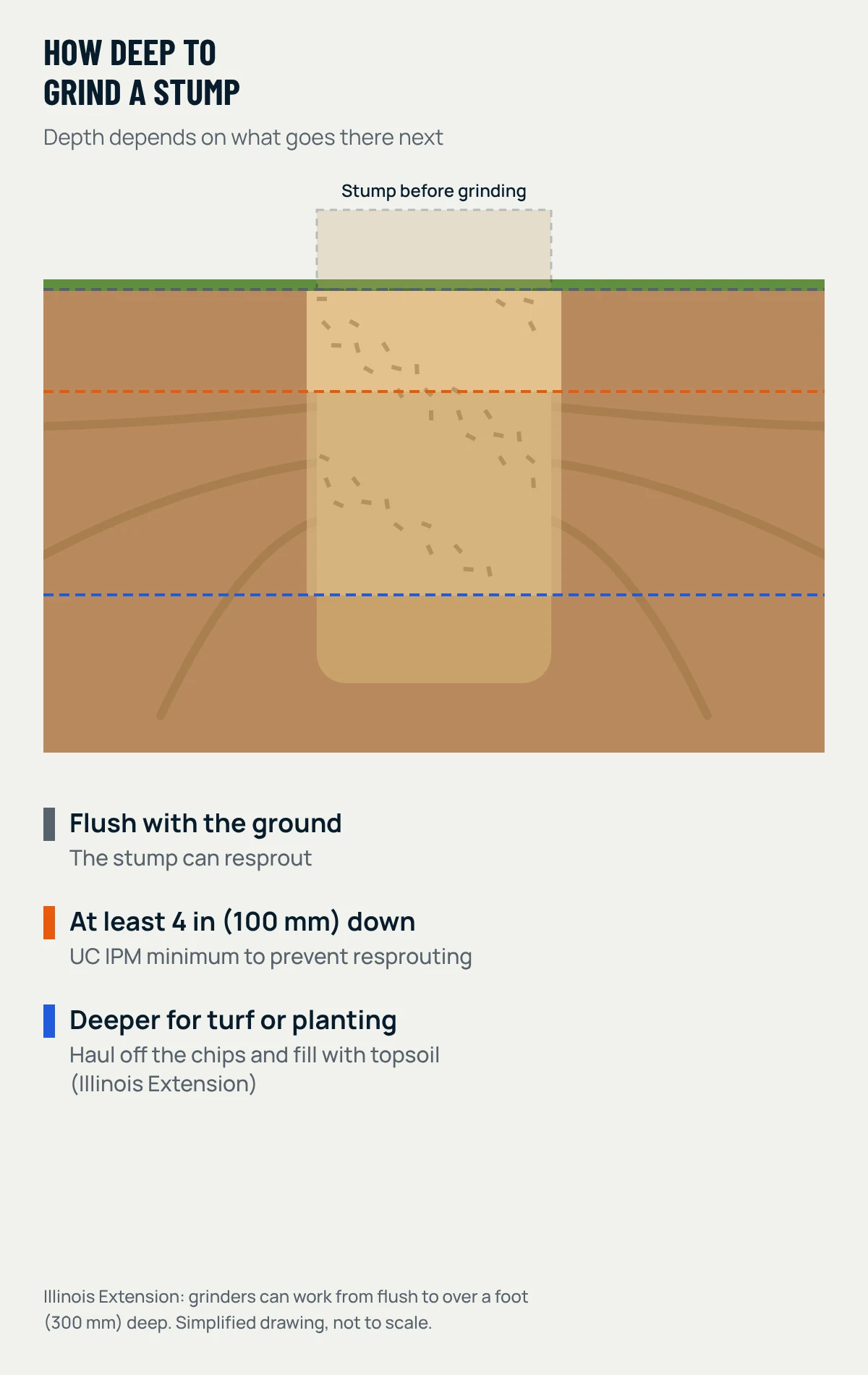
- Grind in shallow bites and sweep the wheel across the stump. UC IPM’s guidance is to take “no more than three inches” at a time and to keep going until the hole is at least 4 inches below ground level “to prevent resprouting”.
- Go deeper where you will replant or lay turf. Illinois Extension notes grinders can work “from flush to the soil line to over a foot deep”, and recommends hauling off the chips and filling with topsoil before turf goes in.
- A stump grinder needs steady hydraulic flow to keep the wheel turning. Look first at our 17.8 to 18.6 kW loaders; the BL-T750-H is the one in our photo. We check flow against the grinder’s motor when we quote.
What is a skid steer stump grinder?
A skid steer stump grinder, often sold as a stump grinder attachment for skid steers, is a cutting wheel fitted with replaceable bolt-on teeth, driven by a hydraulic motor and carried on a steel arm that mounts on the loader’s quick-attach plate. Oil from the loader’s auxiliary hydraulics spins the wheel. A steel guard covers the top of the wheel. The operator lowers the spinning wheel into the stump and sweeps it from side to side, chipping the wood into small pieces until the stump is below the soil.
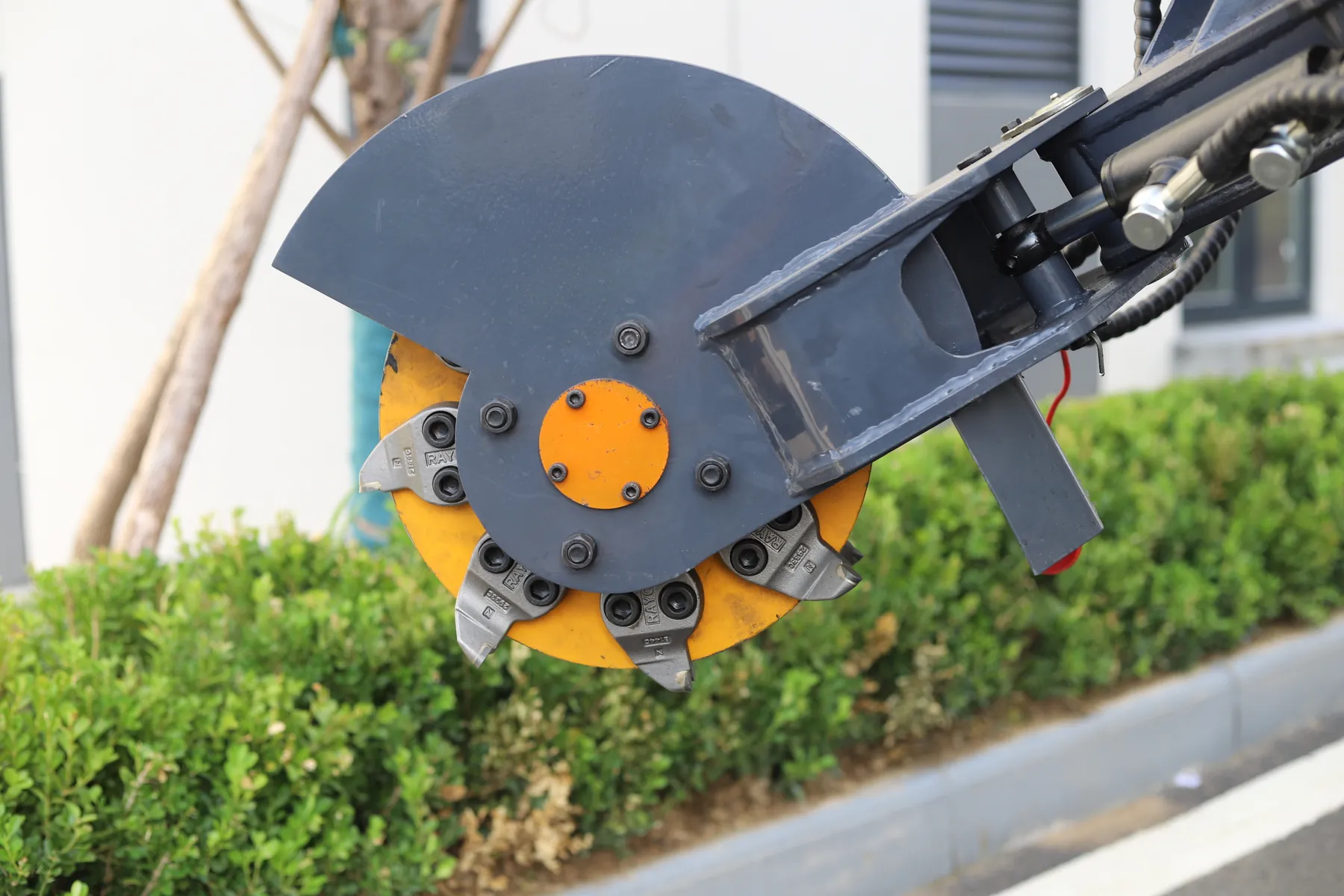
UC IPM describes stump grinding as chipping trees and large shrubs “to below ground level using a power tool with a high-speed, steel-toothed cutting wheel”, and lists attachments to larger equipment alongside walk-behind and self-propelled grinders (UC IPM WeedCUT, Stump Grinding). The mini skid steer version sits between those two: it drives itself to the stump, then lifts, carries and clears up with other attachments on the same machine.
Stump grinder or dig the stump out?
There are two practical ways to get rid of a stump with a mini loader: grind it in place or dig it out. The right one depends on what happens to the ground next.
| Factor | Stump grinder | Dig out (bucket or backhoe) |
|---|---|---|
| What it removes | The stump, down to the depth you grind | The stump and the main roots |
| What it leaves | A shallow hole of chips and soil; roots stay in the ground | A larger hole to backfill, and a root ball to dispose of |
| Ground disturbance | Small: the loader stays beside the stump | Larger: digging around the roots opens up more of the lawn |
| Best for | Lawns, paths and beds near buildings or fences | Footings, driveways and any job that needs the roots gone |
Brush cutters and mulchers clear what grows above ground but are not built to grind stumps below the soil; our brush cutter vs mulcher guide covers that first stage of land clearing. When the roots have to come out, for a footing or a slab, our mini skid steer backhoe attachment guide explains how to dig with the loader.
How to grind a stump with a mini skid steer
Read the grinder’s manual first, because its limits on bite depth and wheel speed override any general advice. A typical sequence:
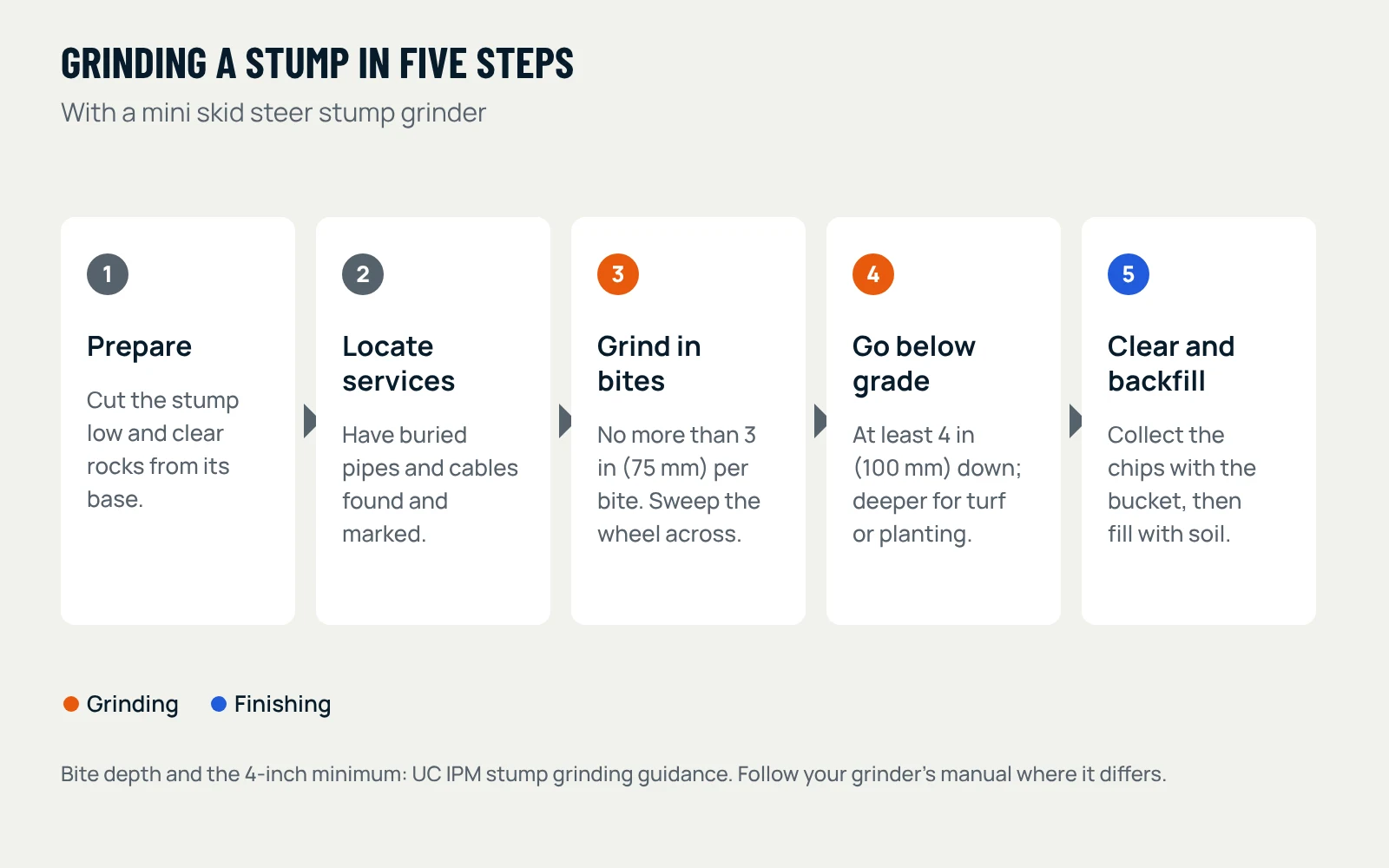
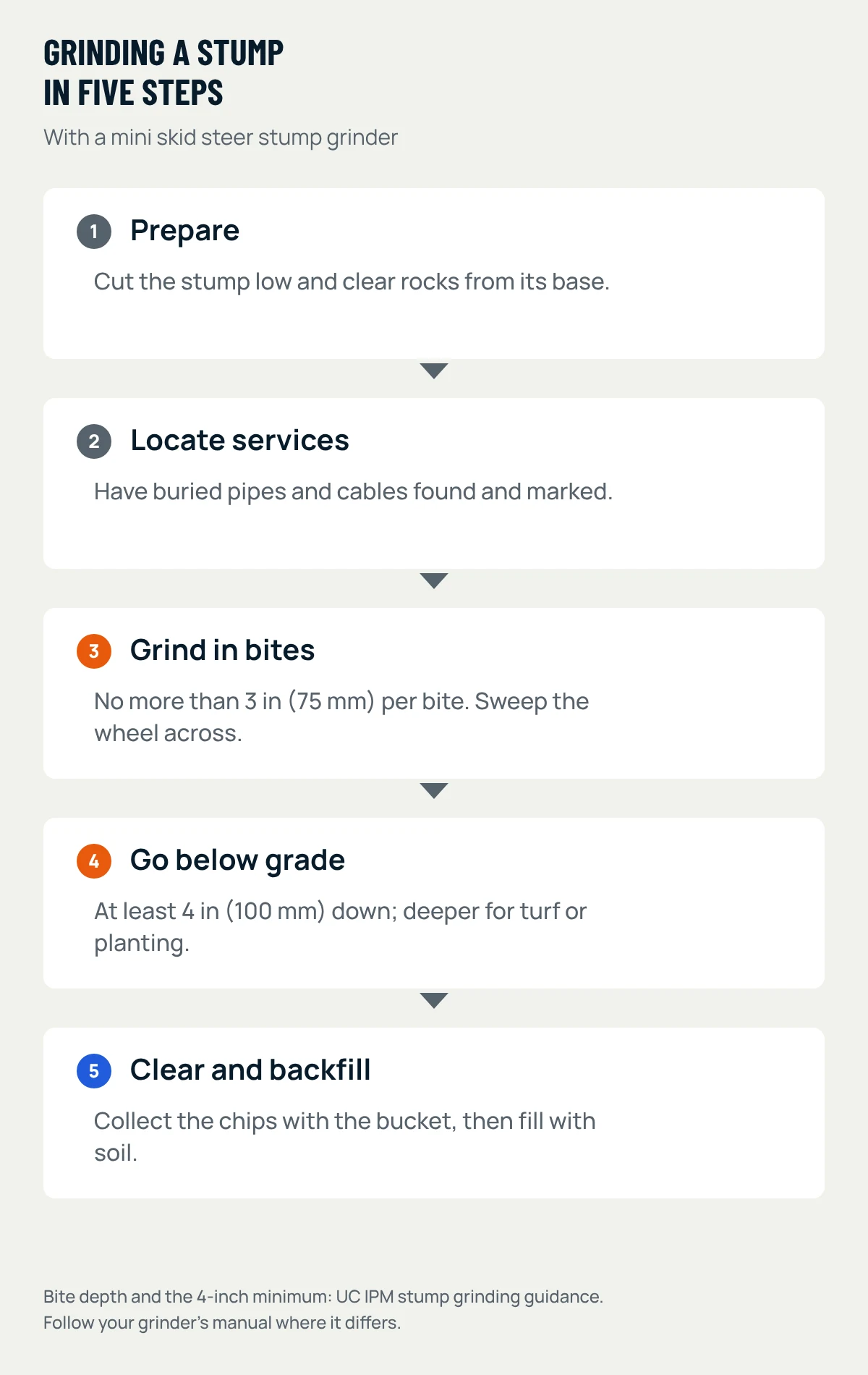
- Prepare the stump. Cut the stump as close to the ground as you can and, as UC IPM advises, remove “all rocks from around its base”. Stones break teeth and get thrown by the wheel.
- Locate buried services. Irrigation pipes, garden lighting cables and utility lines often run near old trees. Have them located and marked before the wheel goes below ground.
- Grind in shallow bites. Start the wheel above the front edge of the stump, then lower it in. UC IPM says to take “no more than three inches (unless stated otherwise in the grinder’s manual) of material at a time to avoid bogging down the engine”, and to “Swing the blade back and forth across the stump”.
- Go below grade. Repeat pass by pass until the hole is at least 4 inches (about 100 mm) below ground, deeper where you will plant or lay turf.
- Clear up and backfill. Collect the chips with the bucket or a grapple bucket, then fill the hole with soil.
How deep should you grind a stump?
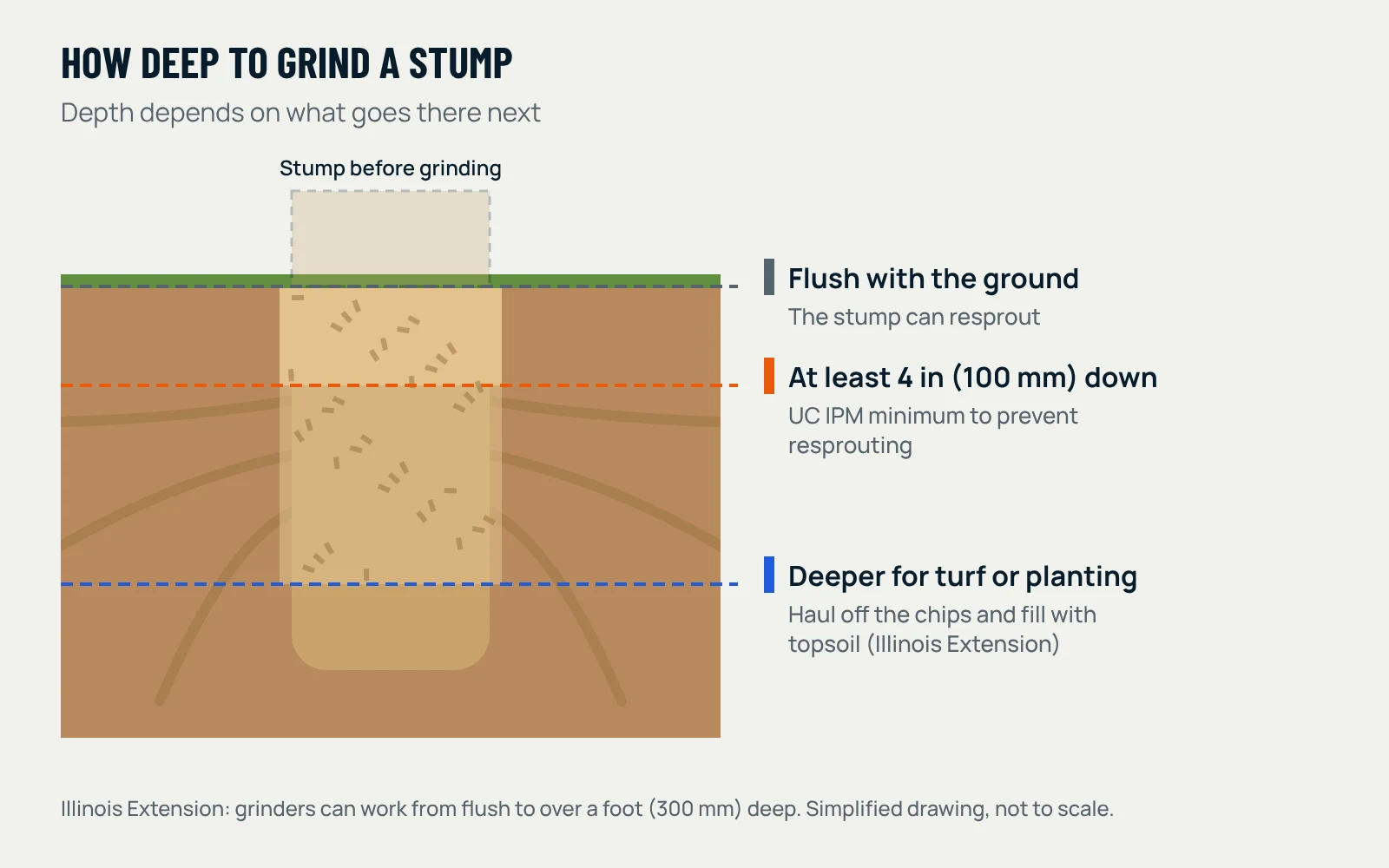
Depth depends on what goes there next. Illinois Extension horticulture educator Christopher Enroth writes that grinders “can remove stumps to a certain depth, ranging from flush to the soil line to over a foot deep”, and that “the deeper you want a stump ground out, the more it will cost you” (Illinois Extension, Good Growing, 18 July 2025). With your own machine, deeper means more time and more wear on the teeth.
- To stop regrowth: at least 4 inches (about 100 mm) below ground, the UC IPM minimum “to prevent resprouting”. UC IPM also warns that some species “resprout vigorously from extensive lateral roots”, so grinding alone may not stop them.
- For new turf: grind deeper, then remove the chips. Illinois Extension recommends that you “haul off the chipped stump debris and fill the hole with quality topsoil”, because “Wood material mixed in with the soil can tie up nitrogen as the wood breaks down”.
- For paving or a path: grind deep enough to keep the stump clear of the base layer, or dig the stump out if the paving needs a firm, root-free base.
Which mini skid steer to pair with a stump grinder
The grinder’s wheel is driven by a hydraulic motor on the loader’s auxiliary lines. Auxiliary flow sets how fast the wheel turns, and hydraulic pressure and engine power set how well it keeps turning when the teeth bite into hard wood. We publish power and pressure for each loader. We do not publish auxiliary flow, so we check it against the grinder’s motor when we quote.
| Loader | Engine power | Hydraulic pressure | Body width | Running gear and operator |
|---|---|---|---|---|
| BL-T750-H | 18.6 kW | 18 MPa | 985 mm | Tracks, stand-on |
| BL-S750-H | 18.6 kW | 18 MPa | 985 mm | Wheels, stand-on |
| BL-T1000-H | 17.8 kW | 20 MPa | 960 mm | Tracks, stand-on |
| BL-T460-H | 16.8 kW | 17 MPa | 1,090 mm | Tracks, stand-on |
| BL-T490-C | 16.8 kW | 16 MPa | 1,089 mm | Tracks, seated |
| BL-S490-C | 16.8 kW | 16 MPa | 1,089 mm | Wheels, seated |
- Start with the 17.8 to 18.6 kW models. The tracked BL-T750-H, shown with a stump grinder above, the wheeled BL-S750-H and the BL-T1000-H have the most power in our range.
- The 16.8 kW models can be matched to a grinder for occasional garden stumps; we confirm the match when we quote.
- Our 7.6 kW models (BL-T360-H, BL-T390-C and BL-S390-C) are better kept for lighter attachments. Ask us before you plan stump work around one of them.
- Tracks or wheels. Tracks spread the loader’s weight on lawns and soft ground around the stump. Our tracked vs wheeled mini skid steer guide compares the two.
All three of the higher-power models are under one metre wide, so they fit through many garden gates. Check the gate and the route against our mini skid steer weight and dimensions guide before the machine arrives.
Stump grinder safety
- Keep a clear zone. The wheel throws chips, soil and any stone it hits. Keep people, pets and vehicles well away, and work so the chips are thrown away from windows and doors.
- Wear the right protection. UC IPM says grinders use “high-power spinning cutting blades and therefore should be handled with extreme care”, and lists “ear, eye, face protection as well as gloves”. Our product pages note that noise at the operator position can exceed 85 dB(A) at full engine speed on some models.
- Stop before you touch the wheel. Lower the grinder to the ground, stop the engine and wait for the wheel to stop before you clear roots or check the teeth. Keep the guard in place; NIOSH tells skid steer operators to “NEVER modify or bypass safety devices” (NIOSH Publication 2011-128).
- Check the teeth. Replace worn, chipped or loose teeth before work, and recheck the bolts after hitting stone.
Before a day of grinding, run through our skid steer maintenance checklist, with extra attention to the auxiliary hoses and couplers.
Mini skid steer stump grinder FAQ
Can a mini skid steer run a stump grinder?
Yes. A mini skid steer stump grinder attachment runs from the loader’s quick-attach plate and auxiliary hydraulics. In our range, the 17.8 to 18.6 kW models are the first choice, and we match the grinder to the loader’s flow when we quote.
How deep does a skid steer stump grinder go?
As deep as you keep grinding, within the reach of the wheel. Illinois Extension notes depths “from flush to the soil line to over a foot deep”. Grind at least 4 inches (about 100 mm) below ground to stop resprouting, and deeper for turf or new planting.
What do I do with the wood chips?
For a lawn, collect them with the bucket and fill the hole with topsoil. Wood mixed into the soil can tie up nitrogen as it breaks down, as Illinois Extension notes, so new grass over the old stump can lack nitrogen.
Will the roots grow back after grinding?
UC IPM’s step to prevent resprouting is to grind until the hole is at least 4 inches below ground. It also notes that some species resprout vigorously from extensive lateral roots, so grinding alone may not stop them.
Is grinding better than digging a stump out?
Grinding disturbs less ground and leaves the roots to rot in place, which suits lawns and gardens. Dig the stump out when the roots must go, for example under a footing or a driveway.
Planning your stump work
Count the stumps, note their size and what the ground will be used for, and measure your narrowest gate. Then compare our nine mini skid steer loaders, or see the full list of attachments that can go on the same machine for the rest of the job. When you ask for a quote, tell us how many stumps, their diameter, the ground and the other attachments you want, and we suggest the loader and grinder to match.
Specifications checked against our product pages on 22 October 2026.