


Key takeaways
- For mini skid steer snow removal, choose the attachment by the snow you get and where it has to go. A sweeper suits light snow on paved ground, a snow blower suits deep snow or sites with nowhere to pile it, and a bucket lifts snow into a truck or skip.
- Our mini skid steer loader range page lists the snow blower (“Clear paths and drives”) and the sweeper (“Yards, roads and light snow”). Plows and pushers are not in our standard list, so ask before you plan around one.
- Weight rarely limits a mini loader in snow. A full 0.19 m³ bucket of very wet snow weighs about 152 kg, under the 200 kg rated load of the BL-T360-H, the lowest-rated loader in our range. Volume and space to put the snow matter more.
- Never run the loader in a closed or attached garage. Before winter, plan cold starts, winter-grade fuel and a wash-down after salted roads.
Which snow attachment fits which job?
Match the attachment to two things: how much snow falls, and where you can put it. A sweeper is the fastest way to clear a few centimetres from a paved surface. A snow blower is the tool for deep or heavy snow, and for paths with no room left at the edges. A bucket moves snow you need to lift, load or carry away. A plow or pusher is the usual choice for wide, open areas where the snow can be pushed into one pile.
Snow varies a lot from one storm to the next. In a forecasting guide, the US National Weather Service office in Nashville describes 6:1 snow (six inches of snow per inch of water) as “heavy, wet snow” and says 30:1 or higher snow is so light that “usually you can brush it away with a broom” (NWS Nashville, Weather 101: Snow, retrieved 19 October 2026). The same site can need a sweeper one week and a blower the next, which is why snow work suits a loader that changes tools in minutes.


| Sweeper | Snow blower | Bucket | Plow or pusher | |
|---|---|---|---|---|
| Best for | Light snow on paved ground | Deep or heavy snow, narrow paths | Loading and carrying snow away | Wide, open, flat areas |
| Where the snow goes | Brushed to the side | Thrown clear of the path | Lifted into a truck, skip or pile | Pushed ahead into one pile |
| Powered by | Auxiliary hydraulics | Auxiliary hydraulics | The loader’s lift and tilt | The loader’s push |
| On our range page | Yes | Yes | Yes (4-in-1 bucket) | No: ask us |
Mini skid steer snow blower: deep snow and nowhere to pile it
A mini skid steer snow blower gathers snow with a rotating auger at the front and throws it out through a chute. Because it puts the snow somewhere else instead of pushing it ahead, it keeps working when the banks at the edge of a path are already full. That makes it the strongest choice for deep snow, heavy snow and long, narrow runs such as footpaths, drives and lanes between buildings. Our range page lists it to “Clear paths and drives”.
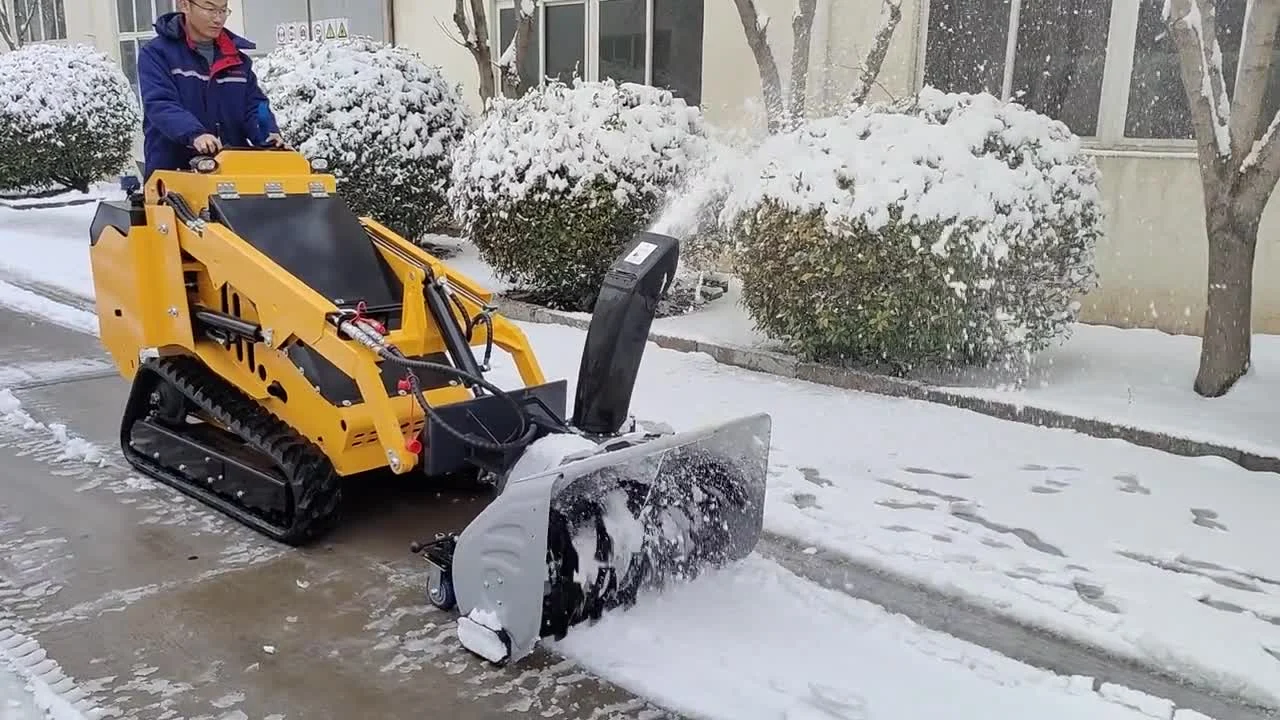
The blower is a powered attachment. Its auger and fan run from the loader’s auxiliary hydraulic lines, so its performance depends on the hydraulic flow the loader supplies. Our nine loaders work at 16 to 20 MPa, and flow differs from model to model. We match the blower to your loader when we quote, so tell us which machine you have in mind and how much snow you expect.
Two practical points come with any blower. Check the throw direction before you start, so snow does not land on cars, windows or people walking past. And never reach into a jammed chute while the machine is running. The US Occupational Safety and Health Administration warns that snow blowers “commonly cause lacerations or amputations when operators attempt to clear jams with the equipment turned on” (OSHA, Winter Weather: Hazards and Precautions, retrieved 19 October 2026). Lower the attachment, stop the engine and clear the jam with a tool.
Mini skid steer sweeper: light snow on paved ground
A sweeper is the quickest tool for a light fall on a hard surface. Its rotating brush lifts the snow off concrete, asphalt or paving and pushes it to one side, leaving the surface close to bare. Our range page lists the sweeper for “Yards, roads and light snow”, and we suggest it, with the snow blower, for streets and public spaces, where a mini loader can clear footpaths and lanes without closing the road.

Keep the sweeper for the snow it suits. A brush handles a few centimetres well; deep, wet snow tends to pack in front of it instead of flying clear. Gravel drives are a poor match too, because the brush throws stones along with the snow. On those surfaces, a bucket or blower set a little above the ground does less damage.
The sweeper is also useful all year. The same attachment cleans yards, workshops and roads in summer, which makes it easier to justify than a tool that only comes out in winter.
Skid steer snow bucket: lifting and loading snow
Use a bucket when snow has to be lifted, stacked or carried away: loading a truck, clearing a car park entrance, or moving a bank that blocks a gate. Our mini skid steer bucket guide explains bucket types and sizes; for snow, the 4-in-1 bucket, listed to “Dig, grab, level and doze”, can also grip a frozen lump between its jaws.
Snow is light compared with the materials a loader usually carries. Densities in the classic snow table from Paterson’s The Physics of Glaciers (1994), as reproduced by the Scottish Avalanche Information Service, run from 50 to 70 kg/m³ for new snow that fell in calm air, through 100 to 200 kg/m³ for damp new snow, to 200 to 300 kg/m³ for settled snow, 350 to 400 kg/m³ for wind-packed snow and 700 to 800 kg/m³ for very wet snow (SAIS Lochaber, High Density Snow, February 2023). We multiplied the top of each range by our largest standard bucket, the 0.19 m³ bucket on the BL-T1000-H.

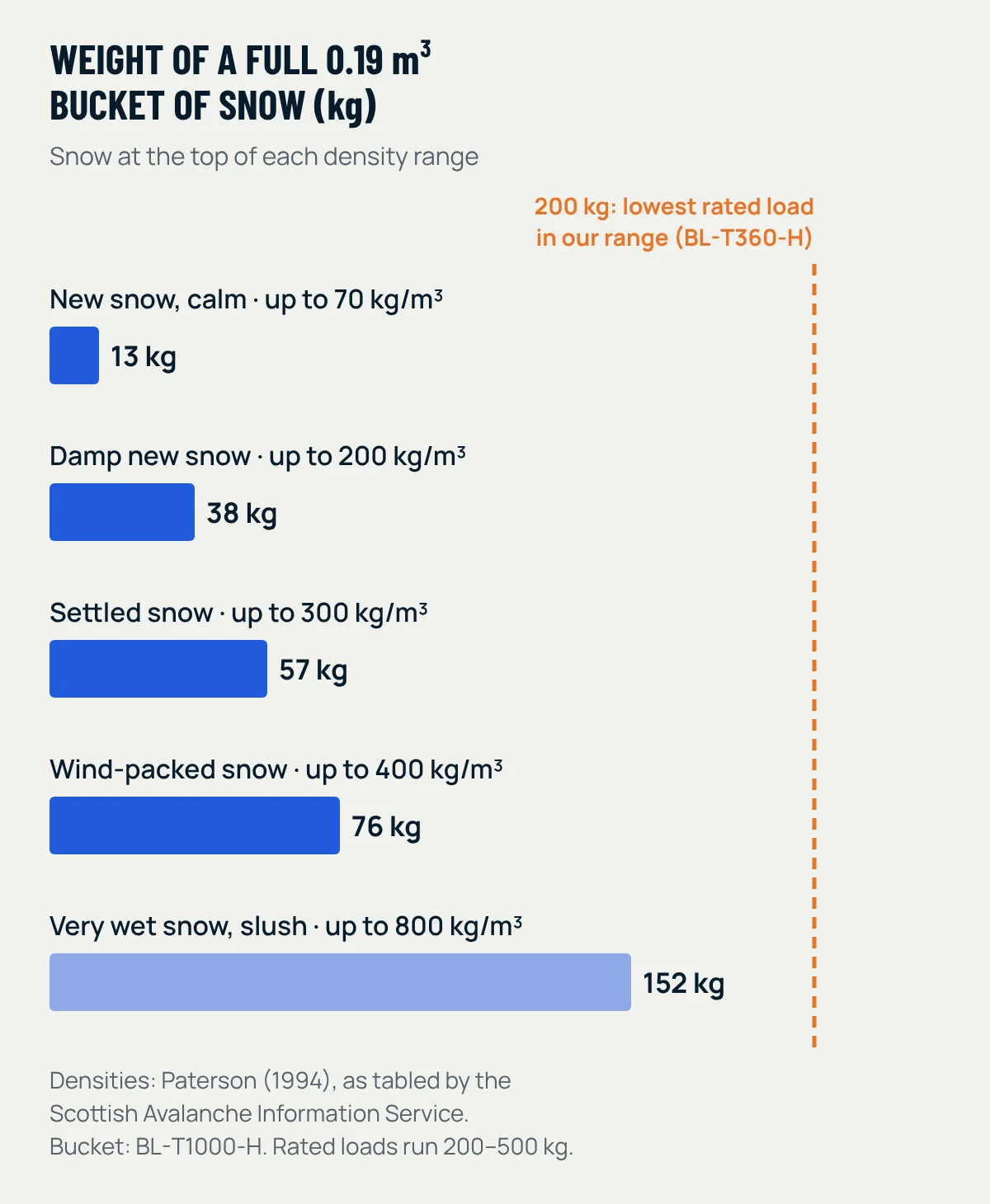
The result: even slush at 800 kg/m³ puts about 152 kg in a full 0.19 m³ bucket. Rated loads in our range run from 200 kg to 500 kg, so that is below even the 200 kg rating of the BL-T360-H, which carries a smaller 0.15 m³ bucket anyway. Settled snow comes to about 57 kg. A heaped or packed bucket holds more than its rated capacity, so treat the rated load as the limit and do not overload with wet slush. In normal use, unlike sand or gravel, loose snow rarely takes a mini loader near its rating. What slows bucket work is volume: a 0.15 to 0.19 m³ bucket moves a large drift a little at a time. For big volumes, a blower that throws the snow aside is usually faster than carrying it.
Skid steer snow plow and snow pusher: clearing big flat areas
A skid steer snow plow (or plough) is an angled blade that rolls snow off to one side. A snow pusher is a box-shaped blade with side walls that holds the snow in front of it and carries it to a pile. Both suit wide, open, flat areas such as car parks and yards, where you can push to one corner. Many buyers ask us about a mini skid steer snow plow or skid steer plow, but plows and pushers are not on our attachment list. If your work is mostly large car parks, tell us when you ask for a quote and we will tell you what we can supply; do not plan around one until we confirm it.
For most of the places a mini skid steer is chosen for, such as paths, gateways and lanes between buildings, there is little room to push snow into a pile. That is where the blower and sweeper earn their place.
Tracks or wheels on snow and ice
Rubber tracks spread the machine’s weight and grip on packed snow and soft ground, so tracked loaders keep moving where wheels may spin. On cleared, paved roads, wheels run smoothly and leave no track marks, which suits our wheeled BL-S750-H, BL-S390-C and BL-S490-C. Neither tracks nor tyres grip on sheet ice, so slow down, keep the attachment low and avoid sharp turns on slopes. Our guide to tracked vs wheeled mini skid steers compares the two in more detail.
The operator position matters in winter too. Stand-on loaders, the five H models, let the operator step off quickly to clear a doorway by hand or move a bin. Seated loaders, the four C models, suit longer shifts in one place. Our stand-on vs seated mini skid steer guide explains the trade-off.
Width decides where the loader can go. Our loaders are 930 to 1,090 mm wide across the body, and most buckets and attachments are wider than the body. Measure your narrowest path or gate against the attachment, not just the machine. Every model’s widths are in our mini skid steer weight and dimensions guide.
Cold-weather checks before you clear snow
A loader that works in snow needs a few checks that summer jobs do not. Run through them before the first fall, and our skid steer maintenance checklist covers the daily checks for the rest of the year.
- Never run the engine indoors. Start and warm the loader outside, not in a closed shed or attached garage. The US Centers for Disease Control and Prevention advises never to run a car or truck inside a garage attached to a house, “even if you leave the garage door open” (CDC, Winter Safety Tips, February 2021). The same applies to a loader’s engine.
- Use winter-grade fuel. The BL-T750-H, BL-S750-H and BL-T1000-H run on diesel, and the 360, 390, 460 and 490 series can be ordered with petrol or diesel. In cold weather, the wax in diesel starts to come out of the fuel at its cloud point, and the crystals can collect on the fuel filter and starve the engine. CHS, the farm co-operative behind Cenex fuels, puts the cloud point of standard No. 2 diesel at −10 °C (14 °F) and recommends blending in No. 1 diesel with a cold-flow improver as winter sets in (CHS, Diesel gelling and how to stop it this winter, November 2018). Ask your fuel supplier for a winter blend before the first frost.
- Warm up the hydraulics. Let the engine idle and cycle the lift and tilt slowly before you load the attachment. Cold oil moves slowly.
- Check the battery and lights. Cold weakens batteries, and winter work often starts before daylight.
- Wash off road salt. Rinse the tracks, frame and attachment after working on salted roads, and dry the couplers before you connect them again.
- Stay clear of power lines and hidden edges. Snow hides kerbs, drains and steps. OSHA advises assuming all power lines are energised and keeping clear of downed or damaged lines.
- Protect your hearing. At full engine speed, noise at the operator position can exceed 85 dB(A) on some models, as each loader’s product page FAQ notes. Always wear earmuffs or earplugs when operating the machine.
Which BOB-LIFT loader for snow work
Start with where the snow is, then pick the loader that fits through it.
- Paths, gates and narrow lanes. A tracked stand-on loader keeps traction on packed snow and lets the operator step off at each doorway. The BL-T360-H is our narrowest at 930 mm, and its 906 mm bucket sits within that width. If you need more rated load, the BL-T460-H carries 300 kg but is 1,090 mm wide, so measure your gates first.
- Larger yards and loading trucks. The BL-T750-H, the loader in our snow blower and sweeper films, is a diesel loader rated for 410 kg. The BL-T1000-H carries the largest bucket, 0.19 m³, and a 500 kg rated load in a body 960 mm wide.
- Cleared, paved roads. The wheeled BL-S750-H, rated for 400 kg, runs smoothly on paving and leaves no track marks on finished surfaces.
These are starting points, not fixed pairings. Hydraulic flow differs from model to model, so not every attachment suits every loader. We confirm the snow blower or sweeper for your machine when we quote.
Frequently asked questions
Can a mini skid steer run a snow blower?
Yes. A snow blower mounts on the quick-attach plate and runs from the loader’s auxiliary hydraulic lines. Our range page lists the snow blower, and the BL-T750-H product page shows one at work. Because flow differs from model to model, we confirm which blower suits your loader when we quote.
Is a mini skid steer good for snow removal?
For paths, drives, yards and lanes between buildings, yes. A mini loader fits where a tractor or full-size skid steer cannot, and it changes between a sweeper, blower and bucket in minutes. For very large car parks, a bigger machine with a wide pusher clears faster.
Do tracks slip on ice?
Rubber tracks grip well on snow and packed snow, but no rubber track or tyre grips on clear ice. Work slowly, keep the attachment low and avoid turning hard on slopes. Grit or salt icy patches before you work on them.
Can I fit a snow attachment from another supplier?
Possibly, but check the mounting plate, hose couplers, flow and pressure first. A blower that needs more flow than the loader supplies will run slowly. The simplest route is to order the attachment with the loader; we confirm the match to your machine’s hydraulics when we quote.
Do I need special snow tracks for a mini skid steer?
Our tracked loaders run on standard rubber tracks, which grip well on snow and packed snow. If your loader will spend most of its time on snow or ice, tell us when you ask for a quote and we will confirm what suits your model.
Planning your snow work
Start with the snow you get and where it has to go: a sweeper for light falls on paved ground, a snow blower for deep snow and narrow paths, and a bucket to load and carry. Then choose the loader that fits your narrowest path, and let us match the attachments to its hydraulics. Compare all nine models and the full mini skid steer attachments list on our mini skid steer loader range page. When you ask for a quote, tell us the area you clear, the usual snow depth and the surfaces involved. Our guide to mini skid steers for sale explains how buying direct from our factory in Xuzhou works.
Specifications checked against our product pages on 19 October 2026.