


Key takeaways
- A mini skid steer auger drills round holes for posts and planting. A mini skid steer trencher cuts narrow trenches for cables and pipes. Our mini skid steer loader range page lists both in the “Dig & trench” group, with the trench filler to backfill afterwards.
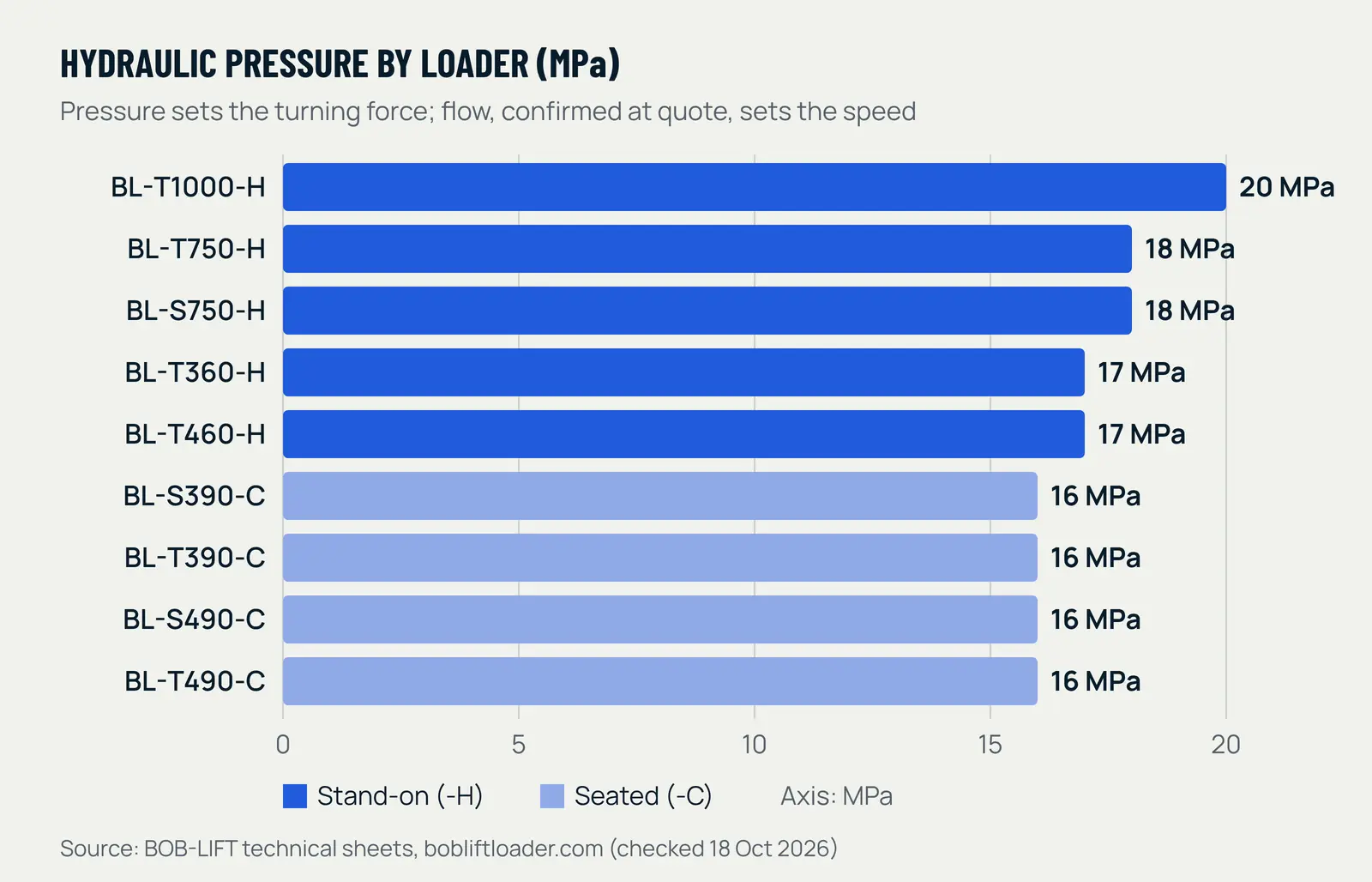
- Both tools run from the loader’s auxiliary hydraulics. Our nine loaders work at 16 to 20 MPa. Flow differs from model to model, so we match the auger or trencher to your loader when we quote.
- Plan the depth before you drill. The University of Georgia’s farm fencing guide sets wooden line posts at least 2 ft (0.6 m) deep, and corner post anchors 3.5 ft (about 1.1 m) deep.
- Find buried services first. In the US, 811 is the national call-before-you-dig number. In Great Britain, HSE’s HSG47 says plans alone are not enough to locate services.
What does a mini skid steer auger attachment do?
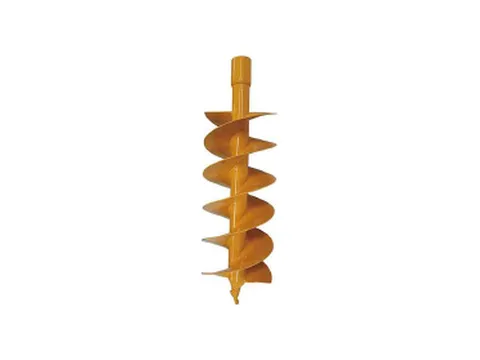
A mini skid steer auger, often sold as a skid steer auger attachment, drills round, vertical holes. We list it for “Holes for posts and planting”: fence posts, deck and sign posts, and planting holes for trees and shrubs. A hydraulic motor at the top turns a spiral bit, and the spiral lifts the soil up and out of the hole as it cuts.
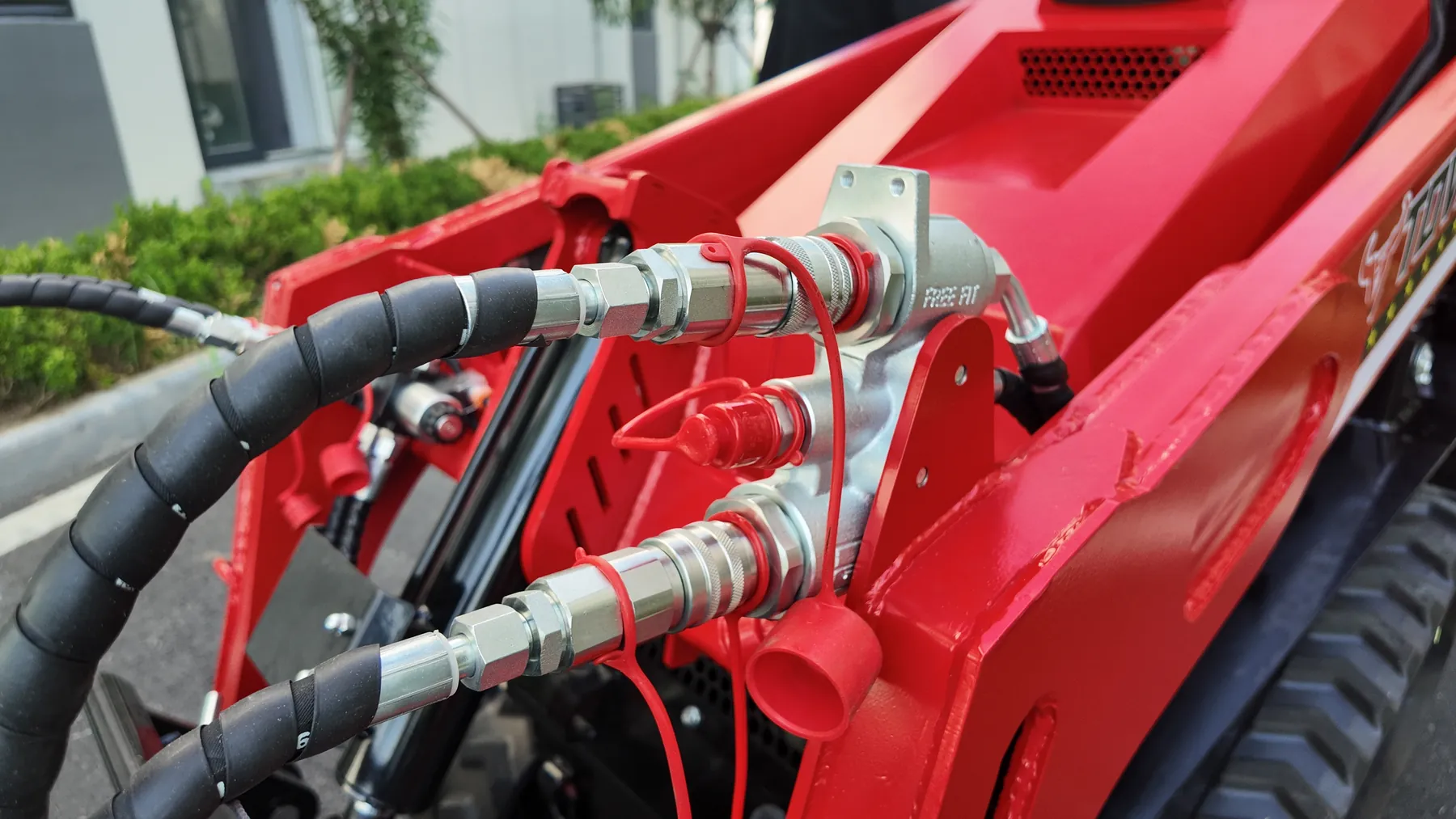
The auger hangs from the quick-attach plate on the front of the lift arms. Its hoses connect to the loader’s auxiliary hydraulic couplers. You lower the lift arms to push the bit into the ground, and lift them to pull it out. On a pivot mount the bit hangs free, so it finds its own vertical line even when the loader is not perfectly level.
An auger is the tool for jobs that repeat. One post hole is quick work with a hand digger. Fifty holes along a fence line, or a row of trees in an orchard, is where a powered auger pays off. For gardens and landscaping, we pair the auger with the leveller, rotary tiller and hydraulic grapple, to dig planting holes, level beds, turn soil and gather cuttings.
What does a mini skid steer trencher attachment do?
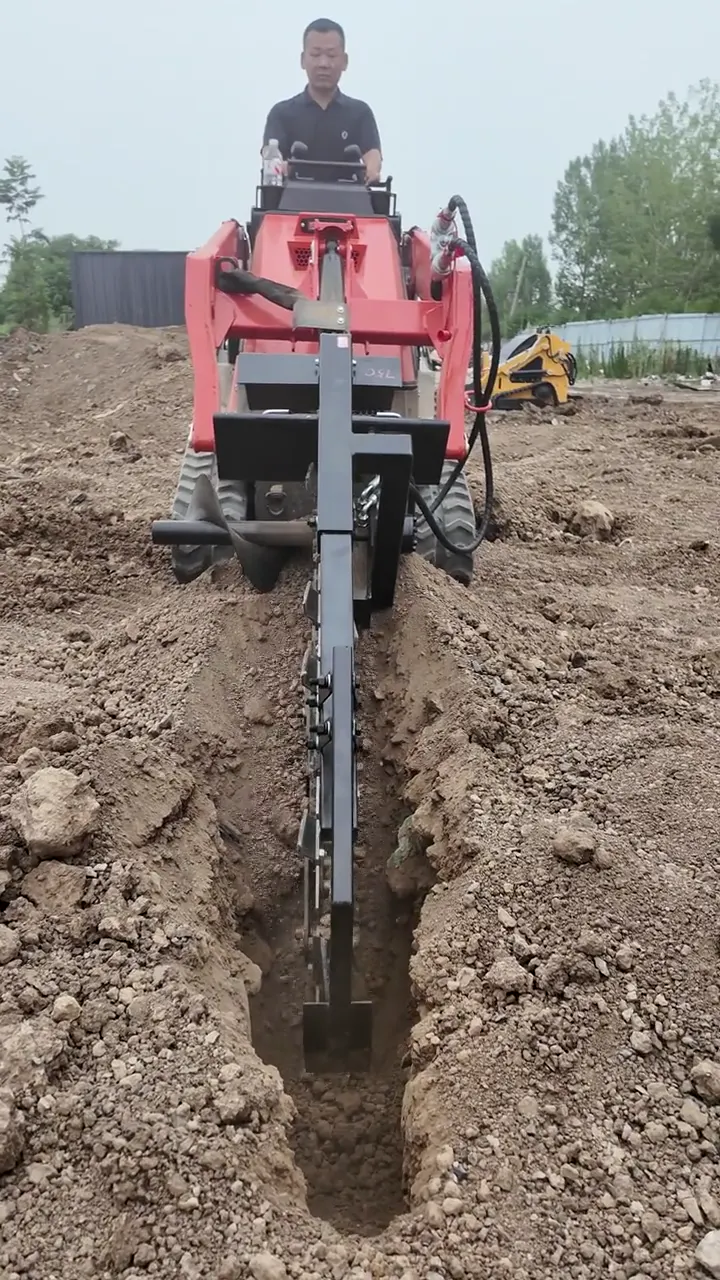
A mini skid steer trencher, or skid steer trencher attachment, cuts a narrow slot in the ground for cables and pipes. A toothed chain runs round a boom, like a chainsaw for soil. As the loader backs slowly along the line, the chain cuts the trench and a spiral at the side throws the spoil clear of the slot.
A trench cut this way is only as wide as the chain. Less soil comes out than with a bucket or backhoe, and less goes back in. That suits power and data cables, water pipes, garden lighting and irrigation lines. Our range page also lists the trencher, with the backhoe and the trench filler, in its “Alongside bigger machines” use section, for footings, trenches, backfill and clean-up.
The trench filler finishes the job: it is listed to “Backfill trenches after the pipe is in”. It pushes the spoil heap back into the trench along its length, so the loader that dug the trench also closes it.
Auger or trencher: which tool for which job
Choose the auger for holes and the trencher for lines. If your job is a row of separate points, such as posts or trees, it is an auger job. If it is a continuous run from A to B, such as a cable or pipe, it is a trencher job.
| Auger | Trencher | Trench filler | |
|---|---|---|---|
| Use on our range page | Holes for posts and planting | Narrow trenches for cables and pipes | Backfill trenches after the pipe is in |
| Shape of the dig | Round, vertical hole | Narrow, continuous slot | None: it moves spoil back |
| Typical jobs | Fence and deck posts, signs, tree planting | Power and data cables, water pipes, irrigation | Closing the trench after the cable or pipe is laid |
| How the loader works | Stands still for each hole | Backs slowly along the line | Drives along the trench |
| Powered by | Auxiliary hydraulics | Auxiliary hydraulics | Push from the loader |
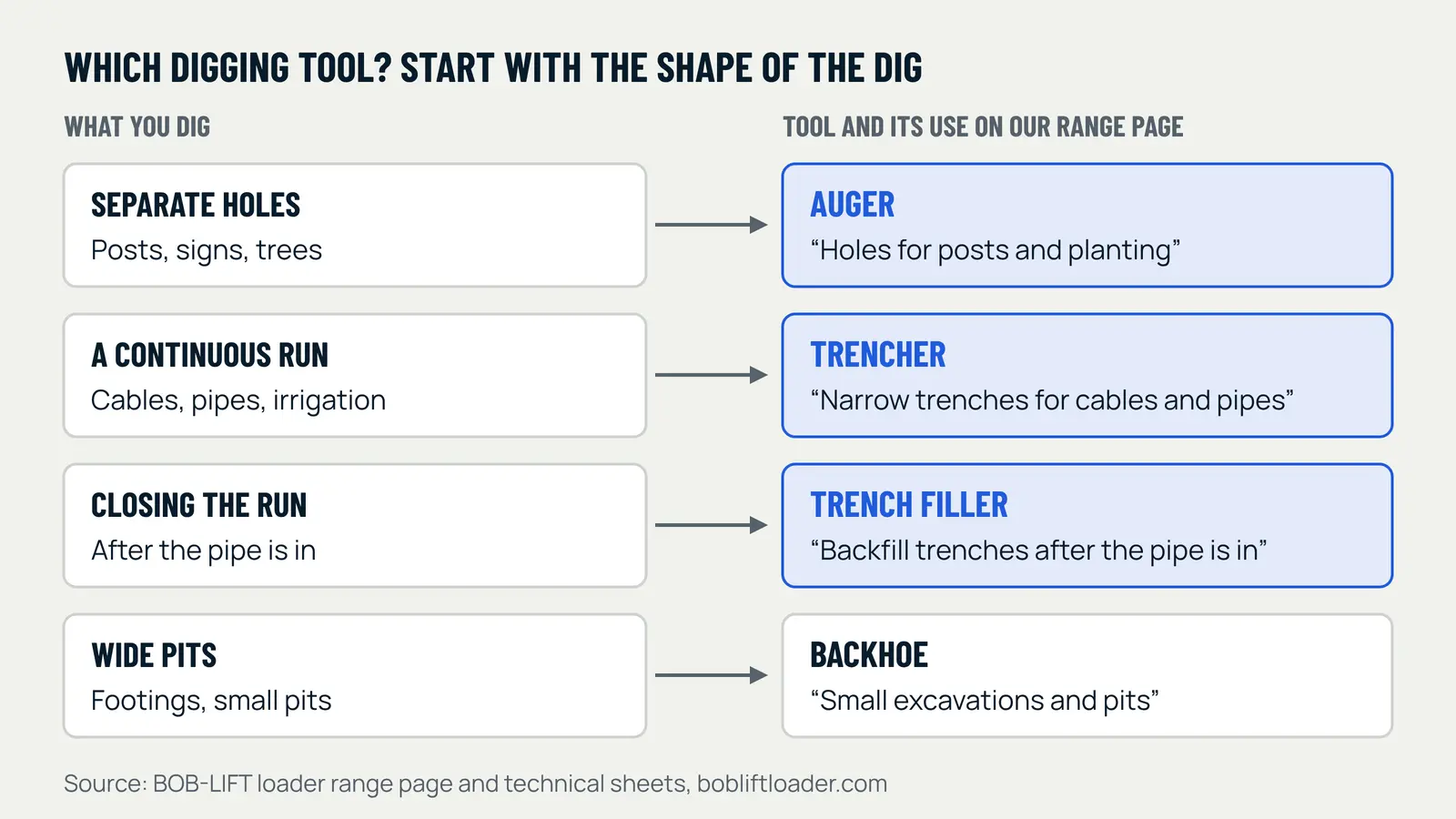

Some jobs need neither. For wider pits and small excavations, our list has the backhoe, for “Small excavations and pits”. For shallow scraping and levelling, a bucket or the 4-in-1 bucket does more. Our mini skid steer attachments guide explains all 26 tools on our list.
Hydraulics: why the loader decides the tool
The loader’s hydraulic system powers the auger’s motor and the trencher’s chain, so the loader decides which auger or trencher it can run. Pressure decides how much turning force the motor can produce. Flow decides how fast the bit or chain turns. A tool built for more flow than the loader gives will run slowly. A tool built for less may need its flow limited.
Our technical sheets publish the working pressure of every loader. Flow is not on the sheets, because it differs from model to model. As our range page puts it, attachments are “quoted with your loader and matched to its hydraulics”.
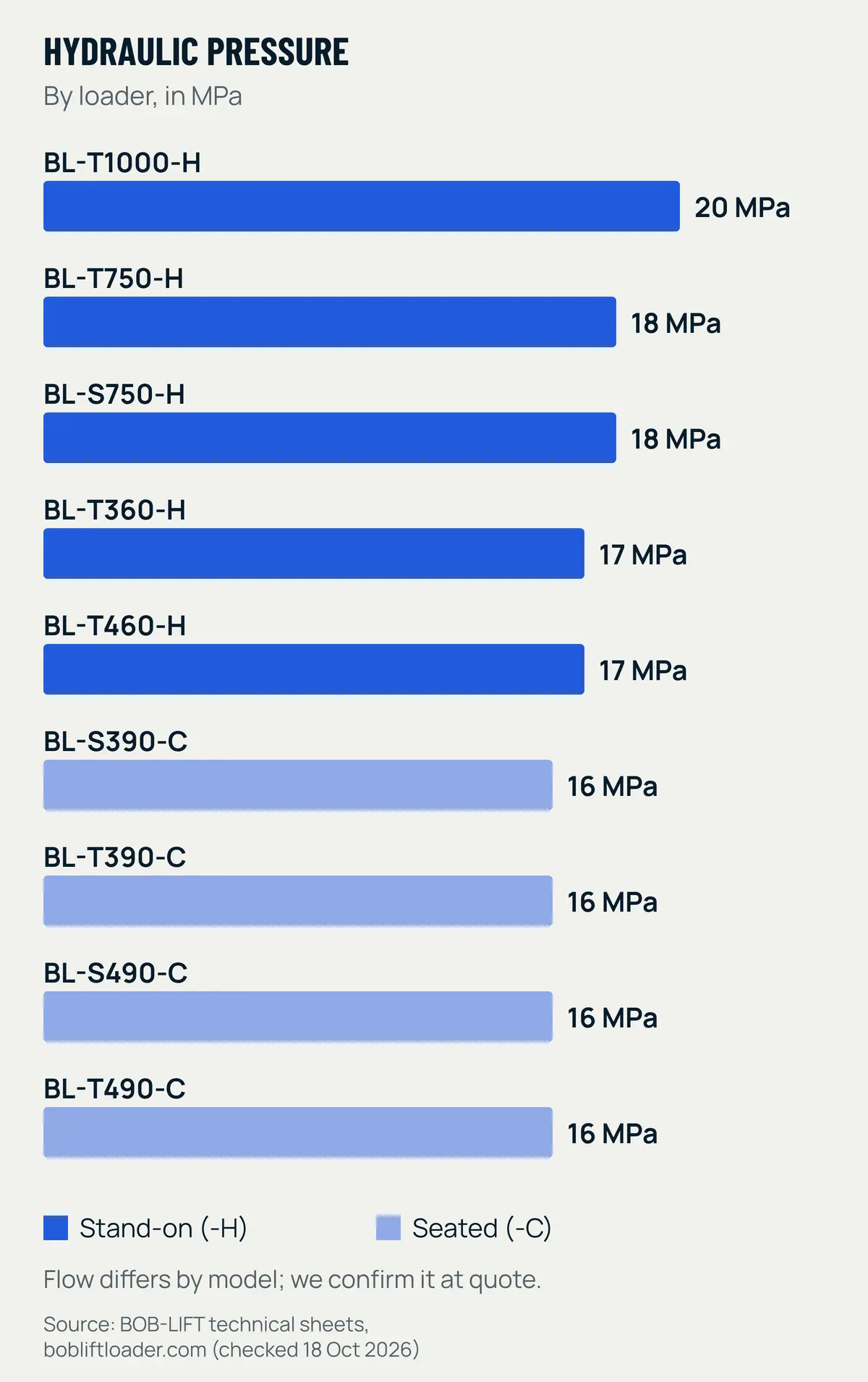
| Loader | Hydraulic pressure | Operator | Running gear | Machine width |
|---|---|---|---|---|
| BL-T360-H | 17 MPa | Stand-on | Rubber tracks | 930 mm (36.6 in) |
| BL-T460-H | 17 MPa | Stand-on | Rubber tracks | 1,090 mm (42.9 in) |
| BL-T750-H | 18 MPa | Stand-on | Rubber tracks | 985 mm (38.8 in) |
| BL-S750-H | 18 MPa | Stand-on | Wheels | 985 mm (38.8 in) |
| BL-T1000-H | 20 MPa | Stand-on | Rubber tracks | 960 mm (37.8 in) |
| BL-S390-C | 16 MPa | Seated | Rubber tyres | 959 mm (37.8 in) |
| BL-T390-C | 16 MPa | Seated | Rubber tracks | 955 mm (37.6 in) |
| BL-S490-C | 16 MPa | Seated | Rubber tyres | 1,089 mm (42.9 in) |
| BL-T490-C | 16 MPa | Seated | Rubber tracks | 1,089 mm (42.9 in) |
When you ask about an auger or trencher, we check three things against your loader: the flow the tool needs, the pressure it is built for, and the size of bit or chain for your job. Tell us the hole size or trench size you need, and we will tell you which tool fits.
Planning post holes with an auger
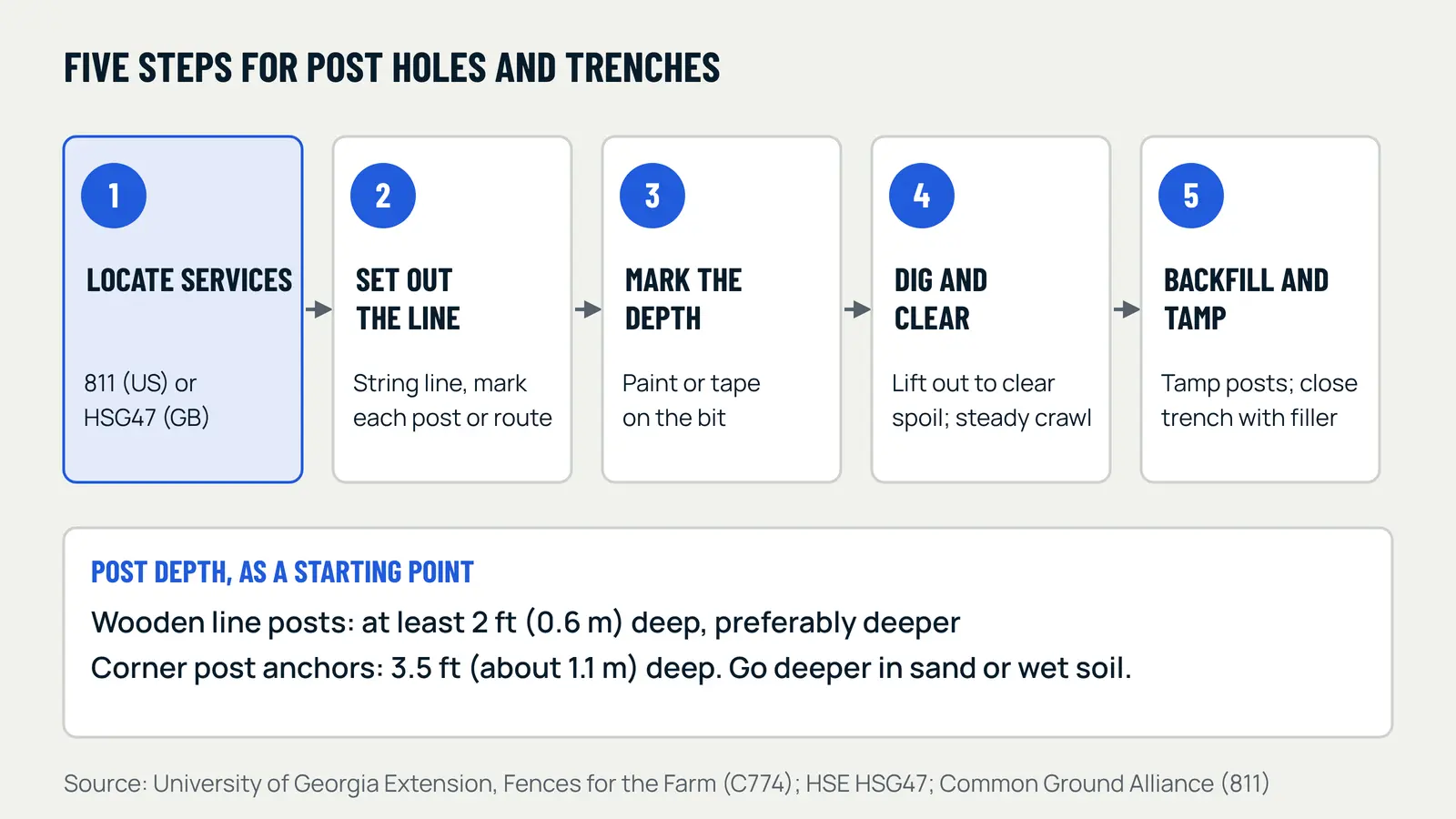
Decide the hole depth before you start drilling, and mark it on the bit. Depth depends on the post, the soil and the frost in your area, so take it from your fence design or local practice. As a starting point, the University of Georgia Cooperative Extension’s Fences for the Farm circular says: “Wooden line posts should be set at least 2 ft deep, preferably deeper.” It sets corner post anchors at 3.5 ft deep and adds: “Use deeper settings for sand or wet soil conditions.”
A practical sequence for a fence line:
- Locate buried services along the whole line before anything else, as described under “Before you dig” below.
- Set out the line. Run a string line between the end posts and mark each post position.
- Mark the depth. The same circular advises: “mark the digging tool or steel post to desired depth.” A band of paint or tape on the bit gives every hole the same depth.
- Drill corners and ends first. These carry the fence tension and are set deeper, so they are worth the most care.
- Drill the line posts. Lift the bit out every so often to clear the spoil, especially in clay.
- Set and tamp. The circular says to “center them before tamping”, for the tightest soil-pack round the post.
In cold climates, local building guidance may require posts and footings to go below the frost line, the depth to which the ground freezes. That depth varies by region, so check it before you mark the bit. Stones and tree roots slow an auger down. If the bit stalls, lift it, clear the hole and try again rather than forcing it.

Planning a trench with a trencher attachment
Take the trench depth and width from what goes into it. The cable or pipe supplier, your designer, or local rules set how deep a service must be buried and how it is bedded. Then choose a trencher chain that cuts that depth and width, and tell us both figures when you ask for a quote.
- Keep runs straight. A chain trencher cuts best in straight lines. Plan a long run as straight sections, and change direction at a pit or a junction.
- Walk the line first. Move stones, roots and debris off the route. Large stones slow the chain and wear the teeth.
- Back up at a steady crawl. The chain needs time to clear the spoil. Moving too fast can stall it.
- Lay the service soon after you cut. An open trench is a trip hazard and can collapse in wet weather. Lay the pipe or cable, then close the trench with the trench filler.
Tracks spread the loader’s weight on lawns and soft ground, which helps on garden and landscaping jobs. Our guide to tracked vs wheeled mini skid steers explains the choice by ground type.
Before you dig: buried services
Find every buried service on the line before you drill or trench. An auger bit and a trencher chain both cut down into the ground, where power cables, gas pipes and water mains run.
- United States. The Common Ground Alliance describes 811 as “the national call-before-you-dig number for professional excavators and homeowners”. A call connects you to the local one-call centre, and utilities send locators to mark the approximate location of their lines. Notice periods are set state by state.
- Great Britain. HSE’s guidance HSG47, Avoiding danger from underground services, says: “Plans alone are not sufficient to identify and locate services before starting work.” It also advises: “Use trial holes to positively identify a service and its depth.”
- Elsewhere. Check the utility owners and the rules for your country before you dig.
Keep people clear of a turning auger and a running chain. Never reach towards either while the hydraulics are engaged. Our product pages note that noise at the operator position can exceed 85 dB(A) at full engine speed on some models, so always wear hearing protection when operating the machine.
Which BOB-LIFT loader to pair them with
Pick the loader for the site first, then match the auger or trencher to it. Our product pages give three things that matter for digging work: width, operator position and hydraulic pressure.
- Garden fencing and planting. Narrow access usually decides. The BL-T360-H is our narrowest loader at 930 mm (36.6 in), on rubber tracks, with a stand-on platform for getting on and off between holes. Our mini skid steer for landscaping guide covers gates, lawns and sizes.
- Long fence lines and cable runs. The tracked stand-on BL-T1000-H (20 MPa) and BL-T750-H (18 MPa) are our two highest-pressure tracked loaders, both under 1 m wide (960 mm and 985 mm).
- Long shifts in one seat. The seated BL-T390-C and BL-T490-C run on tracks at 16 MPa. Our comparison of stand-on vs seated mini skid steers explains which suits your days.
These are starting points, not fixed pairings. The exact auger or trencher for each loader depends on its flow, which we confirm when we quote. Every model’s weight and size are in our mini skid steer weight and dimensions guide.
Frequently asked questions
Can I fit an auger or trencher from another supplier to a BOB-LIFT loader?
Possibly, but check the mounting plate, hose couplers, flow and pressure first. A tool that needs more flow than the loader gives will run slowly. The simplest route is to order the auger or trencher with the loader, so we match it to the loader’s hydraulics before it ships.
Does a skid steer auger attachment need auxiliary hydraulics?
Yes. The auger’s motor and the trencher’s chain are both driven by oil from the loader’s auxiliary hydraulic lines. All our loaders take their tools through a quick-attach plate and auxiliary hydraulic lines.
How deep and wide can a skid steer auger or trencher dig?
That depends on the bit or chain fitted, not on the loader alone. Augers take bits of different diameters and lengths, and trenchers take chains of different depths and widths. Tell us the hole or trench size you need, and we will confirm a tool that suits your loader when we quote.
Should I buy a walk-behind mini trencher or a skid steer trencher attachment?
A walk-behind mini trencher is a separate machine that only digs trenches. A skid steer trencher attachment runs from a loader you already use for other jobs, and the trench filler closes the trench with the same machine. If you dig trenches every day and nothing else, a dedicated machine may suit you; if trenching is one job among many, the attachment does it without a second machine on site.
Should I use a trencher or a backhoe for a pipe trench?
Use the trencher for a long, narrow run, such as a cable or small pipe. It moves less soil. Use the backhoe, listed for “Small excavations and pits”, for wider holes, pits and short trenches where you need room to work.
Choosing your digging tools
Start with the shape of the job: holes point to the auger, lines point to the trencher, and the trench filler closes up afterwards. Then choose the loader for your access, and let us match the tool to its hydraulics. Compare all nine models on our mini skid steer loader range page, and when you ask for a quote, tell us the hole or trench size you need. Our guide to mini skid steers for sale explains how buying direct from our factory in Xuzhou works.
Specifications checked against our product pages on 18 October 2026.