


Key takeaways
- Six of our nine mini skid steer loaders are under 1 metre wide. The narrowest, the BL-T360-H, is 930 mm (36.6 in) across the body, and its 906 mm bucket is narrower still.
- Six models run on rubber tracks for lawns, soft soil and slopes. The three wheeled models suit paving and drives. The BL-T360-H and BL-T460-H are rated for 30° slopes; the rest for 25°.
- Our mini skid steer loader range page lists 26 attachments. Four are named for gardens and landscaping: auger, leveller, rotary tiller and hydraulic grapple. No power box rake is listed.
- Rated loads run from 200 to 500 kg (441 to 1,102 lb). A level-full bucket of stone or gravel weighs about 156 to 297 kg. Only the BL-T360-H goes over its rating with it: about 234 kg against 200 kg.
- Mulch is light: a level-full bucket of wood chips weighs only about 30 to 56 kg. With mulch and compost, the bucket’s volume limits each trip, not its weight.
Why landscapers use mini skid steers
A mini skid steer for landscaping lets one person do the digging, carrying and levelling on a garden job, and it gets in through a gate or side passage. Ours are 930 to 1,090 mm (36.6 to 42.9 in) wide and rated for 200 to 500 kg. A skid steer turns by running its left and right tracks or wheels at different speeds, so it spins on the spot in a small back garden.
The bucket comes off a quick-attach plate, and a fork, auger or leveller goes on in minutes. Auxiliary hydraulic lines power the tools that need them. So one machine moves soil in the morning and drills planting holes in the afternoon.
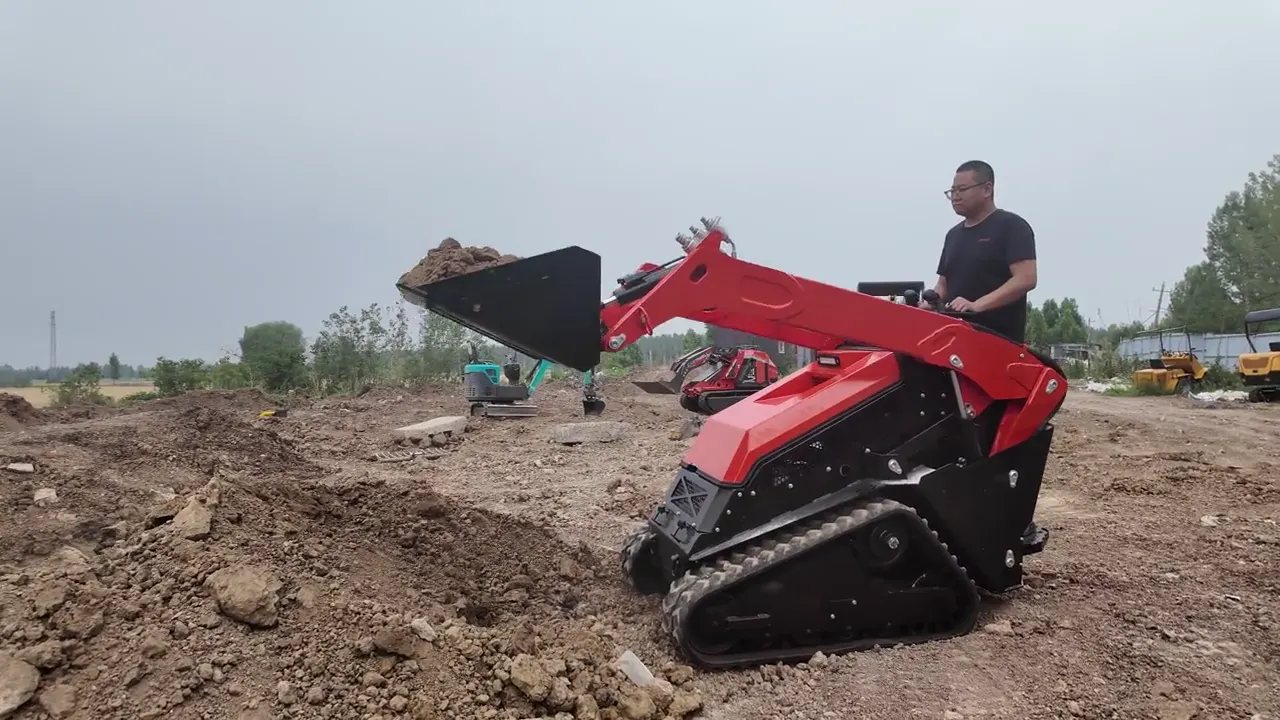
A mini loader suits soil, gravel, turf, mulch and stone moved in small loads over short distances. It also suits ground preparation and planting. It is not a digger. For deep excavation, large volumes of spoil or long hauls, a mini excavator and a mini dumper do the job better.
Which size fits through garden gates?
Six of our nine loaders are under 1 metre across the body, and the widest is 1,090 mm (42.9 in). Bucket width matters too: on eight models the standard bucket is wider than the body. Only the BL-T360-H stays under a metre with its bucket fitted. Rated load and bucket capacity are in the table too; to convert kg to lb, multiply by 2.205.
| Model | Body width | Standard bucket width | Rated load | Bucket capacity | Running gear |
|---|---|---|---|---|---|
| BL-T360-H | 930 mm (36.6 in) | 906 mm (35.7 in) | 200 kg | 0.15 m³ | Tracks |
| BL-T390-C | 955 mm (37.6 in) | 1,050 mm (41.3 in) | 250 kg | 0.1 m³ | Tracks |
| BL-S390-C | 959 mm (37.8 in) | 1,050 mm (41.3 in) | 260 kg | 0.1 m³ | Tyres |
| BL-T1000-H | 960 mm (37.8 in) | 1,240 mm (48.8 in) | 500 kg | 0.19 m³ | Tracks |
| BL-S750-H | 985 mm (38.8 in) | 1,270 mm (50.0 in) | 400 kg | 0.15 m³ | Tyres |
| BL-T750-H | 985 mm (38.8 in) | 1,270 mm (50.0 in) | 410 kg | 0.15 m³ | Tracks |
| BL-S490-C | 1,089 mm (42.9 in) | 1,150 mm (45.3 in) | 250 kg | 0.1 m³ | Tyres |
| BL-T490-C | 1,089 mm (42.9 in) | 1,150 mm (45.3 in) | 250 kg | 0.1 m³ | Tracks |
| BL-T460-H | 1,090 mm (42.9 in) | 1,100 mm (43.3 in) | 300 kg | 0.15 m³ | Tracks |
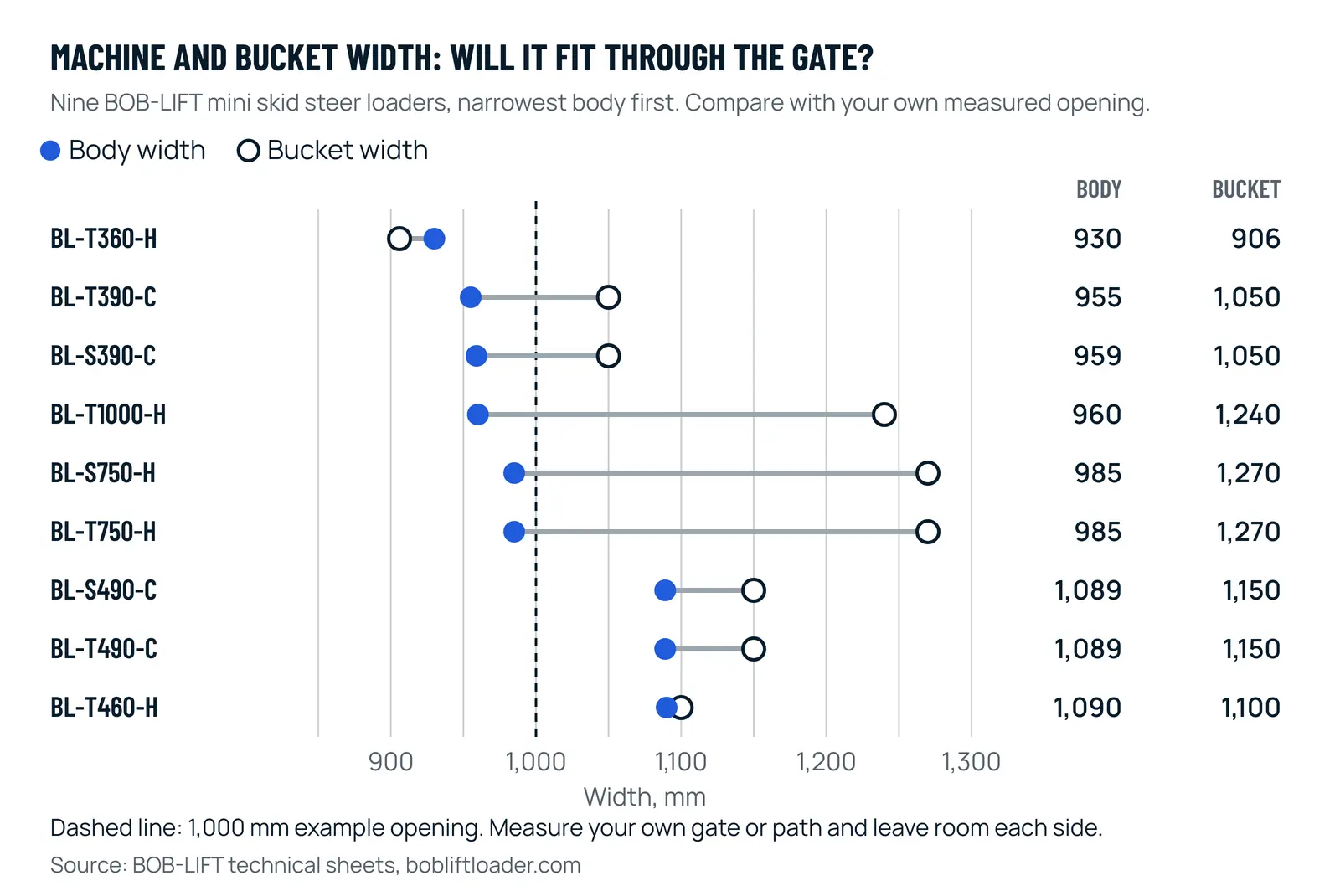
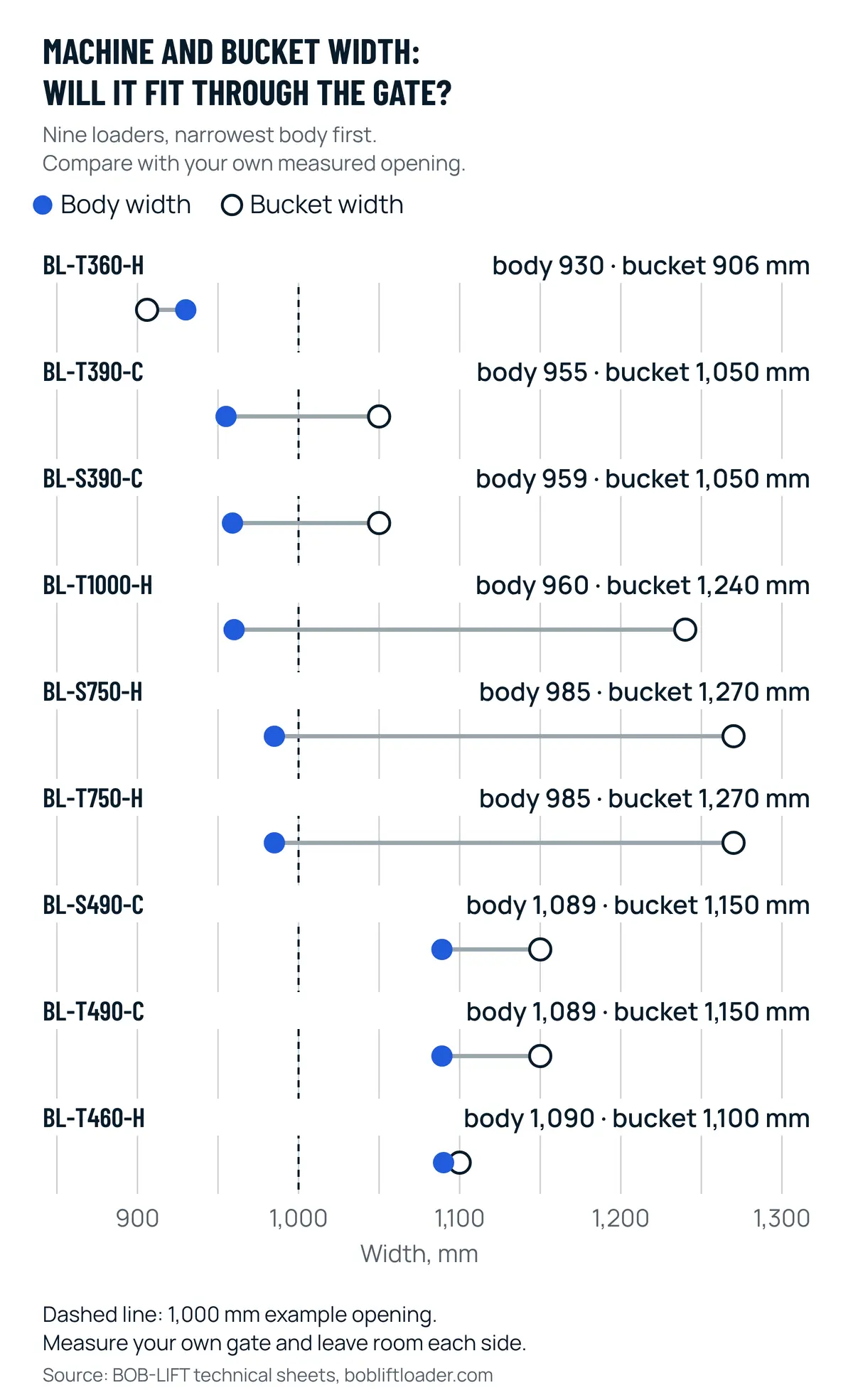
There is no standard garden gate width, so measure the real opening. Here is how:
- Walk the whole route from where the machine is unloaded to where it will work. Note every gate, path, side passage and doorway.
- Measure the narrowest point, not the gate’s nominal size. Measure between gate posts, hinges and latches, and in passages between walls, downpipes, meter boxes and steps.
- Compare it with the wider of body and bucket for the model you are looking at. If the bucket is the wider part, it can come off the quick-attach plate and go through separately.
- Leave clearance on each side. You will be steering through the gap, so a few millimetres of spare width is not enough.
- Check height and corners too. Check overall height against arches and carports: 1,226 mm on the BL-T360-H to 1,550 mm on the 750 models. A tight corner needs room for the machine’s length: 1,906 mm with the bucket on the BL-T360-H. Every model’s length, height and weight is in our mini skid steer weight and dimensions guide.
Tracks or wheels on lawns and finished surfaces
Use tracks on lawns, soft soil and slopes, and tyres on paving, concrete and drives. Six of our loaders are tracked and three are wheeled: the BL-S390-C, BL-S490-C and BL-S750-H. Rubber tracks spread the machine’s weight, 650 to 1,250 kg across the range, on lawns and soft soil.
Tracks still mark a finished lawn if you spin them. A skid steer turns by skidding, so on turf make wide, gradual turns instead of turning on the spot. Keep to one route across a lawn where you can, and avoid crossing lawns when the ground is wet. University of Minnesota Extension calls wheel traffic the major cause of soil compaction, and notes that heavy loads on wet soil push compaction deeper (UMN Extension: Soil compaction).
On slopes, the BL-T360-H and BL-T460-H are rated for 30° and the other seven models for 25°. For the full comparison of grip, speed and wear, read our tracked vs wheeled mini skid steer guide.
Stand-on or seated for garden jobs
Stand-on loaders suit landscaping work where you step off often. Seated loaders suit longer runs on the machine. We build five stand-on models (BL-T360-H, BL-T460-H, BL-T750-H, BL-S750-H and BL-T1000-H) and four seated models (BL-T390-C, BL-S390-C, BL-T490-C and BL-S490-C).
On a garden job you get off to open gates, move boards, check levels and change attachments. Step on the platform for quick on-and-off work, or take the seat for longer shifts. Our stand-on vs seated mini skid steer comparison covers controls, visibility and comfort in detail.
Skid steer attachments for landscaping, by job
Twenty of the 26 attachments on our range page are useful on garden jobs, and they group into four kinds of work. Four are named there for gardens and landscaping: the auger, leveller, rotary tiller and hydraulic grapple. Hydraulic flow differs from model to model, so we match each attachment to your loader when we quote it.


| Job | Attachment | What it is for |
|---|---|---|
| Ground prep and levelling | 4-in-1 bucket | Dig, grab, level and doze |
| Ground prep and levelling | Leveller | Grade and spread loose material |
| Ground prep and levelling | Rotary tiller | Turn soil for beds and planting |
| Ground prep and levelling | Soil conditioner | Prepare a seed bed in one pass |
| Ground prep and levelling | Ripper | Loosen compacted soil and roots |
| Ground prep and levelling | Lawn aerator | Open up compacted turf |
| Planting, posts and trenches | Auger | Holes for posts and planting |
| Planting, posts and trenches | Trencher | Narrow trenches for cables and pipes |
| Planting, posts and trenches | Trench filler | Backfill trenches after the pipe is in |
| Planting, posts and trenches | Backhoe | Small excavations and pits |
| Moving stone and pallets | Pallet forks | Pallets, bagged cement, bales |
| Moving stone and pallets | Grapple bucket | Rubble, logs and awkward loads |
| Moving stone and pallets | High-dump bucket | Tip loads into tall trucks and hoppers |
| Moving stone and pallets | Lifting jib | Lift and place with a chain or sling |
| Clearing and finishing | Hydraulic grapple | Straw, branches and loose debris |
| Clearing and finishing | Brush cutter | Cut back overgrown ground |
| Clearing and finishing | Mulcher | Clear scrub and small trees |
| Clearing and finishing | Wood chipper | Chip branches and prunings on the spot |
| Clearing and finishing | Sweeper | Yards, roads and light snow |
| Clearing and finishing | Lawn mower | Mow large areas of grass |
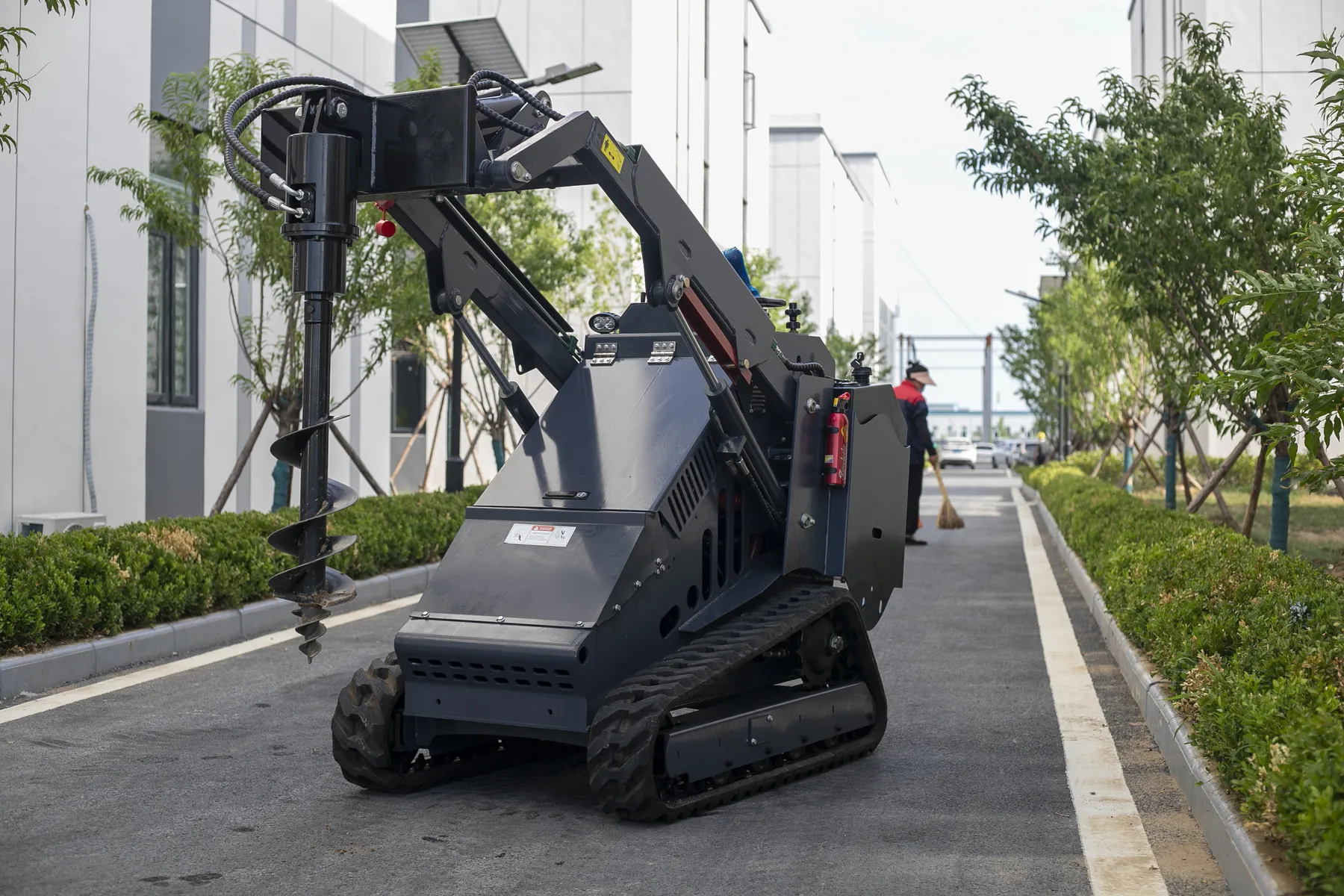
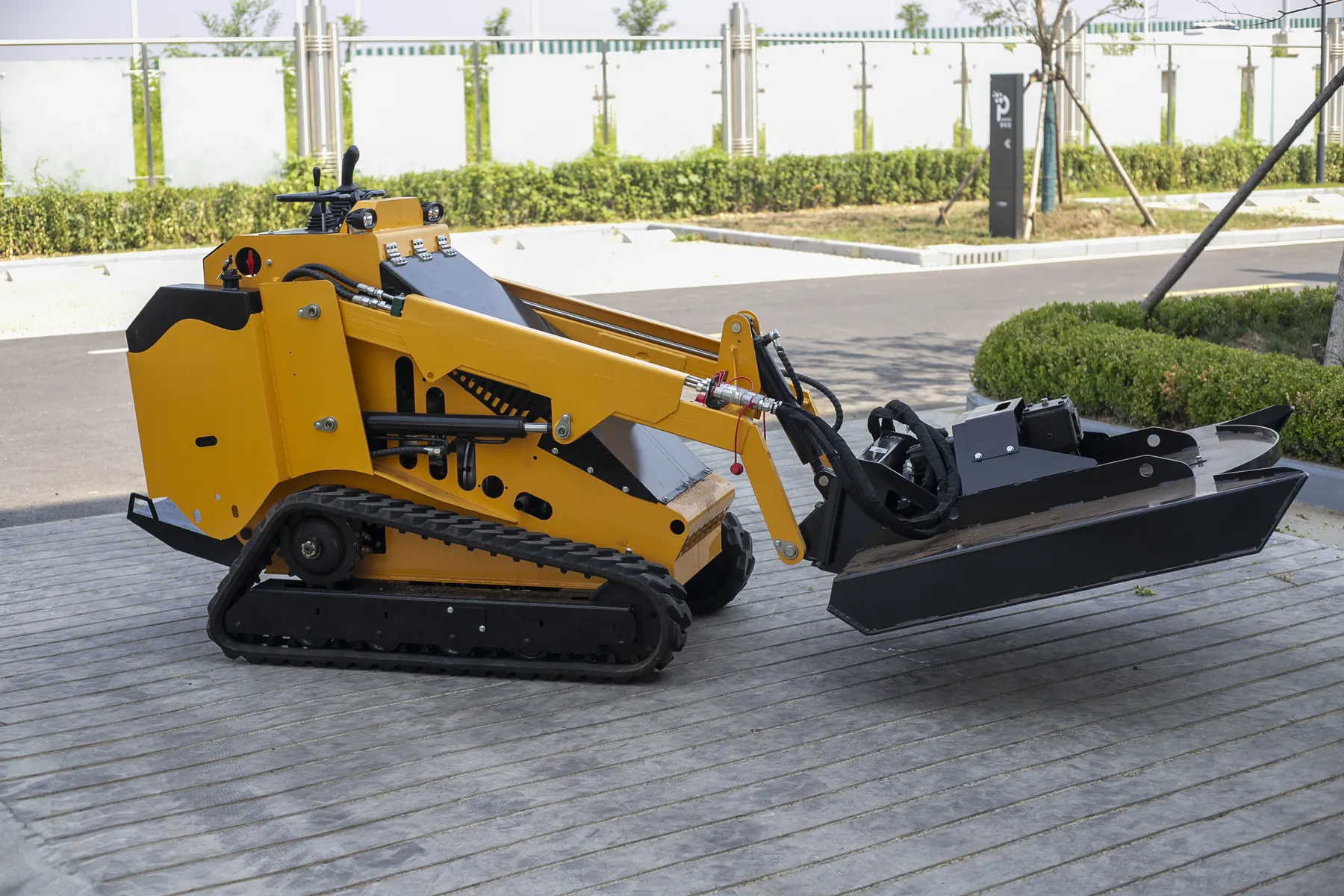
No power box rake. A power box rake, often called a Harley rake, is not among our attachments, and we do not supply one. The FAQ below lists the tools we do offer for grading and seed-bed work.
For what each tool does and how the quick-attach plate works, see our mini skid steer attachments guide.
Rated load: pallets of pavers, soil and mulch
Plan every lift to the rated load, which runs from 200 kg (441 lb) on the BL-T360-H to 500 kg (1,102 lb) on the BL-T1000-H. The standard buckets hold 0.1, 0.15 or 0.19 m³ (3.5, 5.3 or 6.7 ft³). Lifting capacity on our sheets is higher than the rated load, but the rated load is the figure to plan with.
To estimate what a full bucket weighs, multiply its capacity by the material’s density. We use two government tables. The Los Angeles County Public Works volume-to-weight table uses the California Integrated Waste Management Board’s factors. The US EPA volume-to-weight conversion table is an archived appendix. Both give pounds per cubic yard, so we converted them (1 lb/yd³ ≈ 0.593 kg/m³). Real loads vary with moisture and how loose the material is, and the EPA table notes that the density of yard trimmings varies widely with moisture. Treat these figures as approximate.
| Material (source) | Density | Level-full 0.1 m³ | Level-full 0.15 m³ | Level-full 0.19 m³ |
|---|---|---|---|---|
| Soil, dry (LA County) | 2,025 lb/yd³ ≈ 1,201 kg/m³ | 120 kg | 180 kg | 228 kg |
| Soil, wet (LA County) | 2,106 lb/yd³ ≈ 1,249 kg/m³ | 125 kg | 187 kg | 237 kg |
| Stone or gravel (LA County) | 2,632.5 lb/yd³ ≈ 1,562 kg/m³ | 156 kg | 234 kg | 297 kg |
| Finished compost (EPA) | 600 lb/yd³ ≈ 356 kg/m³ | 36 kg | 53 kg | 68 kg |
| Wood chips (EPA) | 500 lb/yd³ ≈ 297 kg/m³ | 30 kg | 44 kg | 56 kg |
Worked example for stone or gravel in a 0.15 m³ bucket: 0.15 × 1,562 = about 234 kg (516 lb). To convert any figure in the table to pounds, multiply by 2.205.
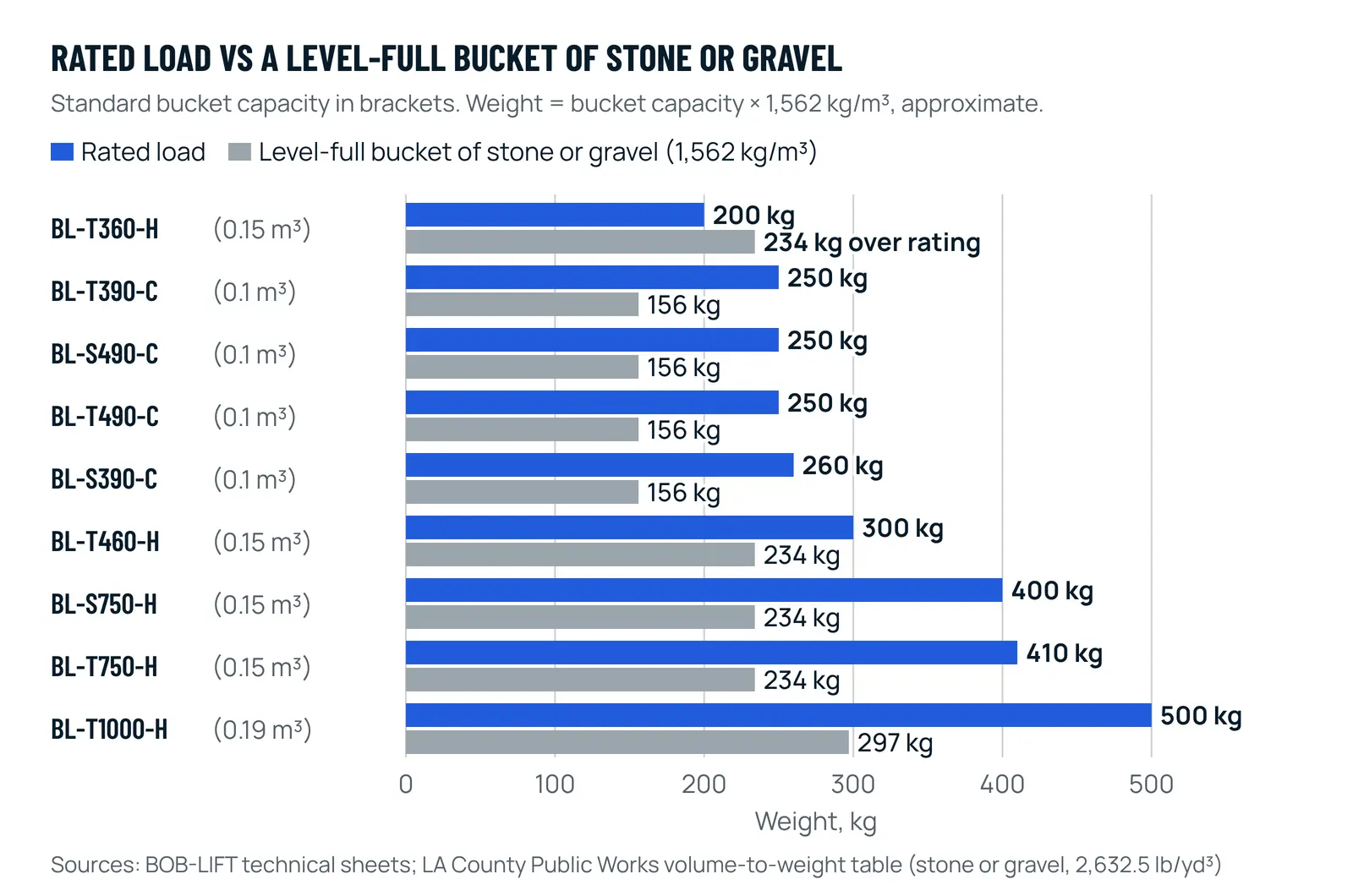
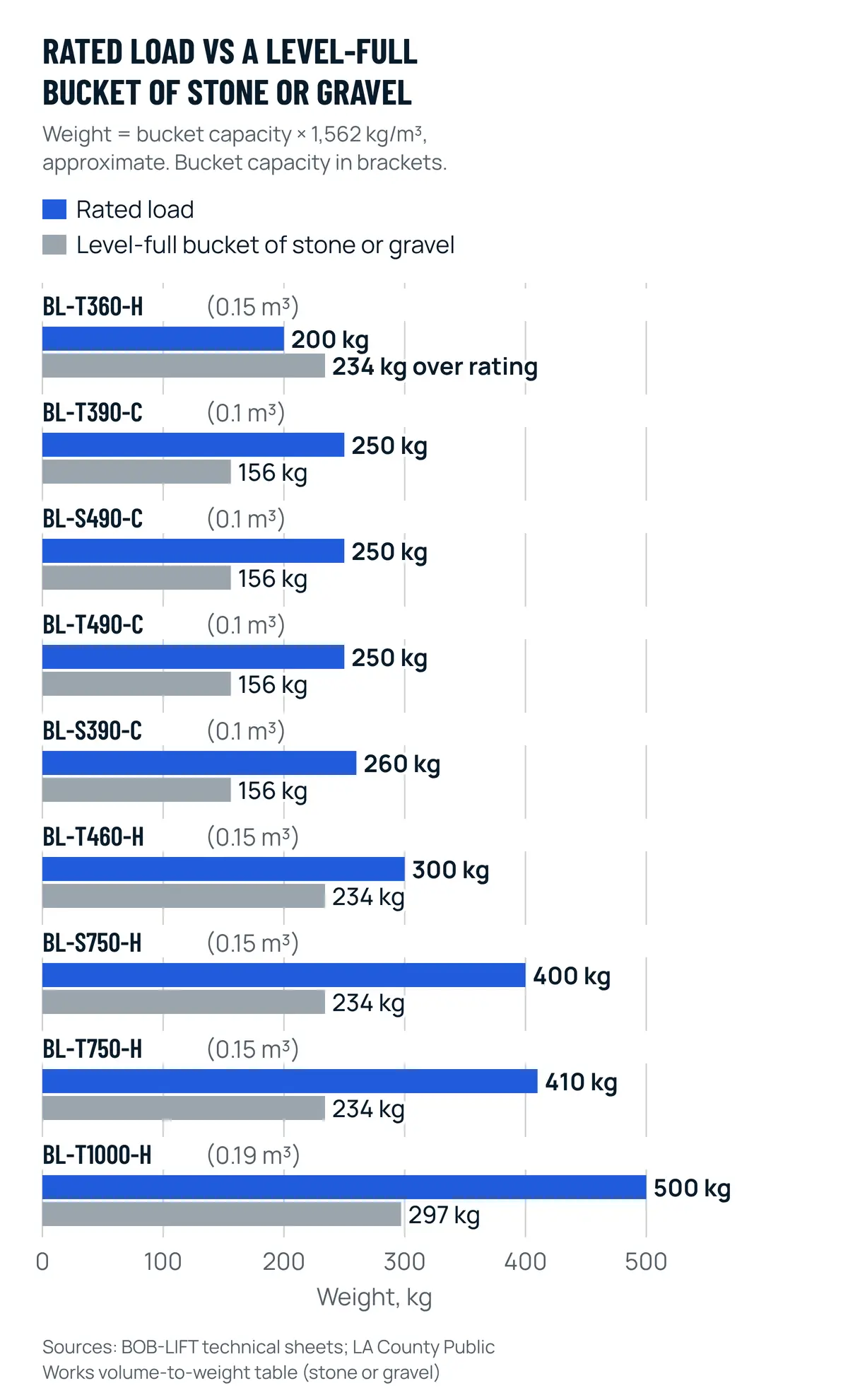
What this means on a landscaping job:
- Soil and gravel: all nine carry a level-full bucket of dry or wet soil within their rating; eight also do with stone or gravel. The BL-T360-H goes over with stone or gravel (about 234 kg against 200 kg), so fill it to about 85%: 200 ÷ 1,562 = 0.128 m³.
- Mulch and compost: a level-full bucket weighs well under every rating, so the bucket’s size limits each trip. One cubic metre of wood chips takes about 10 trips with a 0.1 m³ bucket, 7 with 0.15 m³ and 6 with 0.19 m³.
- Pallets of pavers: the rated load also limits what pallet forks may lift. Check the pallet weight on the supplier’s delivery note. If it is more than the rated load, split the stack and lift it in part loads.
Overloading makes a skid steer front-heavy, which reduces its stability and handling. University of Wisconsin Extension’s skid steer loader safety sheet says not to exceed the rated operating capacity and to keep the bucket as low as possible when travelling or turning. Leave more of the rated load spare on slopes and soft ground.
A typical landscaping day with a mini loader
This is a generic sequence for a back-garden job, not a record of a real one. Our landscaping applications page sets out what to measure before you enquire. The steps below name the attachment for each job. The order changes from job to job.
- Clear the ground. The brush cutter cuts back overgrown areas. The hydraulic grapple gathers branches and loose debris, and the wood chipper chips prunings on the spot.
- Lift the old surface. The 4-in-1 bucket digs out old turf and topsoil and carries it to a skip. To tip into a tall skip or truck, check the loader’s maximum dumping height: 1,340 to 1,826 mm across our range. The high-dump bucket is made for tall trucks and hoppers.
- Prepare and level. The ripper loosens compacted soil and roots, and the rotary tiller or soil conditioner works the beds and the new lawn area. The leveller then grades and spreads topsoil.
- Plant and set posts. The auger drills holes for trees, shrubs and fence posts. For garden lighting cables or irrigation pipes, the trencher cuts a narrow trench and the trench filler backfills it. Our auger and trencher guide covers post depths and planning a cable trench.
- Move stone and materials. Pallet forks carry paving and bagged materials within the rated load. The grapple bucket handles rocks and awkward loads, and the bucket carries gravel and mulch.
- Clean up. The sweeper clears paths and drives, and the bucket takes the last spoil out.
Which loader for which garden?
| Your site | Loader | Why |
|---|---|---|
| Narrowest point 1,000 mm or a little more | BL-T360-H | The only model that passes with its bucket on: 930 mm body and 906 mm bucket leave about 35 mm each side in a 1,000 mm gap. |
| Soft ground, operator wants a seat | BL-T390-C | Tracked and seated, 955 mm body (1,050 mm bucket), 250 kg rated load. |
| Gate over 1.1 m, sloping garden | BL-T460-H | Two-cylinder engine, 300 kg rated load, rated for 30° slopes, 1,090 mm body (1,100 mm bucket). |
Frequently asked questions
What size mini skid steer is best for landscaping?
Choose the loader with the most rated load that still clears your narrowest access point with clearance each side. Behind a garden gate of about 1 metre, that is the BL-T360-H: 930 mm body, 906 mm bucket, 200 kg rated load. The BL-T1000-H (960 mm) and the two 750 models (985 mm) also have bodies under 1 metre and carry 400 to 500 kg, but their buckets are 1,240 to 1,270 mm wide, so the bucket has to come off to pass a 1 metre gap. The BL-T460-H (1,090 mm body, 300 kg) needs an opening of more than 1.1 m.
Can a mini skid steer drive on grass?
Yes. Tracked models are the better choice on grass because rubber tracks spread the weight over lawns and soft soil. Make wide turns instead of spinning on the spot, keep to one route, and lay boards or ground protection for repeated runs over a finished lawn.
Can I use a Harley rake on a mini skid steer?
We do not supply a power box rake or landscape rake for our loaders, so we cannot say one will fit or work on them. For grading and seed-bed work we offer three other tools: the leveller grades and spreads loose material, the soil conditioner prepares a seed bed in one pass, and the rotary tiller turns soil for beds and planting.
Which attachments should a landscaper buy first?
Start with the four we name for gardens and landscaping: the auger, leveller, rotary tiller and hydraulic grapple. Add pallet forks if you move paving or bagged materials, and a 4-in-1 bucket for digging, grabbing and levelling. Each one is matched to your loader’s hydraulic flow before you order.
Choosing your landscaping skid steer
When you choose a skid steer for landscaping, start with three facts: your narrowest access width in millimetres, the ground you will cross, and the materials and attachments you need. Then compare the nine models and ask for a quote on our mini skid steer loader range page. Send us your measurements and we will suggest the loader and attachments that fit your site. How ordering direct from our factory in Xuzhou works is in our guide to mini skid steers for sale.
Specifications checked against our product pages on 14 October 2026.