


Key takeaways
- BOB-LIFT builds eight wheeled site dumpers rated from 1,000 kg (2,205 lb) to 5,000 kg (11,023 lb). They are 1,500 to 1,800 mm (59 to 71 in) wide, with hoppers from 0.8 to 1.5 m³.
- Rated load is a weight and hopper capacity is a volume. Your real limit per trip is whichever you reach first: a full hopper or the rated load. For example, a full 0.8 m³ FC10 hopper of wet sand weighs about 1,520 kg, over its 1,000 kg rating.
- The FY30, FJZ30, FY40 and FY50 all have a 1.5 m³ hopper. Level-full, it holds about 2,330 kg of dry sand or about 3,000 kg of wet gravel.
- With a roof or cab, the FY20-4, FY30, FJZ30, FY40 and FY50 stand 2.65 to 2.75 m tall. That is taller than a typical container door, so plan how they will ship.
What size dumper do I need?
Choose on three things: the weight you carry per trip, the narrowest point on your route, and the ground. Our wheeled mini dumpers cover 1 to 5 tonnes per trip and 1,500 to 1,800 mm of width, so those two measurements narrow the choice quickly.
- Weight per trip. Match the rated load to your heaviest regular load, then check that your material fits in the hopper (see the hopper section below). A dumper that is too small means extra trips. One that is too big is wider and heavier than the job needs.
- Width and access. Measure the tightest gate, ramp or gap between the stockpile and the work. The FC10 and FY15 are 1,500 mm wide, the FY20-2 is 1,600 mm, and the FY20-4, FY30, FJZ30 and FY40 are 1,700 mm. The FY50 is 1,800 mm.
- Ground and slopes. The FC10, FY15 and FY20-2 drive two wheels (4×2). From the FY20-4 up, all four wheels drive (4×4). Our guide to 4×4 vs 4×2 mini dumpers explains when the extra drive matters. All eight models list 21° as the theoretical maximum gradient, with 18° or less recommended in work.
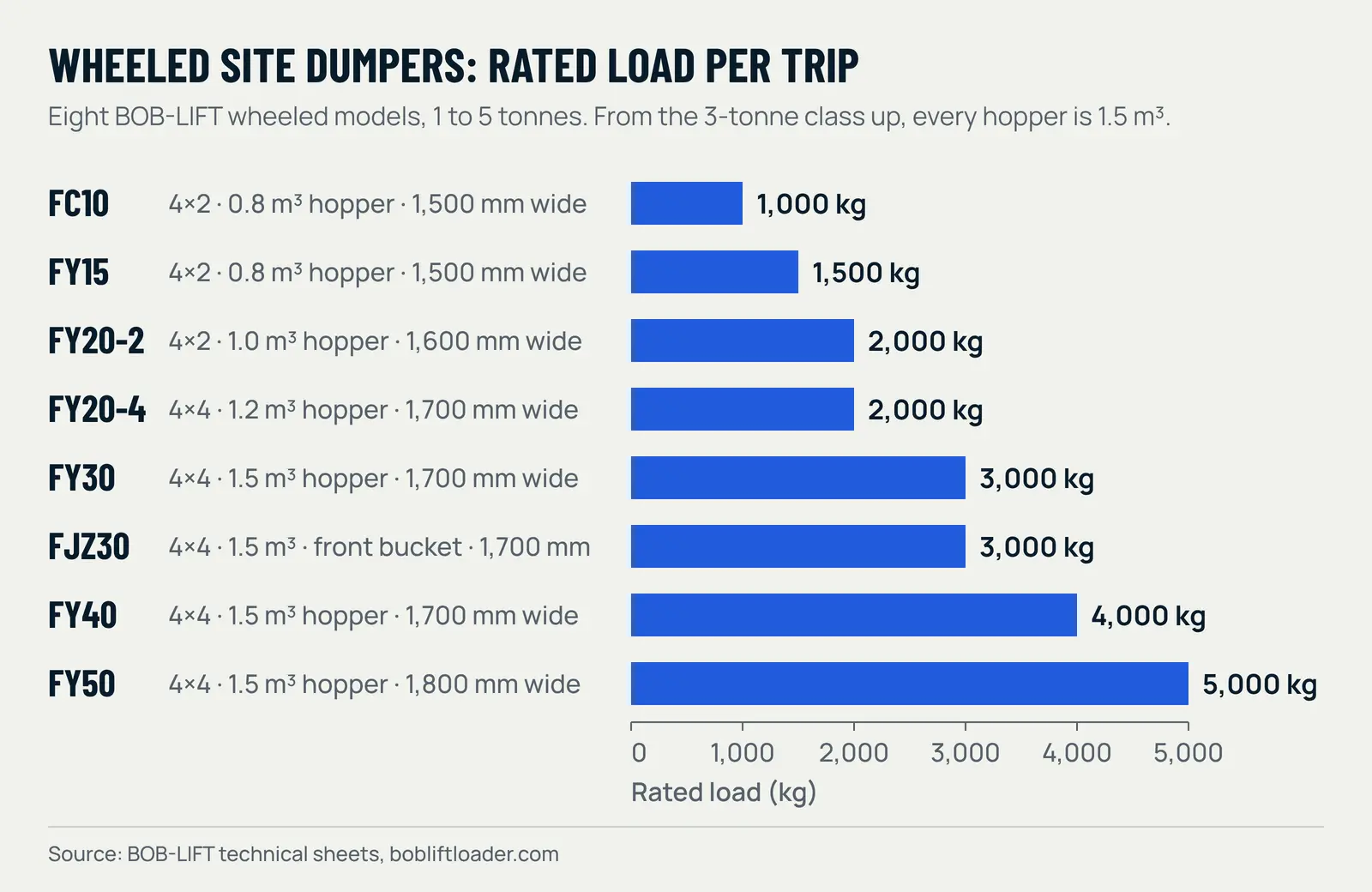
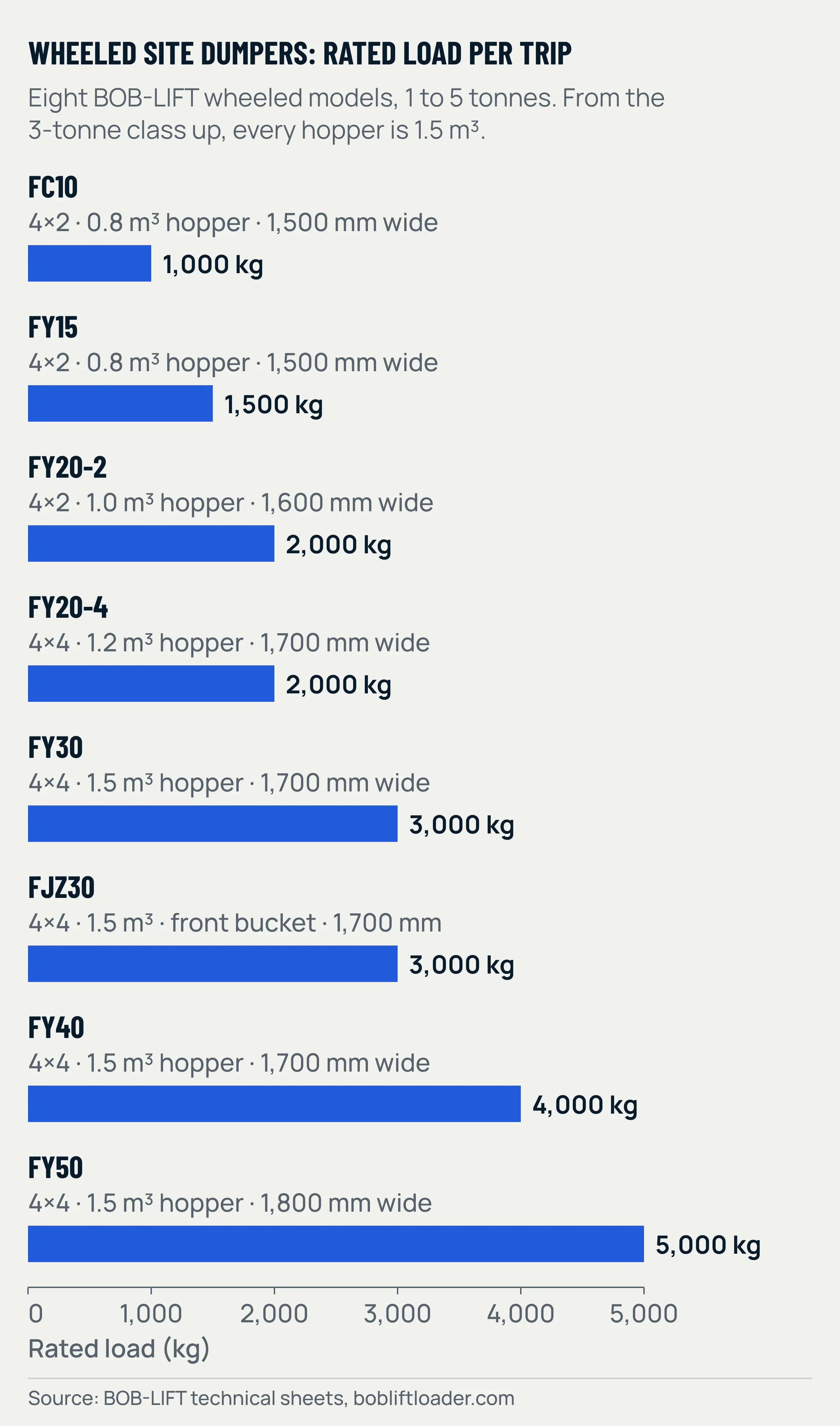
| Model | Rated load | Hopper | Width | Drive | Engine power | Dump height |
|---|---|---|---|---|---|---|
| FC10 | 1,000 kg | 0.8 m³ | 1,500 mm | 4×2 | 12.1 kW | 1,800 mm |
| FY15 | 1,500 kg | 0.8 m³ | 1,500 mm | 4×2 | 13.2 kW | 1,800 mm |
| FY20-2 | 2,000 kg | 1.0 m³ | 1,600 mm | 4×2 | 17 kW | 2,000 mm |
| FY20-4 | 2,000 kg | 1.2 m³ | 1,700 mm | 4×4 | 27.5 kW | 2,200 mm |
| FY30 | 3,000 kg | 1.5 m³ | 1,700 mm | 4×4 | 37 kW | 2,400 mm |
| FJZ30 | 3,000 kg | 1.5 m³ | 1,700 mm | 4×4 | 37 kW | 2,700 mm |
| FY40 | 4,000 kg | 1.5 m³ | 1,700 mm | 4×4 | 40 kW | 2,400 mm |
| FY50 | 5,000 kg | 1.5 m³ | 1,800 mm | 4×4 | 65 kW | 2,500 mm |
The model name tells you the class. FC is the basic front-tip dumper, FY tips hydraulically, and FJZ adds a self-loading front bucket. The number is the rated load in hundreds of kilograms, so the FY30 carries 3,000 kg. On the FY20 only, -2 means two-wheel drive and -4 means four-wheel drive. All eight run on diesel with electric start and oil brakes, and every hopper tips to 45°. The dump height in our specifications is measured from the ground to the lower edge of the hopper lip with the hopper tipped, which is the figure to compare with the side of a skip or truck body. If you are comparing a site dumper with a kei truck or a tracked dumper, see our mini dump truck comparison.
The 1-tonne class: FC10
A 1 ton dumper such as the FC10 1 ton mini dumper carries 1,000 kg in a 0.8 m³ hopper and is 1,500 mm (59 in) wide. At 800 kg, it is the lightest wheeled dumper we build and the simplest. Our 1 ton dumper guide covers the FC10 in full, including how much of its hopper you can fill with sand or gravel.
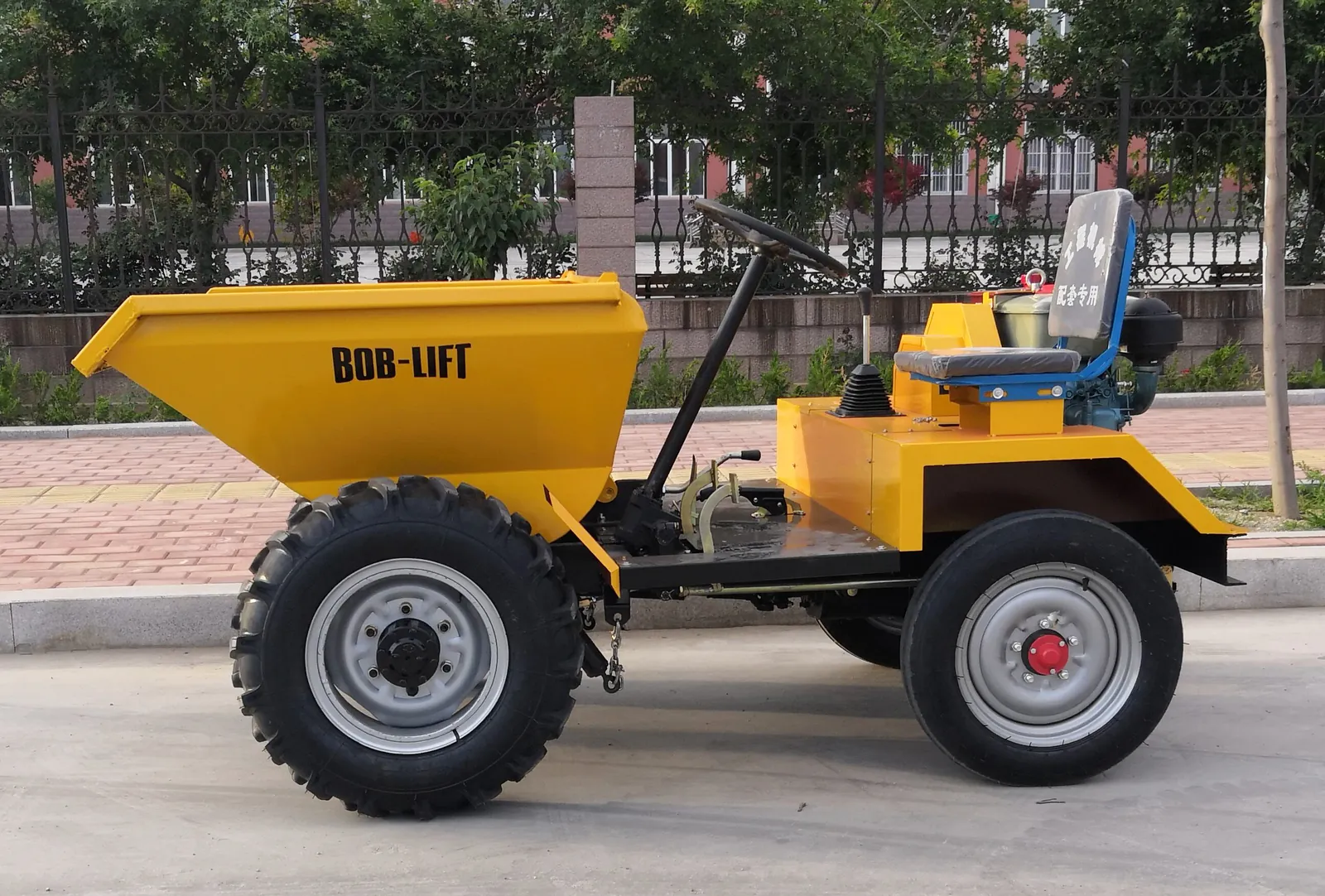
- Size: 2,600 × 1,500 × 1,450 mm, or 2,150 mm high with the simple roof canopy.
- Power and drive: ZS1100 diesel, 12.1 kW, 4×2, top speed 22 km/h, 12 V electrics.
- Tipping: mechanical front tip as standard, with hydraulic tipping and a swivel side-tip hopper as options. Dump height is 1,800 mm.
- Steering and tyres: mechanical linkage steering, 7.50-16 front and 5.50-16 rear tyres, 200 mm ground clearance.
The 1-tonne class suits farms, yards and smaller building jobs where loads are moderate and the route is reasonably firm. The FC10 is supplied with an original diesel filter. If your route is narrower than 1.5 m or the ground is soft, a wheeled dumper may be the wrong tool. Our BL-T500-HD tracked mini dumper is 880 mm wide and carries 500 kg.
1.5 and 2 tonnes: FY15, FY20-2 and FY20-4
This middle class carries 1,500 to 2,000 kg (3,307 to 4,409 lb) per trip in hoppers from 0.8 to 1.2 m³, and all three models tip hydraulically. They differ mainly in width, drive and power.
FY15 1.5 ton mini dumper. The FY15 has the FC10’s footprint (2,600 × 1,500 mm) and the same 0.8 m³ hopper, but it is rated for 1,500 kg and tips hydraulically. It has a 13.2 kW ZS1105 diesel engine and mechanical linkage steering, with hydraulic steering as an option. Because the hopper is no bigger, the extra rating helps with any material heavier than about 1,250 kg/m³, which covers sand, gravel and concrete. The hopper section below shows the numbers.
FY20-2 2 ton two-wheel-drive dumper. The FY20-2 carries 2,000 kg in a 1.0 m³ hopper on a 3,000 × 1,600 mm frame, with a 17 kW L24 diesel engine and hydraulic steering. It weighs only 900 kg, and its dump height is 2,000 mm. A Euro V engine is available at extra cost.
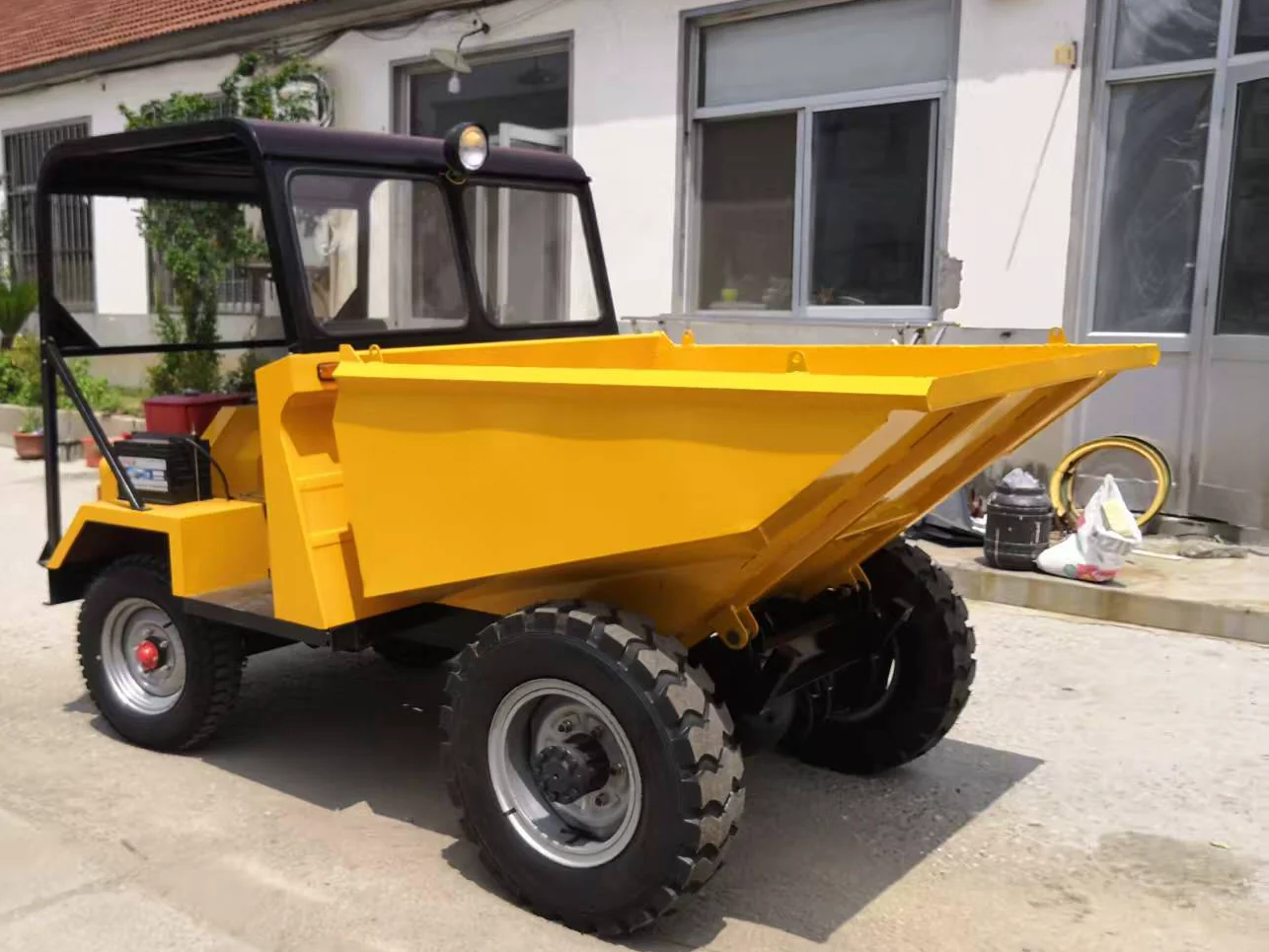
FY20-4 2 ton four-wheel-drive dumper. The FY20-4 has the same 2,000 kg rating, but it is a different class of machine. It has a larger 1.2 m³ hopper, a 27.5 kW ZN490B engine, four-wheel drive and articulated steering. It measures 4,200 × 1,700 mm, weighs 2,100 kg and tips to a 2,200 mm dump height. It runs on 24 V and comes open, with a roof canopy or with a deluxe cab.
In short, choose the FY15 for heavier loads in the FC10’s 1,500 mm width. Choose the FY20-2 for more volume on firm ground. Choose the FY20-4 when the site is rough, wet or sloped and you need drive at all four wheels. Our 2 ton dumper guide compares the FY20-2 and FY20-4 side by side, including how full each hopper can go.
3 to 5 tonnes: FY30, FY40, FY50 and FJZ30
The heavy class carries 3,000 to 5,000 kg (6,614 to 11,023 lb) per trip. All four models share a 1.5 m³ hopper, four-wheel drive, articulated steering, a 4,500 mm length and a 28 km/h top speed. The FY30, FY40 and FJZ30 run on 12-16.5 tyres, and the FY50 on 20.5/70-16.
- FY30 3 ton mini dumper: 3,000 kg, 37 kW YN25GB diesel, 2,400 mm dump height, 200 mm ground clearance, 1,700 mm wide, 2,200 kg machine weight.
- FY40 4 ton mini dumper: 4,000 kg, 40 kW YN25GB diesel, 2,400 mm dump height, 240 mm ground clearance, 1,700 mm wide, 2,400 kg.
- FY50 5 ton mini dumper: 5,000 kg, 65 kW YN33GBZ diesel, 2,500 mm dump height, 200 mm ground clearance, 1,800 mm wide, 2,600 kg. This is the highest-payload wheeled dumper we build.
- FJZ30 3 ton dumper with front bucket: 3,000 kg and 1.5 m³, plus a front bucket that lifts to 2,800 mm, so it loads itself. Its dump height is 2,700 mm and its ground clearance is 250 mm. At 3,920 kg it is the heaviest of the four.
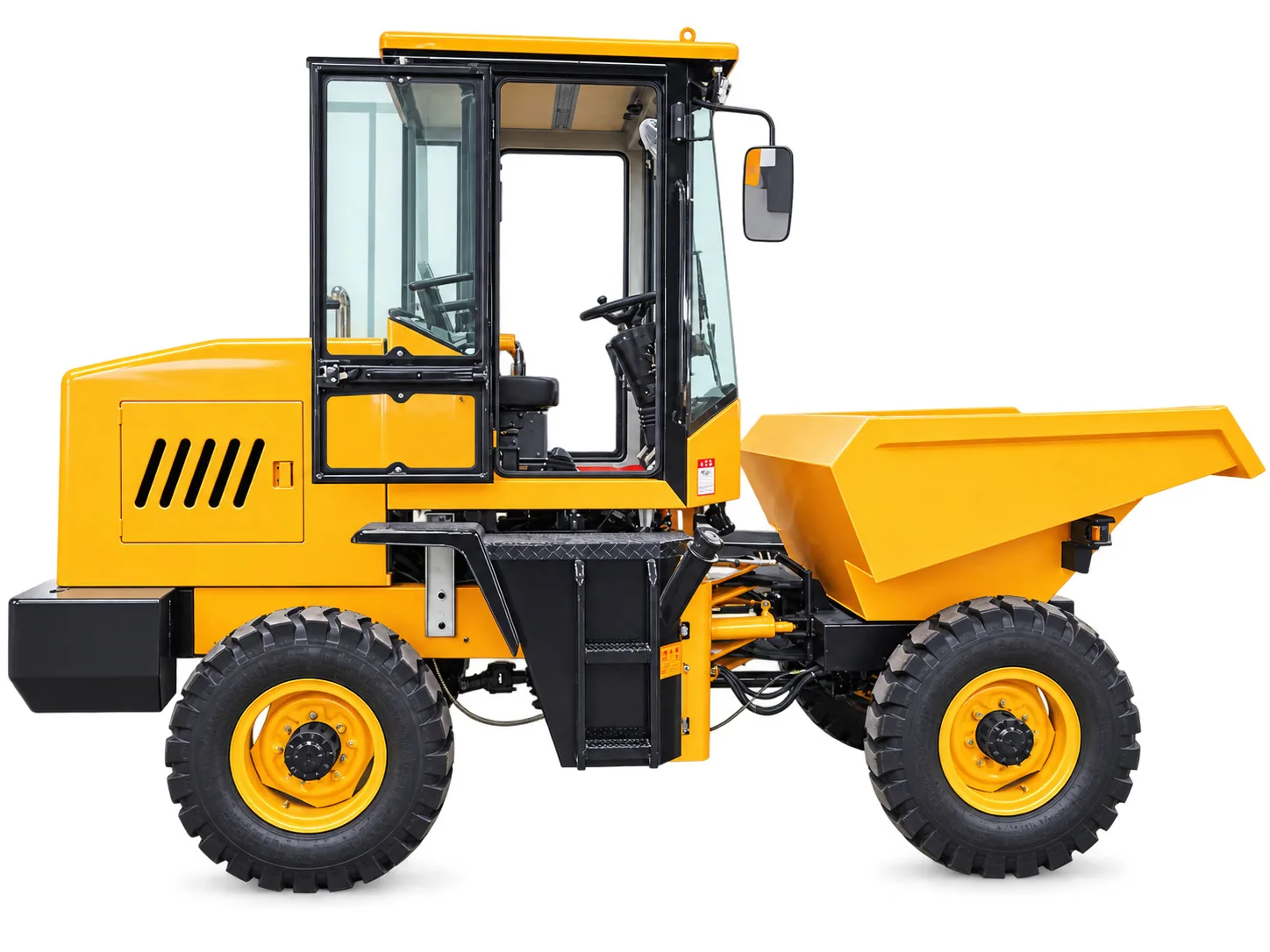
All four have Euro V engines available at extra cost and a swivel side-tip hopper as an option. They come with one set of original diesel, oil and air filters. Our dumpers page suggests the FY20-4, FY30 and FY40 for building sites, and the FY40 and FY50 for contractors moving four to five tonnes a trip. Our 5 ton dumper guide compares the FY50 with the FY40 in detail.
Hopper volume vs rated load
Rated load is a weight and hopper capacity is a volume: a level-full 1.5 m³ hopper of dry sand weighs about 2,330 kg, well under the FY30’s 3,000 kg rating. Use this rule: load per trip ≈ hopper volume × material density. If that figure is below the rated load, the hopper fills first. If it is above, stop at the rated load and leave the hopper part-empty.
Our published hopper capacities are struck volumes, meaning level with the top edge of the hopper. A heaped load holds roughly 20 to 30% more, but site guidance says not to fill above the top edge, so plan your trips on the struck figure used in the tables below.
The density figures below come from Engineering ToolBox, a free engineering reference (Dirt and Mud – Densities and Concrete Properties, retrieved 12 October 2026). Real densities vary with moisture, compaction and grading. Weigh a known volume of your own material if the margin is tight. As a cross-check, the Los Angeles County Public Works conversion table (factors from the California Integrated Waste Management Board) gives dry soil at 2,025 lb/yd³ (about 1,200 kg/m³) and stone or gravel at 2,632.5 lb/yd³ (about 1,560 kg/m³). Those are close to, or a little below, the figures used here.
| Material | Density (kg/m³) | Full 0.8 m³ hopper | Full 1.0 m³ hopper | Full 1.5 m³ hopper |
|---|---|---|---|---|
| Dirt, loose dry | 1,220 | ≈ 980 kg | ≈ 1,220 kg | ≈ 1,830 kg |
| Sand, dry | 1,555 | ≈ 1,240 kg | ≈ 1,560 kg | ≈ 2,330 kg |
| Gravel, dry | 1,680 | ≈ 1,340 kg | ≈ 1,680 kg | ≈ 2,520 kg |
| Sand, wet | 1,905 | ≈ 1,520 kg | ≈ 1,910 kg | ≈ 2,860 kg |
| Gravel, wet | 2,000 | ≈ 1,600 kg | ≈ 2,000 kg | ≈ 3,000 kg |
| Concrete | 2,240–2,400 | ≈ 1,790–1,920 kg | ≈ 2,240–2,400 kg | ≈ 3,360–3,600 kg |
A simple way to read the table is the break-even density: rated load ÷ hopper volume. Any material lighter than this fills the hopper before it reaches the rated load. Any material heavier reaches the rated load first.
| Model | Rated load ÷ hopper | Break-even density | What limits you first |
|---|---|---|---|
| FC10 | 1,000 kg ÷ 0.8 m³ | 1,250 kg/m³ | Rated load for sand, gravel and concrete |
| FY15 | 1,500 kg ÷ 0.8 m³ | 1,875 kg/m³ | Hopper for dry materials; rated load for wet sand, wet gravel and concrete |
| FY20-2 | 2,000 kg ÷ 1.0 m³ | 2,000 kg/m³ | Hopper for everything in the table except concrete |
| FY20-4 | 2,000 kg ÷ 1.2 m³ | ≈ 1,670 kg/m³ | Hopper for dry dirt and dry sand; rated load for gravel and anything heavier |
| FY30 / FJZ30 | 3,000 kg ÷ 1.5 m³ | 2,000 kg/m³ | Hopper for everything in the table except concrete |
| FY40 | 4,000 kg ÷ 1.5 m³ | ≈ 2,670 kg/m³ | Hopper for every material in the table |
| FY50 | 5,000 kg ÷ 1.5 m³ | ≈ 3,330 kg/m³ | Hopper for every material in the table |


Three worked examples
- FY30 with dry sand: 1.5 m³ × 1,555 kg/m³ ≈ 2,330 kg. That is below 3,000 kg, so the hopper is full first, with about 670 kg of rating unused.
- FY30 with concrete: 1.5 m³ × 2,400 kg/m³ = 3,600 kg, which is over the rating. Stop at 3,000 kg, or about 1.25 m³ (3,000 ÷ 2,400).
- FC10 with wet sand: 0.8 m³ × 1,905 kg/m³ ≈ 1,520 kg, which is over 1,000 kg. Fill to about 0.52 m³, roughly two-thirds of the hopper.
FY30, FY40 and FY50: same hopper, different ratings
The published figures give all three models a 1.5 m³ hopper, with rated loads of 3,000, 4,000 and 5,000 kg. With the materials in the table, a level-full hopper on the FY40 or FY50 stays below its rating. For materials up to about 2,000 kg/m³ (dry or wet sand and gravel), they carry the same 1.5 m³ per trip as the FY30. With concrete, the FY30 stops at 3,000 kg, about 1.25 m³, while the FY40 and FY50 can take the full 1.5 m³, about 3,360–3,600 kg. Other differences on the spec sheets include engine power (37, 40 and 65 kW), machine weight (2,200, 2,400 and 2,600 kg), ground clearance (240 mm on the FY40) and dump height (2,500 mm on the FY50). Heaping the hopper is not the answer. The UK Health and Safety Executive’s site dumper guidance says not to fill above the top edge of the skip and not to let loads block the driver’s view. If you are choosing between these three for a particular material, tell us what it is and we will confirm how the rating applies.
Height with roof or cab, and shipping
Open, our wheeled dumpers stand 1,450 to 1,850 mm tall. With a roof or cab, the FC10 and FY15 reach 2,150 mm and the FY20-2 reaches 2,180 mm. The FY20-4 is 2,650 mm, the FY30, FJZ30 and FY40 are 2,700 mm, and the FY50 is 2,750 mm.

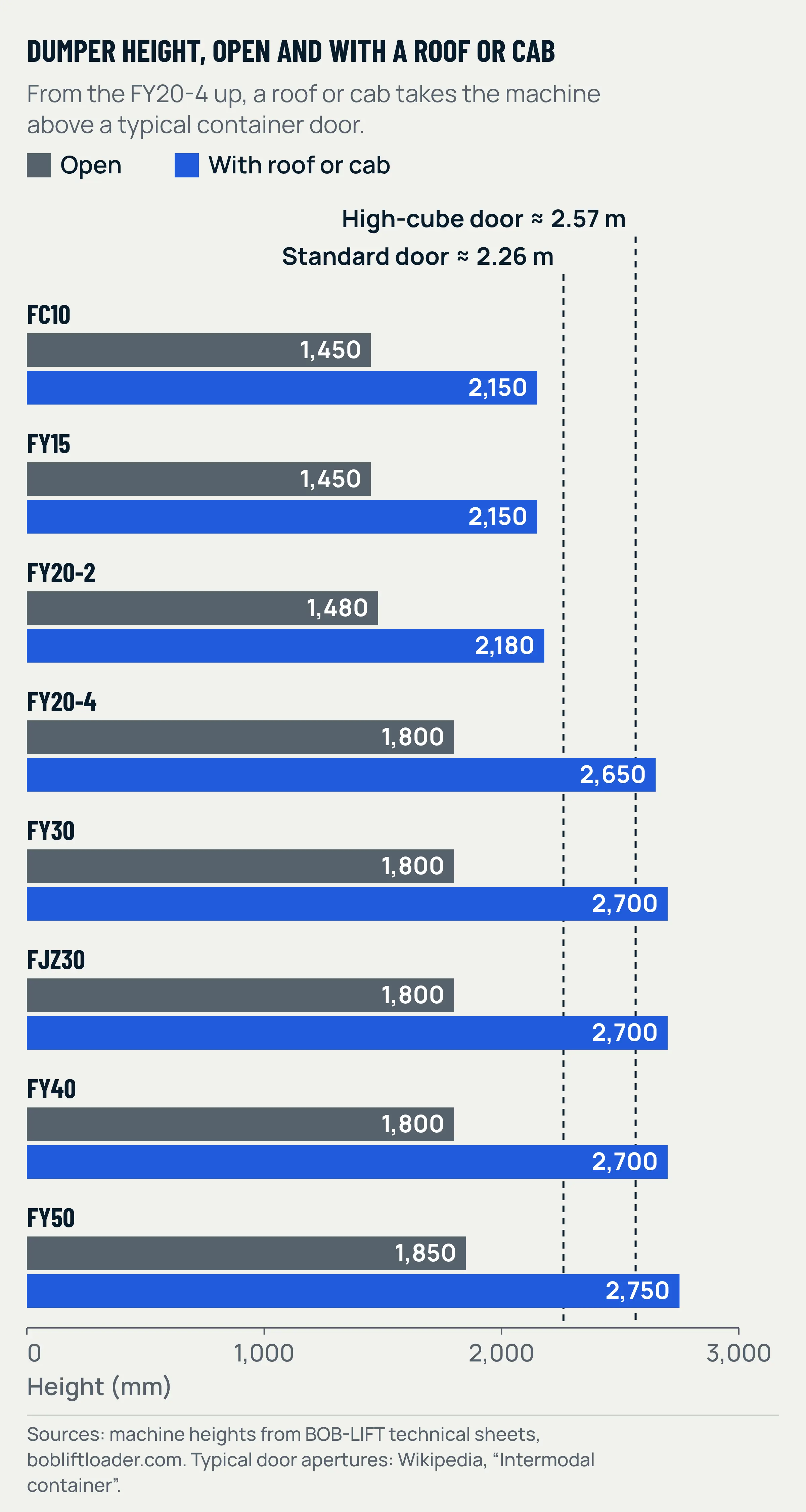
Wikipedia’s intermodal container article gives typical door apertures of about 2.26 m (7 ft 5 in) for a standard box and about 2.57 m (8 ft 5 in) for a high cube. That is why the FY20-4 to FY50 and the FJZ30 do not go through the door with a roof or cab fitted. The same height matters on site under low beams, barn doors and site gantries. Our dumper with cab guide compares roof canopies, simple cabs and enclosed cabs model by model.
For shipping, the wheeled dumper counts in our container table assume each machine is taken apart wherever that lets more fit in, with the cab or roof and the hopper removed. Putting a machine back together needs some assembly experience, and we can give technical assembly guidance. The FJZ30 and FY50 figures are for the whole machine.
| Model | 20GP | 40HQ | Loaded whole: 20GP / 40HQ |
|---|---|---|---|
| FC10, FY15 | ≈ 6 | ≈ 12 | 4 / 8 |
| FY20-2 | ≈ 3 | ≈ 6 | 2 / 4 |
| FY20-4 | ≈ 1 | ≈ 5 | 1 / 2 |
| FY30, FY40 | ≈ 1 | ≈ 5 | 1 / 3 |
| FY50 | ≈ 1 | ≈ 3 | 1 / 3 |
| FJZ30 | ≈ 1 | ≈ 2 | 1 / 2 (no taken-apart figure) |
These are approximate figures from our factory’s loading plans. Most mini dumpers are ready to ship in about 10 working days, while the FJZ30 takes about 30, and every BOB-LIFT dumper carries a 12-month whole-machine warranty. Details, trade terms and the full table are on our buying and support page. If you are importing into Great Britain, our guide to buying a mini dumper for the UK adds the duty, import VAT, noise label and engine rules.
Frequently asked questions
What is the difference between a 1 ton and a 3 ton dumper?
In our range, the 1-tonne FC10 is 1,500 mm wide, weighs 800 kg and carries 0.8 m³ with a 12.1 kW engine and 4×2 drive. The 3-tonne FY30 is 1,700 mm wide, weighs 2,200 kg and carries 1.5 m³ with a 37 kW engine, 4×4 drive and articulated steering.
How many cubic metres does a 3 ton dumper carry?
Both of our 3-tonne models, the FY30 and the FJZ30, have a 1.5 m³ hopper. Level-full with dry sand, that is about 2,330 kg, below the 3,000 kg rating. Our 3 ton dumper guide covers their full specifications and what to check before you buy.
Can I fill a 1-tonne dumper with concrete?
Not to the brim. A full 0.8 m³ hopper of concrete weighs about 1,790 to 1,920 kg, nearly twice the FC10’s 1,000 kg rating. Fill to about 0.42 m³ (1,000 ÷ 2,400), roughly half the hopper.
Which dumper fits through a 1.6 m gate?
The FC10 and FY15 are 1,500 mm wide, which leaves 50 mm each side. The FY20-2 is exactly 1,600 mm, so it is too tight to count on. For openings under 1.5 m, look at the tracked BL-T500-HD, which is 880 mm wide. Our dumper dimensions guide lists the length, width and height of every model and how to measure a gate.
Choosing your size
Start with your heaviest regular load and its material, the narrowest point on your route, and the ground you drive on. Those three answers usually narrow the eight models to one or two. Compare the 1 to 5 ton mini dumpers side by side, then send us those figures with a few photos of the route, and our team in Xuzhou will suggest a model and configuration.
Whatever size you choose, operators still need proper training; see what a dumper ticket involves.