


Key takeaways
- A mini skid steer breaker is a hydraulic hammer that mounts on the loader’s quick-attach plate. The loader holds the hammer and leans on it, so the operator does not carry the weight or take the vibration that a handheld jackhammer puts through the arms.
- Break from an edge or a crack, keep the tool square to the surface and work in short bursts. Never use the chisel as a lever, and stop the hammer when the tool is not on the material.
- Concrete, brick and stone give off silica dust when broken. In the US, OSHA’s Table 1 control for heavy equipment breaking these materials is an enclosed cab. A stand-on mini loader has none, so plan water for dust and an exposure assessment.
- Our range page lists the hydraulic breaker for “Concrete, paving and frozen ground”, and it appears on all nine of our loader pages. Heavier loaders hold the breaker down better; we check auxiliary flow against the breaker when we quote.
What is a skid steer breaker?
A skid steer breaker, also called a hydraulic breaker for skid steer loaders, a hydraulic hammer or a skid steer jack hammer, is a hammer body in a mounting frame that bolts to the loader’s quick-attach plate. Oil from the loader’s auxiliary hydraulics drives a piston inside the body, and the piston strikes a steel tool, usually a chisel or a point, that sticks out of the bottom. The loader’s lift and tilt cylinders aim the tool and press it onto the surface, and the repeated blows crack the material under the tip.
On our mini skid steer loader range page, the hydraulic breaker sits in the Break & clear group, for “Concrete, paving and frozen ground”. The same page pairs it with the 4-in-1 bucket and grapple bucket for renovation and indoor work, to “break out floors, clear rubble and move materials where a full-size loader can’t go”, and with the sweeper and snow blower for streets and public spaces.
Skid steer concrete breaker, jackhammer or bucket?
Three tools get used for breaking out a slab on a small site. They suit different amounts of work.
| Factor | Handheld jackhammer | Mini skid steer breaker | Bucket or ripper |
|---|---|---|---|
| Who holds the tool | The operator | The loader’s arms | The loader’s arms |
| What it breaks | Small areas, edges, work beside walls | Slabs, paths, driveways, kerbs, frozen ground | Loose ground, roots, slabs already broken up |
| Operator effort | High: carrying the weight and taking the vibration | Low: the loader carries and presses the hammer | Low |
| Clearing up | A separate machine or by hand | Swap to a bucket or grapple on the same loader | Same machine |
A bucket cannot crack sound concrete, but it lifts and loads the pieces once the breaker has done its work. The ripper in our range is made to “Loosen compacted soil and roots”, not to break slabs. For loading broken concrete into a truck or a dumper, see our mini skid steer grapple guide.
How to break concrete with a mini skid steer
Read the breaker’s manual first. Its limits on hydraulic flow, pressure and working angle override any general advice. These are the working habits that protect the tool and the loader:
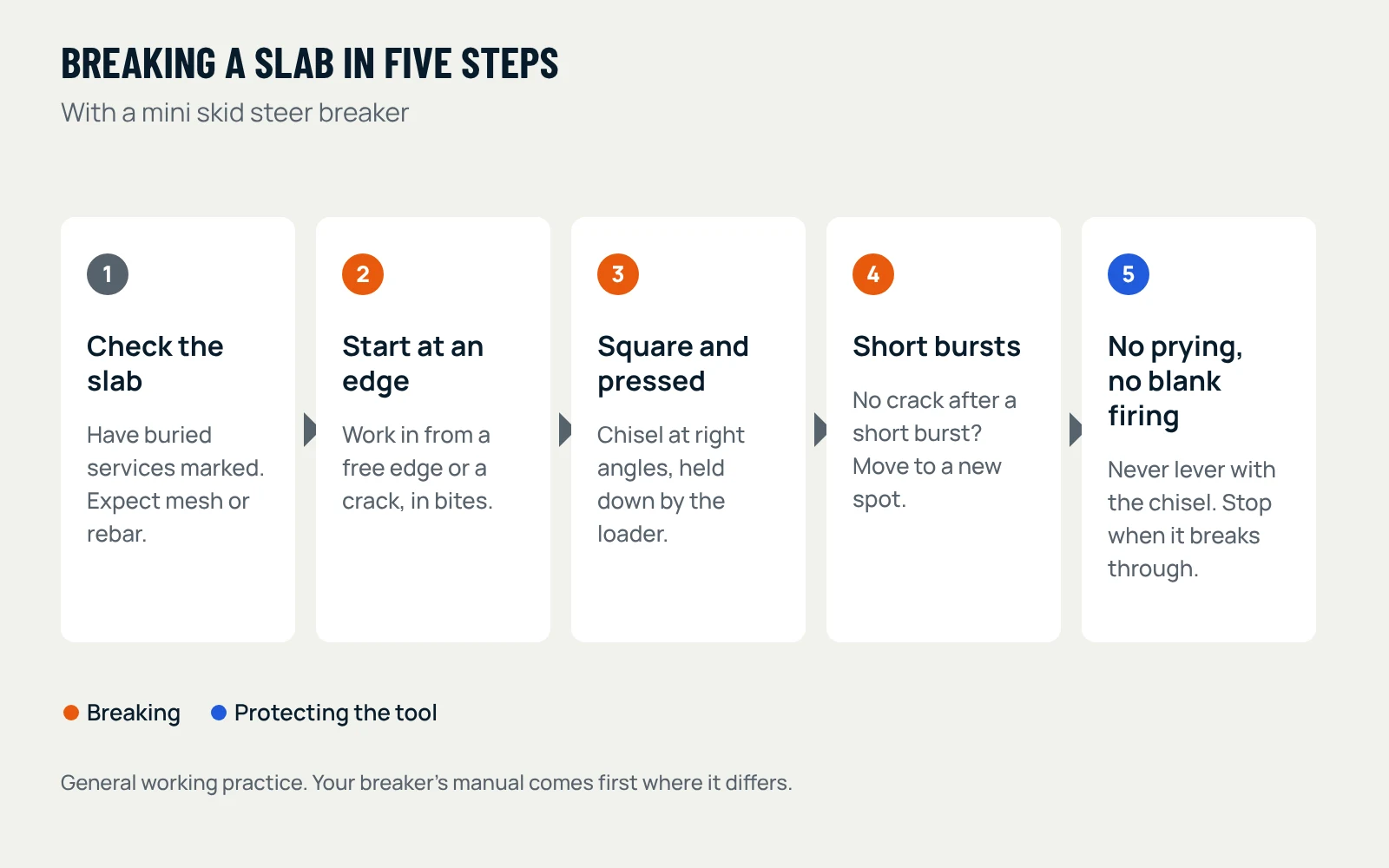
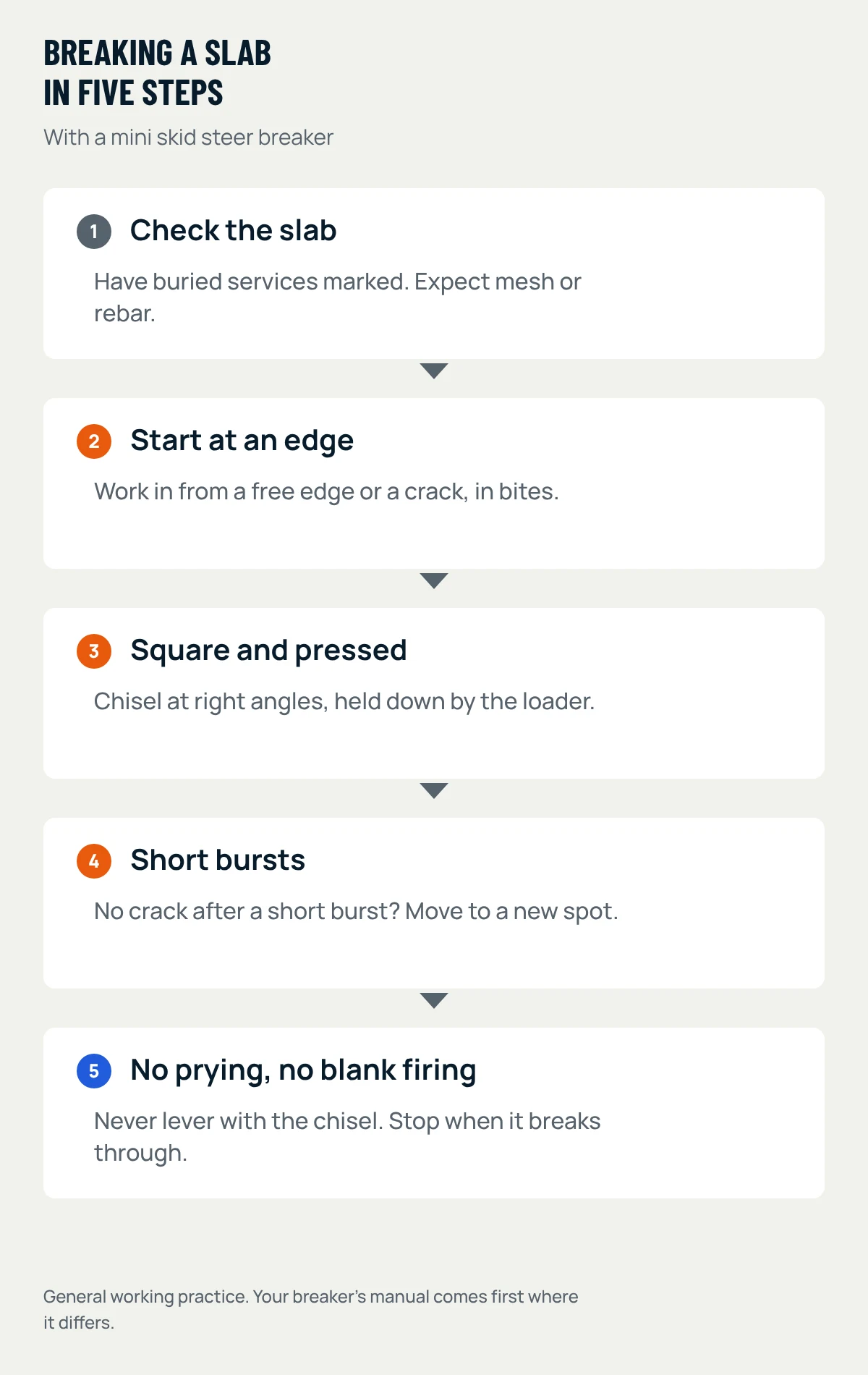
- Check what is under and in the slab. Have buried pipes and cables located and marked, and expect steel mesh or rebar in driveways and floors.
- Start at an edge or a crack. Concrete breaks far more easily toward a free edge than in the middle of a slab. Work in from the edge in bites.
- Keep the tool square and pressed down. Set the chisel at right angles to the surface and use the loader’s weight to hold it there before you start the hammer.
- Hammer in short bursts. If a spot does not crack after a short burst, move the tool to a new spot rather than drilling a hole.
- Do not pry or blank-fire. Never use the chisel as a lever to lift pieces, and stop the hammer as soon as the material breaks away, so the tool is not striking with nothing under it.
Once a section is broken, swap to the 4-in-1 bucket or the grapple bucket on the same quick-attach plate and load the pieces before you break the next section. If the job continues below the slab, for a footing or a new drain, our backhoe attachment guide covers digging with the same loader.
Silica dust: what OSHA expects in the US
Breaking concrete, brick or stone releases respirable crystalline silica. OSHA’s construction silica standard includes a Table 1 of specified controls. For “Heavy equipment and utility vehicles used to abrade or fracture silica-containing materials (e.g., hoe-ramming, rock ripping)”, the control it lists is: “Operate equipment from within an enclosed cab”. It adds: “When employees outside of the cab are engaged in the task, apply water and/or dust suppressants as necessary to minimize dust emissions” (29 CFR 1926.1153).
A stand-on mini skid steer has no cab, so that Table 1 entry cannot be followed as written. The standard covers this case: where an employer does not fully and properly implement Table 1, it must use the “Alternative exposure control methods”, which require that no worker is exposed above a permissible exposure limit of 50 µg/m³ as an 8-hour time-weighted average, and that exposure is assessed. In practice, that means a steady water spray at the point of impact, keeping other workers out of the dust and upwind, and getting your safety adviser to plan the assessment before the job. Indoors, for example when breaking out a basement or car park floor, also plan ventilation for the dust and the engine exhaust.


Which mini skid steer to pair with a breaker
A breaker needs two things from the loader: the right hydraulic supply, and enough weight to hold the tool down. Too little down-force and the hammer bounces instead of breaking. We publish operating weight, power and pressure for each loader. We do not publish auxiliary flow, so we check it against the breaker’s rating when we quote.
| Loader | Operating weight | Engine power | Hydraulic pressure | Running gear and operator |
|---|---|---|---|---|
| BL-T1000-H | 1,250 kg | 17.8 kW | 20 MPa | Tracks, stand-on |
| BL-T750-H | 1,100 kg | 18.6 kW | 18 MPa | Tracks, stand-on |
| BL-S750-H | 1,000 kg | 18.6 kW | 18 MPa | Wheels, stand-on |
| BL-T490-C | 950 kg | 16.8 kW | 16 MPa | Tracks, seated |
| BL-S490-C | 850 kg | 16.8 kW | 16 MPa | Wheels, seated |
| BL-T390-C | 750 kg | 7.6 kW | 16 MPa | Tracks, seated |
| BL-T460-H | 730 kg | 16.8 kW | 17 MPa | Tracks, stand-on |
| BL-T360-H | 650 kg | 7.6 kW | 17 MPa | Tracks, stand-on |
| BL-S390-C | 650 kg | 7.6 kW | 16 MPa | Wheels, seated |
- Driveways, slabs and regular demolition. Look first at the three heaviest models, the BL-T1000-H, BL-T750-H and BL-S750-H, at 1,000 to 1,250 kg.
- Streets and footpaths. The wheeled models, led by the 1,000 kg BL-S750-H, move between jobs on hard surfaces without track wear; the tracked models suit rough and soft ground. Our tracked vs wheeled mini skid steer guide compares them.
- Small jobs and tight access. The lighter models suit a smaller breaker for paths, steps and kerbs; we confirm the breaker size when we quote.
Weight also matters when the loader travels to the site. Our mini skid steer weight and dimensions guide covers trailers, gates and shipping.
Breaker safety
- Keep a clear zone. Breaking throws concrete chips. Keep people out of the work area, and put up barriers on streets and footpaths.
- Protect your hearing and eyes. Our product pages note that noise at the operator position can exceed 85 dB(A) at full engine speed on some models, and the hammer adds its own noise. Wear hearing protection, safety glasses and a dust mask or respirator as your silica plan requires.
- Never bypass safety devices. NIOSH tells skid steer operators to “NEVER modify or bypass safety devices” (NIOSH Publication 2011-128). Lower the breaker to the ground and stop the engine before anyone approaches the tool.
- Look after the tool. Grease the tool bushing as the manual specifies, and check the hoses, couplers and mounting bolts before each shift.
Our skid steer maintenance checklist covers the daily checks on the loader side, including the auxiliary hydraulics a breaker runs on.
Mini skid steer breaker FAQ
Can a mini skid steer run a hydraulic breaker?
Yes. A mini skid steer runs a hydraulic breaker from its quick-attach plate and auxiliary hydraulics. The breaker must be sized to the loader’s flow, pressure and weight, which we check when we quote.
Can a mini skid steer break up a concrete driveway?
Yes, with a breaker sized to the loader. Start at an edge, work in short bursts and load the pieces as you go. Expect mesh or rebar in a driveway, and plan dust control before you start.
What is the difference between a breaker and a jackhammer?
Both hammer a chisel into the material. A handheld jackhammer is held by the operator. A skid steer breaker is held and pressed down by the loader, which takes the weight and the vibration off the operator and lets one machine break and clear.
Why does my breaker bounce instead of breaking?
Usually there is too little down-force, the tool is not square to the surface, or you are working in the middle of a slab instead of from an edge. Press the tool down with the loader, set it square and start from an edge or a crack.
Do I need water to break concrete?
Usually, yes. In the US, OSHA’s silica standard expects dust control. With no enclosed cab, as on a stand-on mini skid steer, plan water at the point of impact and an exposure assessment.
Planning a breaking job
Measure the area and the thickness of the concrete, find out whether it has mesh or rebar, and note the access width and where the broken pieces will go. Then compare our nine mini skid steer loaders, or see the full list of attachments that can share the same machine. When you ask for a quote, tell us what you need to break, how thick it is, the other attachments you want and your narrowest access, and we suggest the loader and breaker to match.
Specifications checked against our product pages on 22 October 2026.