


Key takeaways
- Our nine mini skid steer loaders carry a standard bucket of 0.1 m³ (3.5 ft³), 0.15 m³ (5.3 ft³) or 0.19 m³ (6.7 ft³), 906 to 1,270 mm (35.7 to 50.0 in) wide.
- A level-full bucket of dry sand weighs about 156 kg (344 lb) in a 0.1 m³ bucket and about 295 kg (650 lb) in the 0.19 m³ bucket: bucket capacity × material density.
- With the soils, sand and gravel in our table, eight models carry a level-full bucket within the rated load. The BL-T460-H is exactly at its 300 kg with wet gravel, so fill it level, not heaped. Only the BL-T360-H (0.15 m³, 200 kg rated) goes over, with sand or gravel.
- On eight of nine models the bucket is wider than the body, by 10 to 285 mm. The BL-T360-H bucket is 24 mm narrower than its 930 mm body.
- Five bucket-type tools are on our attachment list: the 4-in-1 bucket, grapple bucket, hydraulic grapple, high-dump bucket and mixing bucket.
Mini skid steer bucket size and capacity
A mini skid steer bucket on our range holds 0.1 to 0.19 m³ (3.5 to 6.7 ft³) and is 906 to 1,270 mm (35.7 to 50.0 in) wide. Those are the standard buckets listed on each loader’s technical sheet. There are three sizes: the four seated models take 0.1 m³, four stand-on models take 0.15 m³, and the BL-T1000-H takes 0.19 m³, the largest of any BOB-LIFT loader.
| Model | Bucket capacity | Bucket width | Machine width | Rated load | Lifting capacity |
|---|---|---|---|---|---|
| BL-T360-H | 0.15 m³ (5.3 ft³) | 906 mm (35.7 in) | 930 mm (36.6 in) | 200 kg (441 lb) | 300 kg (661 lb) |
| BL-T390-C | 0.1 m³ (3.5 ft³) | 1,050 mm (41.3 in) | 955 mm (37.6 in) | 250 kg (551 lb) | 300 kg (661 lb) |
| BL-S390-C | 0.1 m³ (3.5 ft³) | 1,050 mm (41.3 in) | 959 mm (37.8 in) | 260 kg (573 lb) | 290 kg (639 lb) |
| BL-S490-C | 0.1 m³ (3.5 ft³) | 1,150 mm (45.3 in) | 1,089 mm (42.9 in) | 250 kg (551 lb) | 350 kg (772 lb) |
| BL-T490-C | 0.1 m³ (3.5 ft³) | 1,150 mm (45.3 in) | 1,089 mm (42.9 in) | 250 kg (551 lb) | 350 kg (772 lb) |
| BL-T460-H | 0.15 m³ (5.3 ft³) | 1,100 mm (43.3 in) | 1,090 mm (42.9 in) | 300 kg (661 lb) | 375 kg (827 lb) |
| BL-S750-H | 0.15 m³ (5.3 ft³) | 1,270 mm (50.0 in) | 985 mm (38.8 in) | 400 kg (882 lb) | 450 kg (992 lb) |
| BL-T750-H | 0.15 m³ (5.3 ft³) | 1,270 mm (50.0 in) | 985 mm (38.8 in) | 410 kg (904 lb) | 525 kg (1,157 lb) |
| BL-T1000-H | 0.19 m³ (6.7 ft³) | 1,240 mm (48.8 in) | 960 mm (37.8 in) | 500 kg (1,102 lb) | 650 kg (1,433 lb) |
Bucket capacity is a volume; rated load is a weight. Plan your loads to the rated load, not the higher lifting capacity. Our sheets give one capacity figure per bucket and do not say whether it is level (struck) or heaped, so this guide treats it as level-full. A heaped bucket holds, and weighs, more.
For gate widths, trailers and container counts, see our mini skid steer weight and dimensions guide. All four seated models take the 0.1 m³ bucket; our stand-on vs seated mini skid steer guide compares the two operator positions.
Skid steer bucket capacity vs rated load
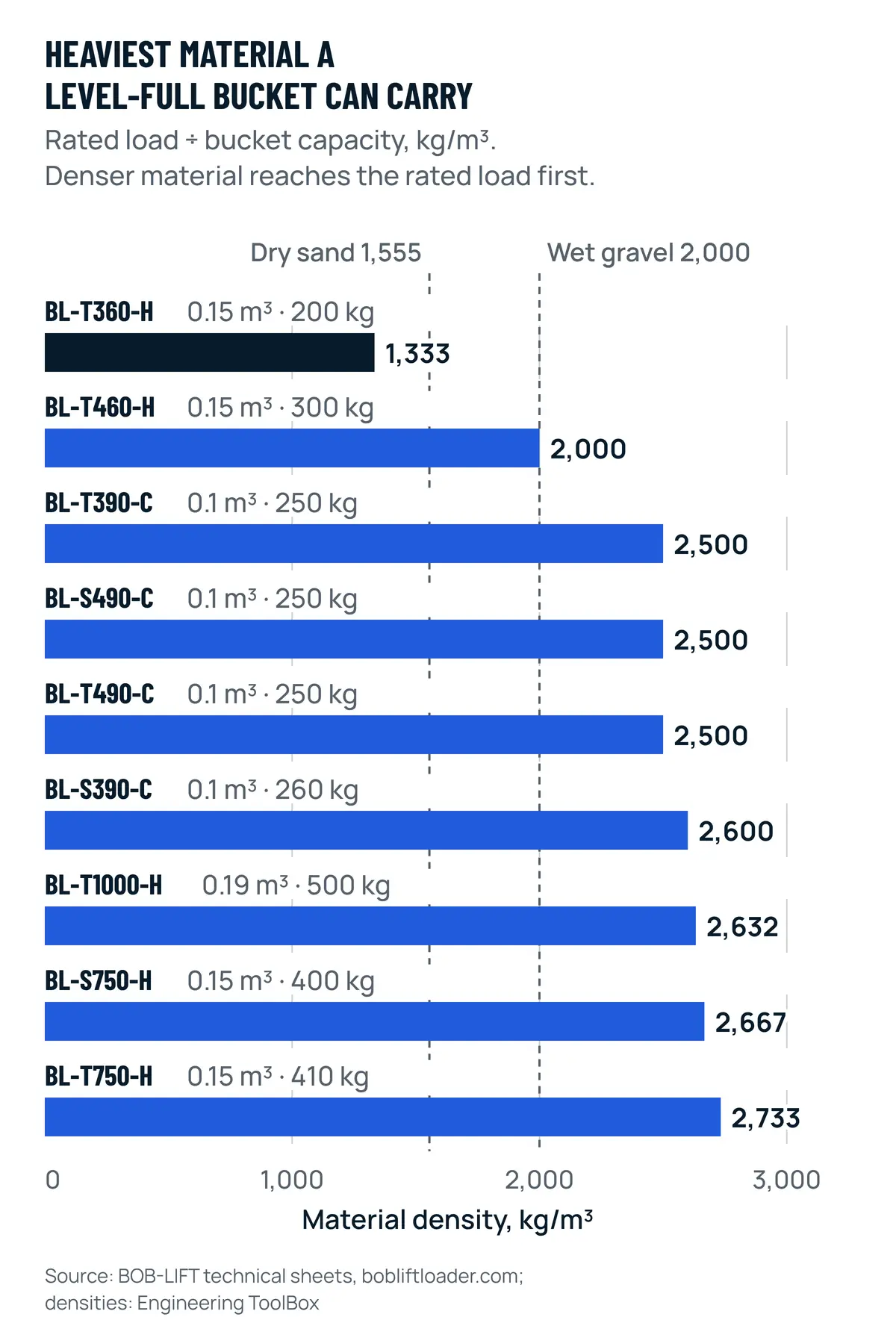
With the soils, sand and gravel in the table below, rated load is the limit only on the BL-T360-H. A level-full bucket weighs its capacity times the density of the material. On the other eight loaders, a level-full bucket of wet gravel at 2,000 kg/m³ stays within the rated load. The BL-T360-H reaches its 200 kg rating first with any material denser than about 1,333 kg/m³, which includes dry sand and dry gravel.
The densities come from Engineering ToolBox, a free engineering reference (Dirt and Mud – Densities, retrieved 12 October 2026). As a cross-check, the Los Angeles County Public Works volume-to-weight table, which uses the California Integrated Waste Management Board’s factors, gives dry soil at 2,025 lb/yd³ (about 1,200 kg/m³) and stone or gravel at 2,632.5 lb/yd³ (about 1,560 kg/m³). Both sit close to, or below, our figures. Real figures vary: bulk density changes with how a material is handled, and it rises as loose material settles and packs closer. Moisture adds weight too; wet sand is about 350 kg/m³ heavier than dry sand.
| Material | Density | Level-full 0.1 m³ | Level-full 0.15 m³ | Level-full 0.19 m³ |
|---|---|---|---|---|
| Dirt, loose dry | 1,220 kg/m³ (76 lb/ft³) | 122 kg | 183 kg | 232 kg |
| Loam | 1,280 kg/m³ (80 lb/ft³) | 128 kg | 192 kg | 243 kg |
| Sand, dry | 1,555 kg/m³ (97 lb/ft³) | 156 kg | 233 kg | 295 kg |
| Gravel, dry | 1,680 kg/m³ (105 lb/ft³) | 168 kg | 252 kg | 319 kg |
| Sand, wet | 1,905 kg/m³ (119 lb/ft³) | 191 kg | 286 kg | 362 kg |
| Gravel, wet | 2,000 kg/m³ (125 lb/ft³) | 200 kg | 300 kg | 380 kg |
To convert the weights to pounds, multiply by 2.205: the heaviest, 380 kg, is about 838 lb.
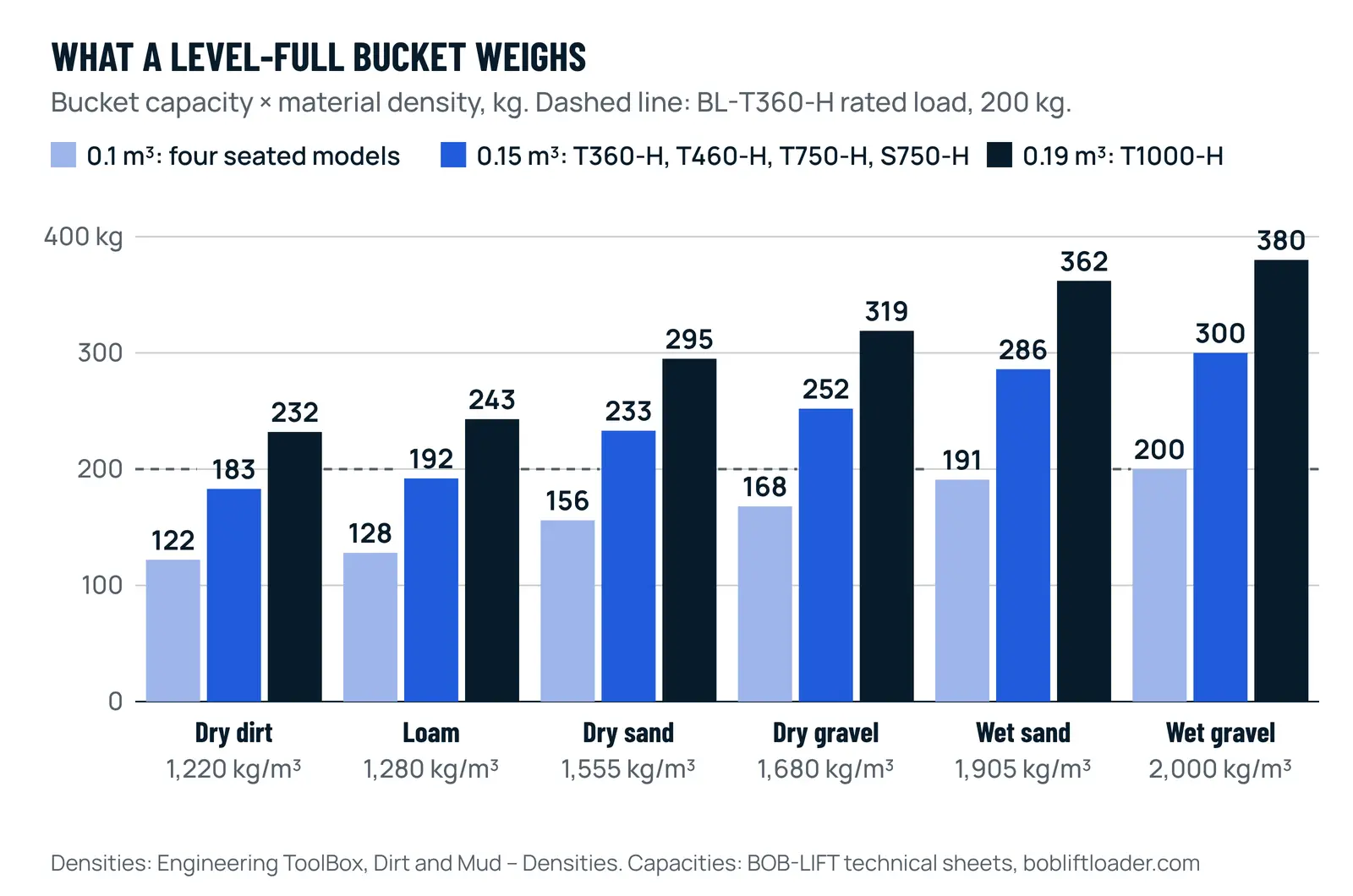
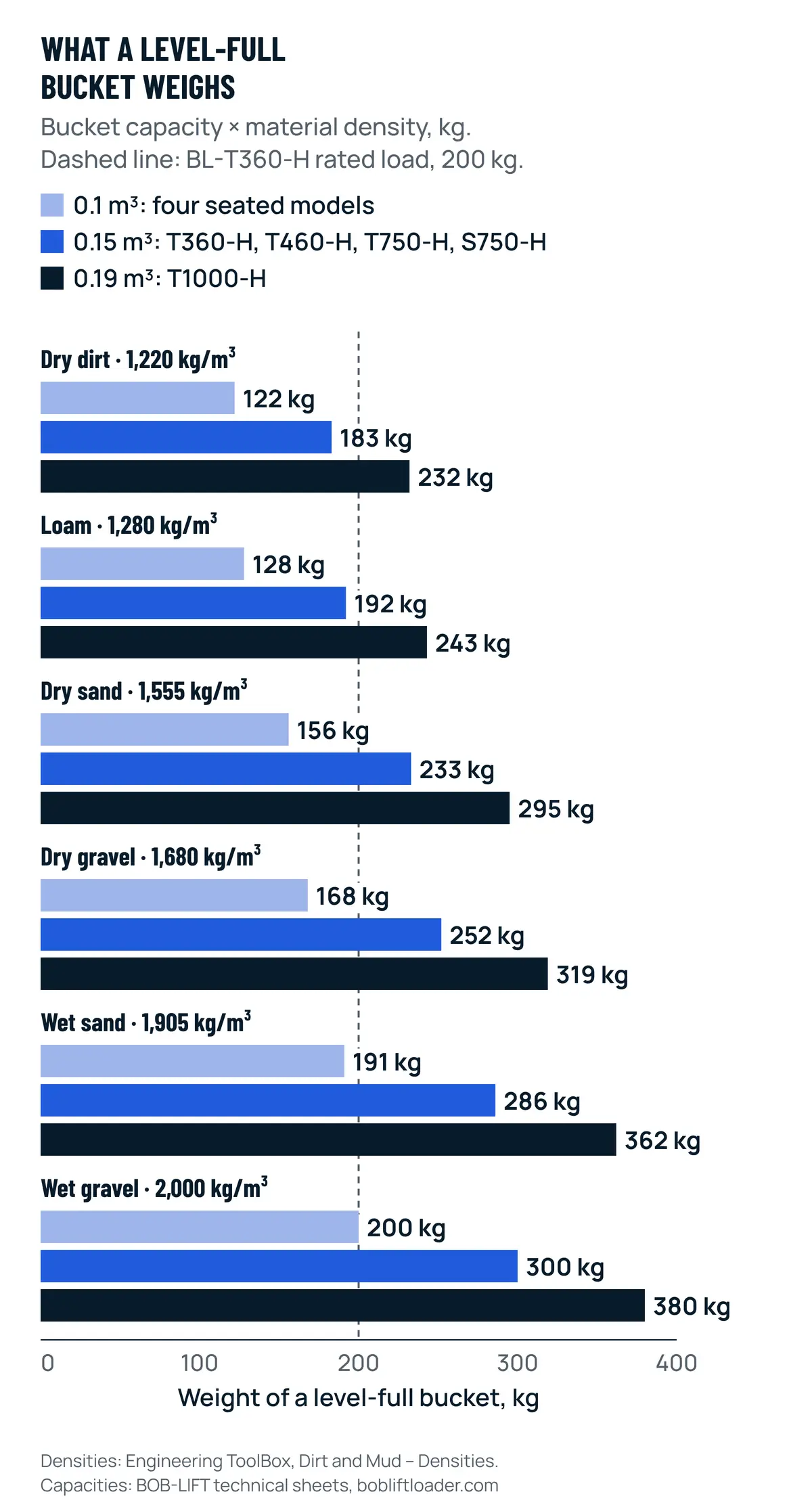
Read it against each model’s rated load:
- 0.1 m³ buckets (BL-T390-C, BL-S390-C, BL-S490-C, BL-T490-C). The heaviest level-full load in the table is 200 kg of wet gravel, below the 250–260 kg rated loads.
- BL-T750-H and BL-S750-H (0.15 m³). Wet gravel reaches 300 kg, well under their 400–410 kg ratings.
- BL-T460-H (0.15 m³, 300 kg rated). Wet gravel reaches exactly 300 kg. Fill it level, not heaped, with wet material.
- BL-T1000-H (0.19 m³). Wet gravel reaches 380 kg against a 500 kg rating.
- BL-T360-H (0.15 m³, 200 kg rated). Loose dirt (183 kg) and loam (192 kg) fit. Dry sand (233 kg), dry gravel (252 kg), wet sand (286 kg) and wet gravel (300 kg) all go over. Fill to about 86% for dry sand (0.129 m³) and two-thirds for wet gravel (0.10 m³).
The quick rule: rated load ÷ bucket capacity gives the heaviest material, in kg/m³, that a level-full bucket can carry within the rating.

Concrete is heavier than anything in the table. Normal-strength concrete is 2,240–2,400 kg/m³ (Engineering ToolBox, Concrete Properties), so a level-full 0.15 m³ bucket would weigh up to 360 kg. That is over the rated load of both the BL-T360-H and the BL-T460-H. The other seven models stay within their ratings, because their limits start at 2,500 kg/m³.
The BL-T360-H is the narrowest loader we build, at 930 mm. Its 0.15 m³ bucket is the same size as on loaders rated up to 410 kg. For sand and gravel work in narrow spaces, fill it short or step up to the BL-T460-H, which keeps the 0.15 m³ bucket with a 300 kg rated load.
Bucket width vs machine width
On eight of our nine loaders the standard bucket is wider than the machine body, by 10 mm on the BL-T460-H and up to 285 mm (11.2 in) on the two 750 models. The BL-T360-H is the exception: its 906 mm bucket is 24 mm narrower than its 930 mm body.
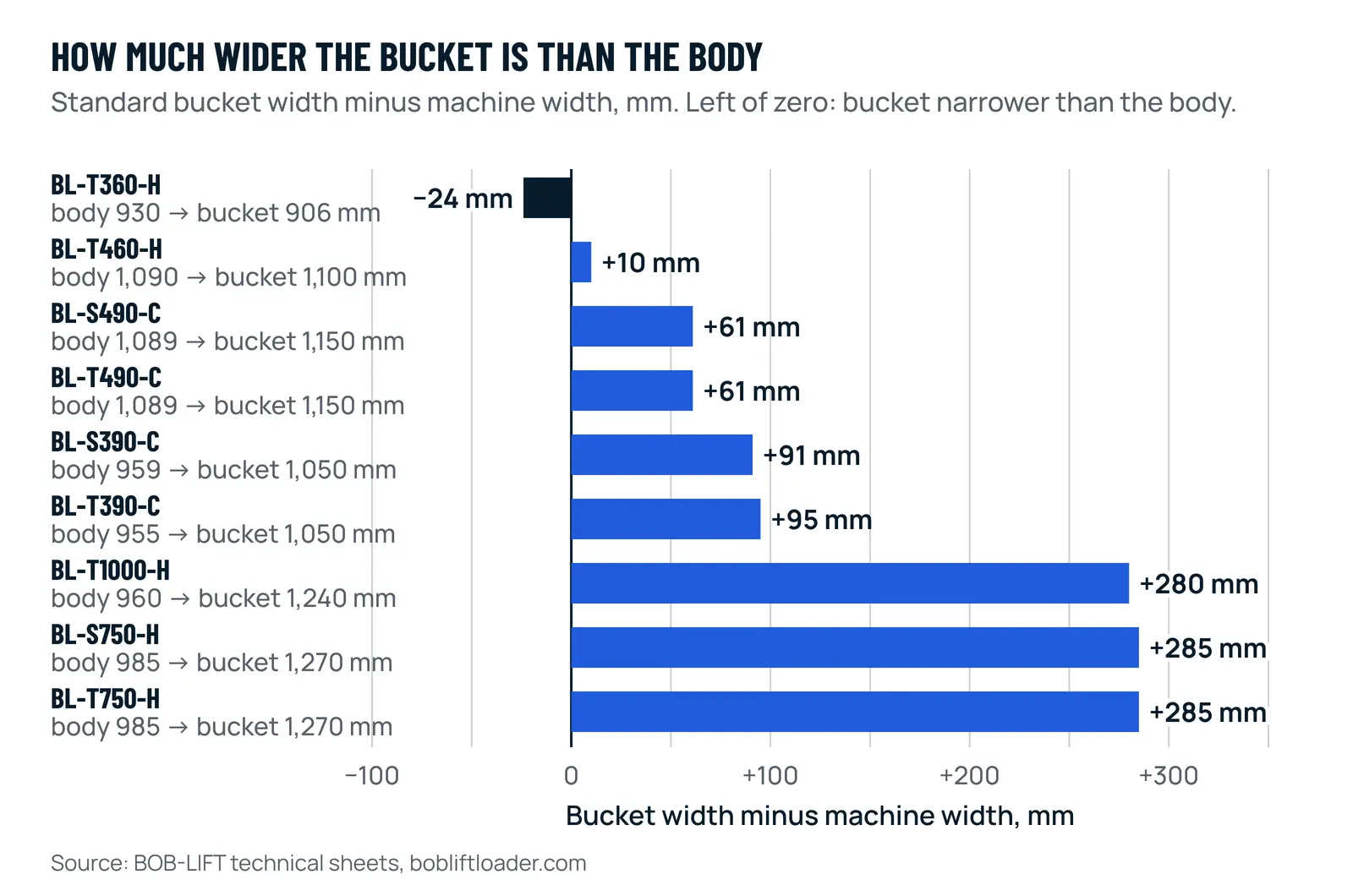

Spread evenly, 285 mm is about 143 mm past the body on each side. That has two effects:
- It covers a wider strip. A wider bucket levels a wider strip on each pass: 1,240–1,270 mm on the 750 and 1000 models.
- It sets your access width. With the bucket fitted, the bucket, not the body, has to clear the gate. The BL-T360-H is the only model whose width with the bucket on is still its 930 mm body.

The bucket comes off the quick-attach plate, so the bare machine can pass where the bucket will not. The width checker on our mini skid steer loaders page shows which models fit your opening.
Skid steer bucket types: 4-in-1, grapple, high-dump and mixing
Besides the standard bucket, our attachment list has five bucket-type tools: the 4-in-1 bucket, grapple bucket, hydraulic grapple, high-dump bucket and mixing bucket.
| Bucket type | What it is for | Suggested for |
|---|---|---|
| Standard bucket | Digging, loading and carrying loose material | Fitted to every model; capacity and width as in the first table |
| 4-in-1 bucket | Dig, grab, level and doze | Renovation and indoor work; farms, greenhouses and barns |
| Grapple bucket | Rubble, logs and awkward loads | Renovation and indoor work; yards and warehouses |
| Hydraulic grapple | Straw, branches and loose debris | Gardens and landscaping; farms, greenhouses and barns |
| High-dump bucket | Tip loads into tall trucks and hoppers | Loading tall trucks and hoppers |
| Mixing bucket | Mix and pour in one attachment | Small batches mixed and poured on site |
Standard bucket. This is the bucket listed in each loader’s specifications, and the one our capacity and width figures describe. It suits loose soil, sand, gravel and spoil.
4-in-1 bucket. The 4-in-1 skid steer bucket has a front section that opens and closes on a hinge. Open, it can doze and level; closed, it digs and loads. Clamped, it grabs objects a plain bucket would push away. Choose it if one bucket has to do most jobs on a site.
Grapple bucket. A grapple bucket for a skid steer is a bucket with a clamp above it. The clamp holds rubble, logs and odd-shaped loads in place while you drive.
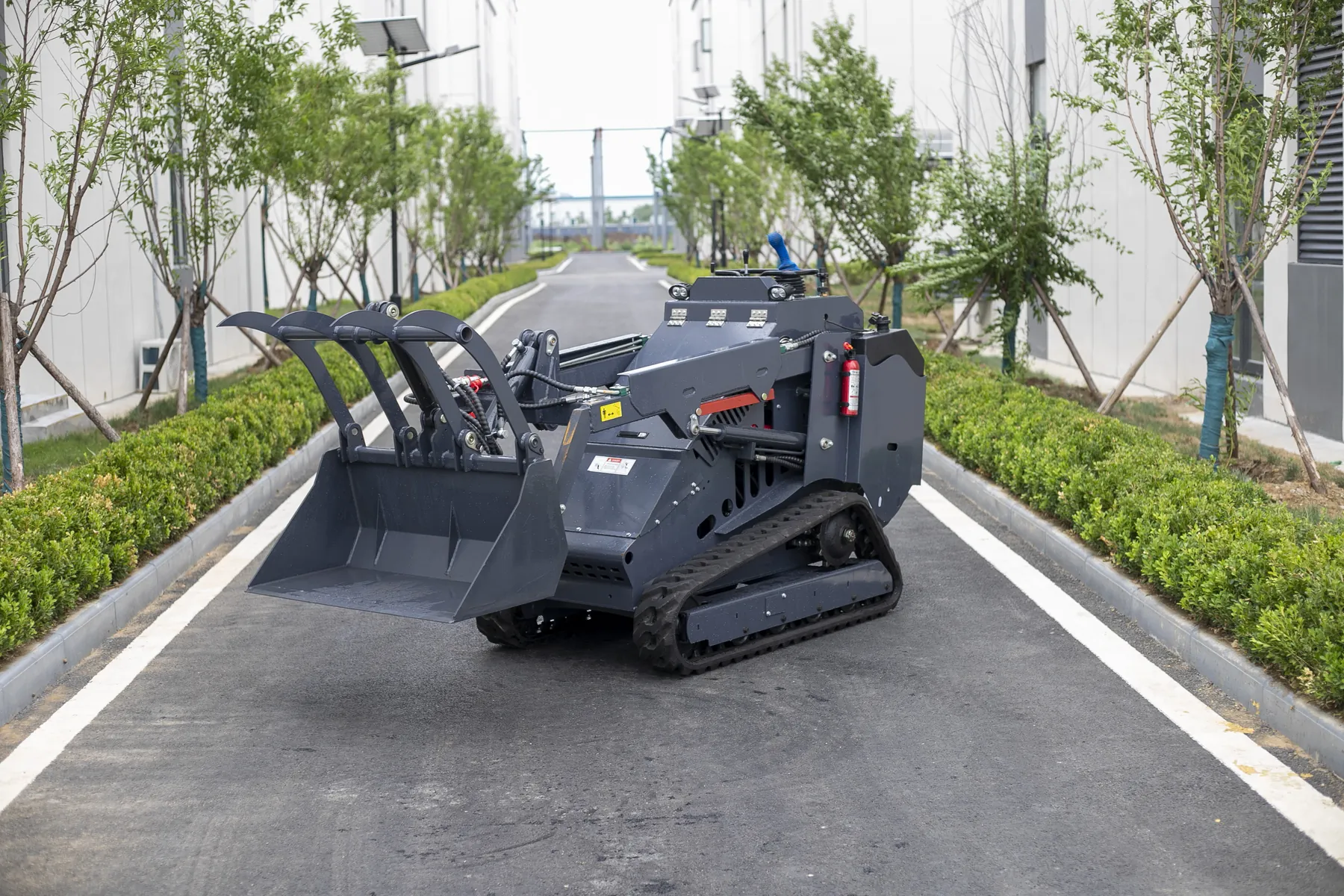
Hydraulic grapple. Our attachment list gives its use as straw, branches and loose debris. Choose it for bulky, loose loads rather than soil or gravel.
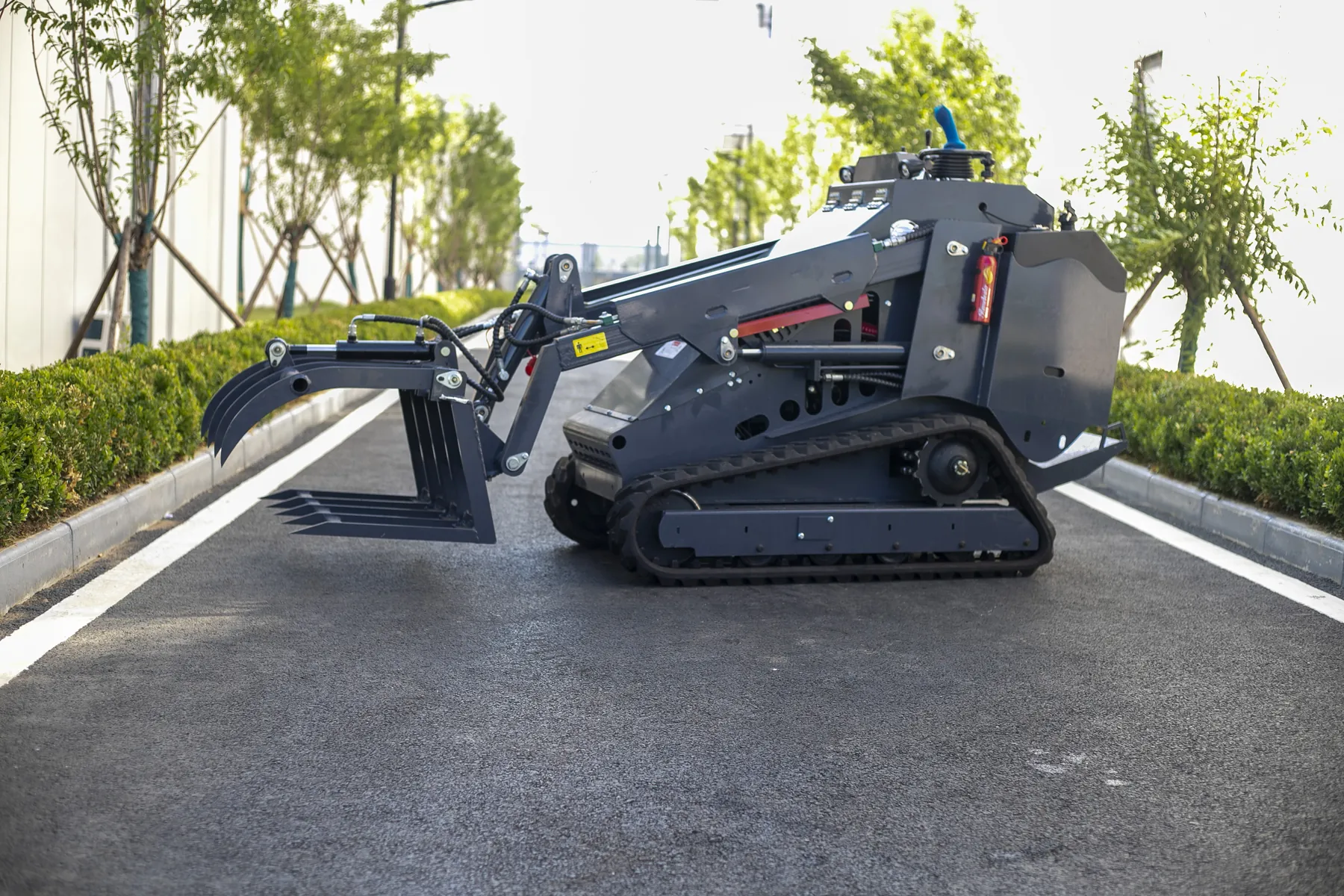
High-dump bucket. Our loaders’ published maximum dumping heights run from 1,340 mm (52.8 in) on the BL-T360-H and BL-T460-H to 1,826 mm (71.9 in) on the BL-T750-H. A high-dump bucket is for loads that must tip higher, into tall trucks and hoppers.
Mixing bucket. It mixes a small batch, such as concrete, and pours it in one attachment. Concrete is the heaviest material in this guide, so check the full load against your loader’s rated load, as shown above.
The 4-in-1 bucket, both grapples and the mixing bucket have moving parts, so they run from the loader’s auxiliary hydraulic lines. Hydraulic flow differs from model to model, so not every bucket suits every loader. We confirm the match when we quote. Our guide to all 26 mini skid steer attachments covers the other tools on the list.
How many bucket loads to move a tonne
A tonne (2,205 lb) of dry sand takes about 5 loads in a 0.15 m³ bucket and about 7 in a 0.1 m³ bucket. The rule: loads = 1,000 kg ÷ the load per trip. The load per trip is the level-full weight, or the rated load if that is lower. Round up, because a part-load still means a trip.
| Loader (bucket, rated load) | Dirt, loose dry | Sand, dry | Gravel, wet |
|---|---|---|---|
| BL-T390-C, BL-S390-C, BL-S490-C, BL-T490-C (0.1 m³, 250–260 kg) | 9 | 7 | 5 |
| BL-T360-H (0.15 m³, 200 kg) | 6 | 5 (capped at 200 kg) | 5 (capped at 200 kg) |
| BL-T460-H (0.15 m³, 300 kg) | 6 | 5 | 4 |
| BL-T750-H, BL-S750-H (0.15 m³, 400–410 kg) | 6 | 5 | 4 |
| BL-T1000-H (0.19 m³, 500 kg) | 5 | 4 | 3 |
Loads per tonne, level-full bucket, rounded up. Densities from Engineering ToolBox.
Worked example: 2 tonnes of dry sand.
- Seated 390 or 490 model (0.1 m³): 2,000 ÷ 156 = 12.8, so 13 loads.
- BL-T360-H: the full bucket (233 kg) is over its 200 kg rating, so carry 200 kg a time: 2,000 ÷ 200 = 10 loads.
- BL-T460-H, BL-T750-H or BL-S750-H: 2,000 ÷ 233 = 8.6, so 9 loads.
- BL-T1000-H: 2,000 ÷ 295 = 6.8, so 7 loads.
Per tonne of dry sand, the BL-T360-H needs the same 5 loads as the BL-T460-H, but the gap shows on bigger jobs (10 against 9 loads for 2 tonnes) and with wet gravel (5 against 4 per tonne). And the 750 models carry no more sand per load than the BL-T460-H, because all three fill the same 0.15 m³ bucket. Their 400–410 kg ratings leave more of the rated load for attachments heavier than the standard bucket.
Bucket care and wear
Our buckets are formed from manganese steel plate and welded before they go to paint, as shown in the factory steps on our loaders page. Every loader’s technical sheet lists the bucket material as manganese steel. Check the edges and the mounting before each shift.
- Cutting edge. Look along the front edge for wear, bends, chips and cracks.
- Teeth, if your bucket has them. Check that each tooth is present and secure. Replace a broken one before it falls into the load.
- Welds and corners. Look for cracks at the side plates, the corners and where the back of the bucket meets the mounting frame.
- Quick-attach plate and pins. Make sure the locking levers or pins are fully engaged on both sides before you lift. Clear soil from the plate before you fit the next tool, so the bucket seats flat.
- Hoses and couplers on powered buckets. For a 4-in-1 bucket, grapple or mixing bucket, check the hoses for rubbing and leaks. Keep the dust caps on the couplers when no tool is connected.
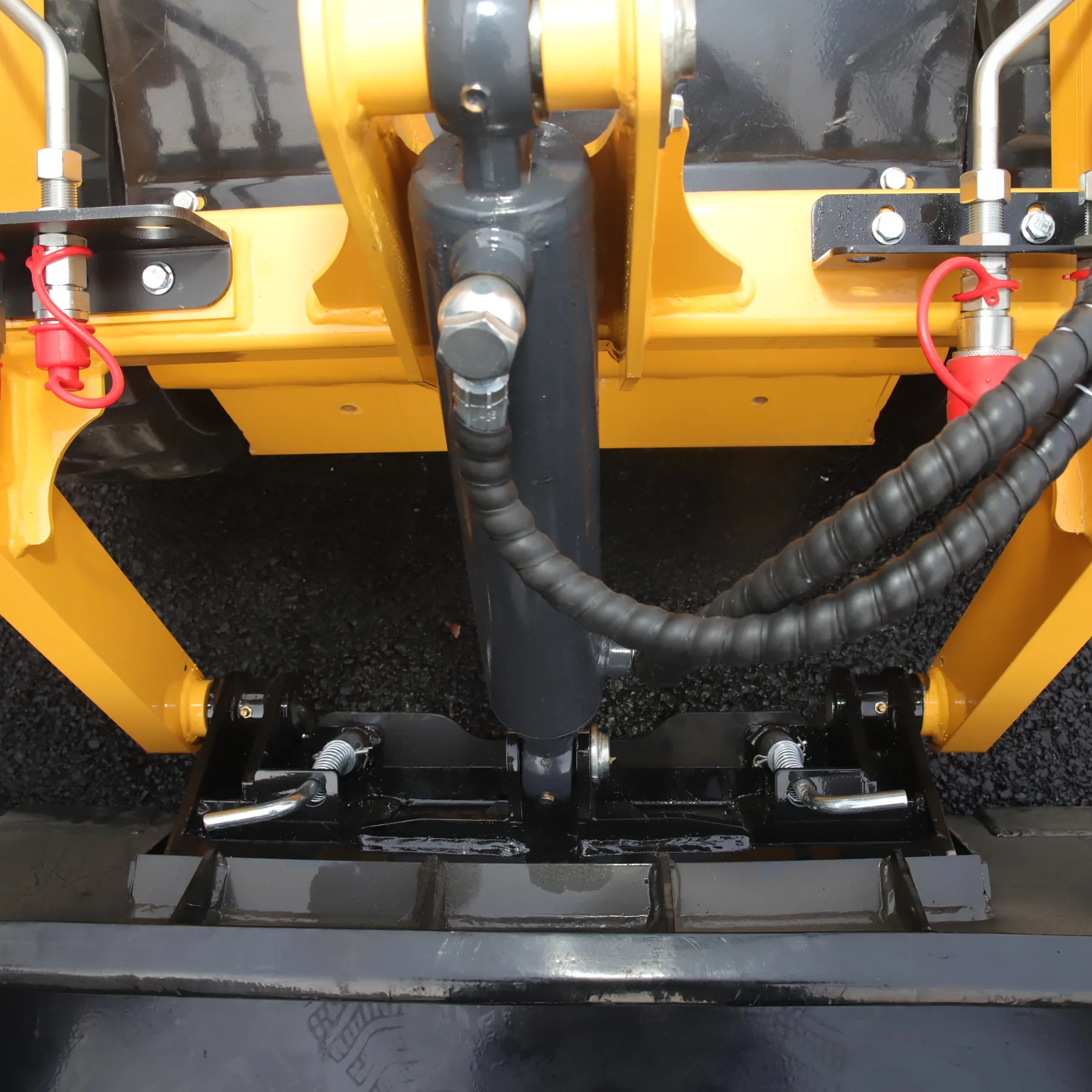
For greasing and inspection intervals, ask our team for your model’s guidance. For original wear parts, quote your model and serial number with a photo of the part.
Frequently asked questions
How much does a mini skid steer bucket hold?
On our range, 0.1 m³ (3.5 ft³, about 0.13 yd³), 0.15 m³ (5.3 ft³, about 0.20 yd³) or 0.19 m³ (6.7 ft³, about 0.25 yd³). The four seated models take 0.1 m³; the BL-T360-H, BL-T460-H, BL-T750-H and BL-S750-H take 0.15 m³; and the BL-T1000-H takes 0.19 m³.
What size bucket do I need?
Check two things. First, width: the loader with its bucket must clear your narrowest opening, and on our range the bucket is 906 to 1,270 mm wide. Second, weight: multiply the bucket capacity by your material’s density and compare the result with the rated load. With sand or gravel, the BL-T360-H reaches its 200 kg rating before the bucket is full. The BL-T460-H reaches its 300 kg exactly with a level-full bucket of wet gravel; the other seven stay under their ratings.
How many bucket loads make a cubic yard?
One cubic yard is 0.765 m³. That takes 8 level-full loads in a 0.1 m³ bucket, 6 in a 0.15 m³ bucket and 5 in the 0.19 m³ bucket, rounded up. On the BL-T360-H, dense material changes this: a cubic yard of wet gravel weighs about 1,530 kg, so at 200 kg a load it takes 8 loads.
Can I fit a bigger bucket to a mini skid steer?
Only for light material, and ask us first. With soil, sand and gravel, a larger bucket reaches the rated load sooner, and on the BL-T360-H the standard 0.15 m³ bucket already goes over the 200 kg rating with dry sand. A wider bucket also changes the width your gate has to clear. Attachments are set per order, and we check each one against your model when we quote.
Do BOB-LIFT buckets fit other brands of skid steer?
Not always. Mini loader quick-attach plates are not all the same size, so a bucket from one maker may not fit another maker’s machine. Our buckets and attachments are matched to the loader’s hydraulics when we quote. Check any other machine’s plate with its own maker. Our attachments guide explains the coupling standards.
Choosing your bucket
Start with the material you move most and the narrowest opening on your route. Then check the rated load against the full-bucket weights above, and choose a 4-in-1 or grapple bucket if loose loading is not the whole job. Compare all nine models on our mini skid steer loaders page, or tell our team your material and opening, and we will match the loader and bucket when we quote.