


Key takeaways
- Five of our nine mini skid steers are stand-on (-H), four are seated (-C). The last letter of the model name tells you which.
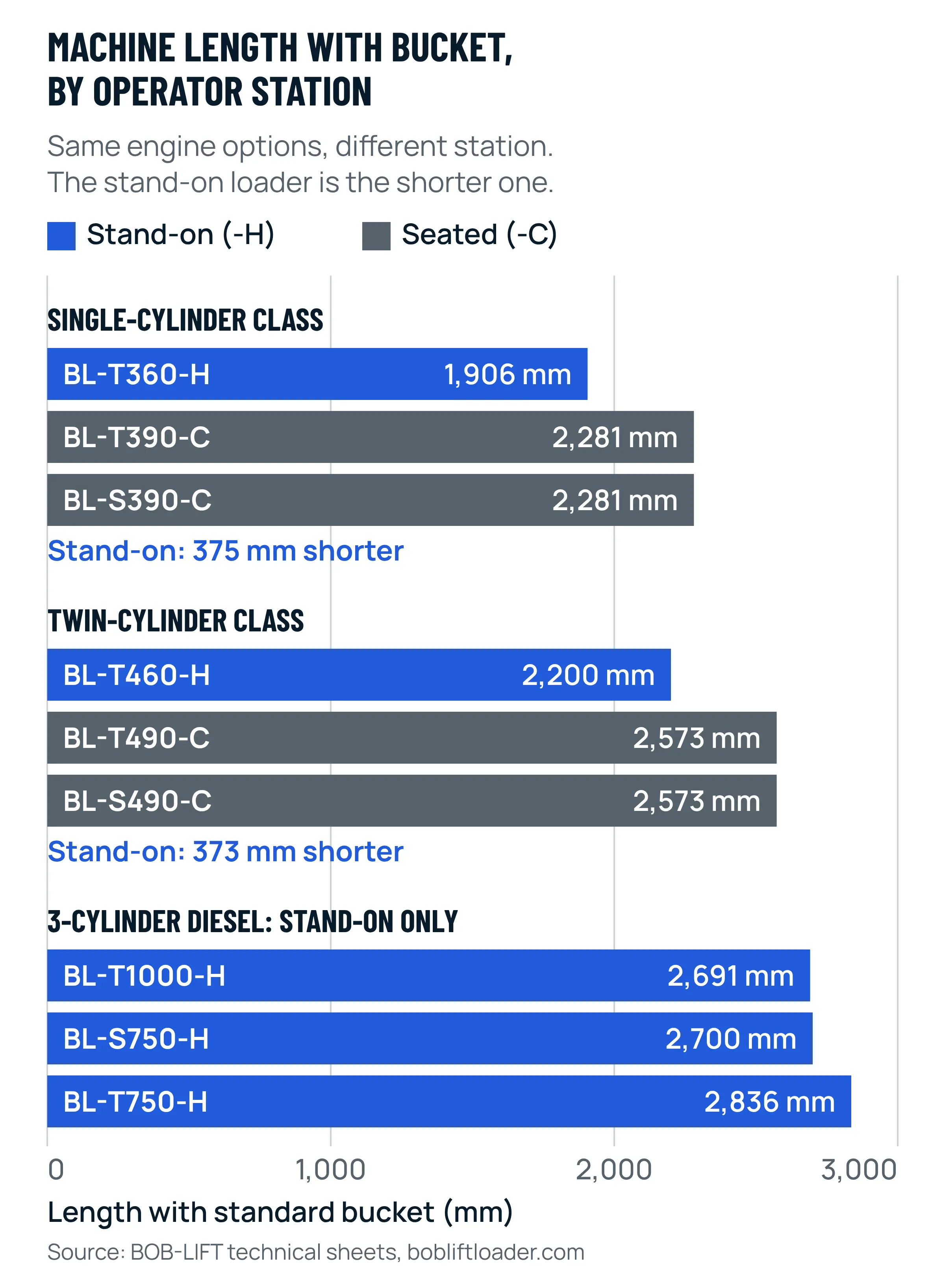
- In the same engine class, the stand-on loader is about 375 mm (14.8 in) shorter: the BL-T360-H is 1,906 mm long with its bucket, the seated BL-T390-C and BL-S390-C are 2,281 mm.
- Stand-on models cover a wider load range, rated 200–500 kg (441–1,102 lb). The seated models are rated 250–260 kg.
- In the small sizes, seated models sit higher off the ground: 193–220 mm on the 390 and 490 seated loaders, against 160 mm on the stand-on BL-T360-H and BL-T460-H. The larger stand-on 750 and 1000 models have 200–240 mm.
- Choose by the shape of the working day: stand-on for short, stop-start jobs and tight access; seated for long, steady shifts in one place.
What is the difference between a stand-on and a seated mini skid steer?
The difference is where the operator rides: on a platform at the back (five of our nine loaders) or in a seat (four). On a stand-on mini skid steer you stand on a platform at the back of the machine and drive with the controls in front of you. On a seated model you sit in a seat with the controls at hand. Both steer the same way, by running the left and right tracks or wheels at different speeds, and both take attachments on a quick-attach plate.
That one choice changes the shape of the machine. On our sheets, the stand-on loader is the shorter machine in each engine class. A seated loader is longer, but it lets the operator stay on the machine for hours in comfort.
Our model names spell this out. In BL-T360-H, T means tracked, 360 is the size class and H (hand) means you drive it standing up. In BL-S390-C, S means wheeled and C (cabin) means you drive it seated. The size class number is not the rated load.
| Operator station | Models | Rated load |
|---|---|---|
| Stand-on (-H) | BL-T360-H, BL-T460-H, BL-T750-H, BL-S750-H, BL-T1000-H | 200–500 kg |
| Seated (-C) | BL-S390-C, BL-T390-C, BL-S490-C, BL-T490-C | 250–260 kg |
You can see all nine side by side in the mini skid steer loader range.
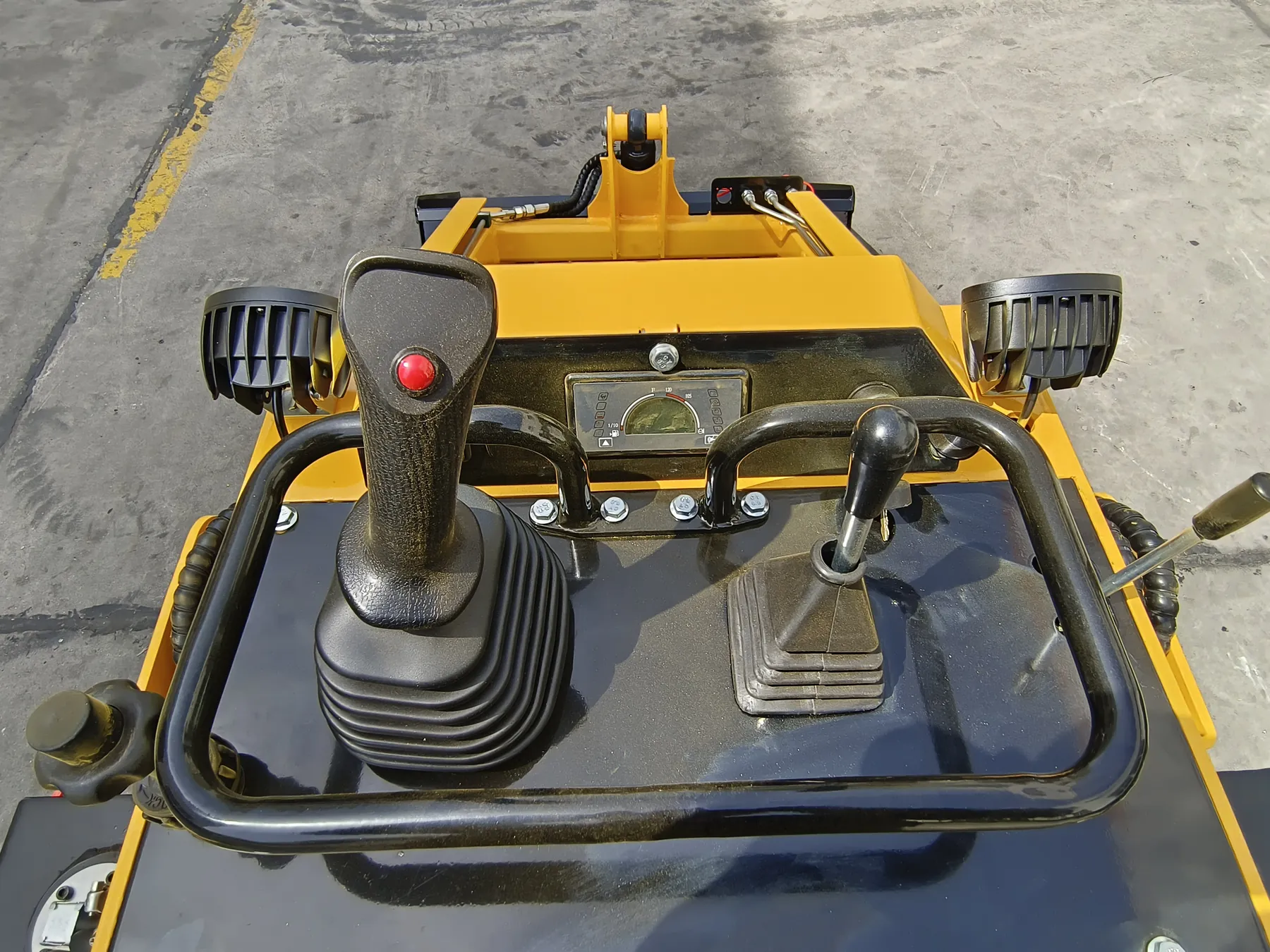
Where a stand-on loader wins
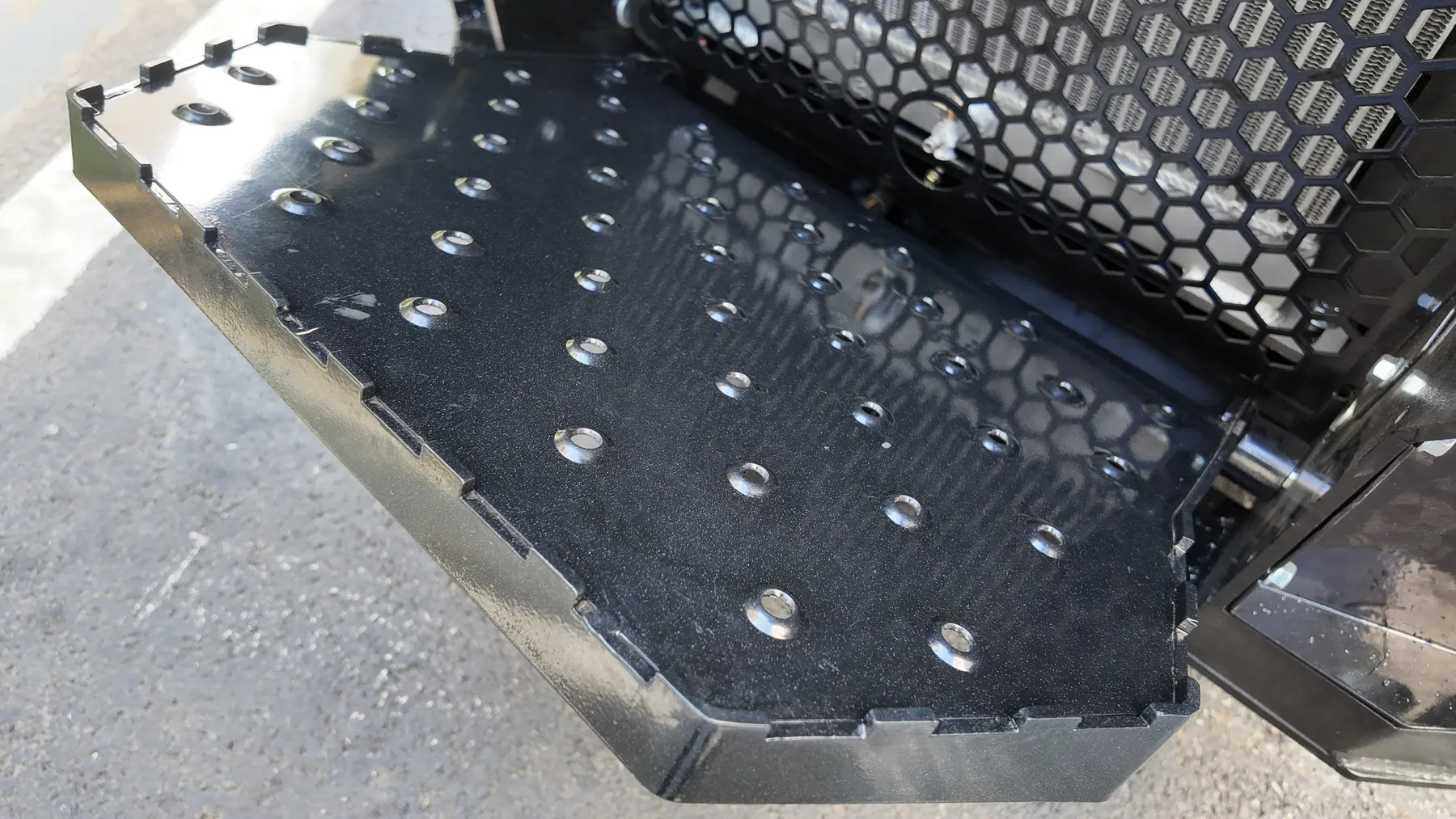
A stand-on loader wins on stop-start work and on length: in the same engine class it is 373–375 mm shorter than the seated model, and only stand-on models are rated above 260 kg. You step on and off a platform, with no seat to climb out of. On a job with many stops, such as opening gates, moving pallets one at a time or checking levels, that adds up over a day.
Compare loaders with the same engine options:
- Single-cylinder class (KOOP 7.6 kW / Rato 7.9 kW / Briggs & Stratton 9.92 kW): BL-T360-H stand-on, 1,906 mm (75.0 in) long with the bucket. BL-T390-C and BL-S390-C seated, 2,281 mm (89.8 in). The stand-on model is 375 mm shorter.
- Twin-cylinder class (15–17 kW options): BL-T460-H stand-on, 2,200 mm. BL-T490-C and BL-S490-C seated, 2,573 mm. The stand-on model is 373 mm shorter.
A shorter machine turns in a smaller space, fits a shorter trailer and is easier to place in a lift, a corridor or a greenhouse bay.

Stand-on models also take bigger buckets for their class: 0.15 m³ on the BL-T360-H and BL-T460-H, against 0.1 m³ on every seated model. The BL-T460-H is rated 300 kg, against 250 kg on the seated 490s. The BL-T360-H is the exception on rated load: it gives up some (200 kg against 250–260 kg on the seated 390s) for its short, narrow body. The two smallest stand-on loaders, the BL-T360-H and the BL-T460-H, are also the only models in our range with a published gradeability of 30°; every other model is 25°.
All of our heavier loaders are stand-on. The BL-T750-H (410 kg rated), BL-S750-H (400 kg) and BL-T1000-H (500 kg) run three-cylinder diesel engines, and there is no seated version of them.
Check the view as well as the size. On a skid steer the lift arms run alongside the operator (Wikipedia, “Skid-steer loader”, retrieved 2026-10-12), so they limit the view to the sides. On a stand-on machine the operator’s eye line is set by the operator’s own height on the platform rather than by a seat. Before you choose, ask for photos taken from the platform or the seat of the model you are considering, and check that you can see the bucket edge and the ground in front of it.
Where a seated loader wins
A seated loader wins on long, steady shifts, and in the 390/490 sizes it has more ground clearance: 193–220 mm against 160 mm. If one person will spend most of the day loading, levelling or moving material without stepping off, a seat is less tiring than standing. That is the main reason to choose one. Against the stand-on loaders of the same size, the spec sheets show three differences.
- Ground clearance. The seated BL-T390-C has 219 mm (8.6 in) and the BL-T490-C 220 mm, against 160 mm (6.3 in) on the stand-on BL-T360-H and BL-T460-H. More clearance helps over ruts, kerbs and rough ground.
- Working height. The tracked BL-T390-C reaches 1,830 mm (72.0 in), against 1,650 mm on the BL-T360-H, and dumps at 1,404 mm against 1,340 mm. The wheeled BL-S390-C is lower, at 1,600 mm working height.
- Choice of wheels or tracks at small size. In the seated range, each size comes on rubber tracks (BL-T390-C, BL-T490-C) or rubber tyres (BL-S390-C, BL-S490-C).
The BL-S390-C is our highest-rated seated model at 260 kg, on a 650 kg (1,433 lb) machine that is 959 mm wide.
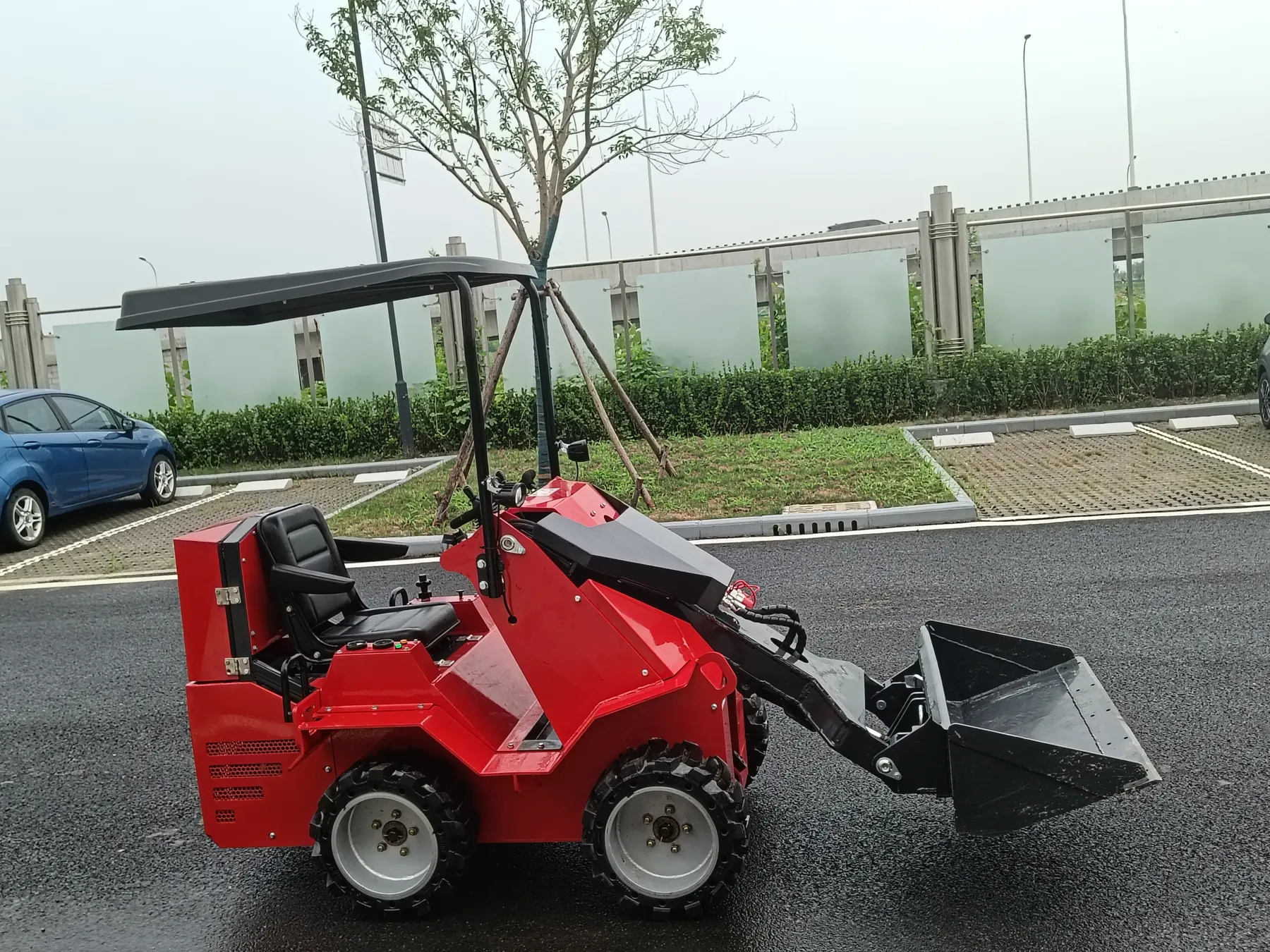
How do walk-behind, stand-on and seated loaders compare?
There are three ways to drive a mini skid steer, and we build two of them: 5 stand-on models and 4 seated models, and no walk-behind machines. A walk-behind machine has no platform; the operator walks behind on foot and steers from a rear control panel. A stand-on machine adds a platform so the operator rides. A seated machine adds a seat.
The terms “walk-behind”, “stand-behind”, “stand-up” and “stand-on” are often used loosely, because the operator is at the back in each case. Every BOB-LIFT -H model has a platform, and on the BL-S750-H it is a retractable footplate.
| Walk-behind | Stand-on | Seated | |
|---|---|---|---|
| Where the operator is | On foot behind the machine | On a rear platform | In a seat |
| Getting on and off | No getting on | Step on, step off | Climb in and out |
| Travel speed | Limited to walking pace | Machine travel speed (5–6 km/h on our models) | Machine travel speed (5–6 km/h on our models) |
| Best for | Very small jobs, short distances | Stop-start work, tight access | Long shifts in one area |
| BOB-LIFT models | None | 5 (-H) | 4 (-C) |
Side-by-side: BOB-LIFT stand-on and seated models
Stand-on models span 200–500 kg rated load and 650–1,250 kg machine weight; the seated models span 250–260 kg and 650–950 kg. The table below lists the published figures for all nine loaders. The seated group is tightly grouped around 250 kg rated load.
| Model | Station | Running gear | Rated load | Lifting capacity | Width | Weight | Engine power | Gradeability |
|---|---|---|---|---|---|---|---|---|
| BL-T360-H | Stand-on | Tracks | 200 kg | 300 kg | 930 mm | 650 kg | 7.6 kW | 30° |
| BL-T460-H | Stand-on | Tracks | 300 kg | 375 kg | 1,090 mm | 730 kg | 16.8 kW | 30° |
| BL-T750-H | Stand-on | Tracks | 410 kg | 525 kg | 985 mm | 1,100 kg | 18.6 kW | 25° |
| BL-S750-H | Stand-on | Wheels | 400 kg | 450 kg | 985 mm | 1,000 kg | 18.6 kW | 25° |
| BL-T1000-H | Stand-on | Tracks | 500 kg | 650 kg | 960 mm | 1,250 kg | 17.8 kW | 25° |
| BL-S390-C | Seated | Tyres | 260 kg | 290 kg | 959 mm | 650 kg | 7.6 kW | 25° |
| BL-T390-C | Seated | Tracks | 250 kg | 300 kg | 955 mm | 750 kg | 7.6 kW | 25° |
| BL-S490-C | Seated | Tyres | 250 kg | 350 kg | 1,089 mm | 850 kg | 16.8 kW | 25° |
| BL-T490-C | Seated | Tracks | 250 kg | 350 kg | 1,089 mm | 950 kg | 16.8 kW | 25° |
Engine power is the figure listed for each model; the actual output depends on the engine brand you choose. The 750 and 1000 models are diesel only; the others take petrol or diesel.


If you need more than 260 kg rated load, the choice is already made: only stand-on models go higher. If width is your limit, see our guide to mini skid steer weight and dimensions, which covers bucket widths and gates.
Which jobs suit each?
Stand-on suits stop-start jobs, tight access and loads over 260 kg; seated suits long shifts in one place. Here is how that maps to the six kinds of work on our loaders page. Match running gear to the ground after that.
- Renovation and indoor work. Doorways, lifts and corridors favour the short, narrow BL-T360-H: 930 mm wide, with a 906 mm bucket that stays inside the body width.
- Gardens and landscaping. Many gates and many stops favour stand-on. For a full day of levelling on one plot, a tracked seated BL-T390-C is the comfortable choice. Our landscaping application page starts with the BL-T360-H, BL-S390-C and BL-T390-C.
- Farms, greenhouses and barns. Narrow aisles and frequent stops for doors and feeding suit stand-on models.
- Streets and public spaces. On paving and asphalt, choose tyres: the stand-on BL-S750-H or the seated BL-S390-C and BL-S490-C.
- Yards and warehouses. Pallet work is stop-start. The wheeled stand-on BL-S750-H is rated 400 kg.
- Alongside bigger machines. Footings, trenches and backfill need capacity; the stand-on BL-T1000-H is rated 500 kg. Our site preparation page lists the BL-T1000-H, BL-S750-H, BL-T490-C and BL-S390-C.
Tracks or tyres is a separate decision. Our tracked vs wheeled mini skid steer guide explains it, and our mini skid steer attachments guide covers the tools both stations can run.
Safety and operator training
Both stations carry the same main risks, rollover and crushing, and the same limits apply: the rated load (200–500 kg) and the published gradeability (25° or 30°). The rules are the same for both: read the operator’s manual, stay within the rated load and the published gradeability, and keep the bucket low when you travel.
Rollover and being crushed by moving parts are the most common causes of serious injury and death with skid steer loaders (Wikipedia, “Skid-steer loader”, retrieved 2026-10-12). Most of the basics follow from that:
- Never stand or reach under raised lift arms, and keep other people clear of the machine.
- Lower the arms to the ground and stop the engine before you step off the platform or climb out of the seat.
- On slopes, keep the heavy end uphill and avoid turning across the slope. Our published gradeability (25° or 30°) is a machine limit, not a working target.
- On a stand-on machine, keep both feet on the platform and both hands on the controls while moving. On a seated machine, use any restraint that is fitted.
In Great Britain, employers must make sure everyone who uses work equipment has had adequate training, under regulation 9 of PUWER (HSE, Training and competence). The same HSE guidance on mobile work equipment covers rollover protection and restraints. Other countries have their own rules; check the ones that apply to your site.
Frequently asked questions
Is a stand-on skid steer safe?
Yes, when it is used within its limits by a trained operator. The main risks are the same as for any skid steer: rollover and being caught by moving parts. Lower the arms and stop the engine before stepping off, and never work under raised arms.
Can a stand-on loader climb slopes?
Our stand-on loaders have a published gradeability of 25° to 30°. The BL-T360-H and BL-T460-H are rated 30°; the BL-T750-H, BL-S750-H and BL-T1000-H are rated 25°. These are machine limits. Work well below them, and follow the manual.
Is a walk-behind skid steer the same as a stand-on?
Not quite. A walk-behind has no platform, so the operator walks. A stand-on has a platform, so the operator rides at the machine’s travel speed. The terms are often mixed up. All five BOB-LIFT -H models are stand-on.
Which is better for a beginner, stand-on or seated?
Neither station is easier by design; both use joystick controls. Choose by the work. A seated machine suits long sessions in one place. A stand-on machine suits short jobs with frequent stops. Training matters more than the station.
Choosing your operator station
Start with how the machine will spend its day. Many short jobs, tight access or loads above 260 kg point to a stand-on loader. Long shifts in one place point to a seated loader. Then pick tracks or tyres for your ground.
Compare all nine models in our mini skid steer loader range, or tell our team about your site: the narrowest opening, the heaviest load and the ground. We will suggest a model and configuration.