


Key takeaways
- A mini skid steer and a compact track loader steer the same way. The differences are size, where the operator stands and how much the machine is rated to carry.
- Our nine mini skid steers weigh 650–1,250 kg (1,433–2,756 lb), measure 930–1,090 mm across the body and are rated for 200–500 kg.
- Two skid steer attachment-coupling standards, SAE J2513 and ISO 24410, cover machines up to 4,500 kg operating mass, and both say narrow skid steers may not fit their dimensions.
- Under ISO 14397-1:2007, rated operating capacity is 50% of tipping load for wheeled loaders and 35% for crawler (tracked) loaders, or the lift capacity to full height if that is lower.
- Choose the mini loader for openings around 1 m (the BL-T360-H is 930 mm with its bucket fitted), indoor work, lawns and light transport. Choose a bigger loader for bulk earthmoving and loads above 500 kg.
What separates a mini skid steer from a compact track loader?
Both are skid steers: they turn by running the left and right tracks or wheels at different speeds, so they spin on the spot. Our mini loaders weigh 650–1,250 kg and are rated for 200–500 kg; the attachment standards for full-size skid steers were written for machines up to 4,500 kg. What separates the two is size, operator position and rated load class. A mini skid steer is a smaller tool carrier, often driven standing up. A compact track loader is a larger skid steer on tracks, with a bigger rated operating capacity.
The names overlap, which causes confusion. Wikipedia’s skid-steer loader entry notes that a skid steer fitted with tracks instead of wheels is known as a compact track loader. At the small end, SAE’s former recommended practice J2752 for compact tool carriers covered machines “sometimes called” mini-loaders, mini skid-steer loaders or compact utility loaders. That document, cancelled in 2021, excluded machines with a seated operator.
So a tracked mini skid steer, also sold as a “mini track loader”, is a tracked skid steer too. It sits in a lighter class than the machines most people mean when they say “compact track loader”.
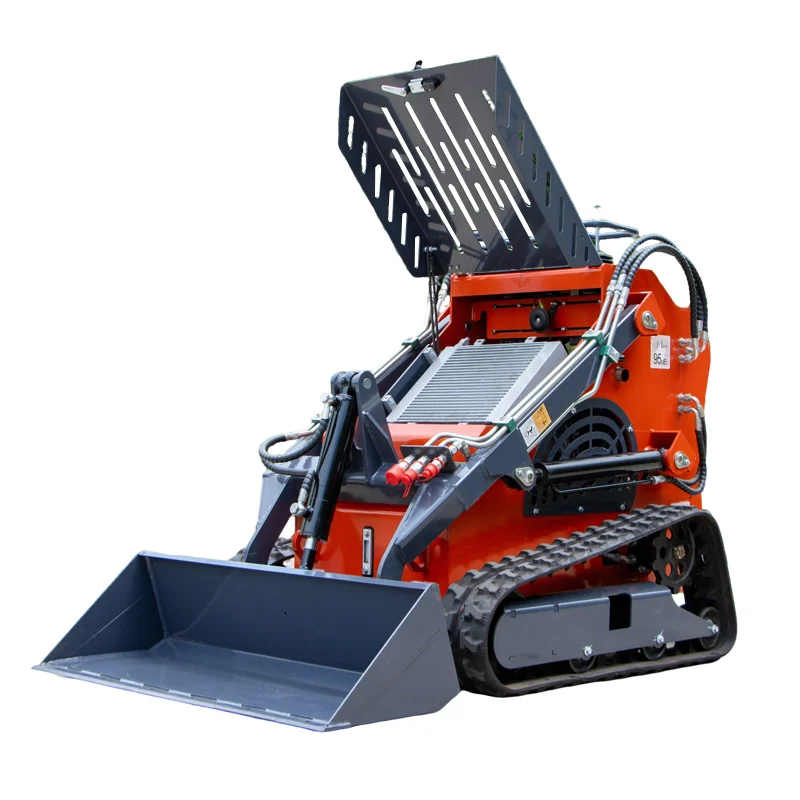
Our model names state the running gear and operator position. BL-T360-H is a tracked, 360-class loader you drive standing up. “T” means tracked, “S” wheeled, “H” stand-on and “C” seated. The size-class number is not the rated load.
Size classes at a glance
Our mini range weighs 650–1,250 kg (1,433–2,756 lb). The attachment-coupling standards SAE J2513 and ISO 24410 were written for skid steers up to 4,500 kg (9,921 lb) operating mass. Our heaviest loader, the BL-T1000-H, weighs 1,250 kg, about 28% of that ceiling.

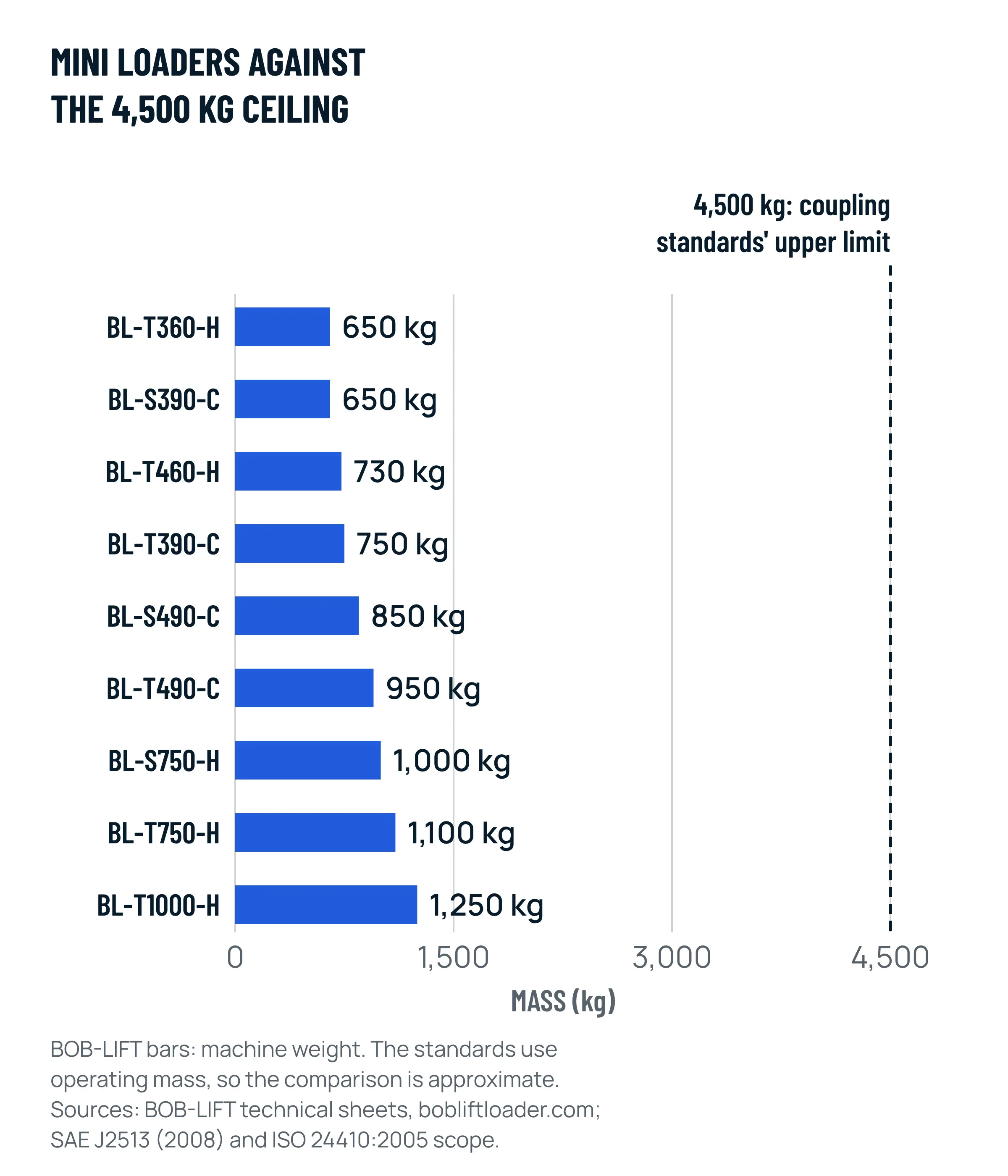
We have not found a neutral source that sets one agreed table of widths and rated loads for “compact track loaders”. Spec sheets vary by maker and by the standard they rate to. The table below therefore sets our published figures against what the standards themselves say.
| Measure | BOB-LIFT mini skid steers (9 models) | Standard skid steer and compact track loader class |
|---|---|---|
| Weight | 650–1,250 kg machine weight | Coupling standards cover up to 4,500 kg operating mass (SAE J2513, ISO 24410) |
| Body width | 930–1,090 mm; 6 of 9 under 1,000 mm | Not fixed by the standards; check each machine’s sheet |
| Rated load | 200–500 kg (441–1,102 lb) | Rated by ISO 14397-1 or SAE J818; check which one the sheet uses |
| Bucket | 0.1–0.19 m³ | Varies by machine |
| Operator | 5 stand-on, 4 seated | Varies by machine |
| Attachment plate | Quick-attach plate with auxiliary hydraulics; fit confirmed at quote | Standard coupler dimensions; the standards note narrow skid steers may not comply |
Both coupling standards have since been cancelled, but their scope statements still mark the boundary. SAE J2513 and ISO 24410:2005 set standard plate dimensions for skid steers of up to 4,500 kg, and each adds that a narrow machine may be too narrow to comply. In practice, mini and full-size attachments are not automatically interchangeable.
How rated operating capacity is set
Rated operating capacity is a fixed share of the load that would tip the machine forward at full reach. ISO 14397-1:2007 sets that share at 0.50 for wheeled loaders and 0.35 for crawler (tracked) loaders. If the lift capacity to maximum height is lower, that lower figure becomes the rating.
Clause 5.1 of ISO 14397-1:2007 gives the rule: rated operating capacity, N, equals k multiplied by the tipping load at maximum reach, or the lift capacity to maximum height, whichever is less. Table 1 gives the stability factor k for machines with a bucket or forks:
- Wheeled machines: k = 0.50. “Normal operation” here means a hard, substantially smooth and level surface, with a maximum travel speed of 15 km/h.
- Crawler machines: k = 0.35. Here normal operation includes softer ground that is less smooth and level, with a maximum travel speed of 6 km/h.


The figures above come from the 2007 text; the standard was amended in 2019. The BSI listing for ISO 14397-1 shows the current edition and summarises its scope. It applies to buckets and forks, and some other attachments may need restricted operation. SAE’s counterpart is SAE J818, Rated Operating Load for Loaders, which applies to wheel and crawler loaders and also takes hydraulic lift capacity and tipping capacity into account.
This has two practical effects when you compare machines:
- Tracks and wheels are rated differently. Under the ISO factors, a tracked and a wheeled loader with the same tipping load get different ratings. Compare like with like.
- Check the standard on the sheet. A rated load means little without knowing how it was set. Ask which standard and factor were used.
Our technical sheets list two figures: a rated load and a higher lifting capacity. On the BL-T1000-H, for example, they are 500 kg and 650 kg. Plan everyday work around the rated load.
When the mini loader is the better tool
The mini loader wins wherever access, ground or transport limits the job. Six of our nine loaders are under 1,000 mm (39.4 in) wide across the body. All nine weigh 1,250 kg (2,756 lb) or less. Check your trailer’s rating and local towing rules before you plan transport.
- Narrow gates and side passages. The BL-T360-H is 930 mm wide and stays under a metre with its 906 mm bucket fitted. On the other eight models the bucket is wider than the body.
- Indoor and renovation work. Inside buildings, basements and car parks, a mini loader can break out floors, clear rubble and move materials where a full-size loader can’t go.
- Lawns and soft ground. Rubber tracks spread the weight on lawns and soft soil. Our tracked models are rated for 25–30° gradeability; work within the published limit. See our landscaping application.
- Quick on and off. On the five stand-on models the operator steps on and off the platform, which suits jobs with frequent stops.
- Transport and shipping. With the standard bucket and no attachments, a 20GP container takes about 6 of most models, or about 4 BL-T1000-H (see machines per container). With steel loading racks, a 40HQ takes about 30 BL-T360-H.
Our guide to mini skid steer weight and dimensions covers gates, trailers and lift heights in detail.
When you need the bigger machine
You need a bigger loader when single loads pass 500 kg, when you move material in bulk, or when you load tall trucks. Our range tops out at a 500 kg rated load, a 0.19 m³ bucket and a 1,826 mm maximum dumping height. Larger skid steers and compact track loaders exist for heavier work than that.
| Limit | Highest figure in our range | Model |
|---|---|---|
| Rated load | 500 kg (1,102 lb) | BL-T1000-H |
| Bucket capacity | 0.19 m³ | BL-T1000-H |
| Maximum dumping height | 1,826 mm | BL-T750-H |
| Working height | 2,230 mm | BL-T750-H |
| Engine power | 18.6 kW | BL-T750-H, BL-S750-H |
| Travel speed | 6 km/h | Most models (5 km/h on BL-T390-C, BL-T490-C, BL-T750-H) |
In practice, consider a bigger machine for:
- Bulk earthmoving. Cutting a site to level or stripping topsoil over a large area takes many trips with a 0.1–0.19 m³ bucket.
- Long pushes and heavy dozing. Pushing force depends on traction, and traction depends on weight; a 650–1,250 kg loader has less of both to work with.
- Loading high-sided trucks. Our highest dumping height is 1,826 mm. A high-dump bucket helps on smaller trucks and hoppers.
- Carrying over distance. At 5–6 km/h, a loader is slow over long runs. A dumper does this better; our wheeled mini dumpers carry 1 to 5 tonnes on firm ground and site roads.
Running one alongside bigger machines
On small sites, a 650–1,250 kg mini loader works best next to bigger machines, not instead of them. On our loaders page, “Alongside bigger machines” lists its jobs on small sites: corners, indoor and finishing work, footings, trenches, backfill and clean-up. The suggested attachments are a backhoe, a trencher and a trench filler.
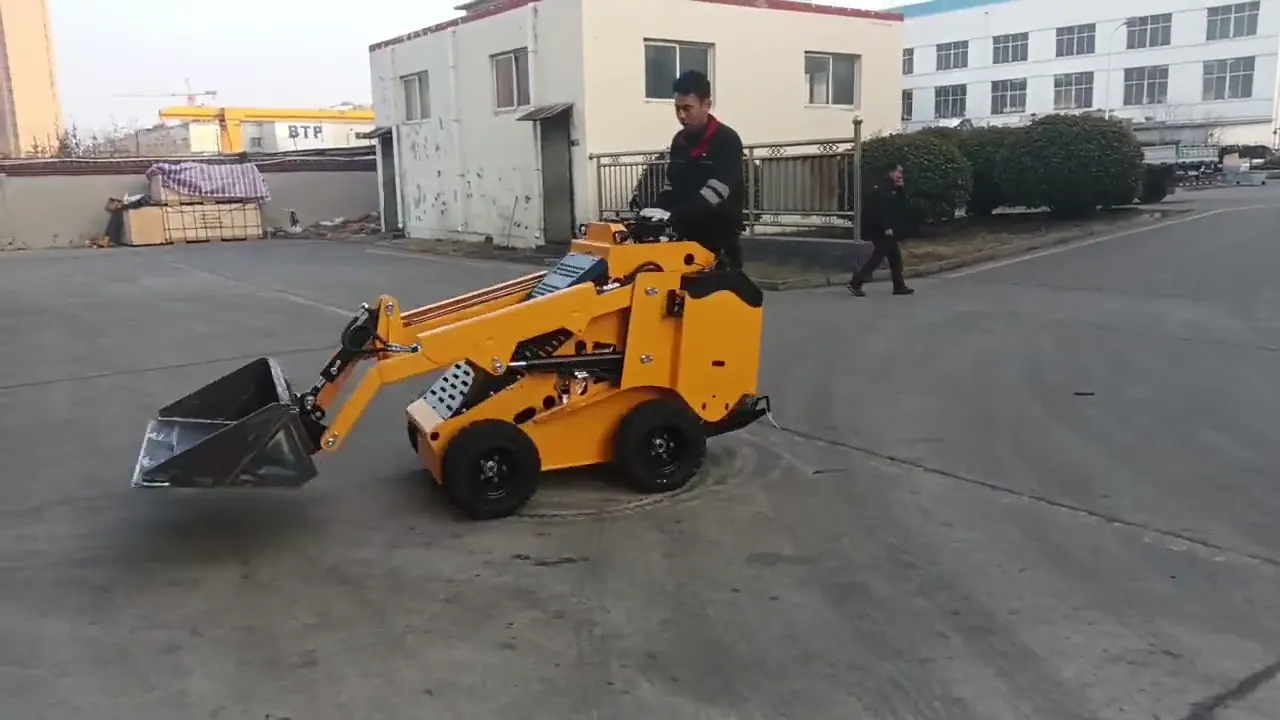
A typical split on a small site looks like this:
- The big machine does the bulk dig and heavy loading in the open.
- The mini loader works the corners, the back garden behind the house and the inside of the building. It cuts service trenches, backfills them with the trench filler and cleans up.
- A narrow dumper carries spoil out through the gate. Our tracked BL-T500-HD is 880 mm wide and carries 500 kg over soft ground and narrow paths.
Our guide to mini skid steer attachments covers all 26 tools and how to match them to a loader.
Frequently asked questions
Is a compact track loader the same as a skid steer?
A compact track loader is a skid steer on tracks instead of wheels. It steers the same way, by driving the two sides at different speeds.
Is a mini track loader a compact track loader?
Not quite. It is a tracked skid steer, but in a lighter class. Our tracked minis weigh 650–1,250 kg and are rated for 200–500 kg.
Why do tracked and wheeled loaders use different rating factors?
Under ISO 14397-1:2007, crawler loaders use a stability factor of 0.35 of tipping load, against 0.50 for wheeled loaders, because the standard’s normal operation for crawlers includes softer, rougher ground. These factors explain how the standard works; they are not a way to recalculate our published rated loads.
Can a mini skid steer use full-size skid steer attachments?
Not as a rule; see the coupling standards above. Full-size tools may also need more hydraulic flow and rated load than a mini gives. We confirm which attachments suit your model when we quote.
Which loader should I choose for slopes?
Our tracked stand-on BL-T360-H and BL-T460-H are rated for 30°; the other seven models for 25°. Always work within the machine’s published limit and the operator’s manual. For the operator position, see our comparison of stand-on vs seated mini skid steers.
Finding the right size
Start with the narrowest opening, the heaviest load and the ground. If your heaviest load is under 500 kg and your narrowest opening is wider than the loader with its tool fitted (930 mm on the BL-T360-H, up to 1,270 mm across the range), a mini loader will usually do it with less access work. Compare all nine models on our mini skid steer loaders page, then contact our team with photos of your site.