


Key takeaways
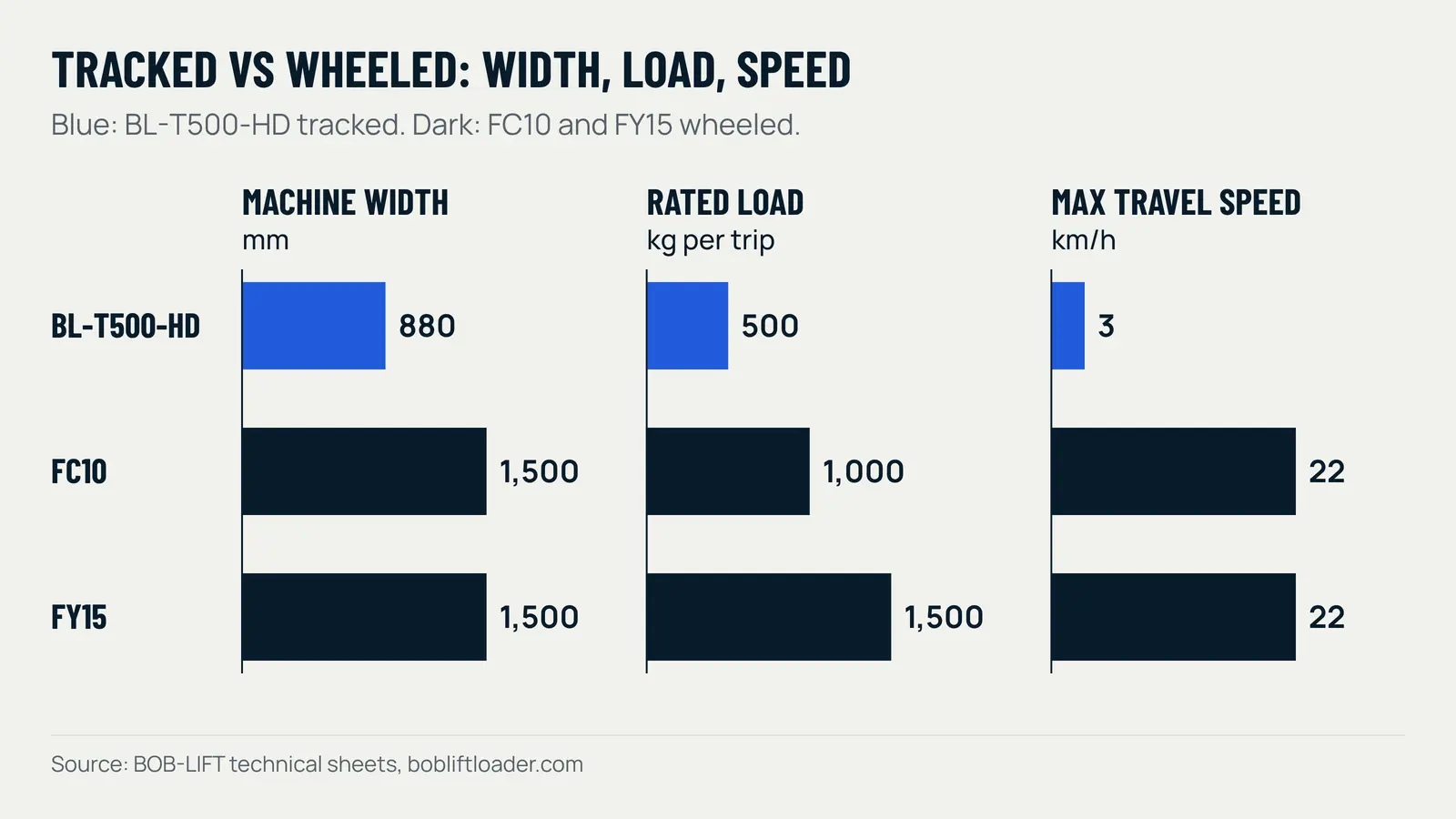
- The tracked BL-T500-HD is 880 mm (34.6 in) wide and carries 500 kg (1,102 lb). The wheeled dumpers are 1,500–1,800 mm (59–71 in) wide and carry 1,000–5,000 kg.
- Tracks go where wheels can’t: garden paths, side passages, lawns and soft soil. Wheels win on firm ground and site roads.
- Speed decides long hauls: 3 km/h on tracks against 22–28 km/h on wheels. At top speed, 100 m takes 2 minutes on tracks and about 16 seconds on wheels.
- Slope ratings are close: 20° for the tracked dumper, 21° theoretical maximum for the wheeled models, with 18° or less recommended in work.
- The tracked hopper tips hydraulically through 100°. The wheeled hoppers front-tip to 45°, with a swivel side-tip hopper as an option.
Tracked or wheeled: the short answer
Choose a tracked dumper when the route is narrower than about 1.5 m (59 in) or the ground is soft. Choose a wheeled mini dumper when the route is wide and firm and you need to move 1 tonne or more per trip. The Support page puts it this way: the tracked BL-T500-HD is 880 mm wide and carries 500 kg over soft ground and narrow paths. The wheeled dumpers are 1,500 to 1,800 mm wide and carry 1 to 5 tonnes on firm ground and site roads.
The table puts the tracked dumper next to the two smallest wheeled models, the FC10 and FY15. They are the wheeled models closest to it in size and load.
| Specification | BL-T500-HD (tracked) | FC10 (wheeled) | FY15 (wheeled) |
|---|---|---|---|
| Rated load | 500 kg | 1,000 kg | 1,500 kg |
| Hopper capacity | 0.2 m³ | 0.8 m³ | 0.8 m³ |
| Width | 880 mm | 1,500 mm | 1,500 mm |
| Length | 1,570 mm (2,050 mm with footplate) | 2,600 mm | 2,600 mm |
| Machine weight | 410 kg | 800 kg | 830 kg |
| Max travel speed | 3 km/h | 22 km/h | 22 km/h |
| Gradeability | 20° | 21° theoretical max. (18° or less in work) | 21° theoretical max. (18° or less in work) |
| Ground clearance | 100 mm | 200 mm | 200 mm |
| Tipping | Hydraulic, 100° | Mechanical front tip, 45° (hydraulic optional) | Hydraulic front tip, 45° |
| Engine | 4.8 kW petrol | 12.1 kW diesel | 13.2 kW diesel |
| Running gear | Rubber tracks | Tyres, 7.50-16 front, 5.50-16 rear | Tyres, 7.50-16 front, 5.50-16 rear |
Source: BOB-LIFT technical sheets for the BL-T500-HD tracked mini dumper, the FC10 1 ton wheeled mini dumper and the FY15 1.5 ton wheeled mini dumper.
Access width and footprint
The BL-T500-HD is 880 mm (34.6 in) wide, which is 620 mm narrower than the FC10 and FY15 at 1,500 mm (59.1 in). The other wheeled models are wider again: 1,600 mm for the FY20-2, 1,700 mm for the FY20-4, FY30, FY40 and FJZ30, and 1,800 mm (70.9 in) for the FY50.
Width is usually the first number that rules a machine in or out. Measure the narrowest point between the delivery spot and the work: a gate, a side passage between two houses, a doorway or a gap between trees. If that gap is under 1.5 m, no wheeled dumper in our range will pass, and the tracked dumper is the only option.
Length matters too, because a long machine needs more room to turn at the end of a passage. The tracked dumper is 1,570 mm (61.8 in) long, or 2,050 mm (80.7 in) with its footplate down. The FC10 and FY15 are 2,600 mm (102.4 in) long, and the 4×4 models run to 4,200–4,500 mm.
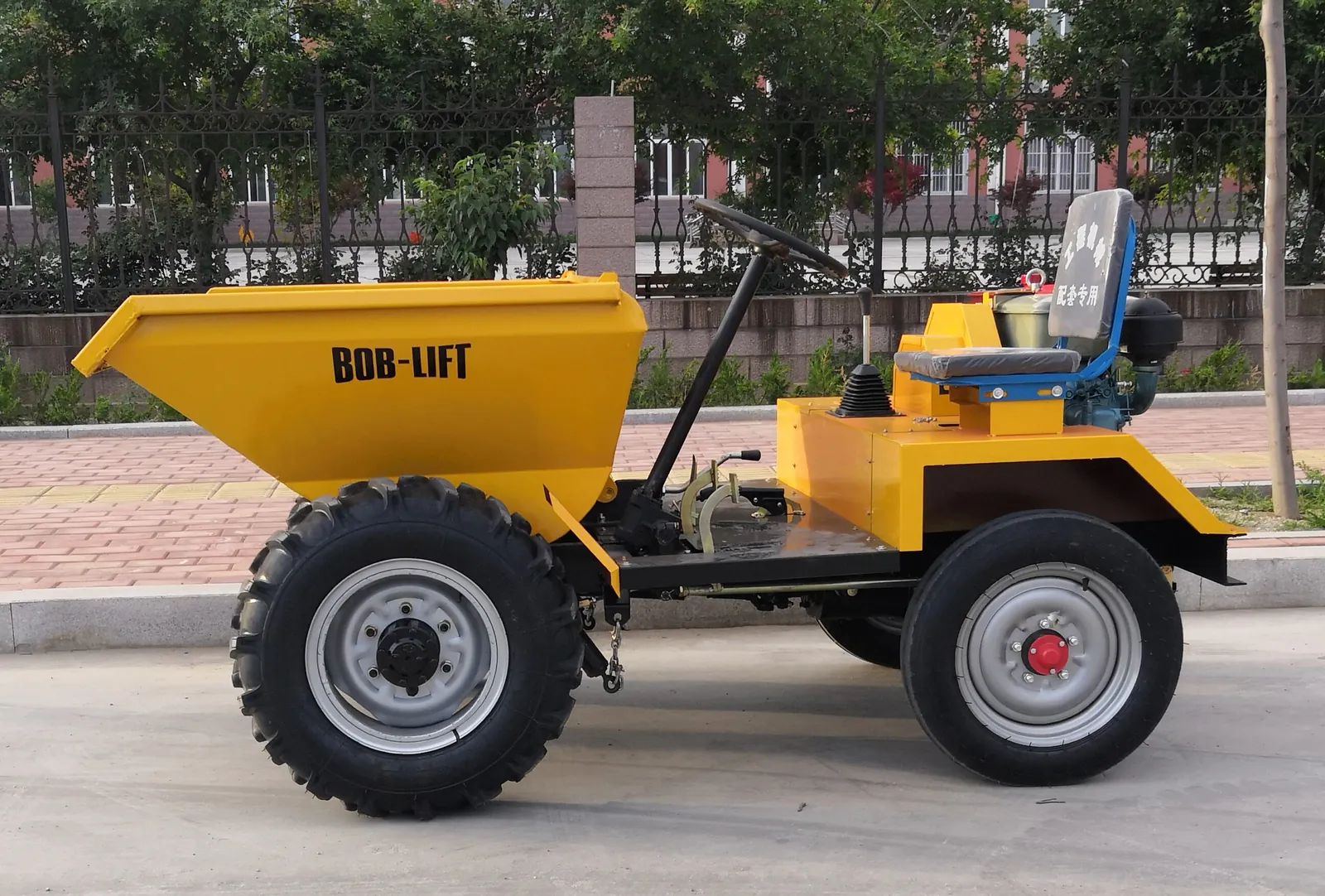
Weight follows width. The tracked dumper weighs 410 kg (904 lb), about half the FC10’s 800 kg (1,764 lb). A lighter machine is easier to move on a trailer and puts less load on paving and lawns. For more on how the gate, the load and the ground narrow the choice, see the gardens and homesteads applications page.

Payload per trip and trips per day
The tracked dumper is rated for 500 kg (1,102 lb) per trip, the FC10 for 1,000 kg (2,205 lb) and the FY15 for 1,500 kg (3,307 lb). Larger wheeled models go up to 5,000 kg (11,023 lb) on the FY50. To compare them on a real job, work out trips first, then time.
Step 1: load per trip
A dumper carries whichever limit it reaches first: its rated load or its hopper volume. To find the volume limit, multiply the hopper capacity by the weight of one cubic metre of your material. Your material supplier can give you that figure.
Here is a worked example. Say the material weighs 1,500 kg per m³; this is an example figure, not a measured one.
- BL-T500-HD: 0.2 m³ × 1,500 kg = 300 kg. That is below its 500 kg rating, so volume is the limit: 300 kg per trip.
- FC10: 0.8 m³ × 1,500 kg = 1,200 kg. That is above its 1,000 kg rating, so the rated load is the limit: 1,000 kg per trip.
- FY15: 0.8 m³ × 1,500 kg = 1,200 kg. That is below its 1,500 kg rating, so volume is the limit: 1,200 kg per trip.
Heavier materials push every machine towards its rated load, and lighter ones such as mulch push it towards the volume limit. Either way, fill only to the top edge of the hopper. The UK Health and Safety Executive advises that loads are spread evenly, do not go above the top edge of the skip and do not block the driver’s view (HSE, site dumpers).
Step 2: number of trips
Divide the total by the load per trip. With the example above, moving 6,000 kg takes 20 trips with the BL-T500-HD, 6 trips with the FC10 and 5 trips with the FY15.
Step 3: trips per day
Trips per day are your working minutes divided by the minutes for one cycle. One cycle is loading time, plus travel out, plus tipping, plus travel back. Loading and tipping times depend on your crew and your loader, so time a few real cycles on site before you plan the week. We don’t publish output figures for this reason. The next section shows how much the travel part changes between tracks and wheels.
Speed and distance
The tracked dumper travels at up to 3 km/h (1.9 mph). The FC10, FY15, FY20-2 and FY20-4 reach 22 km/h (13.7 mph), and the FY30, FY40, FY50 and FJZ30 reach 28 km/h (17.4 mph). On a short haul the difference is small. On a long haul it decides the job.
At 3 km/h, a machine covers 50 m a minute, so 100 m takes 2 minutes. At 22 km/h, it covers about 367 m a minute, so the same 100 m takes about 16 seconds. These are top-speed figures from the technical sheets. Loaded travel over rough ground is slower for both, but the ratio stays large.
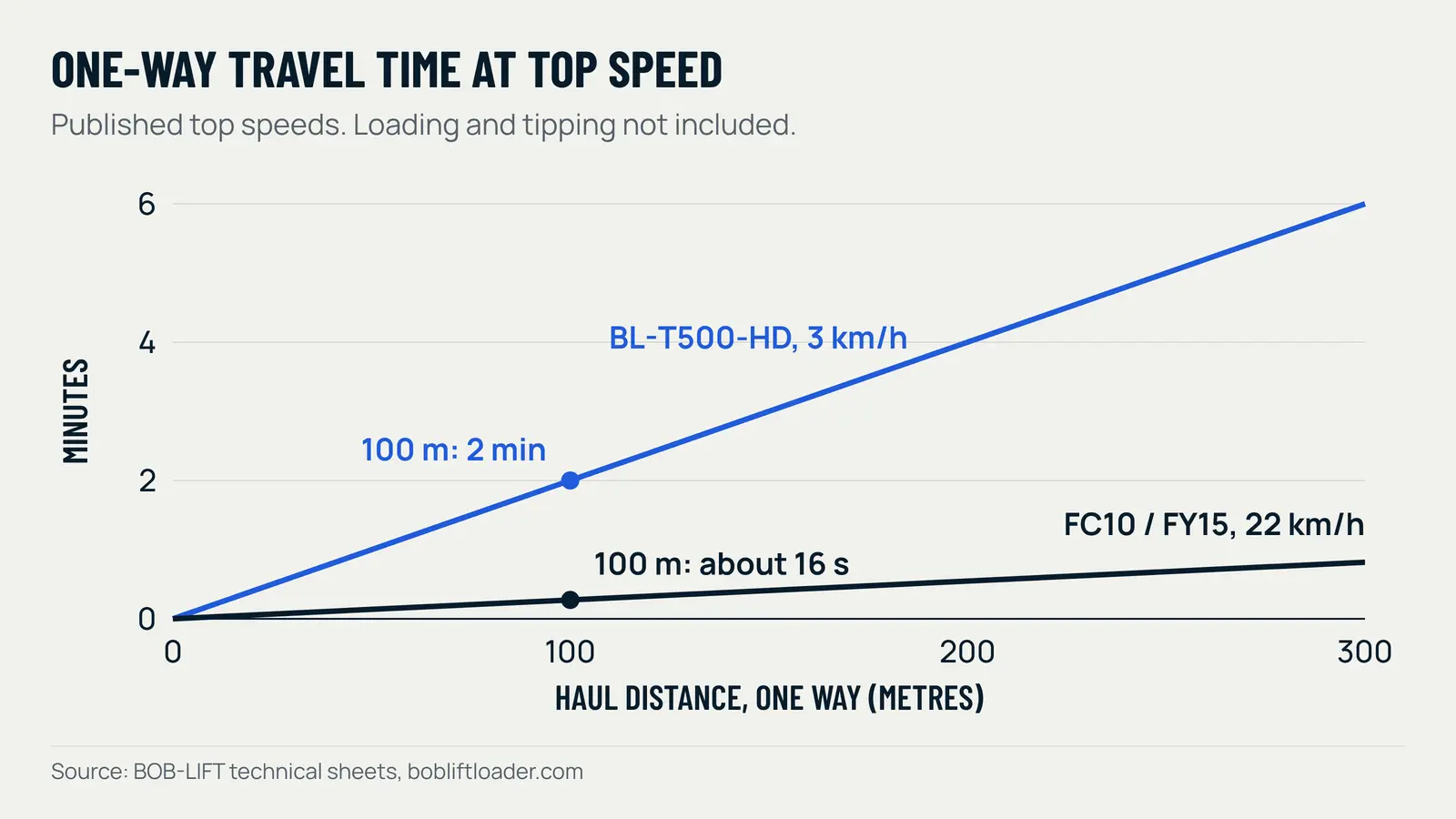

A simple way to use this: if the haul is short, or most of it runs along a narrow path, travel time is a small part of each cycle and the tracked dumper loses little. If the haul is a few hundred metres across a yard or site road, a wheeled dumper does the travelling in a fraction of the time and carries two to three times the load. Our product page puts it the same way: where the route is wider than about 1.5 m and the ground is firm, the FC10 carries twice the load at up to 22 km/h. For heavier site work, the building sites applications page lists the 3–5 tonne wheeled models.
Slopes and ground
The BL-T500-HD is rated for 20° slopes. The wheeled dumpers are rated at 21° theoretical maximum, with 18° or less recommended in work. On paper the two are close; in practice the ground surface makes the bigger difference.
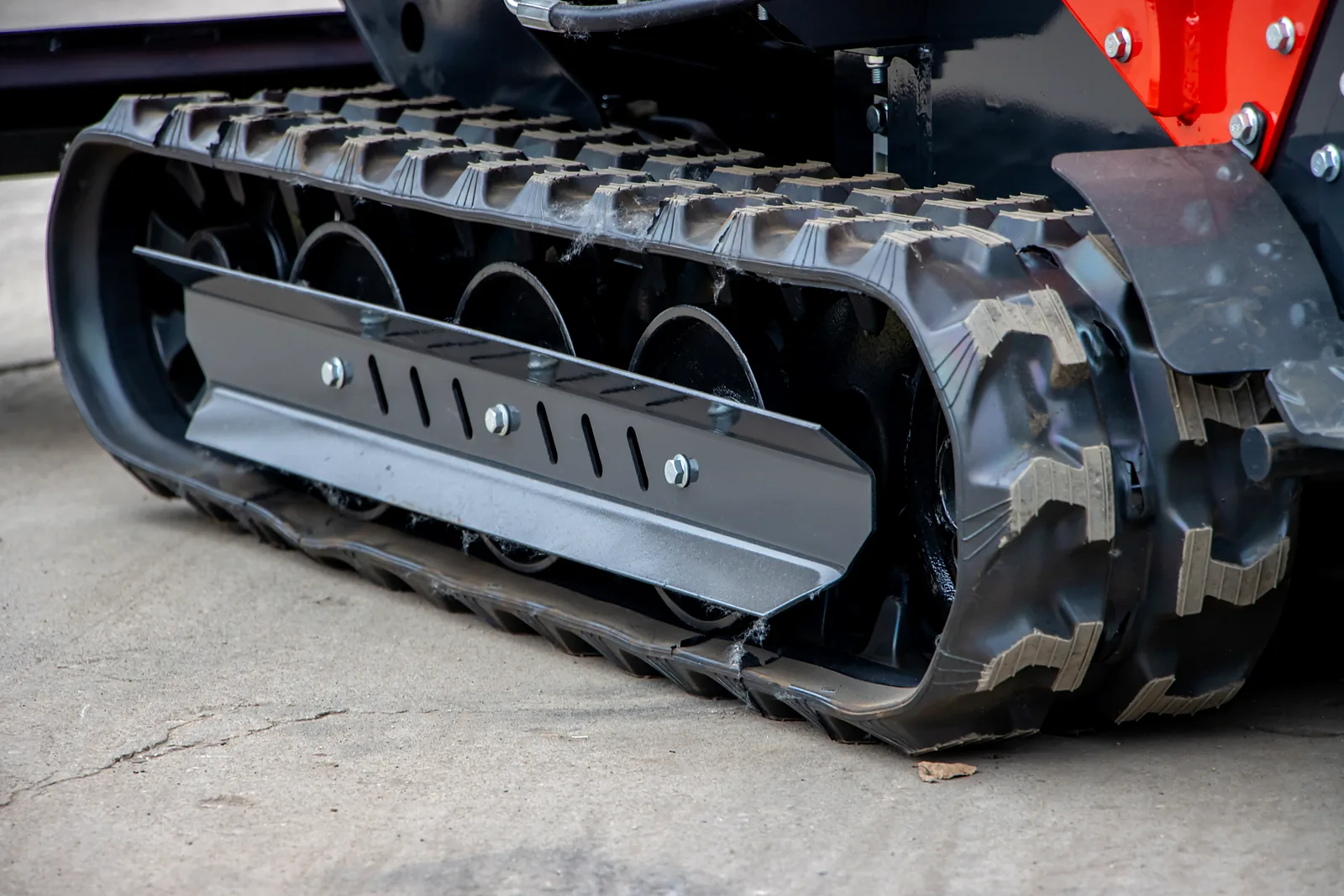
Rubber tracks spread the machine’s weight over a long contact area. As the Wikipedia article on dumpers puts it, dumpers with rubber tracks give a more even distribution of weight than tyres and are used on slick, snowy or muddy surfaces. That is why the tracked dumper suits lawns, soft soil and mud, where a loaded wheel would sink or spin.
Wheels have their own advantage: ground clearance. The FC10 and FY15 have 200 mm (7.9 in) under the chassis, and the FJZ30 has 250 mm. The tracked dumper has 100 mm (3.9 in). On a rutted farm track or over kerbs and rubble, the extra clearance counts. Wheels are also the better choice on concrete, asphalt and paving, where they run faster.
Whichever you choose, treat the slope rating as a limit, not a target. According to HSE, “over 60% of dumper deaths involve the driver being crushed when the vehicle overturns”. HSE advises planning the work so dumpers are used on gradients within their safe working capacity, and checking that capacity with the manufacturer (HSE, site dumpers). As general practice, travel straight up and down slopes, not across them.
Tipping: 100° hydraulic or 45° front tip
The BL-T500-HD tips hydraulically through 100°, so the hopper rotates past upright. All eight wheeled dumpers front-tip to 45°. The FC10 tips mechanically as standard, with hydraulic tipping as an option; the FY models and the FJZ30 tip hydraulically.
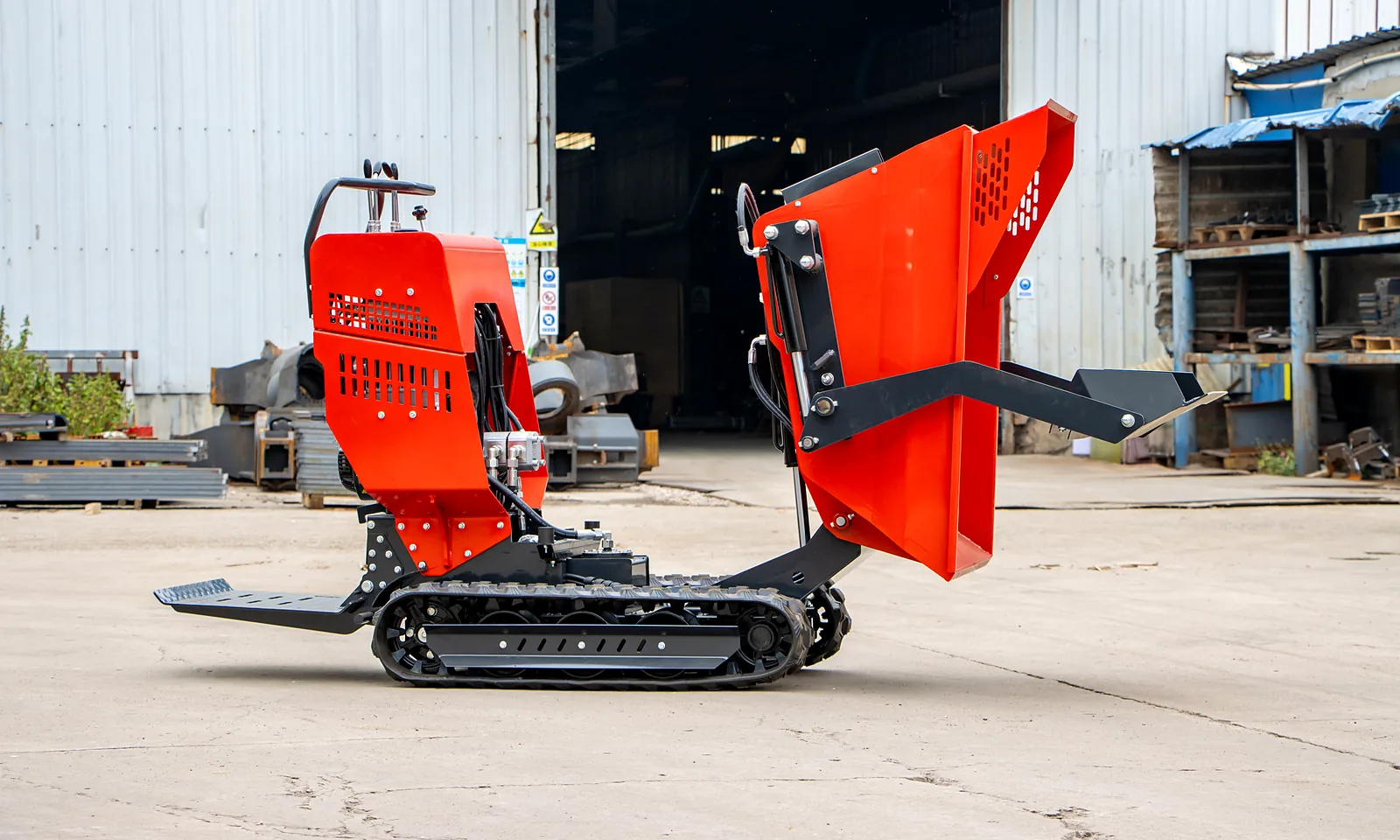
The wheeled models make up for the smaller angle with height: the FC10 and FY15 have a dump height of 1,800 mm (70.9 in), and the FJZ30 reaches 2,700 mm. That height lets a wheeled dumper tip over a low wall or into a skip. The BL-T500-HD’s sheet lists no dump height, so if you need to tip over an edge or into anything raised, ask us before you order.
Side tipping is the other option. A swivel hopper for side tipping is an extra-cost option on every wheeled model. It is useful along trenches and narrow roads, where the dumper can’t turn to face the tip point. The BL-T500-HD’s sheet lists no side-tip option.
Frequently asked questions
Can a tracked dumper go on lawns?
Yes. Rubber tracks spread the load, so the BL-T500-HD can cross lawns, soft soil and mud where a wheeled dumper would rut the ground. Turn gently on grass, because any tracked machine scuffs turf if it spins on the spot.
Is a tracked dumper the same as a power barrow?
Mostly, yes. “Power barrow”, “track barrow”, “mini track dumper” and “crawler dumper” all describe a small engine-driven carrier that replaces the wheelbarrow. Our power barrow guide covers the BL-T500-HD in that role.
Which wheeled dumper should I compare with the tracked one?
Start with the FC10 (1,000 kg) and the FY15 (1,500 kg). They are the narrowest wheeled models at 1,500 mm. If you need more than 1.5 tonnes per trip, our guide to site dumper sizes from 1 to 5 tonnes compares the full wheeled range, and the 4×4 vs 4×2 mini dumper guide explains which models drive all four wheels.
Is the tracked dumper petrol or diesel?
Petrol. The BL-T500-HD has a 4.8 kW single-cylinder petrol engine with electric start, from Rato or Briggs & Stratton. All eight wheeled dumpers run on diesel.
How many tracked dumpers fit in a container?
On steel loading racks, a 20GP takes 10 BL-T500-HD dumpers and a 40HQ takes 24. Without racks, the figures are 7 and 12. The FC10 and FY15 ship at about 6 per 20GP and 12 per 40HQ, taken apart. The Support page lists every model.
Choosing your dumper
Measure the narrowest gap, weigh one trip of your material and walk the route. If the gap is under 1.5 m or the ground is soft, the tracked BL-T500-HD is the fit. If the route is wide and firm and the loads are a tonne or more, start with the FC10 or FY15. You can compare all ten models on the mini dumpers range page, or send our team your measurements and a few photos through the contact page and we will suggest a model.