


Key takeaways
- Choose rubber tracks for lawns, soft soil and slopes; choose rubber tyres for concrete, asphalt and paving.
- BOB-LIFT builds three matched pairs: BL-T390-C / BL-S390-C, BL-T490-C / BL-S490-C and BL-T750-H / BL-S750-H.
- In every pair the tracked loader is 100 kg heavier and tops out at 5 km/h; the wheeled loader reaches 6 km/h.
- All six are published at 25° gradeability, so the slope figure on paper does not separate them. Grip on soft ground does.
- Body width, overall height and hydraulic pressure match closely in each pair. Some lift figures do not, so check the exact sheet.
Tracked vs wheeled skid steer: the short answer
Pick tracks if the loader will spend most of its hours on soft, uneven or sloping ground. Pick tyres if it will work mostly on hard, flat surfaces such as concrete, asphalt and block paving. This is the same advice we give on our Support page, and it holds for all nine loaders in our range.
A skid steer turns by running its left and right side at different speeds, so it pivots on the spot (Wikipedia: Skid-steer loader). That turning action is the reason the choice matters. On grass, a pivoting wheeled machine can dig in and tear the surface. On concrete, a tracked machine scrubs its rubber with every turn.
Ask one question before anything else: where will the loader spend most of its working hours? A machine that crosses a lawn twice a day but loads pallets on concrete all afternoon is a wheeled-loader job.

Three matched pairs: same size class, different running gear
BOB-LIFT sells three size classes in both a tracked and a wheeled version. The model name tells you which is which: T is tracked, S is wheeled, the number is the size class and the last letter is the operator position (C seated, H stand-on). So the BL-T390-C and BL-S390-C are the tracked and wheeled versions of the seated 390-class loader.
The three tables list the published figures for each pair. Within a pair, overall height, bucket capacity, hydraulic pressure, headline engine power and fuel match, and body width is the same or within 4 mm. The 390 and 490 pairs also share the same length; the 750 pair does not.
The 390 pair
| Published figure | BL-T390-C | BL-S390-C |
|---|---|---|
| Running gear | Rubber tracks | Rubber tyres |
| Operator station | Seat | Seat |
| Rated load | 250 kg | 260 kg |
| Lifting capacity | 300 kg | 290 kg |
| Machine weight | 750 kg | 650 kg |
| Machine width | 955 mm | 959 mm |
| Length with bucket | 2,281 mm | 2,281 mm |
| Working height | 1,830 mm | 1,600 mm |
| Max dumping height | 1,404 mm | 1,376 mm |
| Ground clearance | 219 mm | 193 mm |
| Max travel speed | 5 km/h | 6 km/h |
| Gradeability | 25° | 25° |
| Hydraulic pressure | 16 MPa | 16 MPa |
| Engine power | 7.6 kW | 7.6 kW |
| Fuel | Petrol / diesel | Petrol / diesel |
The 490 pair
| Published figure | BL-T490-C | BL-S490-C |
|---|---|---|
| Running gear | Rubber tracks | Rubber tyres |
| Operator station | Seat | Seat |
| Rated load | 250 kg | 250 kg |
| Lifting capacity | 350 kg | 350 kg |
| Machine weight | 950 kg | 850 kg |
| Machine width | 1,089 mm | 1,089 mm |
| Length with bucket | 2,573 mm | 2,573 mm |
| Working height | 1,700 mm | 1,650 mm |
| Max dumping height | 1,402 mm | 1,382 mm |
| Ground clearance | 220 mm | 200 mm |
| Max travel speed | 5 km/h | 6 km/h |
| Gradeability | 25° | 25° |
| Hydraulic pressure | 16 MPa | 16 MPa |
| Engine power | 16.8 kW | 16.8 kW |
| Fuel | Petrol / diesel | Petrol / diesel |
The 750 pair
| Published figure | BL-T750-H | BL-S750-H |
|---|---|---|
| Running gear | Rubber tracks | Wheels |
| Operator station | Stand-on platform | Stand-on platform with retractable footplate |
| Rated load | 410 kg | 400 kg |
| Lifting capacity | 525 kg | 450 kg |
| Machine weight | 1,100 kg | 1,000 kg |
| Machine width | 985 mm | 985 mm |
| Length with bucket | 2,836 mm | 2,700 mm |
| Working height | 2,230 mm | 2,140 mm |
| Max dumping height | 1,826 mm | 1,700 mm |
| Ground clearance | 230 mm | 240 mm |
| Max travel speed | 5 km/h | 6 km/h |
| Gradeability | 25° | 25° |
| Hydraulic pressure | 18 MPa | 18 MPa |
| Engine power | 18.6 kW | 18.6 kW |
| Fuel | Diesel | Diesel |

What changes the same way in every pair
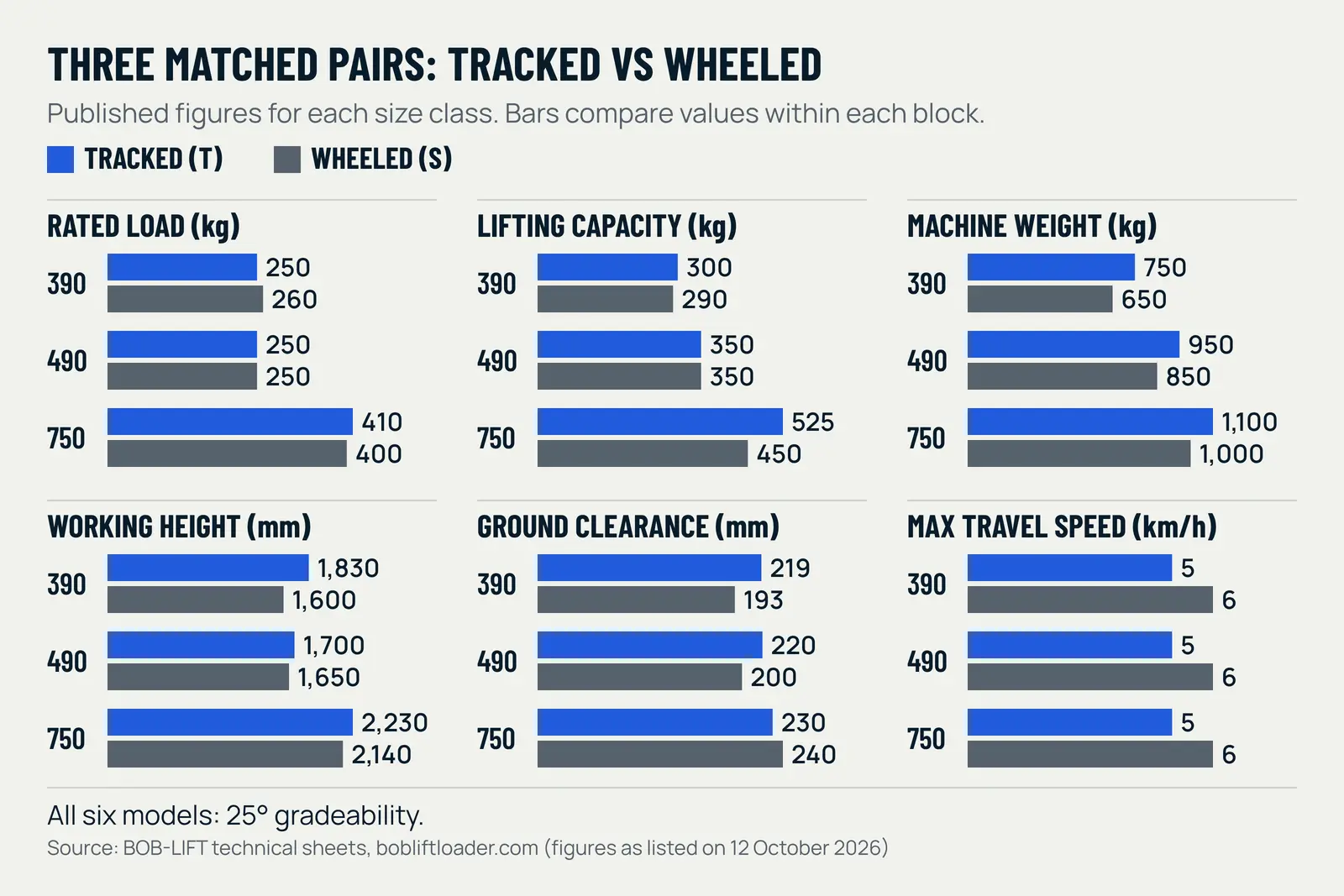
Two figures move together across all three pairs. The tracked loader is 100 kg heavier: 750 vs 650 kg (1,653 vs 1,433 lb), 950 vs 850 kg and 1,100 vs 1,000 kg. The wheeled loader is faster: 6 km/h (3.7 mph) against 5 km/h (3.1 mph). All six models list the same 25° gradeability, about a 47% grade.
Where the published figures differ unevenly
Some figures do not follow one pattern, and we report them exactly as the technical sheets give them:
- 390 pair: the wheeled BL-S390-C has the higher rated load (260 kg vs 250 kg) but the lower lifting capacity (290 kg vs 300 kg). Its working height is 230 mm lower (1,600 mm vs 1,830 mm). Its height with arms raised is only 28 mm lower (2,460 mm vs 2,488 mm).
- 490 pair: rated load and lifting capacity are identical (250 kg and 350 kg). The tracked BL-T490-C lists 50 mm more working height and 20 mm more ground clearance.
- 750 pair: the tracked BL-T750-H lists more rated load (410 kg vs 400 kg), more lifting capacity (525 kg vs 450 kg) and more working height (2,230 mm vs 2,140 mm). But the wheeled BL-S750-H lists more ground clearance (240 mm vs 230 mm) and more height with arms raised (2,920 mm vs 2,880 mm). It is the only pair where the wheeled loader sits higher off the ground. The tracked BL-T750-H is also 136 mm longer with the bucket (2,836 mm vs 2,700 mm).
- 750 engines: both list Laidong 385B, Yanmar 3TNV80 or Kubota D1105. The Laidong figure is 18.6 kW on both, but the sheets give the Yanmar and Kubota as 17.8 kW and 17.1 kW on the tracked loader, and 18.4 kW and 18.5 kW on the wheeled one.
If one of these figures decides your purchase, quote it to us with the model name. We confirm the configuration, engine and attachments for your order before you buy.
Ground pressure and turf damage
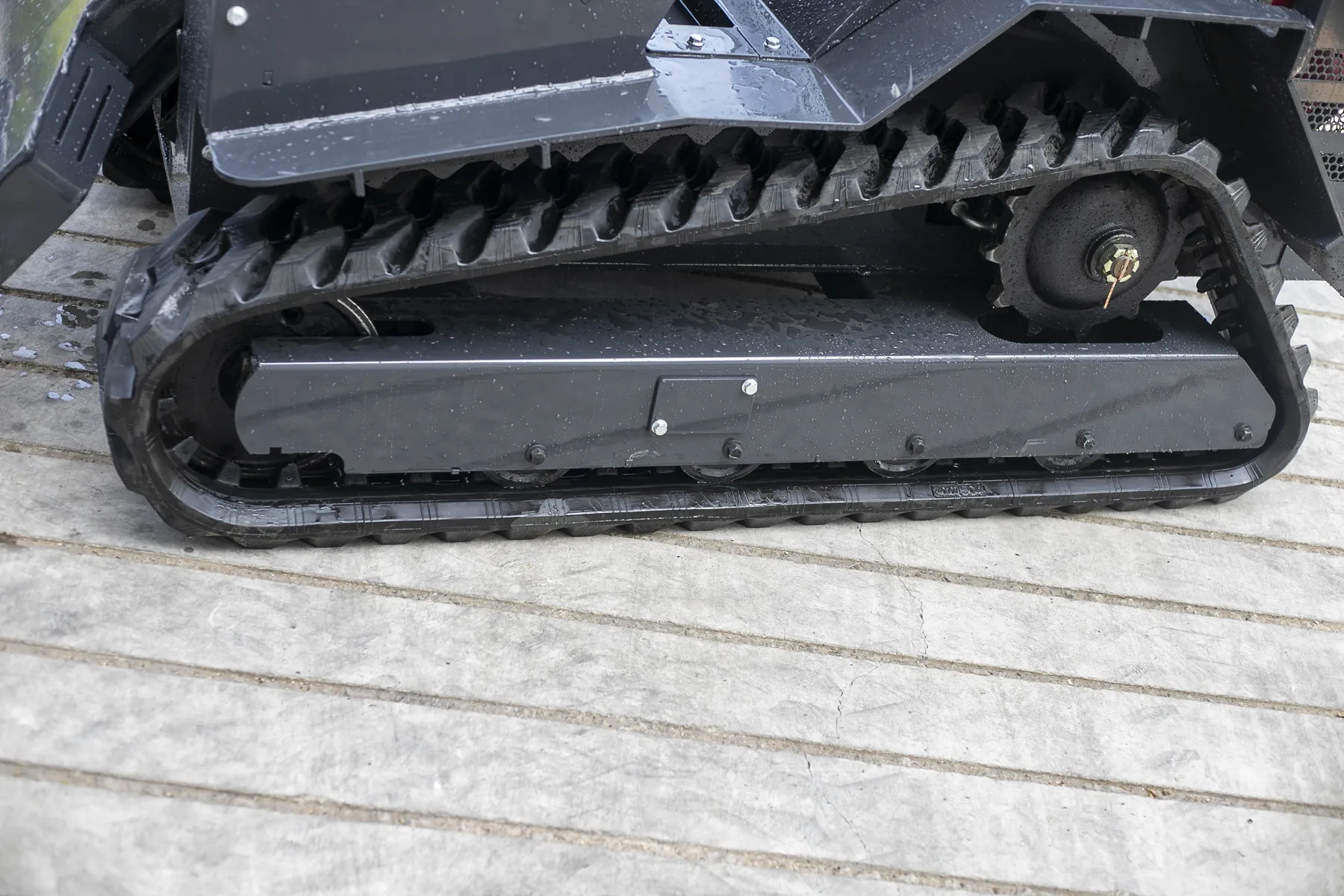
Tracks put less pressure on the ground than tyres because they spread the weight over a larger contact area. Ground pressure is the machine’s weight divided by the area in contact with the ground, P = F/A (Wikipedia: Ground pressure). Double the contact area and the pressure halves, even if the machine is a little heavier.
That is why a tracked loader can be 100 kg heavier than its wheeled twin and still be the gentler machine on a lawn. Four tyres touch the ground in four small patches. Two rubber tracks touch it along their whole length.
We do not publish a ground-pressure figure for these loaders, so we will not quote one here. To compare any two machines yourself, use this method:
- Take the machine weight plus the heaviest load you will carry in the bucket.
- Measure or ask for the contact area: track length on the ground × track width × 2, or the tyre footprint × 4.
- Divide the weight by the area. The lower number marks the ground less.
Contact area is not the whole story on turf. Every skid-steer turn drags the tracks or tyres sideways. On a finished lawn, wide gentle turns do less harm than spinning on the spot, whichever running gear you choose. For garden and lawn work, see our landscaping applications.
Speed, wear and running costs
On our published figures, the wheeled loaders are 1 km/h faster: 6 km/h against 5 km/h for every tracked loader in the three pairs. Over a 500 m run, that is about 5 minutes on tyres against 6 minutes on tracks. The gap matters on large yards and long runs between jobs. It hardly matters on a garden that is 30 m long.
Wear follows the surface. As a general rule:
- Rubber tracks last best on soil, grass and gravel. Constant turning on concrete and asphalt wears the rubber faster. A track also has more parts to check: sprockets, rollers and track tension.
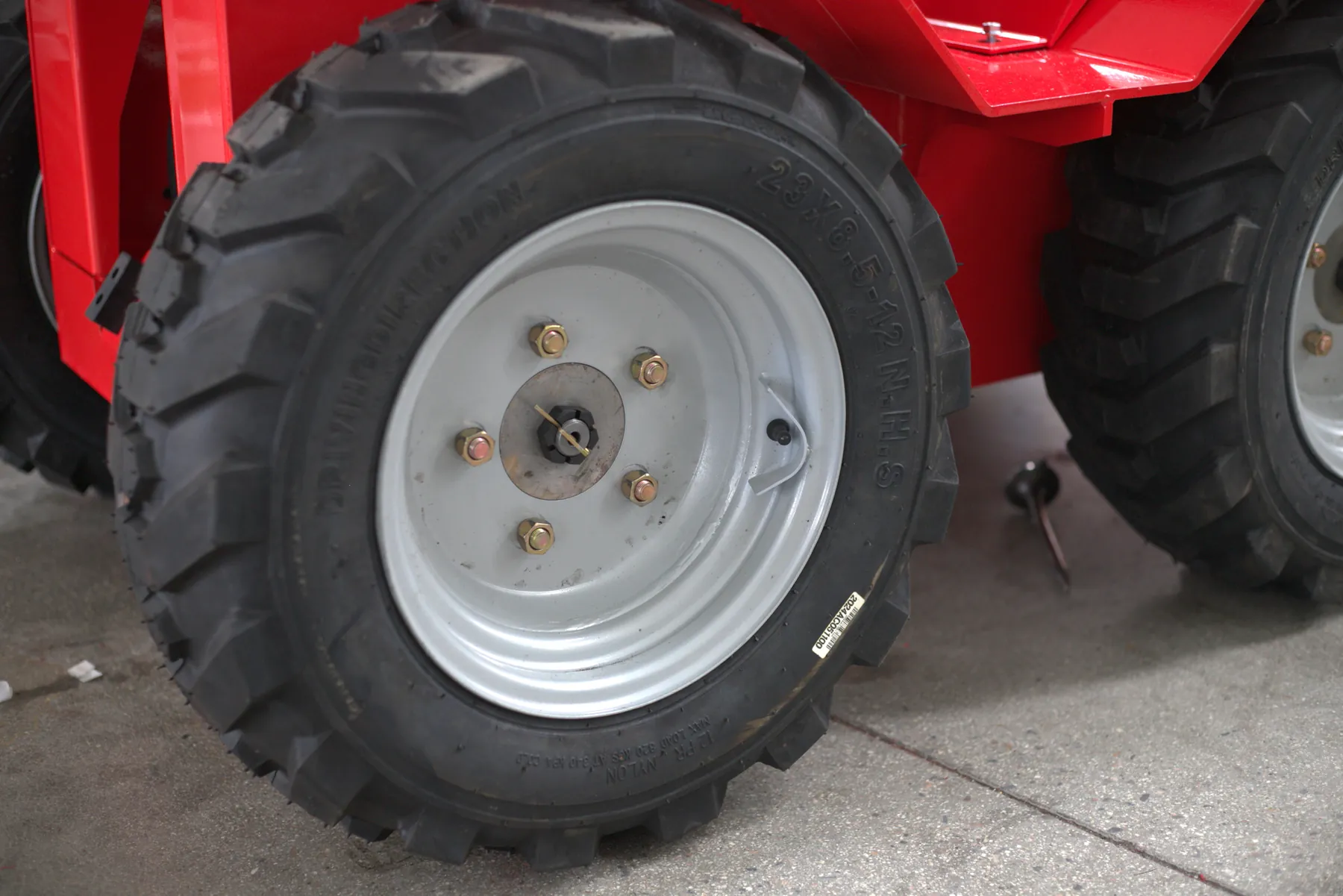
- Rubber tyres suit hard surfaces and are simple to check and replace. On soft or wet ground they lose grip sooner and leave deeper marks.
Beyond the running gear, a matched pair costs much the same to run. Each pair lists the same engine brands, fuel tank and hydraulic pressure. The 390s offer KOOP, Rato or Briggs & Stratton engines on a 5 L tank. The 490s take a twin-cylinder engine on a 10 L tank. The 750s use a three-cylinder diesel on a 20 L tank. Shipping is the same too: about 6 of any of these six loaders fit in a 20GP container, and about 22 in a 40HQ with steel loading racks, according to the container table on our Support page.
Which to choose for your site
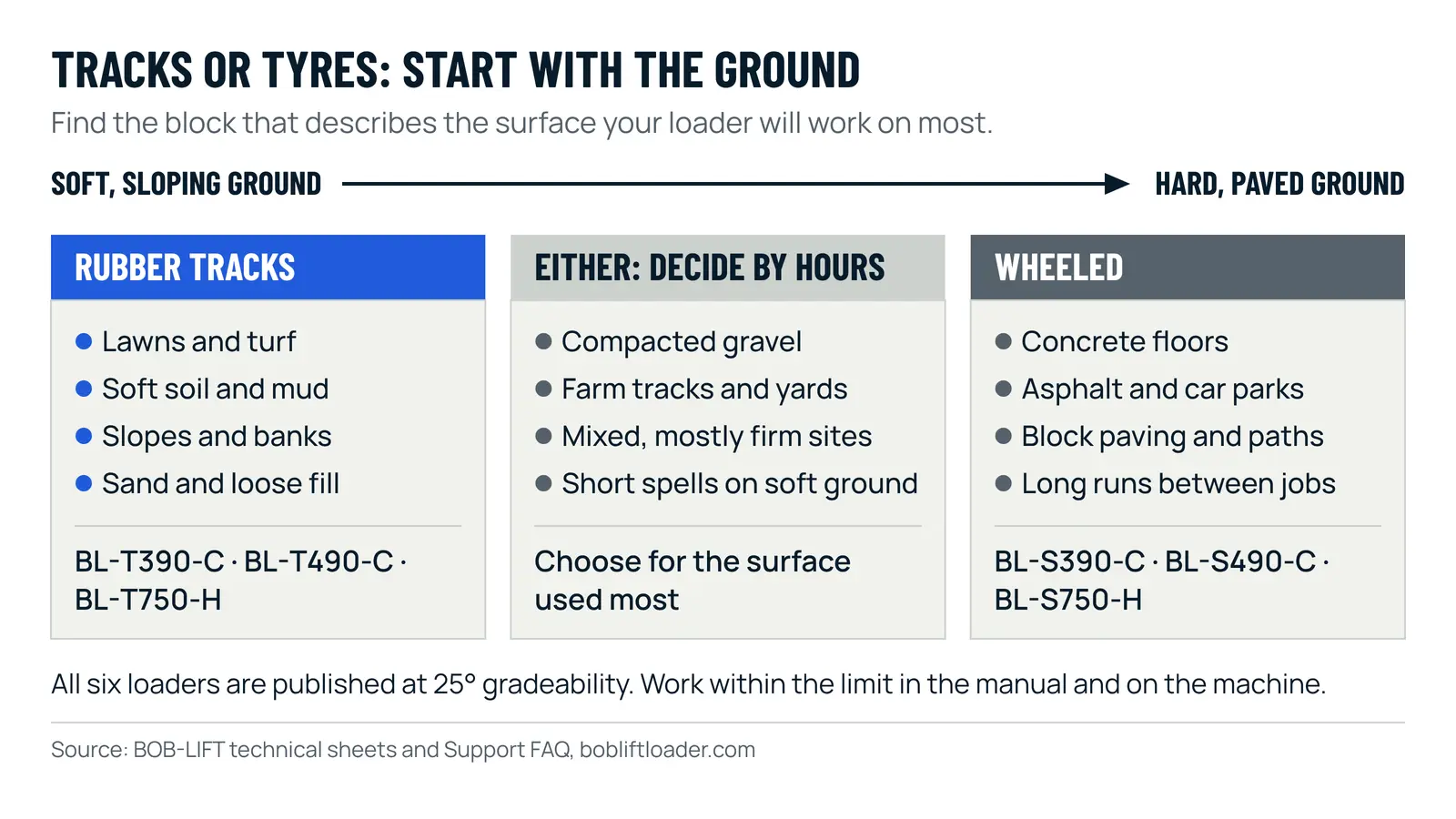
Choose tracks if most hours are on lawns, soft soil or slopes, and tyres if most are on concrete, asphalt or paving; then check width, because the 490 pair is 1,089 mm wide and the 390 and 750 pairs are 955–985 mm. The chart and table below sum up the choice.

| Your site | Running gear | Pair to look at |
|---|---|---|
| Lawns, gardens and soft beds | Tracks | BL-T390-C for 1,830 mm working height in a 955 mm body |
| Slopes and banks, wet or loose soil | Tracks | BL-T490-C or BL-T750-H, depending on the load |
| Concrete floors, car parks, warehouses | Tyres | BL-S390-C or BL-S490-C |
| Paved yards with heavier loads | Tyres | BL-S750-H: 400 kg rated, stand-on |
| Heavier loads on soft ground | Tracks | BL-T750-H: 410 kg rated, 2,230 mm working height |
| Mixed site, mostly firm | Either | Choose for where most of the hours are |
Width can decide the pair before the running gear does. The 390 and 750 pairs are under one metre wide across the body (955–985 mm). The 490 pair is 1,089 mm wide. Check your narrowest gate in our guide to mini skid steer weight and dimensions. The operator position is a separate choice: the 390 and 490 pairs are seated, the 750 pair is stand-on. Our guide to stand-on vs seated mini skid steers covers that decision.

Frequently asked questions
Can you put tracks on a wheeled mini skid steer?
Over-the-tyre tracks exist as a general product type, but they are not listed for our wheeled loaders. If you need tracks, choose the tracked model of the pair from the start. Treat any conversion as a question for your quote, not an assumption.
Is a tracked or a wheeled mini skid steer better on slopes?
On paper, neither in our three pairs: all six are published at 25°. On soft or loose ground, tracks hold their grip better because the weight is spread over a longer contact area. Always work within the slope limit in the operator’s manual and on the machine. Canada’s federal occupational health and safety agency advises never travelling across a slope: go straight up or down, with the heavy end of the loader pointed uphill (CCOHS: Landscaping – Loaders).
Are tracked mini skid steers slower?
Yes, slightly. Every tracked loader in the three pairs is published at 5 km/h and every wheeled one at 6 km/h. Over short garden distances the difference is a few seconds. Over long yard runs it adds up.
Do the tracked and wheeled versions take the same attachments?
Each pair shares the same hydraulic pressure: 16 MPa for the 390s and 490s, 18 MPa for the 750s. Hydraulic flow differs from model to model, so we confirm which attachments suit your loader when we quote it.
Get the running gear right first time
Running gear is set by the model you order, so settle it before you choose the size. Tell us the ground, the narrowest opening and the heaviest load, and send a few photos of the route. You can compare all nine models on our skid steer loaders page, or send us your site details and our team in Xuzhou will suggest the pair that fits.