


Key takeaways
- In the UK, a dumper ticket is usually a CPCS or NPORS card for the forward tipping dumper. The law asks for adequate training, and many sites check it by asking for the card.
- The CPCS training standard sets a minimum of 17 hours for a novice and 7 hours for an experienced operator, including assessment, for one learner on one machine.
- A red Trained Operator card lasts 2 years. With the NVQ or SVQ, the blue Competent Operator card lasts 5 years, and the CPCS blue card is renewable.
- Over 60% of dumper deaths involve the driver being crushed when the machine overturns, says HSE. Daily checks, the rated load and slope limits matter on every model.
What is a dumper ticket?
A dumper ticket is a plant operator card that shows you have been trained and tested on a forward tipping dumper, the front-tip site dumper used on building sites. People also call it a dumper licence, but it is not a government licence. It is a card issued by a card scheme.
In the UK, dumper cards come from plant card schemes such as CPCS, run by NOCN Group, and NPORS. NOCN Group describes CPCS as “the Plant partner Card Scheme of the Construction Skills Certification Scheme (CSCS)”, and the NPORS construction operator cards display the CSCS logo. The CSCS FAQ says: “Holding a CSCS card is not a legal requirement but most principal contractors and major house builders in the UK require workers on their sites to hold a valid CSCS card.”
What the law does require is training. Regulation 9 of the Provision and Use of Work Equipment Regulations 1998 (PUWER) says every employer shall ensure that all persons who use work equipment “have received adequate training for purposes of health and safety”. HSE’s guidance on dumpers adds that drivers should be “trained, competent and authorised to operate the specific dumper”, and that training certificates from recognised schemes help demonstrate competence. In short, the law asks for adequate training, HSE expects competence, and the card is how most sites check it.
NPORS vs CPCS: which dumper ticket?
Both schemes issue a red Trained Operator card valid for 2 years, then a blue Competent Operator card valid for 5 years once you hold the NVQ or SVQ. Which scheme you choose usually depends on what your site or employer accepts, so ask them first.
How to get a dumper ticket
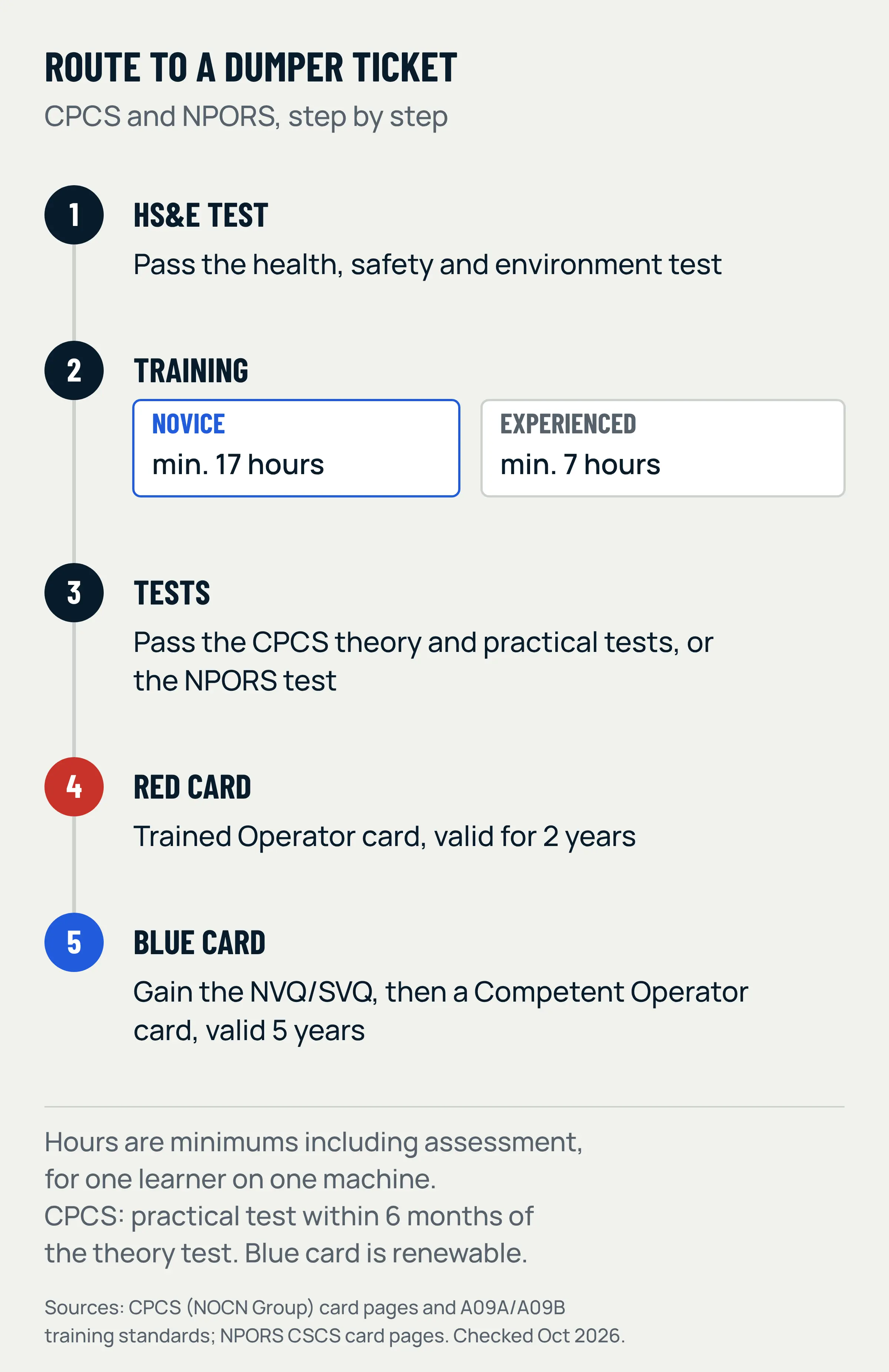
- Pass the health, safety and environment test. CPCS and NPORS both ask for it within the two years before you apply.
- Train on the route that fits you: a novice course, or a shorter course and test if you already have experience.
- Pass the tests for the forward tipping dumper. For CPCS, that means the theory test, then the practical test “within six months of the CPCS theory test”.
- Receive the red Trained Operator card, valid for 2 years.
- Achieve the NVQ or SVQ within those 2 years (both schemes set this deadline), then move to the blue Competent Operator card, valid for 5 years.

The CPCS dumper ticket
CPCS lists the forward tipping dumper as category A09. It covers tracked as well as wheeled machines, with a wheeled standard (A09A) and a tracked one (A09B). The CPCS red card page says that once you have passed the tests with an approved test centre, you “will now automatically be awarded your 2 year CPCS Red Trained Operator Card”. Within those 2 years you need to register for and achieve an NVQ or SVQ.
The NPORS dumper ticket
The NPORS CSCS Trained Operator card works the same way. Once tested, an operator without the NVQ or SVQ gets a card “valid for 2 years from the date they were tested”. After the qualification, the NPORS Competent Operator card is valid for 5 years. NPORS publishes its current CITB-funded forward tipping dumper courses under category C204, for wheeled and tracked machines.
Dumper training: novice course or experienced test
Training is split by experience. The CPCS A09A training standard sets these minimum durations, including assessment:
| Route | Who it is for | Minimum, 1 learner on 1 machine |
|---|---|---|
| Novice | No current card in the category, or little or no practical experience | 17 hours (2½ days) |
| Experienced | Holds a red card in the category, or has equivalent experience | 7 hours (1 day) |
Group courses have longer minimums: at least 28 hours for two novices and 37 hours for three, sharing one machine. The same 17-hour and 7-hour minimums appear in the CITB-mapped standards that NPORS publishes. Before you book a dumper course, ask which card scheme and category it leads to.
Does a small mini dumper need a ticket?
Size does not take a machine out of the training duty. PUWER’s training duty covers “all persons who use work equipment”, and it sets no size exemption. Whether your site asks for a card on a small machine is a site rule, so check with your employer or the principal contractor. NPORS’s April 2019 category list, still linked from its standards page, included a separate forward tipping mini dumper category. Ask your training provider which category applies to your machine.

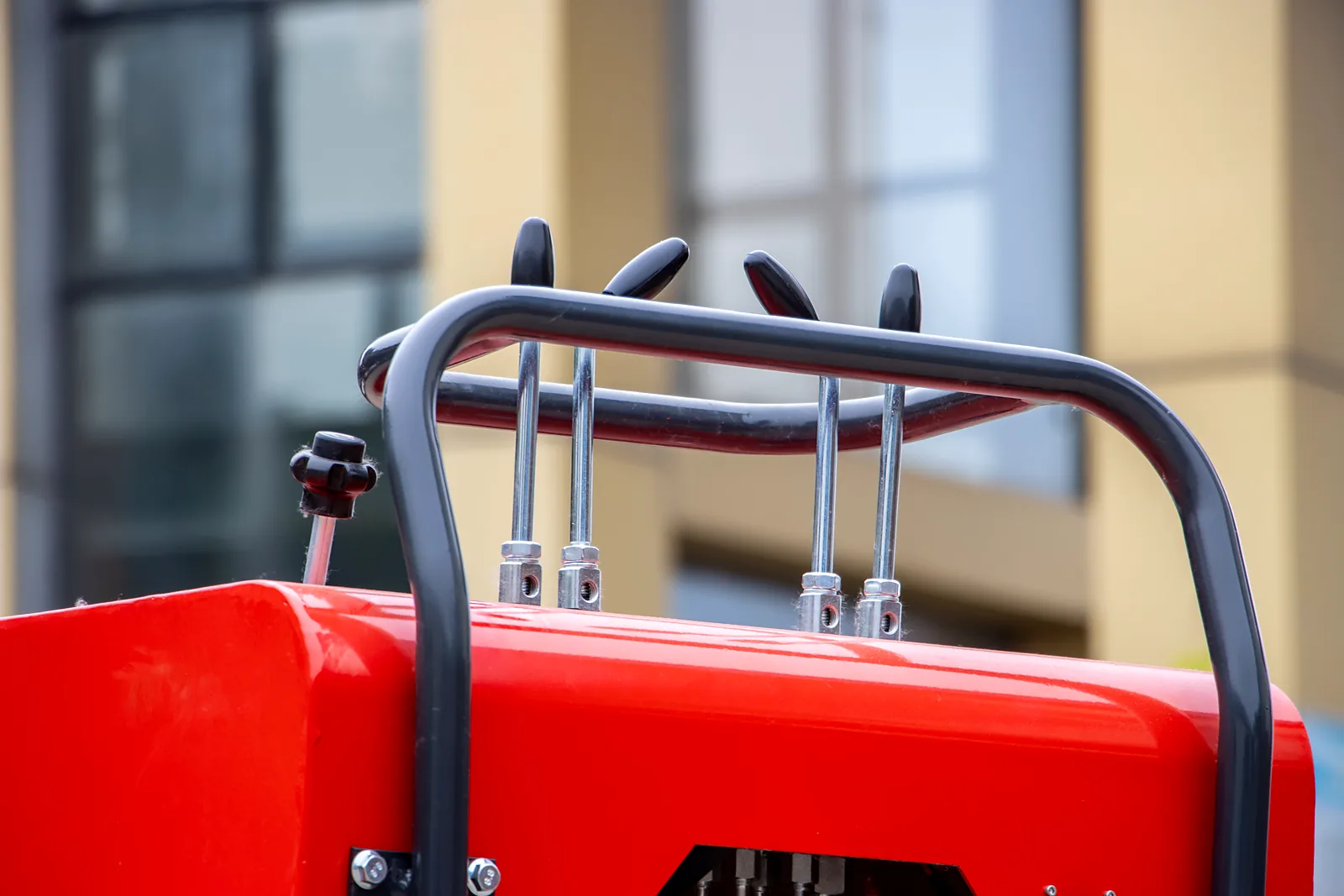
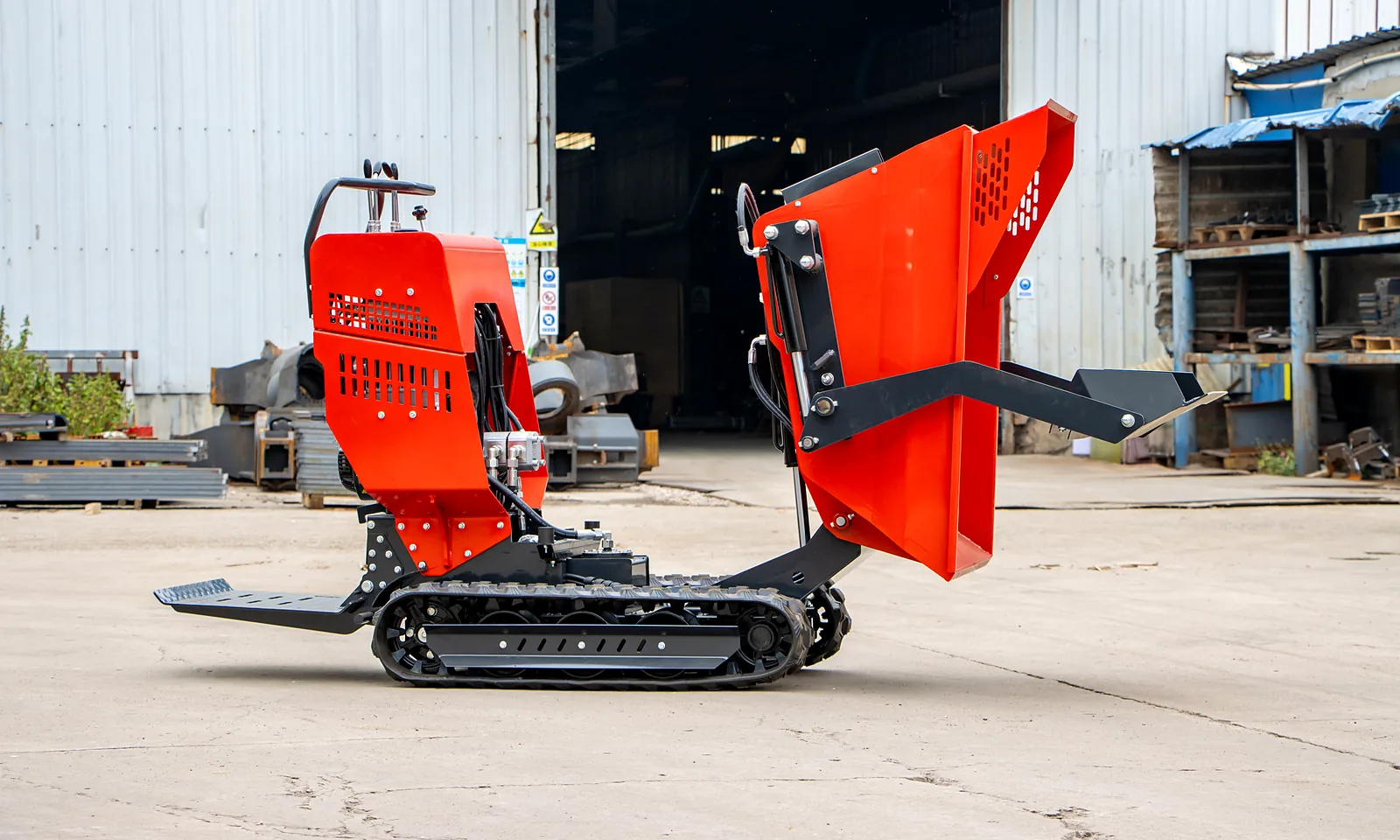
Across our mini dumper range, the difference shows in how you drive. The tracked BL-T500-HD 500 kg mini dumper is driven from a standing platform with joysticks, travels at up to 3 km/h and is 880 mm (34.6 in) wide. The wheeled FC10 1-tonne mini dumper carries 1,000 kg, is steered with a wheel and travels at up to 22 km/h. The two handle very differently, so the specific machine needs specific training. HSE’s information sheet CIS52, Safe use of site dumpers (2006, still linked from HSE’s dumpers page) says drivers should be trained on the dumpers they are required to drive, including the layout of the controls, stability limits and daily checks.
Our guides to the power barrow and to tracked vs wheeled mini dumpers compare how each type drives.
Daily checks before you start
Check the dumper at the start of every working day, before you move off. HSE says a programme of daily visual checks, regular inspections and servicing should be set up “in accordance with the manufacturer’s instructions”. CIS52 tells drivers to “check tyres, brakes etc to ensure dumpers are safe to use at the start of the working day”.
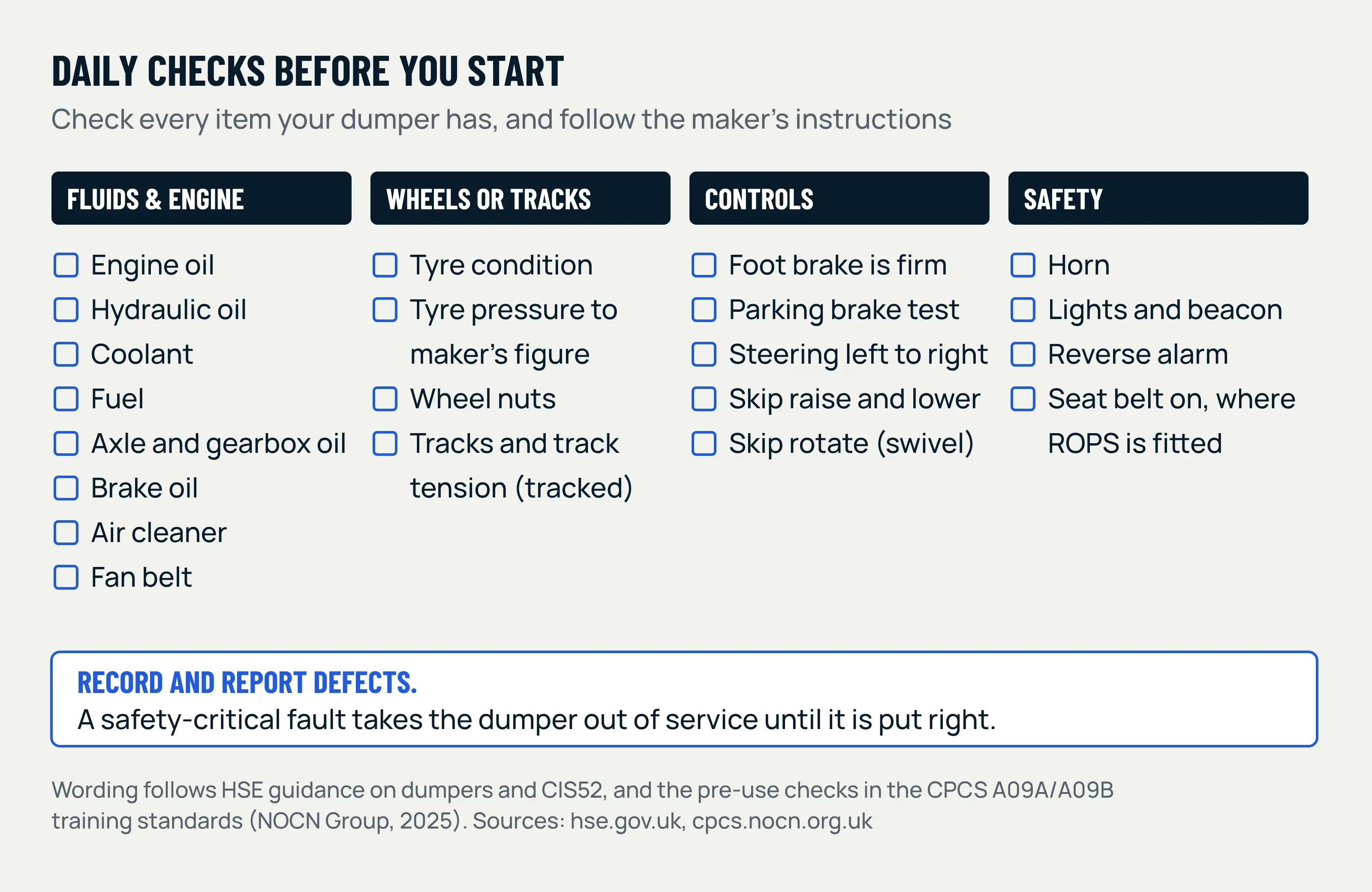
The CPCS A09A and A09B standards list what a trained operator checks:
- Fluids and engine: engine oil, hydraulic oil, coolant, fuel, axle and transmission oil, brake oil, the air cleaner and the fan belt.
- Wheels or tracks: wheel nuts and tyre pressure on wheeled machines, track assembly and track tension on tracked ones.
- Controls: the foot brake should feel firm, then test the parking brake. Turn the steering left to right, and raise and lower the skip. On a swivel skip, rotate it both ways.
- Safety items: horn, reverse alarm, beacon and lights, where fitted. CIS52 says drivers should use seat belts where ROPS are fitted.
On protection, HSE’s dumpers page says: “Check that dumpers are provided with roll-over protection and that drivers use their seatbelts.” Ask us what your model is supplied with.
Record what you find and report any defect. HSE says reported problems should be put right quickly, and a dumper should be taken out of service if the fault is safety-critical. Keep the specification sheet for your model on file: every product page has a specification sheet you can save as a PDF (see our Support page). If a fault appears, the team there talks you through it over WhatsApp, video or email.
Safe loading and tipping
Most dumper deaths come from overturning. HSE says “over 60% of dumper deaths involve the driver being crushed when the vehicle overturns”, and most of the rest happen when pedestrians are struck by a moving dumper. Loading, slopes and edges are where those risks start.
Stay within the rated load
CIS52 warns that “a dumper that is too small is likely to be overloaded, increasing the risks of overturning and reducing its ability to stop safely”. Choose a model rated for your heaviest load per trip, and never load past that figure. Our ten mini dumpers run from 500 kg to 5,000 kg (1,102 to 11,023 lb).

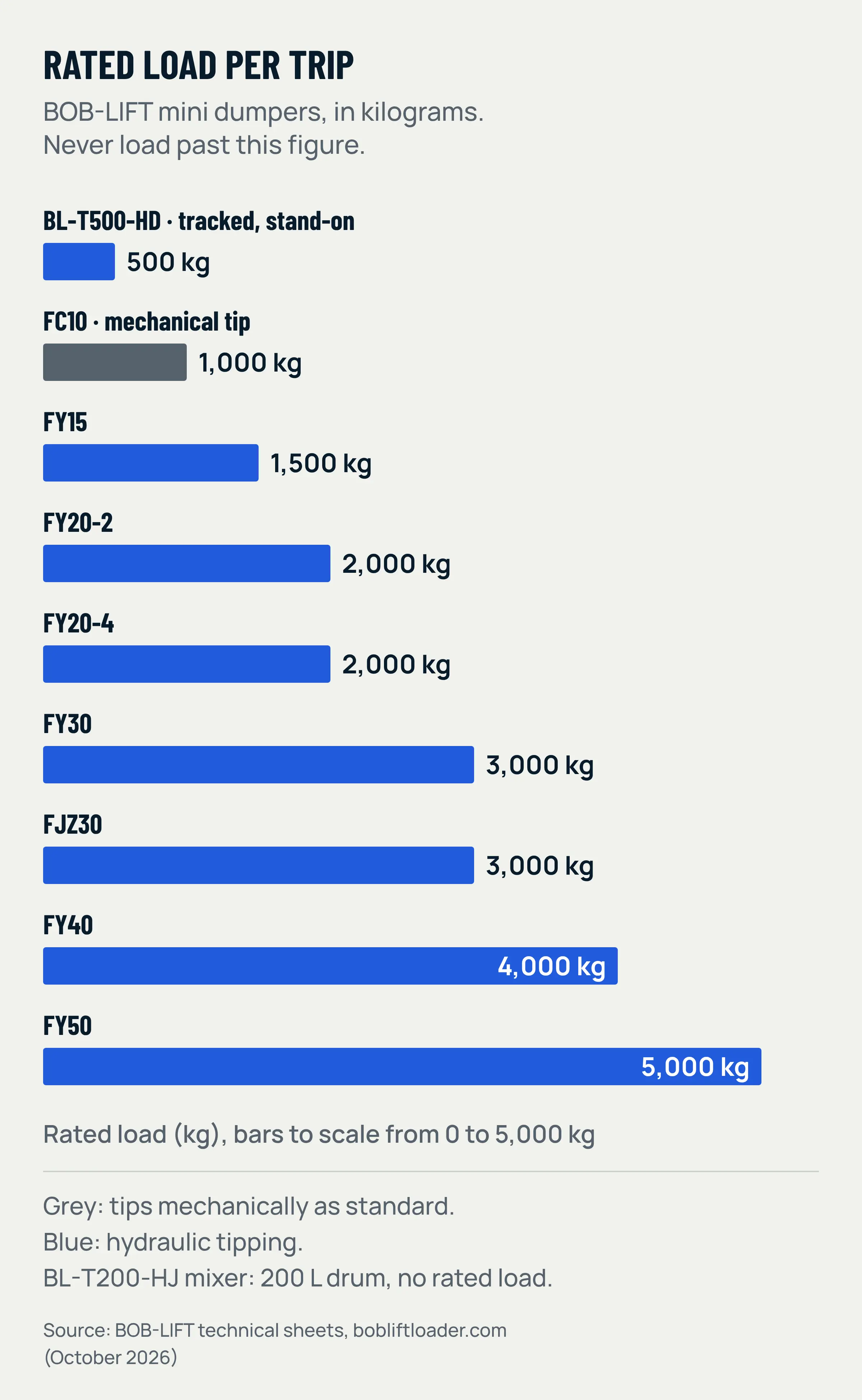
Weight is not the only limit. HSE says loads should be spread evenly and should not be filled “above the top edge of the skip”. A full hopper must not block the driver’s view of the route ahead. CIS52 adds two habits: load only on level ground with the parking brake on, and get off the dumper while it is being loaded. If you are still choosing a size, see our guide to site dumper sizes from 1 to 5 tonnes.
Slopes
Use the dumper only on slopes within its rated capacity, and check that figure with the manufacturer. On our specification sheets, every wheeled model is listed at “21° theoretical max. (18° or less recommended in work)”, and the BL-T500-HD at 20°. CIS52 says to reverse down slopes when the skip is loaded, and to turn uphill, not downhill, if you must turn across a slope. On rough ground, CIS52 says the maker’s slope figure should be reduced. For mud and grades, our 4×4 vs 4×2 mini dumper guide explains which drive suits which ground.
Edges and tipping
Never tip at an unprotected edge. HSE asks for wheel stops at a safe distance from the edges of excavations and pits, so the dumper cannot fall in when tipping. When tipping into an excavation while stationary, CIS52 says to stop, select neutral and apply the parking brake. Do not drive around site with the skip raised. Before leaving the machine, apply the parking brake, switch off the engine and take the key.
Mechanical vs hydraulic tipping on our dumpers
The FC10 tips mechanically as standard. Every other BOB-LIFT dumper tips hydraulically. The model name tells you which: FC is our basic front-tip dumper, and FY means hydraulic tipping.
| Model | Tipping | Tipping angle | Dump height |
|---|---|---|---|
| FC10 | Mechanical front tip (hydraulic tip and swivel side tip optional) | 45° | 1,800 mm (70.9 in) |
| FY15, FY20-2, FY20-4, FY30, FY40, FY50 | Hydraulic front tip (swivel side tip optional) | 45° | 1,800 to 2,500 mm (70.9 to 98.4 in) |
| FJZ30 | Hydraulic front tip (swivel side tip optional), plus a self-loading front bucket | 45° | 2,700 mm (106.3 in) |
| BL-T500-HD | Hydraulic, joystick controls | 100° | Not listed |
For the operator, the tipping method changes a few things:
- The controls differ, so an operator who knows one type needs familiarisation on the other.
- The daily check includes the tipping control: raise and lower the skip, and rotate it if it swivels.
- A swivel side-tip hopper changes where the load lands. Check the side you tip towards as carefully as the front, and keep pedestrians clear.
- Dump height decides overhead clearance. The hydraulic FY30 3-tonne mini dumper tips to a 2,400 mm (94.5 in) dump height, so look up before you tip.
Dumper tickets outside the UK
CPCS and NPORS are UK schemes. Elsewhere, local law and site rules decide what an operator needs.
If you are looking for a dump truck ticket in Australia, the national training register lists units for large haul trucks: RIIMPO338 Conduct rigid haul truck operations and RIIMPO337 Conduct articulated haul truck operations, both released on 2 September 2026. Both state: “No licensing, legislative or certification requirements apply to this unit at the time of publication.” For a small site dumper, check with your state work health and safety regulator and the site. In any other market, start with the national safety regulator and your employer.
Frequently asked questions
Do you need a ticket to drive a dumper?
The law asks for adequate training, not a particular card. PUWER requires employers to make sure everyone who uses work equipment has received adequate training. The card is a site requirement: most principal contractors and major house builders ask for a CSCS-logo card, such as a CPCS or NPORS dumper card. Check with your employer or site before you start.
How long is a dumper course?
The CPCS A09A standard sets minimums of 17 hours (2½ days) for a novice and 7 hours (1 day) for an experienced operator, including assessment, for one learner on one machine. Groups take longer.
How long does a dumper ticket last?
A red Trained Operator card lasts 2 years with both CPCS and NPORS. The blue Competent Operator card lasts 5 years. To renew a CPCS blue card, you need a health, safety and environment test from the last two years, the CPCS CPD Renewal and evidence of ongoing operating experience. CPCS says applications can be made 3 months before the expiry date.
Can I use a dumper on my own land without a ticket?
The card schemes are site requirements, so a private job on your own land may never ask for one. If you use the dumper at work, HSE’s guidance on PUWER expects drivers of self-propelled equipment to be trained; check with your employer or HSE’s training guidance. Whatever the setting, the overturn risk is the same, so get proper training.
Is a dumper ticket the same as a dumper roller ticket?
No. The dumper and the roller are separate categories (for example in NPORS’s category lists). A course may cover both, but check which categories are printed on the card at the end.
Does BOB-LIFT provide operator training?
No. BOB-LIFT builds the machines; operator training and cards come from accredited training providers and the card schemes, or from a competent in-house trainer, as HSE allows. We supply the specification sheet for every model and technical assembly guidance for machines shipped taken apart.
Choosing a dumper for trained operators
A trained operator on the right-sized machine is the safest set-up. Start with the heaviest load per trip, the slopes on your site and the narrowest gap on the route. Then compare rated load, width and tipping on every model in our mini dumper range.