


Key takeaways
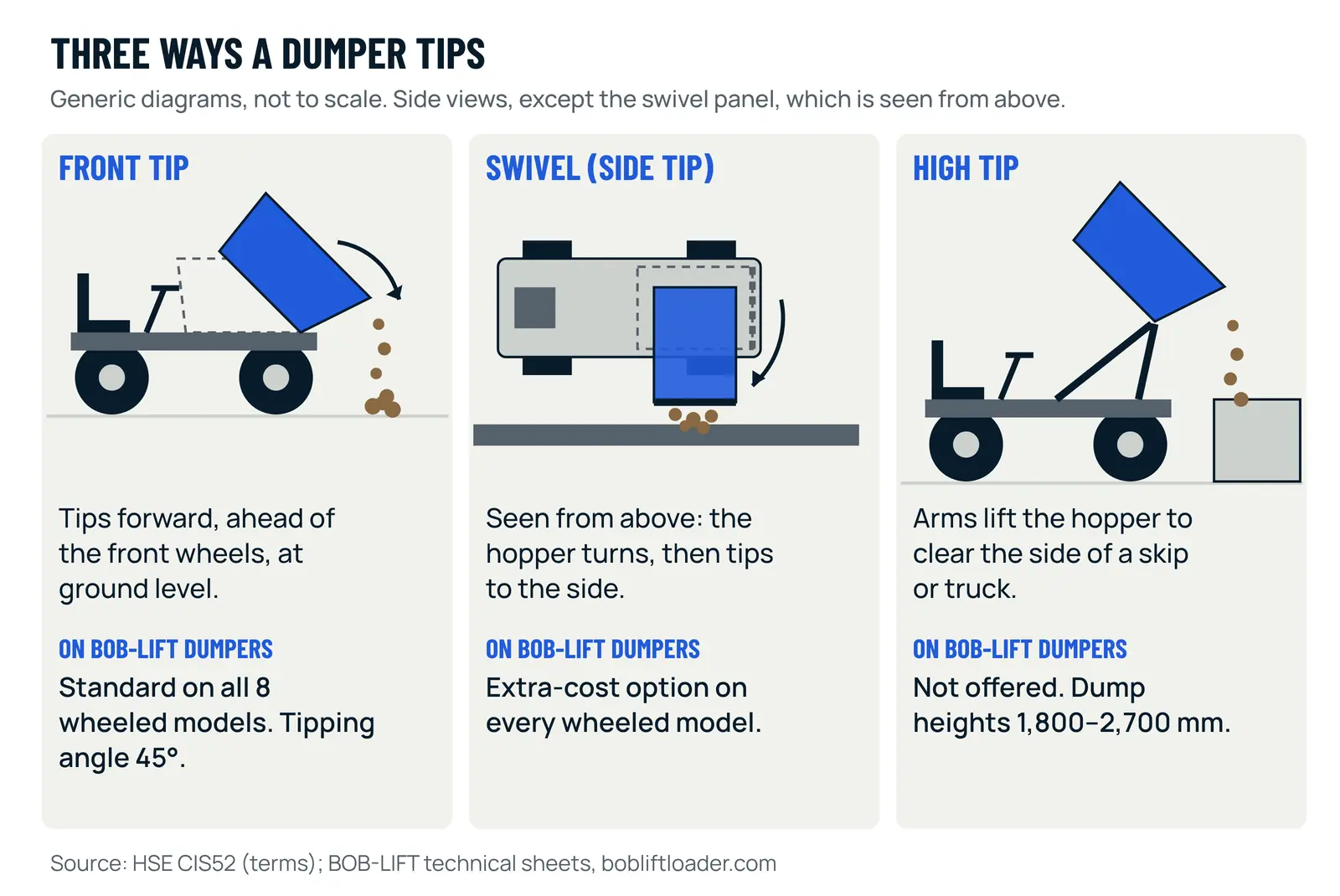
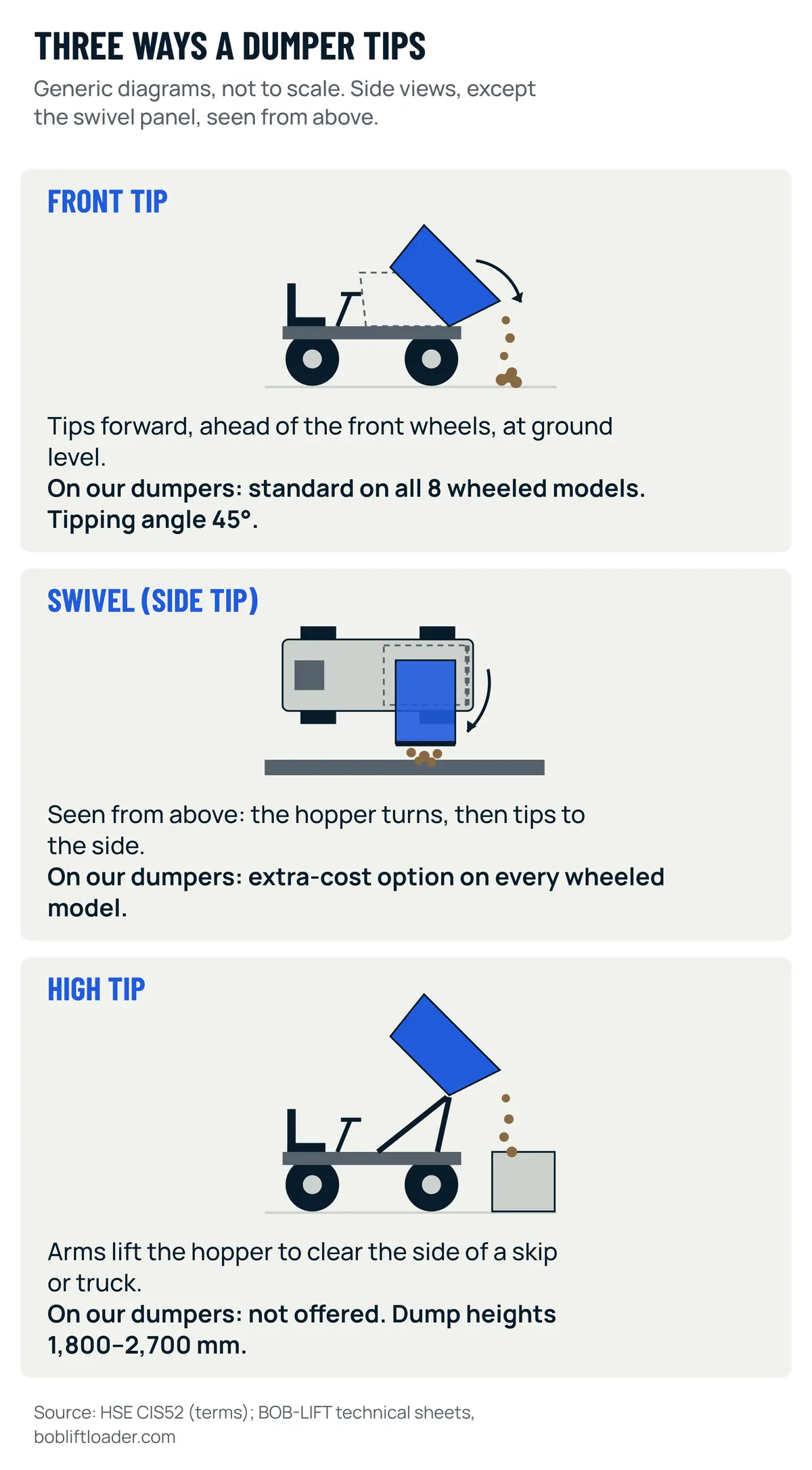
- A front-tip dumper tips its hopper forward. A swivel dumper turns the hopper on the chassis so it can tip to the side. A high-tip dumper lifts the hopper on arms before it tips.
- All 8 BOB-LIFT wheeled mini dumpers tip forward through 45°. The FC10 tips mechanically as standard; the FY models and the FJZ30 tip hydraulically.
- A swivel side-tip hopper is an extra-cost option on every wheeled model, from the 1,000 kg FC10 to the 5,000 kg FY50.
- Published dump heights run from 1,800 mm (70.9 in) on the FC10 and FY15 to 2,700 mm (106.3 in) on the FJZ30. We do not build a high-tip dumper.
- The tracked BL-T500-HD tips hydraulically through 100° and is 880 mm (34.6 in) wide.
Front tip, swivel and high tip: what’s the difference?
The difference is where the load lands. A front-tip dumper drops it in front of the machine. A swivel dumper turns its hopper, then tips to the side. A high-tip dumper lifts the hopper first, so the load can go over the side of a skip or a truck body.
All three are site dumpers. HSE’s information sheet on site dumpers, CIS52, covers articulated and rigid-frame machines “with front, rotary, side-tipping or high-lift skips”. The tipping type decides where you can stand the machine to unload, so it is worth settling before you choose a model.
A swivel skip is not a swivel cab
“Swivel” means two different things in dumper listings. A swivel skip, or swivel hopper, turns the load. A swivel seat or swivel cab turns the driver, so they can face the other way. If a listing only says “swivel”, ask which one it means.
On our machines, “swivel” always means the hopper. The spec sheets list it under Tipping as “swivel side tip optional”. No BOB-LIFT dumper is listed with a swivelling seat or cab.
How our mini dumpers tip
Every BOB-LIFT wheeled mini dumper tips forward through a tipping angle of 45°. What changes is the power behind it: the FC10 tips mechanically, and the other seven wheeled models tip hydraulically. The model name tells you which. FC is our basic front-tip dumper, FY means hydraulic tipping, and FJZ adds a self-loading front bucket on an articulated frame.
| Model | Rated load | Tipping (as listed) | Tipping angle | Dump height |
|---|---|---|---|---|
| FC10 | 1,000 kg | Mechanical front tip (hydraulic tip and swivel side tip optional) | 45° | 1,800 mm |
| FY15 | 1,500 kg | Hydraulic front tip (swivel side tip optional) | 45° | 1,800 mm |
| FY20-2 | 2,000 kg | Hydraulic front tip (swivel side tip optional) | 45° | 2,000 mm |
| FY20-4 | 2,000 kg | Hydraulic front tip (swivel side tip optional) | 45° | 2,200 mm |
| FY30 | 3,000 kg | Hydraulic front tip (swivel side tip optional) | 45° | 2,400 mm |
| FJZ30 | 3,000 kg | Hydraulic front tip (swivel side tip optional) | 45° | 2,700 mm |
| FY40 | 4,000 kg | Hydraulic front tip (swivel side tip optional) | 45° | 2,400 mm |
| FY50 | 5,000 kg | Hydraulic front tip (swivel side tip optional) | 45° | 2,500 mm |
| BL-T500-HD (tracked) | 500 kg | Hydraulic | 100° | Not listed |
| BL-T200-HJ (tracked mixer) | None (200 L drum) | Hydraulic | 45° | Not listed |
Specifications checked against our product pages on 14 October 2026.
The two tracked models work differently. The BL-T500-HD is 880 mm (34.6 in) wide and tips its 1,070 × 730 × 730 mm hopper hydraulically through 100°, with joystick controls. The BL-T200-HJ is a mixer: its 200 L drum tips hydraulically through 45° to pour. Neither has a swivel option on its spec sheet. The swivel side-tip hopper is listed for the wheeled models.

Searching for a 3 ton swivel dumper? Both our 3-tonne models, the FY30 and the FJZ30, are hydraulic front-tip dumpers, and both can be ordered with the swivel side-tip hopper at extra cost. For how the 1- to 5-tonne classes compare on load, hopper and width, see our guide to site dumper sizes.
When a swivel hopper pays off
A swivel hopper pays off when the place you tip is beside the dumper, not in front of it. Then the machine can drive along the work and tip sideways, instead of turning to face each tip point. Typical jobs:
- Backfilling a trench. Drive alongside the trench and tip into it, rather than approaching it nose first.
- Kerbs, edging and verges. Drop material along a line while the dumper stays on the firm surface.
- Narrow lanes and paths. Where there is no room to turn the machine, the hopper turns instead.
- Walls and fence lines. Tip against a boundary that the front of the machine cannot reach.
Front tip stays the simpler choice when you tip onto open ground or a heap ahead of the machine, and every wheeled model does that without extras. If you only tip sideways now and then, a standard front-tip dumper may be all you need.
Two points to settle before you order. First, our spec sheets list one rated load per model, so ask us to confirm it for the configuration you order. Second, we do not publish how far our swivel hopper rotates. If the angle matters for your job, ask when you request the quote.
Dump height and high-tip dumpers
Our wheeled mini dumpers list a dump height of 1,800 mm (70.9 in) to 2,700 mm (106.3 in), shown as “Dump height” on each spec sheet. They are front-tip dumpers with an optional swivel hopper. None of them lifts its hopper on arms, so none is a high-tip dumper.

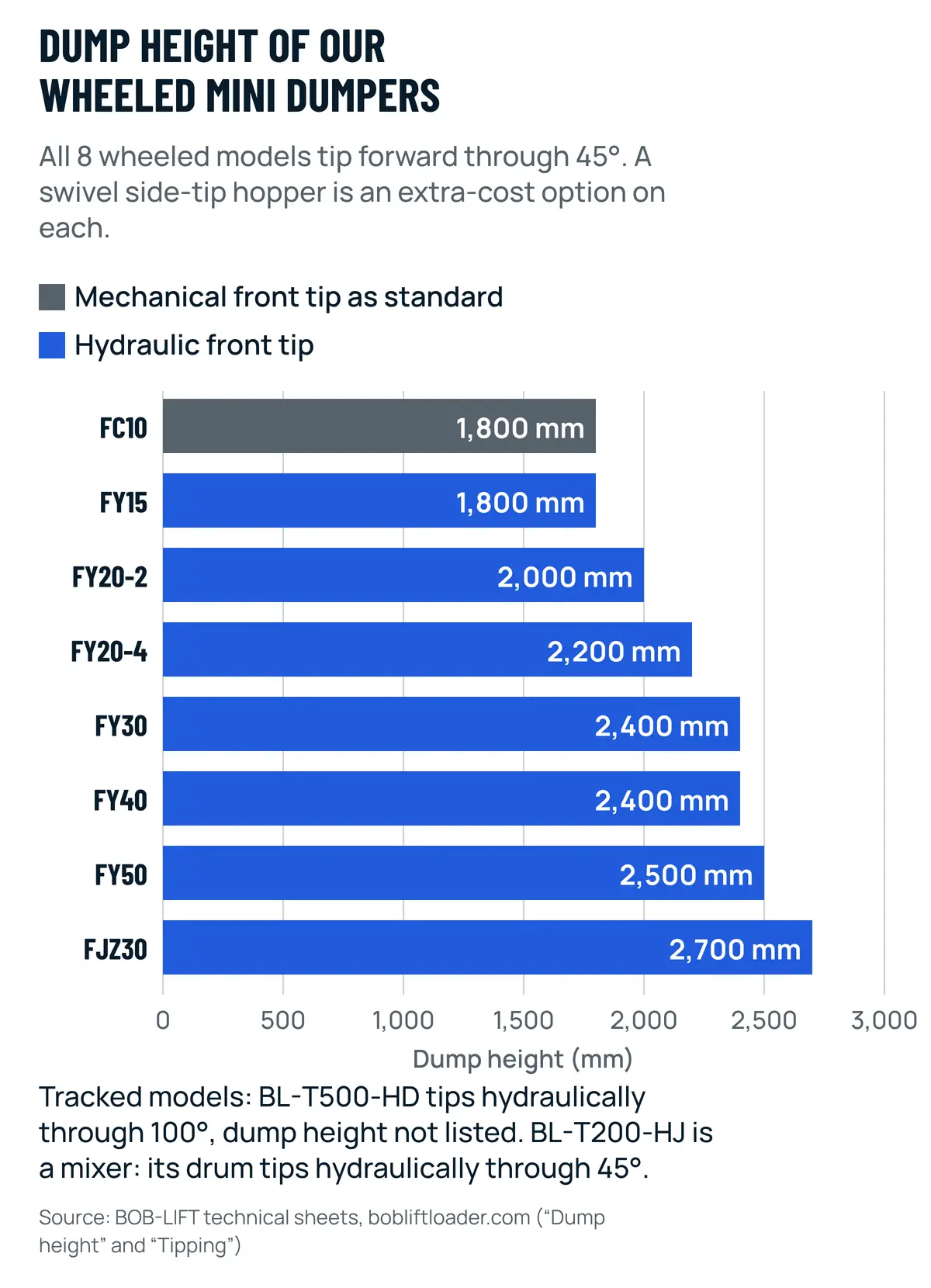
To tip into a skip, a trailer or a truck body, compare its top edge with the dump height of the model you are looking at:
- Measure the height of the receiving edge, on the ground where you will tip.
- Compare it with the dump height in the chart, and leave a margin.
- If the margin is tight, ask us how dump height is measured on that model before you order.
The FJZ30 also lists a front bucket lift height of 2,800 mm (110.2 in). That figure belongs to its self-loading front bucket, not to the hopper.
If most of your work is tipping over high sides, a high-tip dumper is a different class of machine with its own risks. CIS52 warns that the stability of high-lift skip dumpers is greatly reduced when the skip is raised. Where the skip has to go up to tip into a container, the ground should be “substantially flat, level and free from debris”. A high-lift dumper should never travel with its skip up.
Mechanical or hydraulic tipping on the FC10
The FC10 is the only model in our range that tips mechanically as standard, and it can be ordered with hydraulic tipping instead. Hydraulic tipping raises and lowers the hopper with the machine’s hydraulic system. From the FY15 up to the 5,000 kg FY50, every other wheeled model comes with hydraulic tipping.
The FC10 spec sheet lists its standard tipping as “Mechanical front tip” but does not describe how the mechanism is worked. If that matters to your operators, ask us before you order and we will answer for your machine.
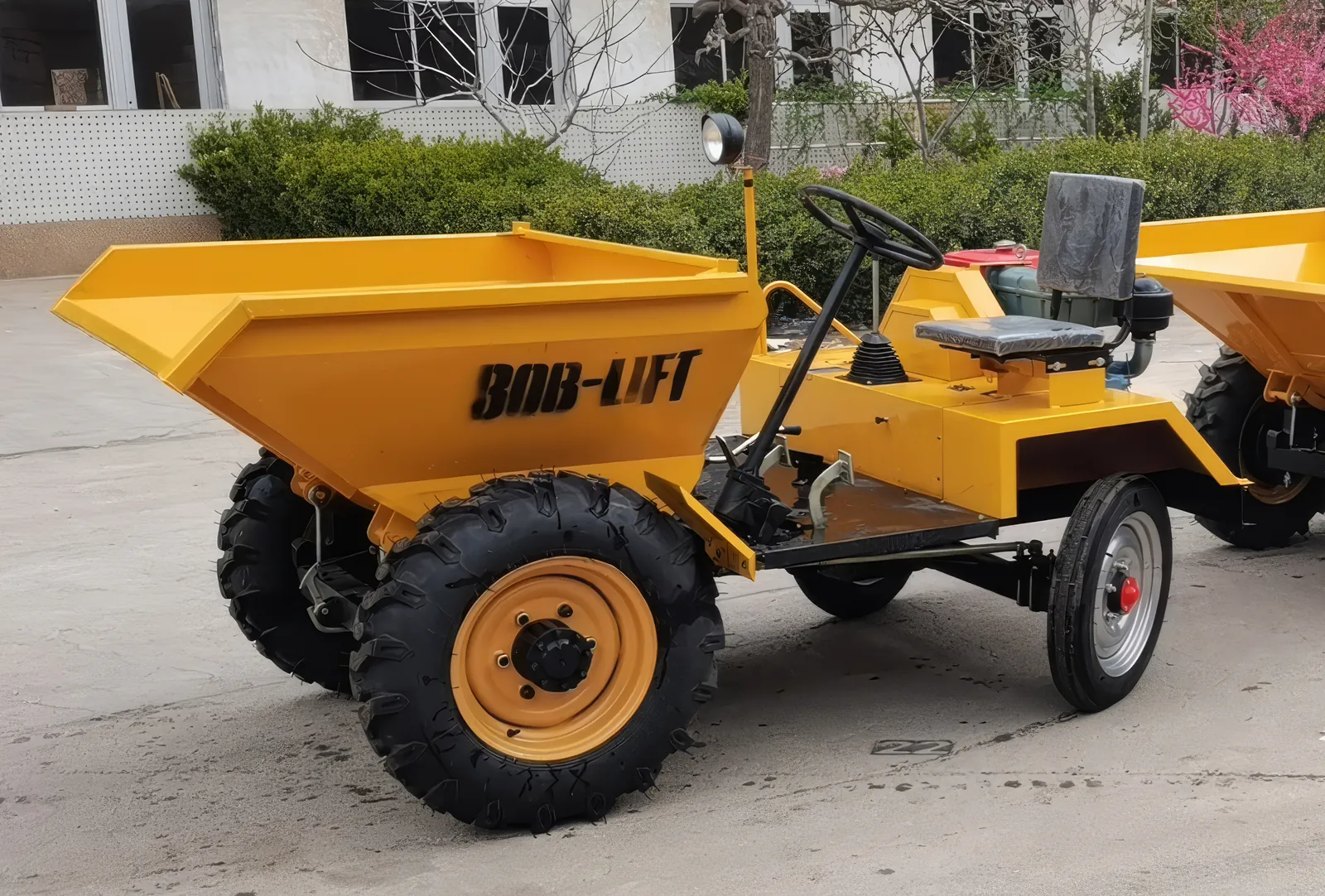
Three things help you choose on the FC10:
- The machine. The FC10 is our entry wheeled model: 1,000 kg (2,205 lb) rated load, a 0.8 m³ hopper, a 12.1 kW engine and 800 kg machine weight. Mechanical front tipping is how it leaves the factory unless you choose the option.
- How often you tip. If the machine tips many loads a day, talk to us about the hydraulic tip option before you order.
- Checks. With the hydraulic tip option, the hydraulic system becomes part of your daily checks. HSE’s dumper guidance asks for daily visual checks, regular inspections and servicing in line with the manufacturer’s instructions. Before shipping, we check the hydraulic speed and the oil circuit of every wheeled dumper.
Our dumper ticket guide covers what the tipping method changes for the operator, including controls and familiarisation.
Safe tipping
Overturning is the main cause of dumper deaths: the HSE dumpers page says over 60% of dumper deaths involve the driver being crushed when the vehicle overturns, and CIS52 names slopes, rough ground and the edges of excavations among the main causes. At the tip point, that means:
- Edges. Set stop blocks well back from any trench, pit or spoil heap you tip into, so the wheels meet the block before the ground gives way. Before tipping into an excavation, stop, put the dumper in neutral and set the parking brake.
- Loads. Spread the load evenly, keep it below the rim of the hopper, and make sure the driver can still see the route ahead.
- Slopes. Keep to gradients within the dumper’s safe working capacity. Our wheeled spec sheets give 21° as the theoretical maximum and recommend 18° or less in work.
- Travel. Lower the hopper fully before you move off.
- People. Keep pedestrians and dumpers apart. With a swivel hopper, check the side you tip towards as carefully as the front.
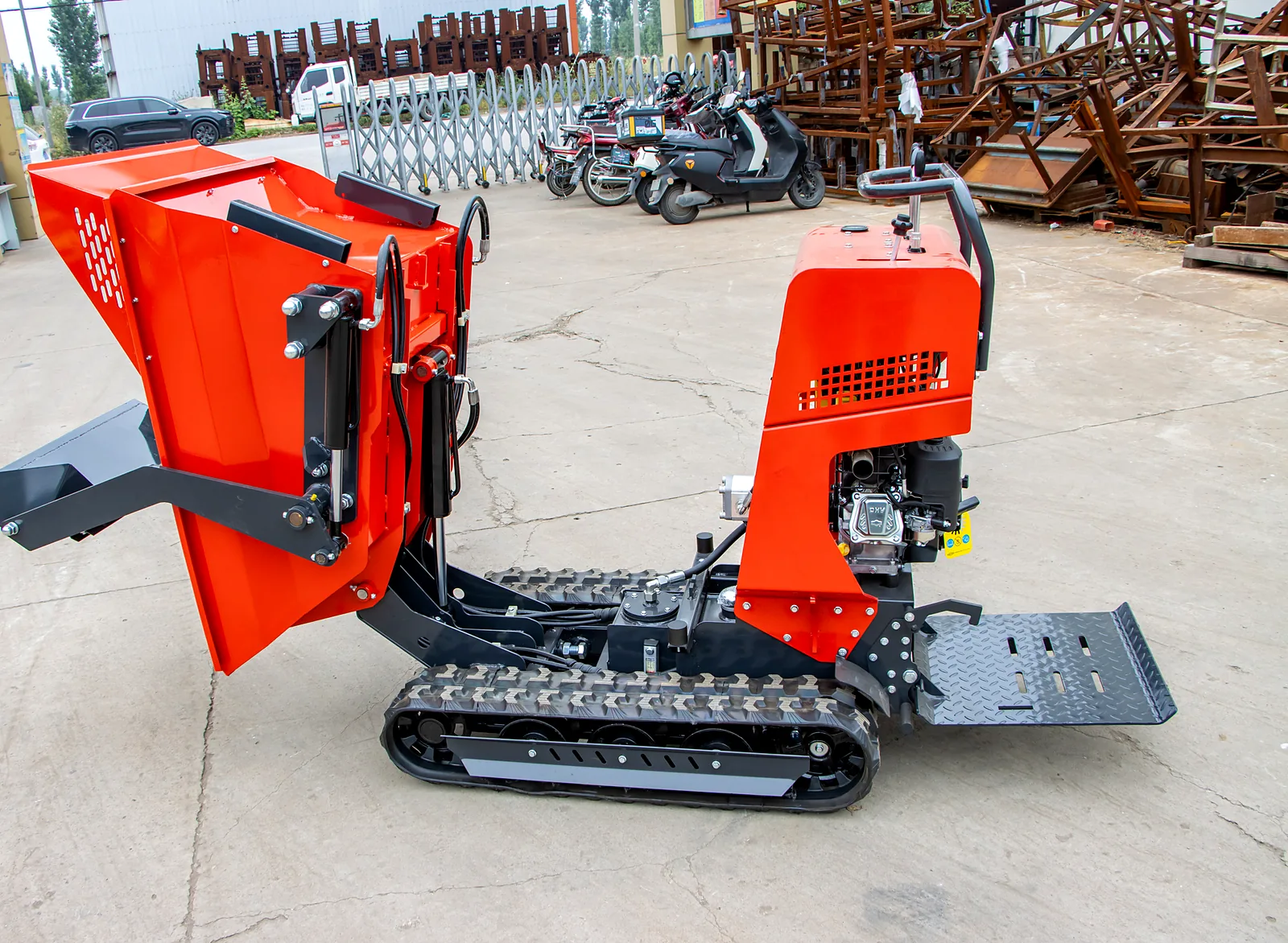
Operator training and the CPCS and NPORS dumper tickets are covered in the same dumper ticket guide, so we do not repeat them here.
How to spec tipping when you order
Name the tipping you want in your first message: the standard front tip, hydraulic tipping on the FC10, or the swivel side-tip hopper on any wheeled model. Then our team can quote the exact machine.
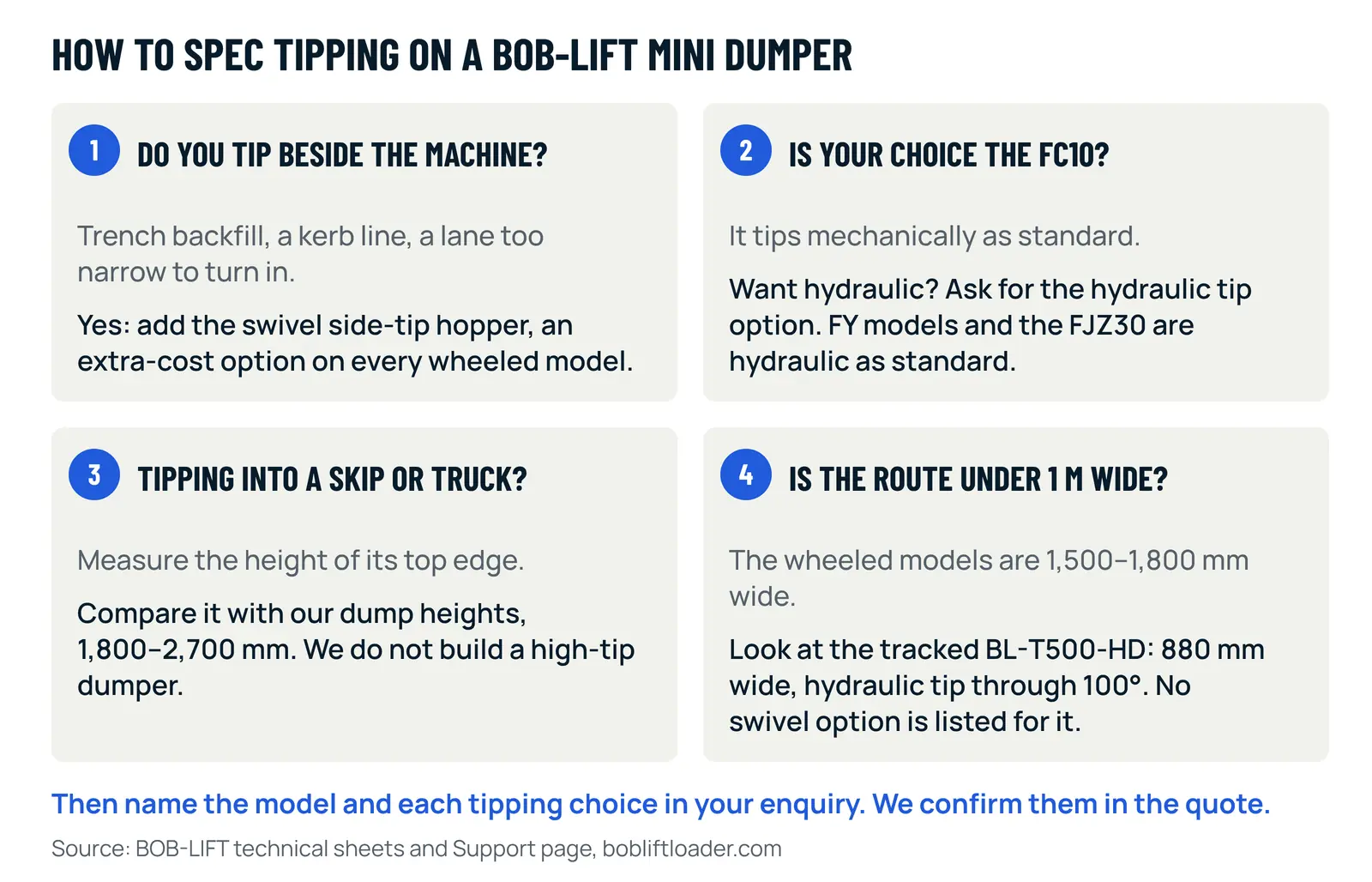
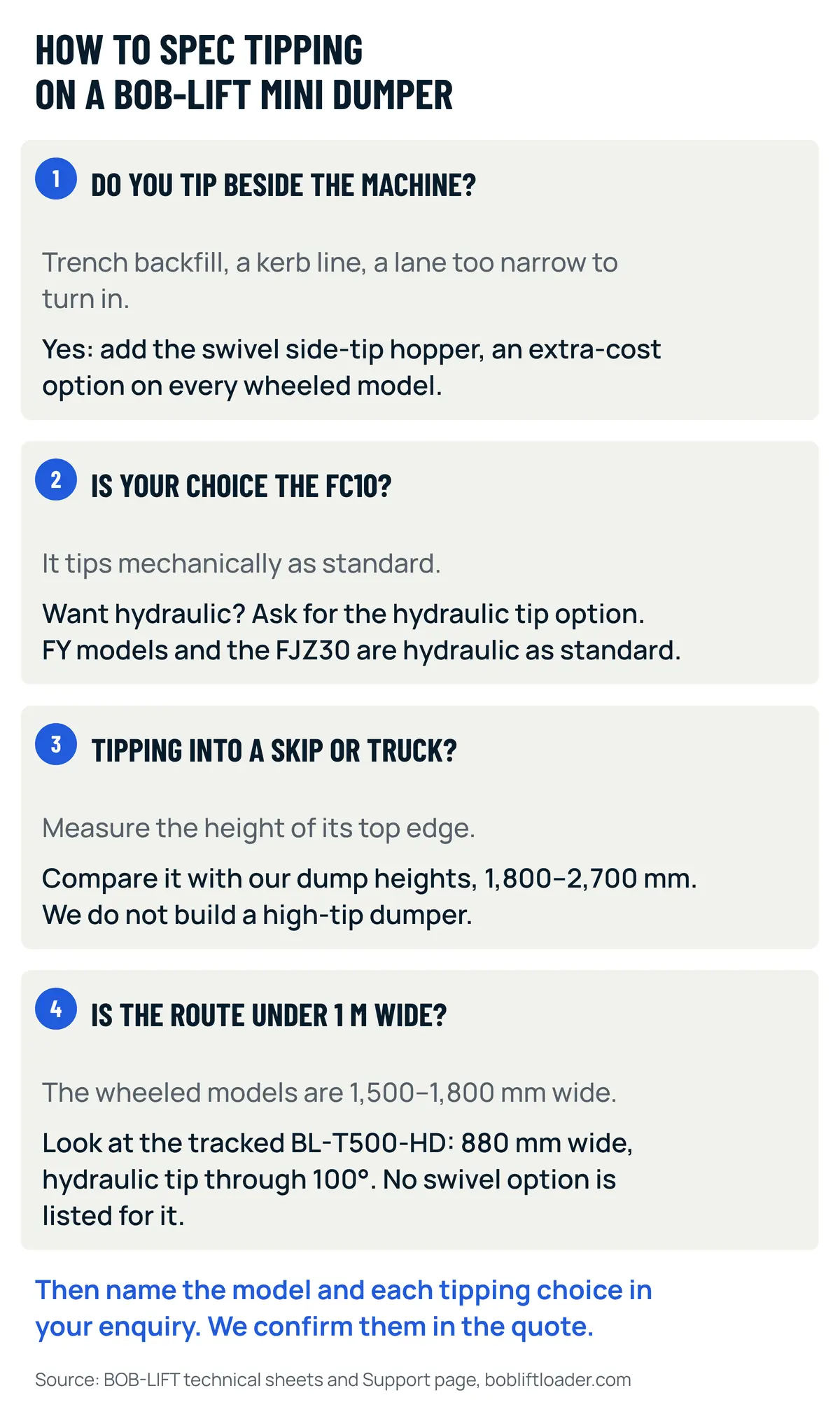
- Choose the model by load, width and ground. Our wheeled models are 1,500–1,800 mm wide. Compare 4×4 and 4×2 dumpers, and tracked and wheeled dumpers for narrow or soft routes.
- State the tipping. On the FC10, mechanical (the default) or hydraulic. On any wheeled model, add the swivel side-tip hopper if you tip beside the machine.
- Tell us where the load lands. A trench, a heap or a skip. Give the height of any edge you tip over, so we can check it against the dump height.
- Ask for the quote. The swivel hopper is an extra-cost option. We confirm the engine, running gear, colour and attachments in the quote.
Most of our mini dumpers ship in about 10 working days from order; the FJZ30 takes about 30. Quantity and configuration decide the date, which we confirm with your order. You can order a single machine, paid by T/T bank transfer. Our guide to buying a mini dumper from the factory covers lead times, containers and trade terms.
Frequently asked questions
What is a swivel dumper?
A swivel dumper is a site dumper whose hopper, or skip, turns on the chassis so the load can be tipped to the side rather than only forward. It helps where the tip point is beside the machine, such as a trench or a kerb line. On our range, the swivel side-tip hopper is an extra-cost option on all 8 wheeled models.
Do you make a high tip mini dumper?
No. Our mini dumpers are front-tip dumpers with an optional swivel hopper, and none of them lifts its hopper on arms. The highest dump height in our range is 2,700 mm (106.3 in), on the FJZ30. If the edge you tip over is higher than that, you need a high-tip dumper, which is a different class of machine.
Can a swivel hopper be fitted to any mini dumper?
On our range, the swivel side-tip hopper is listed as an option for every wheeled model: FC10, FY15, FY20-2, FY20-4, FY30, FY40, FY50 and FJZ30. It is not listed for the tracked BL-T500-HD or the BL-T200-HJ mixer. Choose it when you order, and ask us about any configuration not on the spec sheet.
What dump height do I need to tip into a skip?
The dump height has to be above the top edge of the skip, with a margin. Measure the edge on the ground where you will tip. Our wheeled models list dump heights from 1,800 mm (70.9 in) to 2,700 mm (106.3 in). If the edge is higher than the dump height of the model you want, tell us before you order.
Choosing your tipping set-up
Start with where the load has to land. Ahead of the machine, the front tip every wheeled model comes with does the job. Beside it, add the swivel side-tip hopper. Over a high edge, check the dump height first. Compare the models on our mini dumper range page, then tell us the job and the tipping you need, and we will quote the machine to match.