


Key takeaways
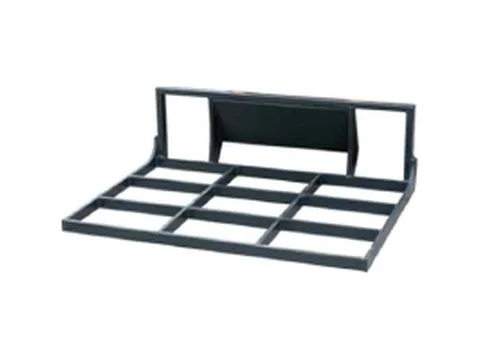
- A skid steer land leveler is a steel frame that you drag over loose soil or gravel to knock down high spots and fill low ones. Ours is an open grid frame that mounts on the quick-attach plate and needs no hydraulics.
- Use the bucket to move and dump material, then the leveler to spread and smooth it. A box grader cuts harder ground, a land plane shaves high spots over long runs, and a soil conditioner prepares the final seedbed.
- Grade away from buildings. The International Residential Code asks for a fall of at least 6 inches within the first 10 feet of a house foundation, about 150 mm over 3 m, or 5%.
- Plan material by volume. Topsoil 100 mm deep over 100 m² is 10 m³, which takes 53 to 100 level-full bucket trips on our loaders, depending on bucket size.
What is a skid steer land leveler?
A skid steer land leveler, also called a ground leveler or levelling attachment, is a frame of steel bars that rides flat on the ground in front of the loader. As the loader drives, the bars shave soil off the high spots, carry it along and drop it into the hollows. You end up with an even surface for turf, paving, a shed base or a gravel drive.
On our mini skid steer loader range page, the leveler (listed as “Leveller”) sits in the “Ground & lawn” group, listed to “Grade and spread loose material”. It is a rectangular grid of flat steel bars joined to an upright frame on the quick-attach plate. It has no motor and no hoses, so it fits any of our nine loaders on the plate alone.
Land leveler vs box grader vs land plane: which grading attachment?
Sellers use several names for grading attachments, and they do different jobs. A land leveler spreads loose material that is already there; a box grader or land plane cuts and carries more of it.
| Grading attachment | What it is | Cuts hard ground? | Best for |
|---|---|---|---|
| Grid-frame land leveler (ours) | An open steel grid on a mounting frame | No; it spreads loose soil and gravel | Final levelling of yards, lawns, shed bases and gravel drives |
| Box grader or box blade | A three-sided steel box with a cutting edge, often with ripper teeth | Yes, with the teeth down | Cutting and carrying more material in one pass |
| Land plane | A long frame with angled blades | Some; it shaves high spots over a long run | Larger areas such as arenas and long drives |
| Laser or GPS grader | A blade set by a laser or satellite system | Yes | Exact grades on commercial jobs |
We offer the grid-frame leveler, not a box grader or land plane. For hard or compacted ground, loosen it first with a ripper or rotary tiller, both listed in our mini skid steer attachments guide, then level it.
Leveler, bucket or soil conditioner: which tool for each step?
Levelling a yard uses more than one attachment. A mini skid steer changes tools in minutes on its quick-attach plate, so use each one for the step it does best:
| Step | Attachment | What it does |
|---|---|---|
| Loosen hard or compacted ground | Ripper or rotary tiller | Breaks up the surface so it can be moved and levelled |
| Cut high areas and move soil | Standard or 4-in-1 bucket | Digs, carries and dumps material; the 4-in-1 can also doze |
| Spread and smooth | Leveler | Drags loose material from high spots into low spots |
| Prepare a seedbed | Soil conditioner | Breaks clods, rakes out stones and levels the top layer in one pass |
A bucket can level too: lower it flat and back-drag it across the ground. It works for small areas, but the bucket’s straight edge tends to leave ridges at each end of a pass. The leveler’s wide frame bridges small bumps, so it leaves a flatter surface with less going back over the same ground. For turf, finish with a soil conditioner, which our tiller vs soil conditioner guide compares with the rotary tiller.
How much fall does a yard need?
Level does not mean flat. Water has to run somewhere, and it should run away from buildings. The International Residential Code, section R401.3, says: “Lots shall be graded to drain surface water away from foundation walls. The grade shall fall not fewer than 6 inches (152 mm) within the first 10 feet (3048 mm).” Where that is not possible, it calls for drains or swales, and it asks for hard surfaces within 10 feet of the foundation to slope “not less than 2 percent away from the building” (ICC, 2021 International Residential Code, Chapter 4). Local codes vary, so check yours.
Further from the house, a lawn needs much less. Washington State University Extension’s Home Lawns guide says “a slope of 6 inches per 100 feet is satisfactory”, and recommends finishing the grade “approximately one-half inch below” paths, kerbs and the foundation (WSU Extension, Home Lawns, EB0482E).
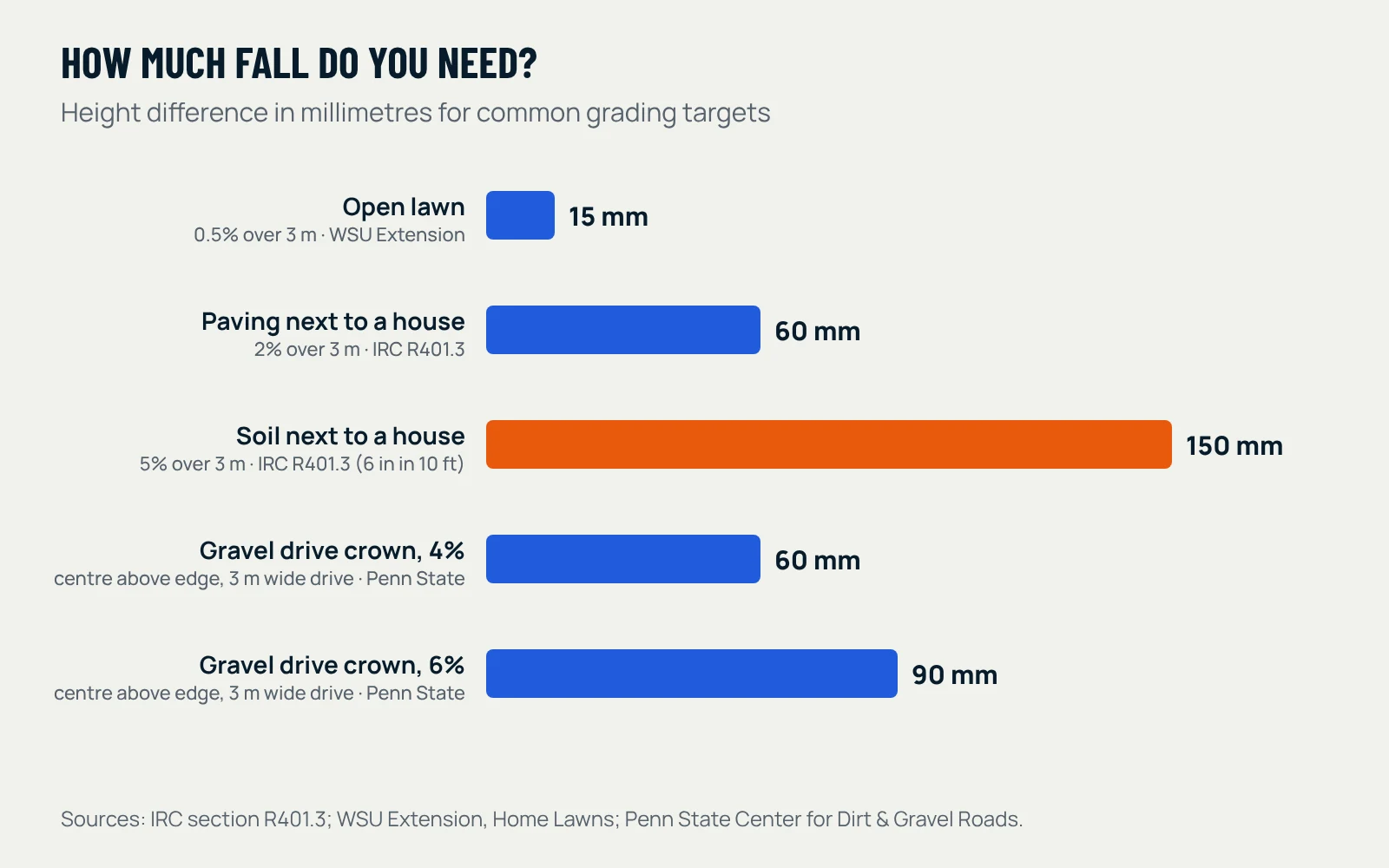

A quick way to turn a percentage into a measurement: multiply the distance by the percentage. Over 3 m, 1% is 30 mm, so 5% is 150 mm and 2% is 60 mm. Run a string line from a stake at the house to a stake 3 m out, set it level with a line level, and measure down to the ground at each end. The gap should be about 150 mm bigger at the far stake.
How to level a yard with a mini skid steer
Work in this order. Each step makes the next one quicker.
- Find buried services. Levelling is shallow, but cutting high spots, ripping and stripping turf can reach cables and pipes. In the US, 811 is “the free national before-you-dig service” (Common Ground Alliance, Call 811). Elsewhere, ask your local utility locating service.
- Set your grade. Mark the high and low points with stakes, decide where water should go, and string lines at the finished height.
- Work only when the soil is workable. Wet, sticky soil smears and compacts under the frame, the bucket and the wheels or tracks; wait until it crumbles in your hand.
- Strip and loosen. Remove turf and debris. If you are changing the grade a lot, WSU Extension advises that you “remove about 6 inches of the surface soil and spread it evenly over the area after completing the grading.” Loosen compacted ground with a ripper or tiller.
- Rough-grade with the bucket. Cut the high areas, carry soil to the low ones and dump it in small piles rather than one heap. Bring in extra topsoil the same way.
- Spread with the leveler. Lower the arms until the frame rests flat on the ground, then drive slowly. Many operators work in reverse, pulling the frame across the material, so the tracks or wheels run on ground that has not been levelled yet. Adjust the frame height and tilt with the loader controls to take a lighter or heavier cut.
- Cross the passes. Make a second set of passes at right angles to the first. This removes the long ridges that straight passes leave.
- Firm and check. Let loose fill settle, or firm it with a light roller, then fill the hollows that appear. Measure from your string lines every few passes, and leave the finished surface half an inch (about 13 mm) below paths and the foundation.
- Finish the surface. For turf, run a soil conditioner over the area or rake it by hand, then seed or lay turf.
On lawns and soft ground, make wide turns rather than spinning on the spot, which tears up the surface. Our mini skid steer for landscaping guide covers working on turf and in gardens.
How much topsoil or gravel do you need?
Work out the volume first: area multiplied by depth. A layer 100 mm deep over 100 m² is 10 m³. A layer 50 mm deep over the same area is 5 m³. In feet, a 4-inch layer over 1,000 sq ft is about 12.3 cubic yards.
Then work out how many bucket trips that takes. Our loaders take standard buckets of 0.1, 0.15 or 0.19 m³. Loam weighs about 1,280 kg/m³ (Engineering ToolBox, Dirt and Mud Densities), so a level-full bucket weighs 128 to 243 kg, inside every loader’s rated load. Our mini skid steer bucket capacity and size guide works out bucket weights for other materials.
| Loader | Bucket | Rated load | Trips for 10 m³ of topsoil | Trips for 10 m³ of dry gravel |
|---|---|---|---|---|
| BL-T1000-H | 0.19 m³ | 500 kg | 53 | 53 |
| BL-T750-H, BL-S750-H | 0.15 m³ | 410 kg, 400 kg | 67 | 67 |
| BL-T460-H | 0.15 m³ | 300 kg | 67 | 67 |
| BL-T360-H | 0.15 m³ | 200 kg | 67 | 89 |
| BL-S390-C, BL-T390-C, BL-S490-C, BL-T490-C | 0.1 m³ | 250–260 kg | 100 | 100 |
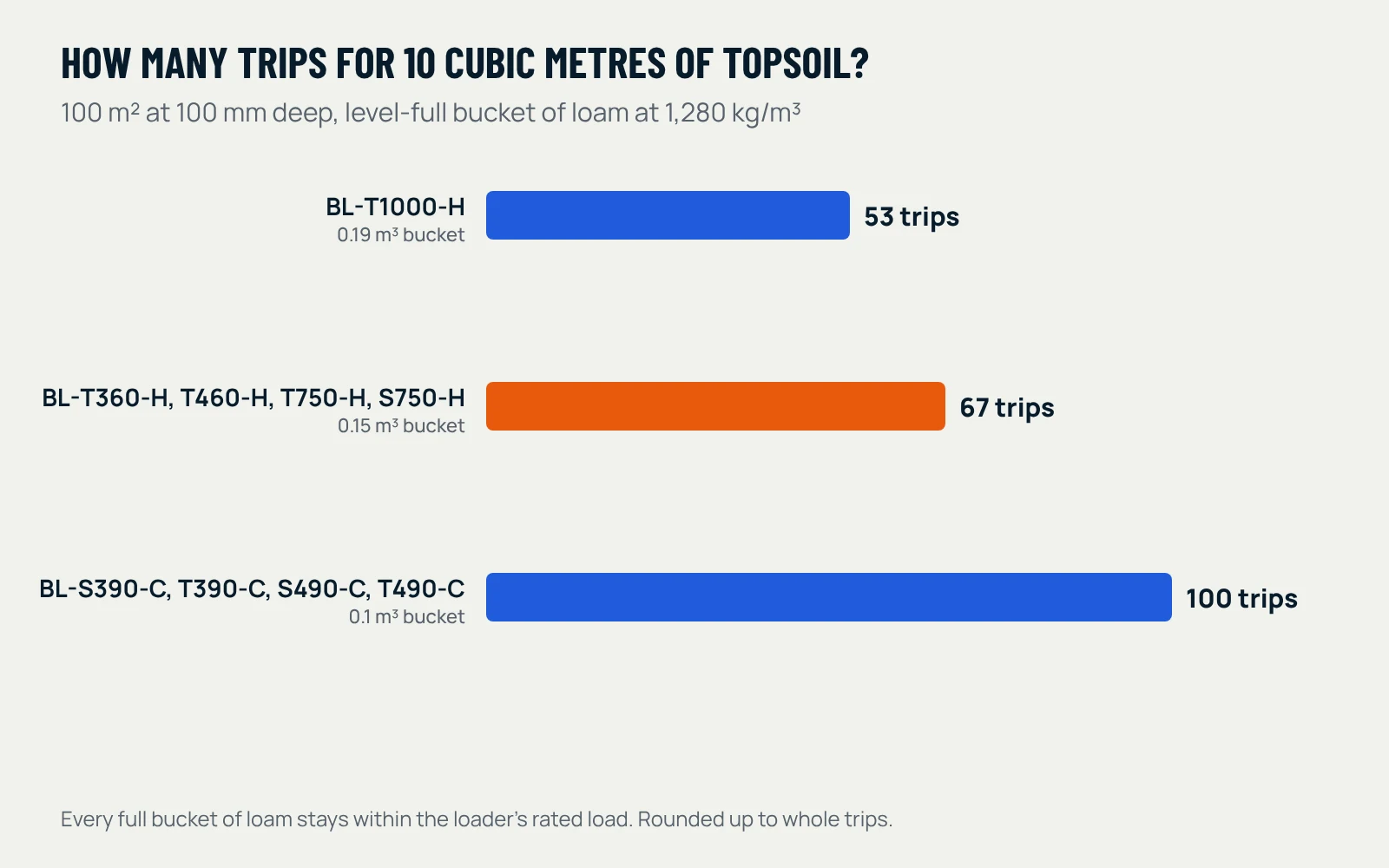
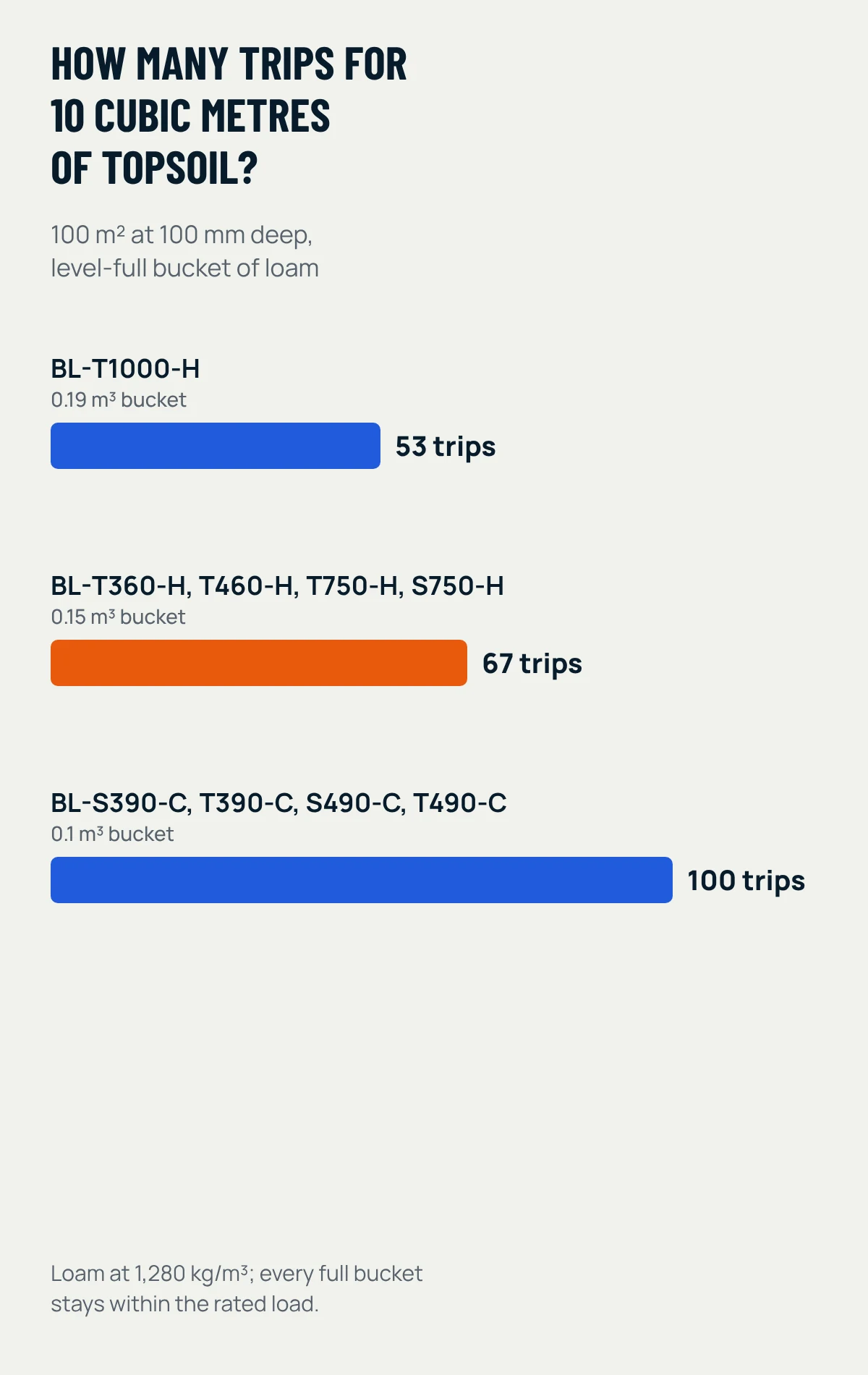
Dry gravel, at about 1,680 kg/m³ in the same source, changes only one row: a level-full 0.15 m³ bucket weighs 252 kg, over the 200 kg rating of the BL-T360-H, so fill it no more than about three-quarters full (about 190 kg) and allow 89 trips. Loose soil settles after spreading, so order a little more than the volume you calculate.
The trip count is why delivery position matters. Have the load tipped as close to the work as the truck can get. On a big job, a site dumper can carry material to the far end while the loader spreads.
Grading a gravel driveway
A gravel drive should shed water to the sides, not hold it in the middle. Penn State’s Center for Dirt and Gravel Roads Studies says “the recommended cross-slope is between 4% and 6%” (Penn State CDGRS, Crown & Cross-Slope). On a crowned drive, that slope runs from the centre line to each edge.
| Driveway width | Centre higher than edge at 4% | Centre higher than edge at 6% |
|---|---|---|
| 3.0 m (10 ft) | 60 mm | 90 mm |
| 3.5 m (11.5 ft) | 70 mm | 105 mm |
| 4.0 m (13 ft) | 80 mm | 120 mm |
To regrade a rutted drive: loosen the surface with a ripper if it has packed hard, pull gravel from the edges back towards the middle with the bucket, and then drag the leveler along the drive to fill the potholes and shape the crown. Work along the length of the drive, not across it. Top up with fresh gravel where the layer has worn thin.
Rubber tyres suit a firm gravel drive. Our wheeled BL-S390-C, BL-S490-C and BL-S750-H reach 6 km/h, against 5 km/h for their tracked twins. Our tracked vs wheeled mini skid steer guide explains the trade-off.
Which mini skid steer suits a land leveler?
Every one of our nine loaders can carry the leveler, because it needs only the quick-attach plate. Choose by ground, access and how much material you move:
- Lawns and soft ground. Tracks spread the weight. The stand-on BL-T460-H and BL-T360-H are 1,090 mm and 930 mm wide, and the BL-T360-H is our narrowest. Our weight and dimensions guide lists every width with the bucket on.
- Bigger areas. The BL-T1000-H, with the 0.19 m³ bucket and a 500 kg rating, moves the most material per trip.
- Long days. The seated BL-T390-C, BL-T490-C, BL-S390-C and BL-S490-C suit longer shifts. Our stand-on vs seated guide compares the two operator positions.
Tell us your loader when you order the leveler, and we confirm the fit on your quick-attach plate.
Safety when grading
- Keep the load low on slopes. Carry the bucket close to the ground, and drive straight up and down slopes rather than across them. Follow the slope limits in your operator’s manual.
- Keep people clear. In reverse, look behind you before every pass. Keep children, pets and helpers out of the work area.
- Check for services first. Call 811 in the US, or your local locating service, before you cut or rip.
- Protect your hearing. Our product pages note that noise at the operator position can exceed 85 dB(A) at full engine speed on some models. Wear hearing protection.
Before each day, run through our skid steer maintenance checklist.
Skid steer land leveler FAQ
What does a land leveler do on a skid steer?
It spreads and smooths loose soil or gravel. The frame shaves off high spots, carries the material forward and drops it into low spots, leaving an even surface ready for turf, paving or a gravel finish.
Can you level a yard with a skid steer bucket?
Yes, for small areas. Back-drag the bucket with its edge flat. A leveler covers ground faster and leaves fewer ridges, because its wide frame bridges small bumps.
Does a land leveler need hydraulics?
Our leveler does not. It mounts on the quick-attach plate and works from the loader’s lift and tilt, so it suits all nine of our mini skid steers.
What slope should a yard have away from a house?
The International Residential Code asks for at least 6 inches of fall within the first 10 feet, about 150 mm over 3 m. Further out, WSU Extension calls 6 inches per 100 feet satisfactory for a lawn.
Is a land leveler the same as a box grader?
No. A box grader is a three-sided box with a cutting edge that cuts and carries more material. A grid land leveler spreads and smooths loose material that is already in place.
What is the difference between a land plane and a land leveler?
A land plane is a long frame with angled blades that shaves high spots over long runs, such as arenas and drives. A grid land leveler spreads and smooths loose material that is already in place, which suits yards, lawns and the tighter spaces a mini skid steer works in.
Planning a levelling job
Measure the area, decide which way water should run, and work out how much topsoil or gravel you need. Then compare our nine mini skid steer loaders, or see the full list of attachments that share the same machine. When you ask for a quote, tell us the size of the area, the ground, your narrowest gate or path and the other attachments you need, and we suggest the loader and tools to match.
Specifications checked against our product pages on 26 October 2026.