


A mini skid steer spec sheet tells you four things before you buy: how much the loader can carry safely, whether it fits the access on your jobs, which engine and emission paperwork it comes with, and which attachments it can run. Read the rated load first, then the machine width, then the engine. Everything else refines the choice. Across the nine mini skid steers we build in Xuzhou, China, rated loads run from 200 to 500 kg (441 to 1,102 lb) and widths from 930 to 1,090 mm (36.6 to 42.9 inches).
This guide goes through a spec sheet line by line, using the published figures for all nine of our loaders. It is written for dealers, rental fleets and contractors comparing quotations from different factories, and each section gives the short answer before linking to a longer guide on that particular subject.
Key takeaways
- Plan every job around the rated load, not the higher lifting capacity. On our loaders the gap between the two is 30 to 150 kg (66 to 331 lb).
- Machine width decides which gates and doors the loader passes. Our narrowest is the BL-T360-H at 930 mm (36.6 inches).
- Check max dumping height, not working height, against the side of the skip or truck you load. Ours runs from 1,340 to 1,826 mm (52.8 to 71.9 inches).
- The engine model and its emission certificate decide where the loader can be sold and used. Confirm both on the quotation.
- The quick-attach plate is not on the spec sheet, and its size differs between our models. Check it before you order attachments.
Our nine mini skid steers at a glance
Our range splits into three groups: small stand-on tracked loaders (BL-T360-H, BL-T460-H), seated loaders on tyres or tracks (the 390 and 490 models), and larger diesel stand-on loaders (BL-S750-H, BL-T750-H, BL-T1000-H). In model names, T means tracks, S means tyres, H means a stand-on platform and C means a seat. The table gives the five lines most buyers compare first.
| Model | Running gear | Operator | Rated load | Width | Weight | Engine |
|---|---|---|---|---|---|---|
| BL-T360-H | Tracks | Stand-on | 200 kg (441 lb) | 930 mm (36.6 in) | 650 kg (1,433 lb) | 7.6 kW, petrol or diesel |
| BL-T460-H | Tracks | Stand-on | 300 kg (661 lb) | 1,090 mm (42.9 in) | 730 kg (1,609 lb) | 16.8 kW, petrol or diesel |
| BL-S390-C | Tyres | Seated | 260 kg (573 lb) | 959 mm (37.8 in) | 650 kg (1,433 lb) | 7.6 kW, petrol or diesel |
| BL-T390-C | Tracks | Seated | 250 kg (551 lb) | 955 mm (37.6 in) | 750 kg (1,653 lb) | 7.6 kW, petrol or diesel |
| BL-S490-C | Tyres | Seated | 250 kg (551 lb) | 1,089 mm (42.9 in) | 850 kg (1,874 lb) | 16.8 kW, petrol or diesel |
| BL-T490-C | Tracks | Seated | 250 kg (551 lb) | 1,089 mm (42.9 in) | 950 kg (2,094 lb) | 16.8 kW, petrol or diesel |
| BL-S750-H | Tyres | Stand-on | 400 kg (882 lb) | 985 mm (38.8 in) | 1,000 kg (2,205 lb) | 18.6 kW, diesel |
| BL-T750-H | Tracks | Stand-on | 410 kg (904 lb) | 985 mm (38.8 in) | 1,100 kg (2,425 lb) | 18.6 kW, diesel |
| BL-T1000-H | Tracks | Stand-on | 500 kg (1,102 lb) | 960 mm (37.8 in) | 1,250 kg (2,756 lb) | 17.8 kW, diesel |
All figures come from our product pages as published on 15 November 2026, and the imperial values are converted from the metric figures and rounded. You can filter the same models by load and width on our mini skid steer loaders page.
In what order should you read a spec sheet?
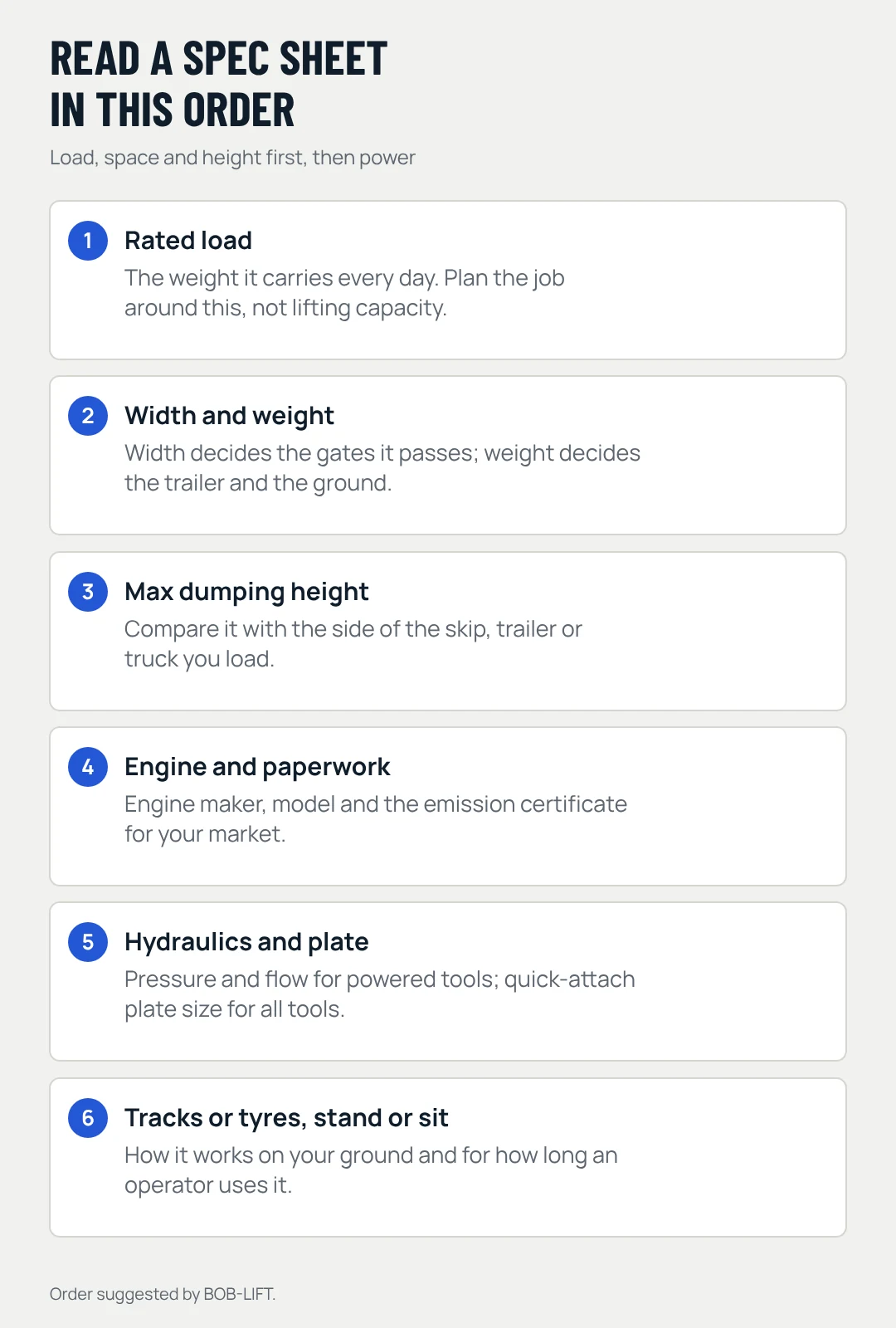
Read it in the order the job limits you. First, the load you must carry; second, the space the machine must pass through; third, the height it must reach; and only then power, hydraulics and travel speed. A loader that fails on load or width is the wrong machine whatever its engine.

Rated load and lifting capacity
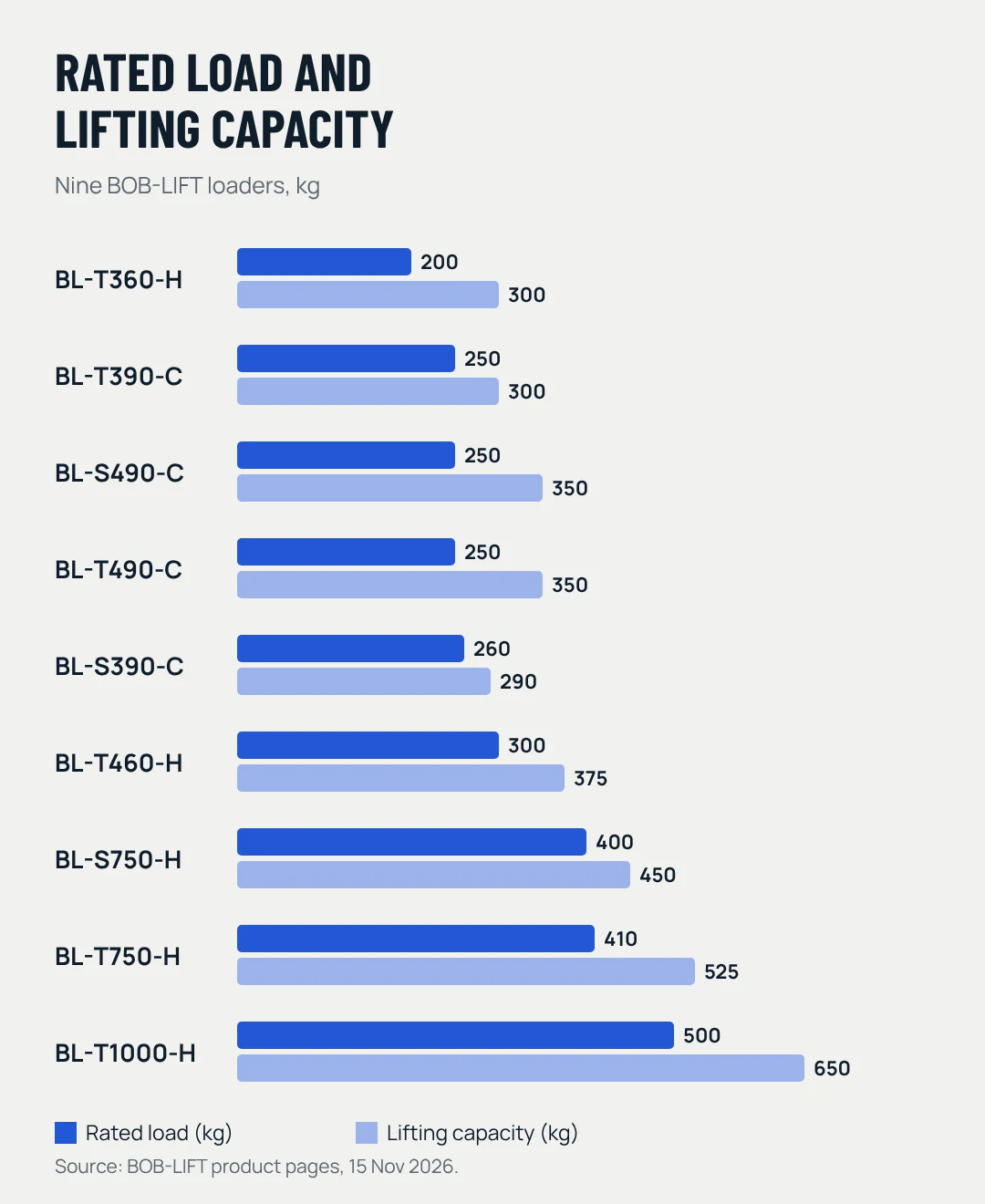
Rated load, also called rated operating capacity, is the weight the loader is designed to carry in everyday work. Lifting capacity is a higher figure that some sheets, including ours, publish as well. Plan your work around the rated load. ISO 14397-1 sets out how rated operating capacity is calculated for loaders and how the calculated tipping load is checked by test [1]. Factories do not all publish the same figure, so when two quotations differ, first check which number each one quotes.
| Model | Rated load | Lifting capacity | Bucket |
|---|---|---|---|
| BL-T360-H | 200 kg (441 lb) | 300 kg (661 lb) | 0.15 m³ (5.3 cu ft) |
| BL-T460-H | 300 kg (661 lb) | 375 kg (827 lb) | 0.15 m³ (5.3 cu ft) |
| BL-S390-C | 260 kg (573 lb) | 290 kg (639 lb) | 0.1 m³ (3.5 cu ft) |
| BL-T390-C | 250 kg (551 lb) | 300 kg (661 lb) | 0.1 m³ (3.5 cu ft) |
| BL-S490-C | 250 kg (551 lb) | 350 kg (772 lb) | 0.1 m³ (3.5 cu ft) |
| BL-T490-C | 250 kg (551 lb) | 350 kg (772 lb) | 0.1 m³ (3.5 cu ft) |
| BL-S750-H | 400 kg (882 lb) | 450 kg (992 lb) | 0.15 m³ (5.3 cu ft) |
| BL-T750-H | 410 kg (904 lb) | 525 kg (1,157 lb) | 0.15 m³ (5.3 cu ft) |
| BL-T1000-H | 500 kg (1,102 lb) | 650 kg (1,433 lb) | 0.19 m³ (6.7 cu ft) |
Bucket size alone does not tell you the load. A level-full 0.15 m³ bucket of dry sand, at about 1,555 kg/m³ [2], weighs about 233 kg (514 lb). That is already more than the 200 kg rated load of the BL-T360-H, although it carries a 0.15 m³ bucket. With heavy material, fill by weight, not to the rim. Our mini skid steer lift capacity guide explains rated load, lifting capacity and tipping load in detail, and our mini skid steer bucket guide covers bucket sizes and materials.

Machine width, length and weight
Machine width decides access; weight decides the trailer and the ground. Measure the narrowest gate, door or path on your typical job, then leave room on each side for steering. Our seated 490 models and the BL-T460-H are the widest at 1,089 to 1,090 mm (42.9 inches). The BL-T360-H, at 930 mm (36.6 inches), passes where the others cannot.
Weight runs from 650 kg (1,433 lb) on the BL-T360-H and BL-S390-C to 1,250 kg (2,756 lb) on the BL-T1000-H. Add the attachment and the trailer when you check the towing limit of your vehicle. Length with the bucket fitted runs from 1,906 mm (75.0 inches) to 2,836 mm (111.7 inches). Our mini skid steer weight and dimensions table lists every measurement, and the smallest tracked skid steer guide compares our narrowest models.
Working height, dumping height and arms raised
Our spec sheets list three heights, and they answer different questions. Max dumping height is the one to compare with the side of the skip, trailer or truck you load. Height with arms raised is the overall height at full lift, which matters under doorways, branches and overhead lines. Working height sits between the two on every model.
| Model | Max dumping height | Working height | Height with arms raised | Overall height |
|---|---|---|---|---|
| BL-T360-H | 1,340 mm (52.8 in) | 1,650 mm | 2,230 mm | 1,226 mm |
| BL-T460-H | 1,340 mm (52.8 in) | 1,650 mm | 2,230 mm | 1,267 mm |
| BL-S390-C | 1,376 mm (54.2 in) | 1,600 mm | 2,460 mm | 1,300 mm |
| BL-T390-C | 1,404 mm (55.3 in) | 1,830 mm | 2,488 mm | 1,300 mm |
| BL-S490-C | 1,382 mm (54.4 in) | 1,650 mm | 2,466 mm | 1,300 mm |
| BL-T490-C | 1,402 mm (55.2 in) | 1,700 mm | 2,489 mm | 1,300 mm |
| BL-S750-H | 1,700 mm (66.9 in) | 2,140 mm | 2,920 mm | 1,550 mm |
| BL-T750-H | 1,826 mm (71.9 in) | 2,230 mm | 2,880 mm | 1,550 mm |
| BL-T1000-H | 1,522 mm (59.9 in) | 2,102 mm | 2,794 mm | 1,548 mm |
The BL-T750-H dumps highest, at 1,826 mm (71.9 inches), and reaches 2,880 mm (113.4 inches) with the arms raised. If you load skips, our guide to loading skips with a mini skid steer shows how to match dump height to the skip side.
Engine, fuel and emissions
The engine line tells you power, fuel and, most importantly, which emission rules the machine can meet. Our six smaller loaders take single- or twin-cylinder engines in petrol or diesel, from makers such as KOOP, Rato, Zongshen and Briggs & Stratton. The three largest, the BL-S750-H, BL-T750-H and BL-T1000-H, are diesel only, with a three-cylinder Laidong 385B, Yanmar 3TNV80 or Kubota D1105 depending on the model. Our guide to Kubota, Yanmar and Laidong engines compares those three, and diesel or petrol mini skid steer covers the fuel choice.
| Model | Engine | Fuel | Hydraulic pressure | Max travel speed | Gradeability |
|---|---|---|---|---|---|
| BL-T360-H | 7.6 kW (10.2 hp), 1-cylinder | Petrol or diesel | 17 MPa (2,466 psi) | 6 km/h (3.7 mph) | 30° |
| BL-T460-H | 16.8 kW (22.5 hp), 2-cylinder | Petrol or diesel | 17 MPa (2,466 psi) | 6 km/h (3.7 mph) | 30° |
| BL-S390-C | 7.6 kW (10.2 hp), 1-cylinder | Petrol or diesel | 16 MPa (2,321 psi) | 6 km/h (3.7 mph) | 25° |
| BL-T390-C | 7.6 kW (10.2 hp), 1-cylinder | Petrol or diesel | 16 MPa (2,321 psi) | 5 km/h (3.1 mph) | 25° |
| BL-S490-C | 16.8 kW (22.5 hp), 2-cylinder | Petrol or diesel | 16 MPa (2,321 psi) | 6 km/h (3.7 mph) | 25° |
| BL-T490-C | 16.8 kW (22.5 hp), 2-cylinder | Petrol or diesel | 16 MPa (2,321 psi) | 5 km/h (3.1 mph) | 25° |
| BL-S750-H | 18.6 kW (24.9 hp), 3-cylinder | Diesel | 18 MPa (2,611 psi) | 6 km/h (3.7 mph) | 25° |
| BL-T750-H | 18.6 kW (24.9 hp), 3-cylinder | Diesel | 18 MPa (2,611 psi) | 5 km/h (3.1 mph) | 25° |
| BL-T1000-H | 17.8 kW (23.9 hp), 3-cylinder | Diesel | 20 MPa (2,901 psi) | 6 km/h (3.7 mph) | 25° |
Our sheets list EPA Phase 3 (petrol), EPA Tier 4 (diesel) and EU Stage V as the emission standards. What counts on your order is the exact engine model and its certificate. In the United States, EPA publishes certification data for each certified nonroad engine family, so you can check the family on the engine label against that list [3]. In the European Union, Regulation (EU) 2016/1628 sets the Stage V limits for engines in non-road mobile machinery [4]. Ask us to name the engine model and the certificate in the quotation, not only the standard.
Hydraulic pressure and attachments
Our loaders work at 16 to 20 MPa (2,321 to 2,901 psi), with the highest pressure on the BL-T1000-H. Pressure is one half of what an attachment needs; the other half is oil flow. Our spec sheets do not list auxiliary flow, so send us the hydraulic requirements of any powered attachment, such as an auger, trencher or breaker, and we check it against the model you want. The mini skid steer attachments guide lists what each loader can run.
The quick-attach plate is the other attachment check, and it is not on the spec sheet at all. ISO 24410 sets the mounting frame for full-size skid steer attachments, and it allows small skid steers a different width [5]. On our range, the plate is the same on every loader of one model but differs between models. Our quick attach plate guide lists the six measurements to send us.
Running gear, operator station and speed
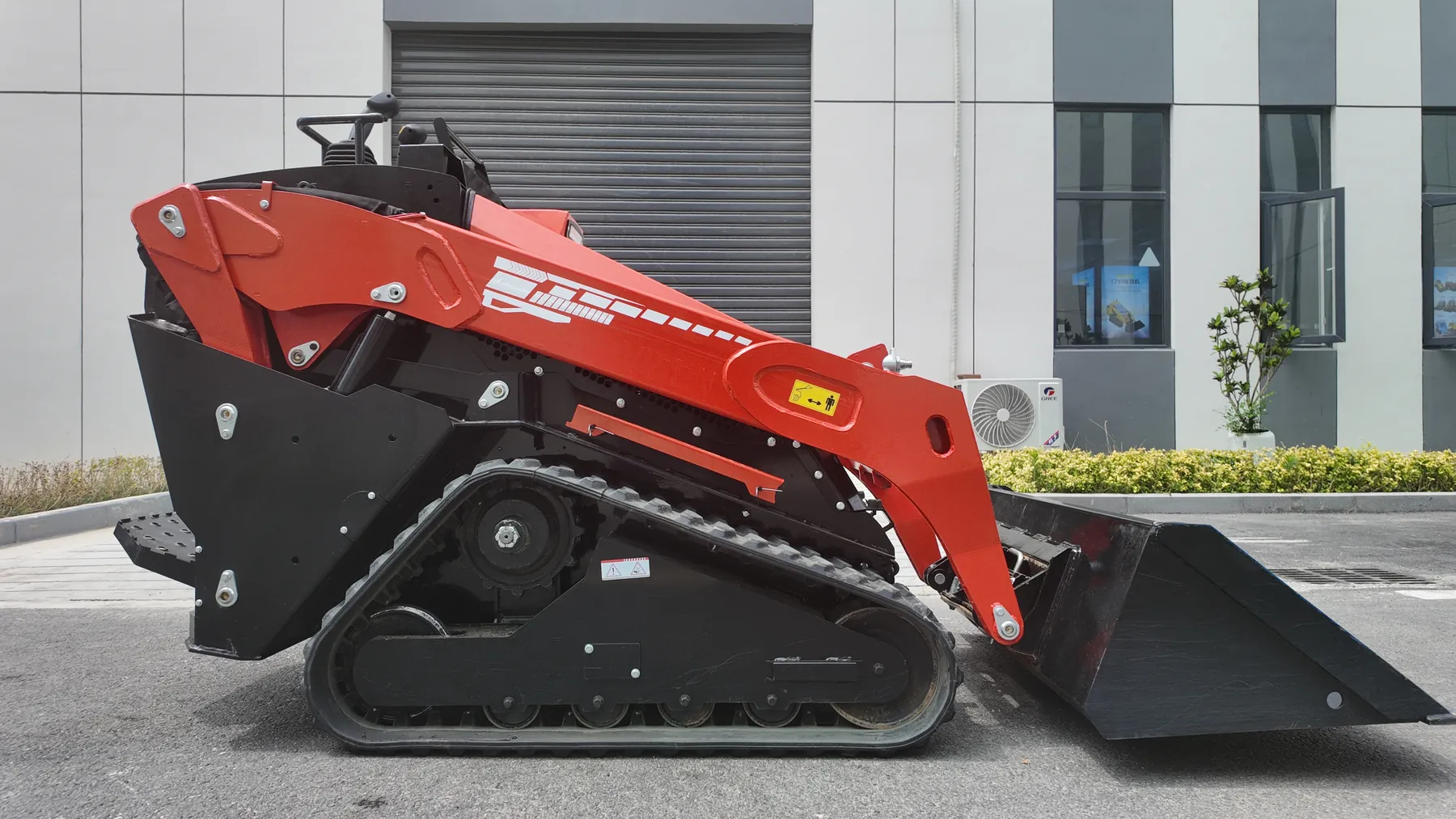
Running gear and the operator station shape how the loader works more than any single number. Tracks spread the weight on soft ground and lawns; tyres travel faster on hard surfaces and cost less to replace. A stand-on platform lets the operator step off quickly and see the attachment well; a seat suits long shifts. Our tracked stand-on BL-T360-H and BL-T460-H list the steepest gradeability, 30°, against 25° for the other seven.
Top speed is 5 to 6 km/h (3.1 to 3.7 mph) on every model, so speed rarely separates our loaders. For the details, read tracked or wheeled mini skid steer, stand-on or seated mini skid steer and our mini skid steer track sizes for replacement tracks.
How to compare two quotations line by line
When two factories quote similar loaders, line up the sheets and check five things before you compare prices:
- Same load figure. Is each sheet quoting rated load or a higher lifting or tipping figure?
- Same units. Convert kg, mm and MPa to one system. Our figures are metric, with imperial conversions on our pages.
- Named engine. Is the engine maker and model written, with the emission certificate for your market?
- Attachment fit. Does the plate match the attachments you own, and does the hydraulic supply suit the powered ones?
- What is included. Bucket, filters, manual and spare parts can differ between quotations.
Our mini skid steer for sale guide covers lead times, trade terms and warranty once the specification is settled.
Frequently asked questions
What is the most important line on a mini skid steer spec sheet?
The rated load. It is the weight the loader is designed to carry in everyday work, and every other choice follows from it. On our nine loaders it runs from 200 to 500 kg (441 to 1,102 lb).
Why does a spec sheet show two load figures?
Our specification sheets show the rated load and a higher lifting capacity, and you should plan everyday work around the rated load. Other factories may quote a tipping load instead, so check carefully which figure each quotation uses.
Which of your mini skid steers is the narrowest?
The BL-T360-H, a tracked stand-on loader rated for 200 kg, at 930 mm (36.6 inches) wide and 650 kg (1,433 lb) in operating weight.
Do your spec sheets list auxiliary hydraulic flow?
No. They list hydraulic pressure, 16 to 20 MPa depending on the model, so please send us the requirements of your powered attachment and we will check it against the loader you are considering.
How we got these figures
Every machine figure in this guide comes from our nine product pages as published on 15 November 2026. Imperial values are our own conversions of the metric figures, rounded for easy reading. The material density comes from the Engineering ToolBox, and the standards and regulations link to BSI, ISO, the US EPA and EUR-Lex. Read more about our factory and company.
Ask for a specification and quotation
Tell us the heaviest load you move, the narrowest access on your jobs, your country and the attachments you plan to run. We reply with the model that fits, its full spec sheet and a quotation. Compare all nine loaders first, or send us your requirements now.