


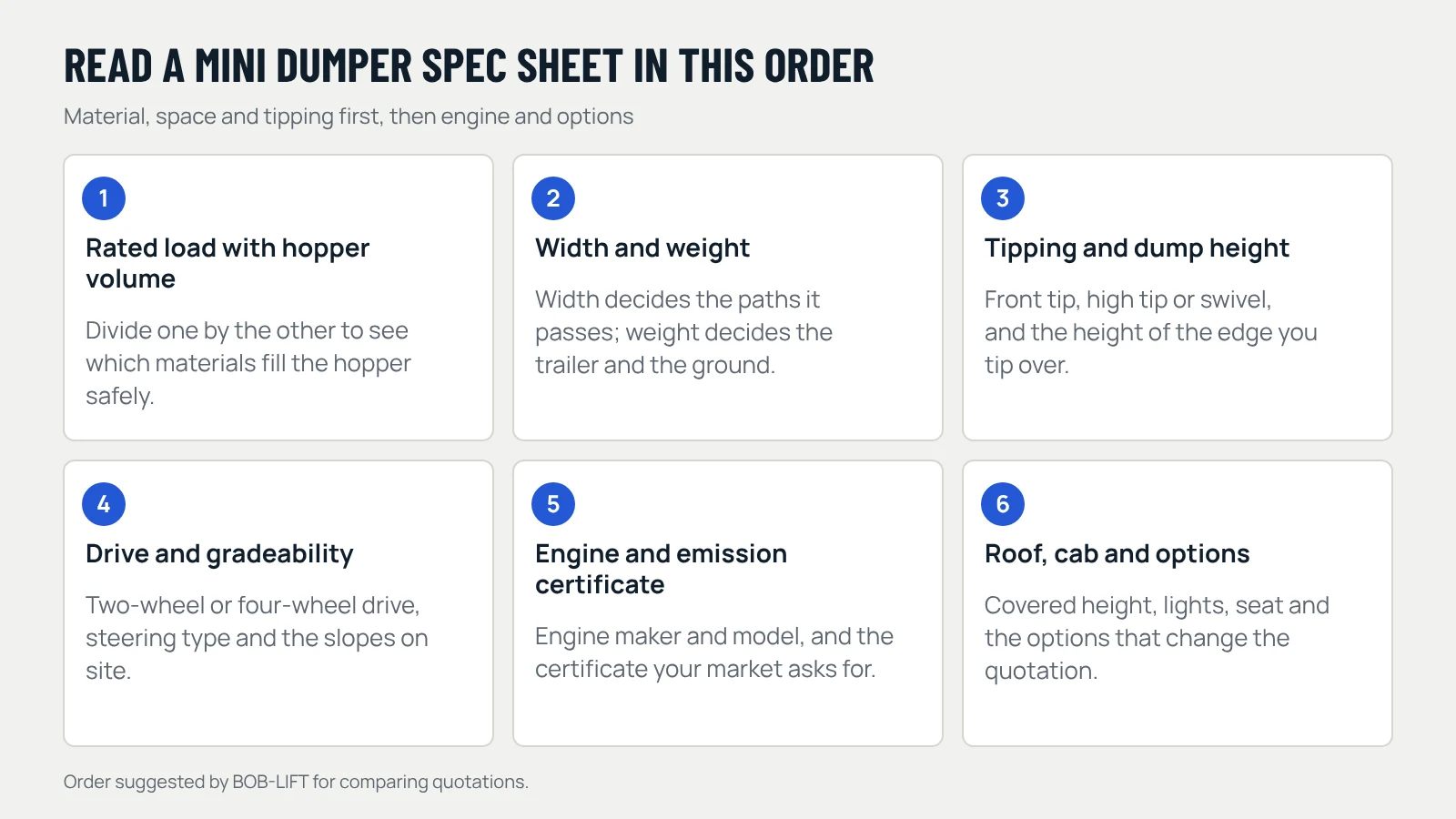
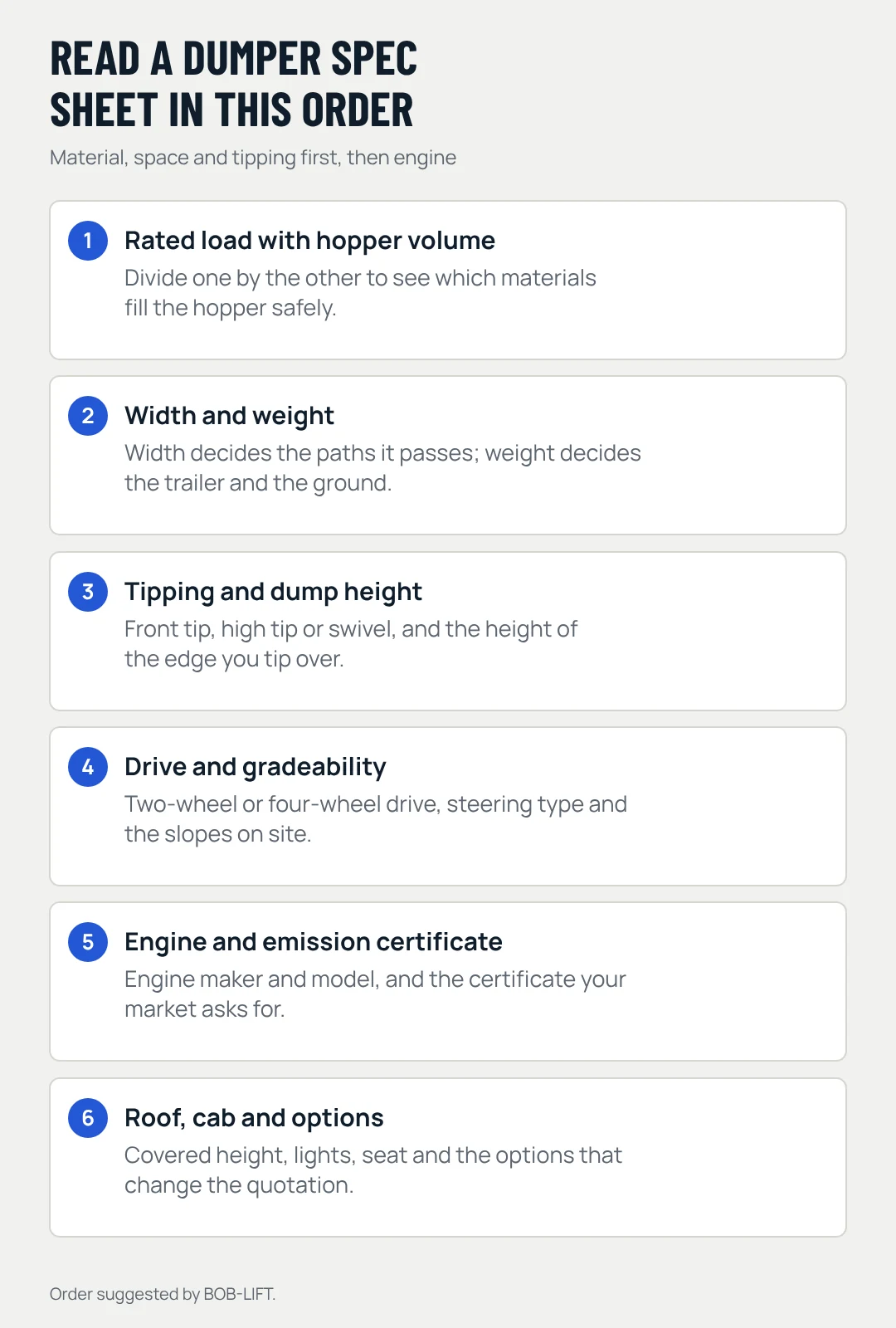
A mini dumper spec sheet answers four questions before you buy: how much the machine carries, whether the hopper suits your material, whether it fits your site and transport, and which engine paperwork comes with it. Read the rated load and hopper volume together first, then width and weight, then tipping, drive and engine. Our mini dumpers, built in Xuzhou, China, carry from 500 kg (1,102 lb) on the tracked BL-T500-HD to 5,000 kg (11,023 lb) on the FY50, with hoppers from 0.2 to 1.5 m³ (7.1 to 53.0 cu ft).
This guide explains each line of a dumper spec sheet with the published figures for our models. It is written for rental fleets, dealers and contractors who compare dumpers from more than one factory, and each section gives the short answer before linking to a longer guide on that particular subject.
Key takeaways
- Read rated load and hopper volume together. Divide one by the other to see which materials fill the hopper before the weight limit.
- Our 4×4 dumpers weigh 2,100 to 3,920 kg (4,630 to 8,642 lb) empty, two to four times the 4×2 models. Check transport before you choose.
- Every wheeled model front-tips through 45°, with dump heights of 1,800 to 2,700 mm (70.9 to 106.3 inches). A swivel hopper is an option; we do not build a high-tip dumper.
- A roof or cab adds 700 to 950 mm (27.6 to 37.4 inches) to the height. Check doors, containers and trailers against the covered height.
- Our wheeled diesels are supplied without an emission certificate as standard. A certified engine is an extra-cost option, and it decides where the machine can work.
Our mini dumpers at a glance
We build one tracked carrier, the BL-T500-HD, and eight wheeled dumpers from the 1 ton FC10 to the 5 ton FY50. The tracked BL-T200-HJ mixer dumper is specified by its 200 L drum volume rather than a rated load, so it is not included in the tables below, which show the specification lines most buyers compare first.
| Model | Rated load | Hopper | Drive | Width | Weight | Engine |
|---|---|---|---|---|---|---|
| BL-T500-HD | 500 kg (1,102 lb) | 0.2 m³ (7.1 cu ft) | Rubber tracks | 880 mm (34.6 in) | 410 kg (904 lb) | 4.8 kW petrol |
| FC10 | 1,000 kg (2,205 lb) | 0.8 m³ (28.3 cu ft) | 4×2 | 1,500 mm (59.1 in) | 800 kg (1,764 lb) | 12.1 kW diesel |
| FY15 | 1,500 kg (3,307 lb) | 0.8 m³ (28.3 cu ft) | 4×2 | 1,500 mm (59.1 in) | 830 kg (1,830 lb) | 13.2 kW diesel |
| FY20-2 | 2,000 kg (4,409 lb) | 1.0 m³ (35.3 cu ft) | 4×2 | 1,600 mm (63.0 in) | 900 kg (1,984 lb) | 17 kW diesel |
| FY20-4 | 2,000 kg (4,409 lb) | 1.2 m³ (42.4 cu ft) | 4×4 | 1,700 mm (66.9 in) | 2,100 kg (4,630 lb) | 27.5 kW diesel |
| FJZ30 | 3,000 kg (6,614 lb) | 1.5 m³ (53.0 cu ft) | 4×4 | 1,700 mm (66.9 in) | 3,920 kg (8,642 lb) | 37 kW diesel |
| FY30 | 3,000 kg (6,614 lb) | 1.5 m³ (53.0 cu ft) | 4×4 | 1,700 mm (66.9 in) | 2,200 kg (4,850 lb) | 37 kW diesel |
| FY40 | 4,000 kg (8,818 lb) | 1.5 m³ (53.0 cu ft) | 4×4 | 1,700 mm (66.9 in) | 2,400 kg (5,291 lb) | 40 kW diesel |
| FY50 | 5,000 kg (11,023 lb) | 1.5 m³ (53.0 cu ft) | 4×4 | 1,800 mm (70.9 in) | 2,600 kg (5,732 lb) | 65 kW diesel |
All figures come from our product pages on 15 November 2026; imperial values are our rounded conversions. You can compare the whole range on our mini dumpers page.
In what order should you read a dumper spec sheet?
Read it in the order the job limits you: the weight and type of material, the available space on site and on the transport, how and where you tip, and then the engine and its certification paperwork. A dumper that is too heavy for your trailer or too tall for your workshop door is the wrong machine, whatever its advertised payload.
Rated load and hopper volume: read them together
Rated load is the weight the dumper is designed to carry in normal operation, and hopper volume is the space that load occupies. Dividing the first by the second gives the heaviest material density that fills the hopper completely without exceeding the weight limit. Denser material reaches the rated load before the hopper is full, so in practice you should fill it by weight rather than by eye.
| Model | Rated load | Hopper | Rated load ÷ hopper |
|---|---|---|---|
| BL-T500-HD | 500 kg | 0.2 m³ | 2,500 kg/m³ |
| FC10 | 1,000 kg | 0.8 m³ | 1,250 kg/m³ |
| FY15 | 1,500 kg | 0.8 m³ | 1,875 kg/m³ |
| FY20-2 | 2,000 kg | 1.0 m³ | 2,000 kg/m³ |
| FY20-4 | 2,000 kg | 1.2 m³ | 1,667 kg/m³ |
| FJZ30 | 3,000 kg | 1.5 m³ | 2,000 kg/m³ |
| FY30 | 3,000 kg | 1.5 m³ | 2,000 kg/m³ |
| FY40 | 4,000 kg | 1.5 m³ | 2,667 kg/m³ |
| FY50 | 5,000 kg | 1.5 m³ | 3,333 kg/m³ |
Compare those figures with what you carry. The Engineering ToolBox lists dry sand at about 1,555 kg/m³, wet sand at 1,905 kg/m³ and wet gravel at 2,000 kg/m³ [1], and normal concrete at about 2,240 to 2,400 kg/m³ [2]. For example, on the FC10 (1,250 kg/m³) a full 0.8 m³ hopper of wet sand would weigh about 1,524 kg, so the operator must part-fill it, whereas the FY50 (3,333 kg/m³) can take a full hopper of any of these materials.

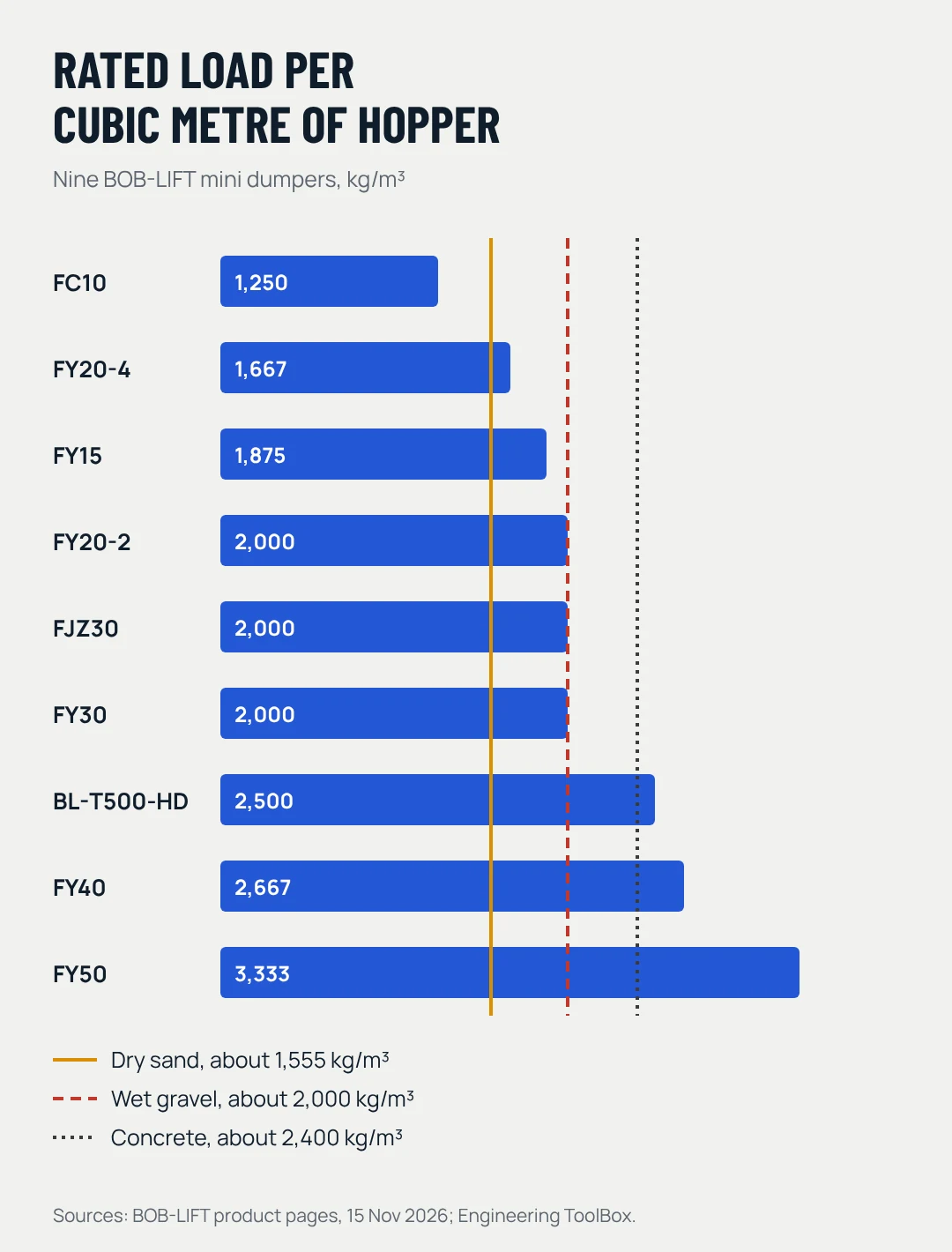
Our specification sheets give one hopper volume per model, so when you compare quotations, ask whether each competing figure is level-full or heaped, because a heaped figure always looks larger. Our site dumper sizes guide explains how to size a dumper to the job, and there are model guides for the 1 ton, 2 ton, 3 ton, 4 ton and 5 ton classes.
Width, weight and size
Width decides where the dumper can go, weight decides how it travels, and height decides where it is stored and how it ships. The BL-T500-HD is 880 mm (34.6 inches) wide for garden paths and gates, while the wheeled dumpers run from 1,500 mm (59.1 inches) on the FC10 and FY15 to 1,800 mm (70.9 inches) on the FY50.
| Model | Length × width × height | Height with roof or cab | Wheelbase | Ground clearance |
|---|---|---|---|---|
| FC10 | 2,600 × 1,500 × 1,450 mm | 2,150 mm | 1,500 mm | 200 mm |
| FY15 | 2,600 × 1,500 × 1,450 mm | 2,150 mm | 1,500 mm | 200 mm |
| FY20-2 | 3,000 × 1,600 × 1,480 mm | 2,180 mm | 1,500 mm | 200 mm |
| FY20-4 | 4,200 × 1,700 × 1,800 mm | 2,650 mm | 2,090 mm | 200 mm |
| FJZ30 | 4,500 × 1,700 × 1,800 mm | 2,700 mm | 2,280 mm | 250 mm |
| FY30 | 4,500 × 1,700 × 1,800 mm | 2,700 mm | 2,130 mm | 200 mm |
| FY40 | 4,500 × 1,700 × 1,800 mm | 2,700 mm | 2,130 mm | 240 mm |
| FY50 | 4,500 × 1,800 × 1,850 mm | 2,750 mm | 2,210 mm | 200 mm |
Weight is where the 4×2 and 4×4 models differ most. For example, the FY20-2 and FY20-4 both carry 2,000 kg, yet the FY20-4 weighs 2,100 kg (4,630 lb) against 900 kg (1,984 lb). The FJZ30, with its front loading bucket, is the heaviest at 3,920 kg (8,642 lb). A roof or cab adds 700 mm on the 4×2 models and 850 to 950 mm on the 4×4 models; our dumper with cab guide shows which cover each model takes.

Tipping and dump height
All eight wheeled dumpers tip forward through 45°; the FC10 tips mechanically as standard, while the others use hydraulic tipping. A swivel side-tip hopper is an additional-cost option on every wheeled model, and the tracked BL-T500-HD tips hydraulically through 100°.
| Model | Tipping | Dump height | Drive and steering |
|---|---|---|---|
| FC10 | Mechanical front tip | 1,800 mm (70.9 in) | 4×2, mechanical |
| FY15 | Hydraulic front tip | 1,800 mm (70.9 in) | 4×2, mechanical (hydraulic optional) |
| FY20-2 | Hydraulic front tip | 2,000 mm (78.7 in) | 4×2, hydraulic |
| FY20-4 | Hydraulic front tip | 2,200 mm (86.6 in) | 4×4, articulated |
| FJZ30 | Hydraulic front tip | 2,700 mm (106.3 in) | 4×4, articulated |
| FY30 | Hydraulic front tip | 2,400 mm (94.5 in) | 4×4, articulated |
| FY40 | Hydraulic front tip | 2,400 mm (94.5 in) | 4×4, articulated |
| FY50 | Hydraulic front tip | 2,500 mm (98.4 in) | 4×4, articulated |
Dump height matters whenever you tip into a skip, over a trench edge or onto a growing heap, and if your work requires tipping high over a wall, please note that we do not manufacture a high-tip dumper. Our front tip or swivel dumper guide explains the three tipping types and when a swivel hopper pays off.
Drive, steering and slopes
The drive line tells you how the dumper copes with soft and steep ground: our FC10, FY15 and FY20-2 are 4×2, with two driven wheels, while the FY20-4, FY30, FY40, FY50 and FJZ30 are 4×4 with articulated steering, which helps traction in mud and loose ground. Gradeability is the steepest slope a machine is rated to climb, and all eight wheeled models list the same figure, a 21° theoretical maximum with 18° or less recommended in operation, and four-wheel drive does not raise that published limit. Top speed is 22 km/h (13.7 mph) on the smaller models and 28 km/h (17.4 mph) on the 3 to 5 ton models.
The tracked BL-T500-HD is rated for 20° and travels at up to 3 km/h (1.9 mph). Its ground pressure is about 24.8 kPa with a 500 kg load, which is why it suits lawns and soft paths. For the details, read 4×4 or 4×2 mini dumper and tracked or wheeled mini dumper.
Engine, electrics, tyres and emissions
Every wheeled dumper runs a diesel engine, from 12.1 kW on the FC10 to 65 kW on the FY50, and the electrical system is 12 V on the smaller three models and 24 V on the 4×4 models. The engine line matters most for paperwork: our wheeled diesels are supplied without an emission certificate as standard, and a certified engine is an extra-cost option.
| Model | Engine | Power | Electrics | Certified engine option | Tyres |
|---|---|---|---|---|---|
| FC10 | ZS1100 | 12.1 kW (16.2 hp) | 12 V | US EPA at extra cost | 7.50-16 / 5.50-16 |
| FY15 | ZS1105 | 13.2 kW (17.7 hp) | 12 V | US EPA at extra cost | 7.50-16 / 5.50-16 |
| FY20-2 | L24 | 17 kW (22.8 hp) | 12 V | Euro V or US EPA at extra cost | 7.50-16 / 5.50-16 |
| FY20-4 | ZN490B | 27.5 kW (36.9 hp) | 24 V | Euro V or US EPA at extra cost | 12-16.5 |
| FJZ30 | YN25GB | 37 kW (49.6 hp) | 24 V | Euro V or US EPA at extra cost | 12-16.5 |
| FY30 | YN25GB | 37 kW (49.6 hp) | 24 V | Euro V or US EPA at extra cost | 12-16.5 |
| FY40 | YN25GB | 40 kW (53.6 hp) | 24 V | Euro V or US EPA at extra cost | 12-16.5 |
| FY50 | YN33GBZ | 65 kW (87.2 hp) | 24 V | Euro V or US EPA at extra cost | 20.5/70-16 |
The FC10 and FY15 can be ordered with a US EPA-certified engine but not a Euro V one, whereas the FY20-2 and larger models can take either certification. In the European Union, Regulation (EU) 2016/1628 sets the Stage V limits for engines in non-road mobile machinery [3], and in the United States EPA publishes the certified engine families [4]. Choose the certified engine your market needs when you place the order. The petrol BL-T500-HD lists EPA and Euro 5 as standard.

Lines that are not on every spec sheet
Some differences only show in the notes or in the quotation. Check these before you order:
- Self-loading. The FJZ30 has a front bucket that lifts to 2,800 mm, so it loads its own hopper. Our self-loading dumper guide compares it with the BL-T200-HJ mixer dumper.
- What comes with the machine. The FC10 and FY15 ship with one diesel filter; the FY20-2 and larger ship with a set of original diesel, oil and air filters.
- Operator cover. Open, roof canopy or cab depend on the model, and the covered height changes how the dumper ships.
- Safe use. The UK Health and Safety Executive lists overturning and collisions among the main dumper risks, and stresses training and seat belts where roll-over protection is fitted [5].
How to compare two dumper quotations
When two factories quote similar dumpers, line up the sheets and check five things before price:
- Load and volume. Is the hopper figure level-full or heaped, and does rated load ÷ volume suit your material?
- Empty weight. Does the machine, with roof or cab, fit your trailer and your ground?
- Tipping. Front tip or swivel, mechanical or hydraulic, and at what dump height?
- Named engine. Is the engine model written, and is the emission certificate for your market included in the price?
- Drive. 4×2 or 4×4, and is the steering mechanical, hydraulic or articulated?
Our guide to buying a mini dumper from the factory covers lead times, shipping and warranty once the specification is settled.
The same lines work as a yardstick for a second hand machine: our used mini dumper inspection checklist shows how to test a listed payload, tip angle and speed on site. If you plan to resell dumpers, our mini dumper dealer guide covers which models to stock and how to order.
Frequently asked questions
What is the most important line on a mini dumper spec sheet?
The rated load, read together with the hopper volume, because the two figures together tell you whether your material fills the hopper before it reaches the weight limit. Our dumpers carry between 500 and 5,000 kg.
Can a 1 ton dumper carry a full hopper of concrete?
Not on our FC10. Its 0.8 m³ hopper filled with concrete at about 2,400 kg/m³ would weigh roughly 1,920 kg, almost twice its 1,000 kg rated load, so either fill it by weight or choose a model with a higher load per cubic metre.
Do you build a high-tip dumper?
No. Our wheeled dumpers front-tip through 45°, with a swivel hopper as an option, and the highest dump height is 2,700 mm on the FJZ30.
Do your dumpers come with an emission certificate?
Not as standard on the wheeled diesels. A US EPA-certified engine is an extra-cost option on every wheeled model, and a Euro V engine on the FY20-2 and larger.
How we got these figures
Every machine figure in this guide comes from our mini dumper product pages as published on 15 November 2026, including the emission options listed on each page. Load per cubic metre is our own calculation from those figures. Material densities come from the Engineering ToolBox, and the regulations and safety guidance link to EUR-Lex, the US EPA and the UK HSE. Read more about our factory and company.
Ask for a specification and quotation
Tell us which materials you carry, the heaviest load per trip, the narrowest access on your sites and your country, and we will reply with the model that fits, its full spec sheet and a quotation with the right engine for your market. Compare the range first, or send us your requirements now.