


Key takeaways
- 4×4 means all four wheels are driven. 4×2 means four wheels, two of them driven.
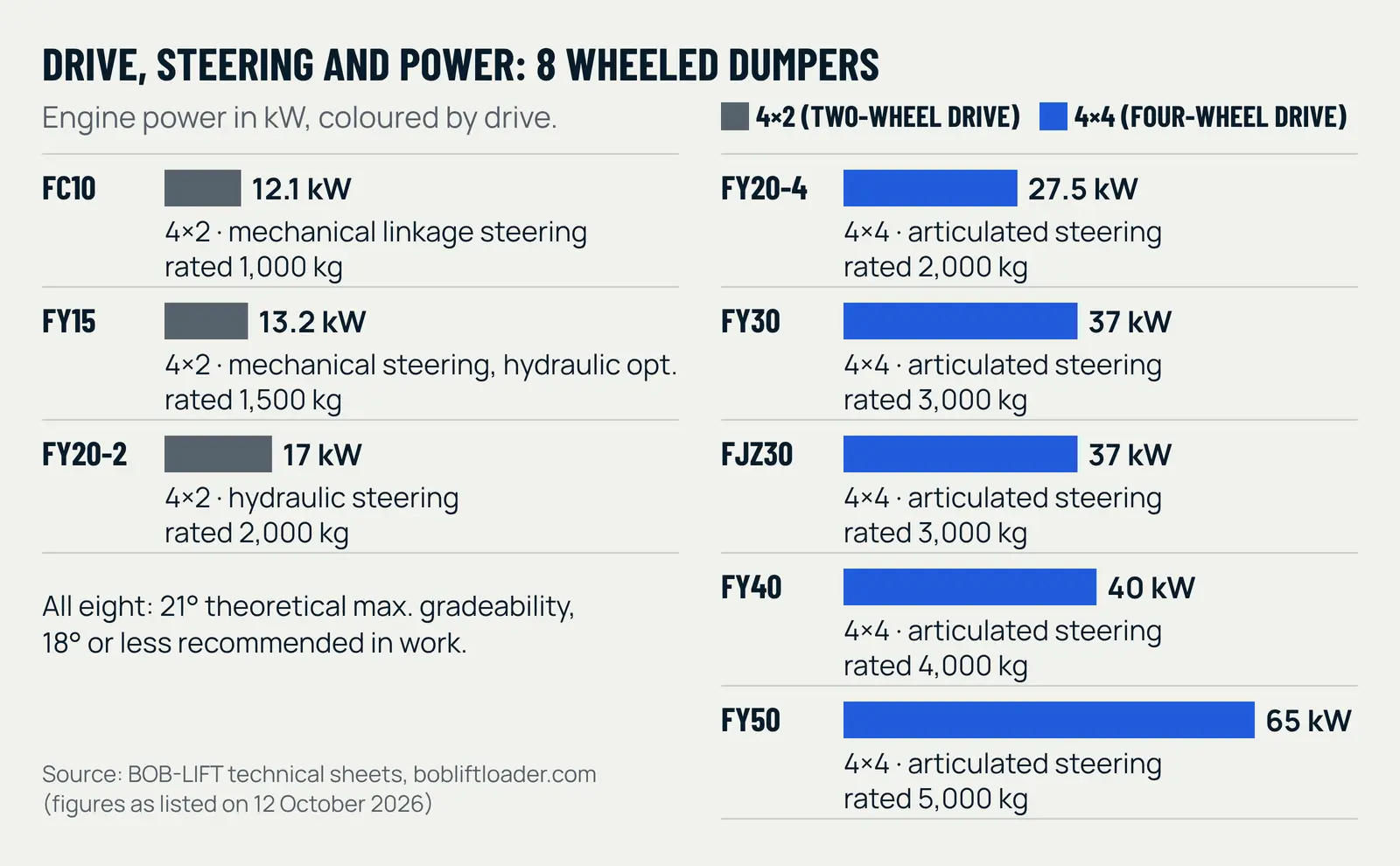
- Five BOB-LIFT wheeled dumpers are 4×4 with articulated steering: FY20-4, FY30, FY40, FY50 and FJZ30. Three are 4×2: FC10, FY15 and FY20-2.
- Every wheeled model has the same published gradeability: 21° theoretical maximum, 18° or less recommended in work. Four-wheel drive does not raise that limit.
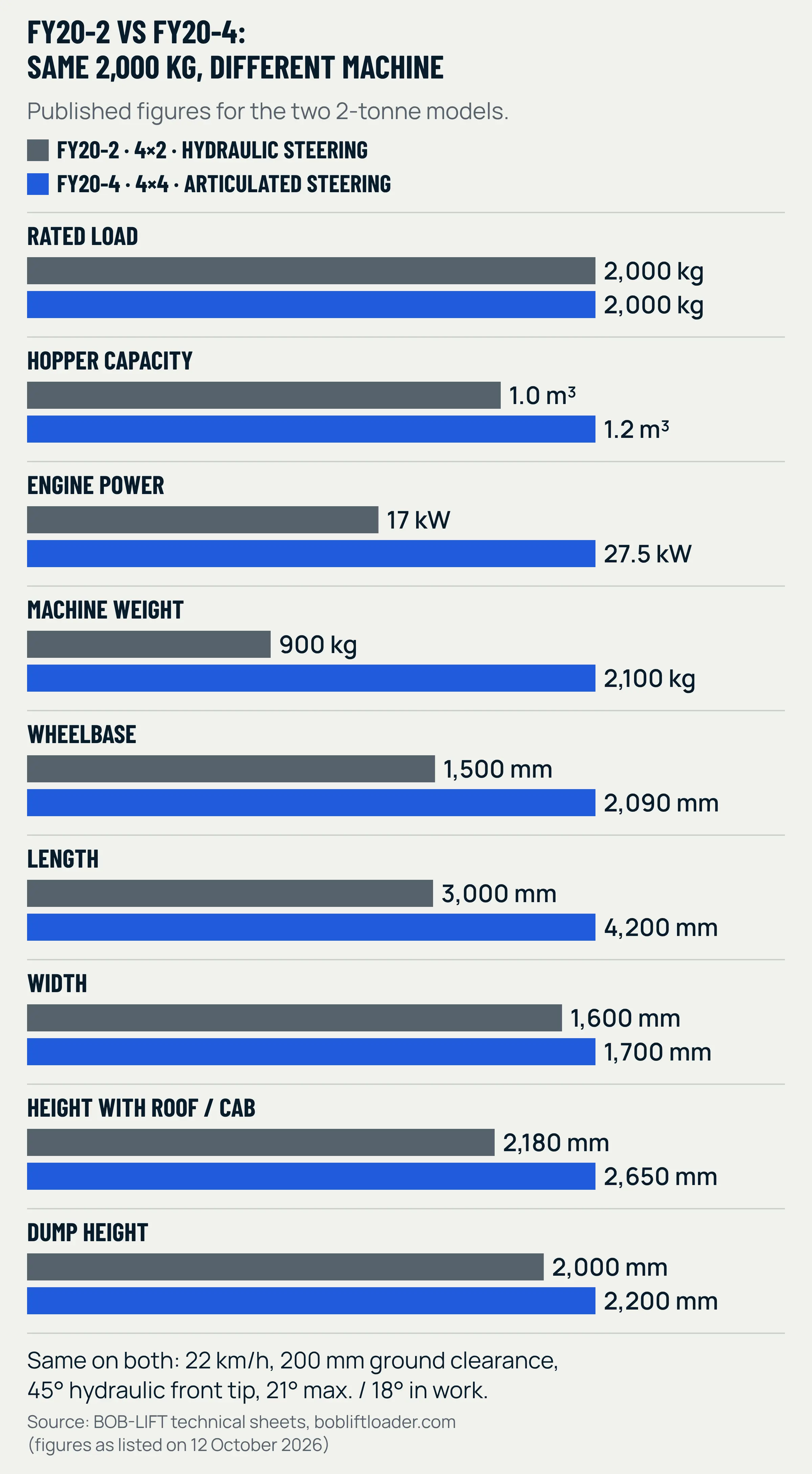
- The FY20-2 and FY20-4 both carry 2,000 kg, but the 4×4 weighs 2,100 kg against 900 kg and has 27.5 kW against 17 kW.
- 4×2 is usually enough on firm farm tracks, yards and hard site roads up to 2 tonnes a trip.
What does 4×4 mean on a dumper?
A 4×4 (4×4) dumper drives all four of its wheels; a 4×2 dumper has four wheels but drives only two. The first number counts the wheel positions and the second counts the driven ones (Wikipedia: Four-wheel drive).
In the BOB-LIFT wheeled dumper range, the split is simple:
- 4×4: FY20-4, FY30, FY40, FY50 and FJZ30, all with articulated steering.
- 4×2: FC10 and FY15 with mechanical linkage steering (hydraulic steering is optional on the FY15), and the FY20-2 with hydraulic steering.
Only the FY20 comes in both forms, and its name tells you which: -2 is two-wheel drive (4×2) and -4 is four-wheel drive (4×4). In every wheeled model name, the number is the rated load in hundreds of kilograms, so the FY20 carries 2,000 kg and the FY30 3,000 kg (6,614 lb).
| Model | Drive | Steering | Rated load | Engine power | Max travel speed |
|---|---|---|---|---|---|
| FC10 | 4×2 | Mechanical linkage | 1,000 kg | 12.1 kW | 22 km/h |
| FY15 | 4×2 | Mechanical (hydraulic opt.) | 1,500 kg | 13.2 kW | 22 km/h |
| FY20-2 | 4×2 | Hydraulic | 2,000 kg | 17 kW | 22 km/h |
| FY20-4 | 4×4 | Articulated | 2,000 kg | 27.5 kW | 22 km/h |
| FY30 | 4×4 | Articulated | 3,000 kg | 37 kW | 28 km/h |
| FJZ30 (front bucket) | 4×4 | Articulated | 3,000 kg | 37 kW | 28 km/h |
| FY40 | 4×4 | Articulated | 4,000 kg | 40 kW | 28 km/h |
| FY50 | 4×4 | Articulated | 5,000 kg | 65 kW | 28 km/h |
Above 2 tonnes, every BOB-LIFT wheeled dumper is 4×4. So for 3 to 5 tonnes a trip, the real choice is between the 4×4 models, which our guide to site dumper sizes covers.
Articulated steering on the 4×4 models
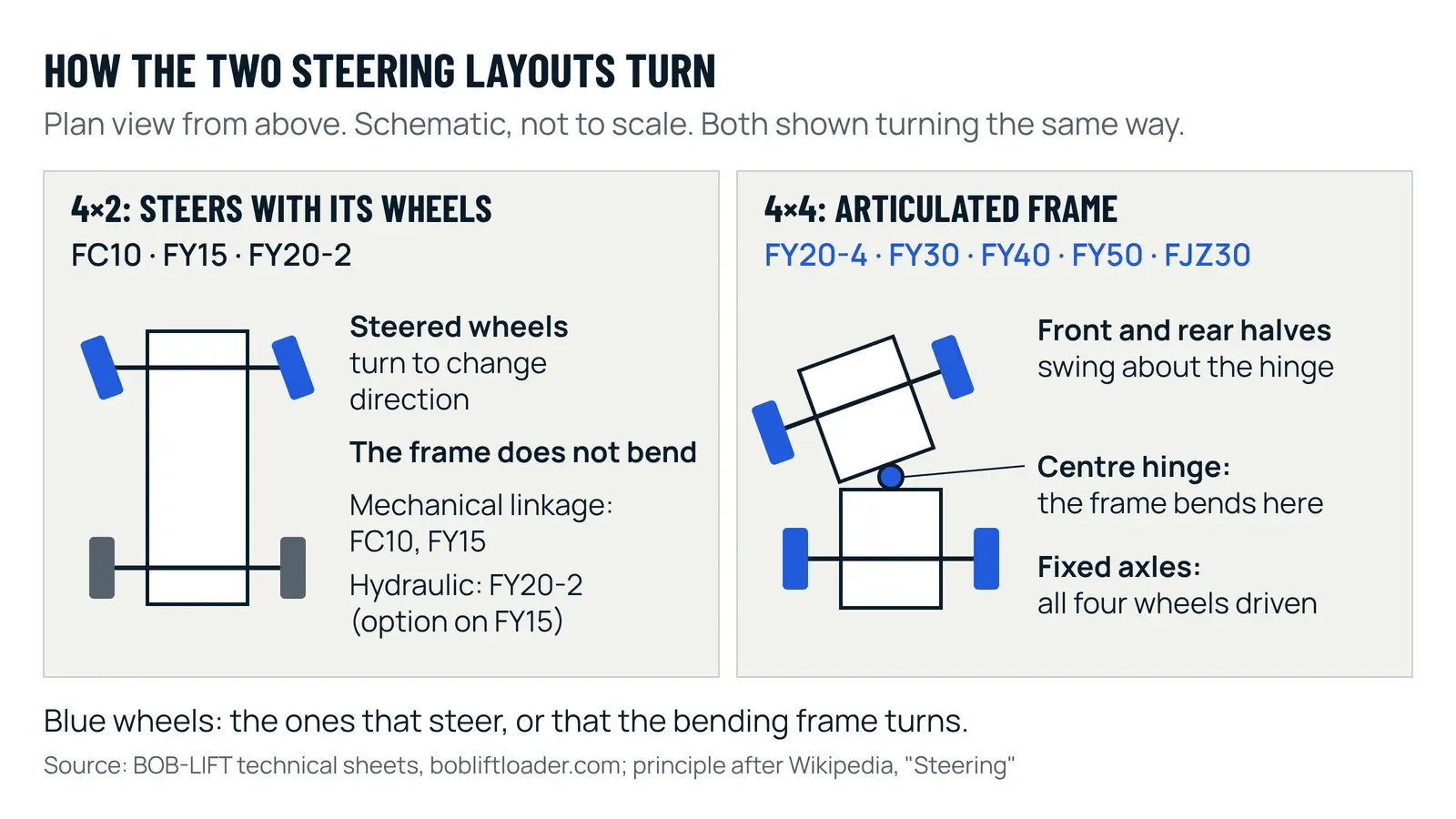
Our 4×4 dumpers use articulated steering: they bend in the middle. On an articulated machine the frame is split into a front and a rear half joined by a vertical hinge. Hydraulic cylinders change the angle between the two halves, while the wheels on each half stay straight relative to that half (Wikipedia: Steering, articulated steering).
The 4×2 models do not bend in the middle; they steer with their wheels. On the FC10 and FY15 the steering is by mechanical linkage, with hydraulic steering optional on the FY15. On the FY20-2 it is hydraulic.
What this means in practice:
- No steered wheels on a 4×4. Both axles stay fixed to their half of the frame, and the whole front half turns.
- A pinch point in the middle. The gap between the two halves closes when an articulated machine turns. Nobody should stand near the hinge while the engine is running.
Traction on slopes, mud and loose ground
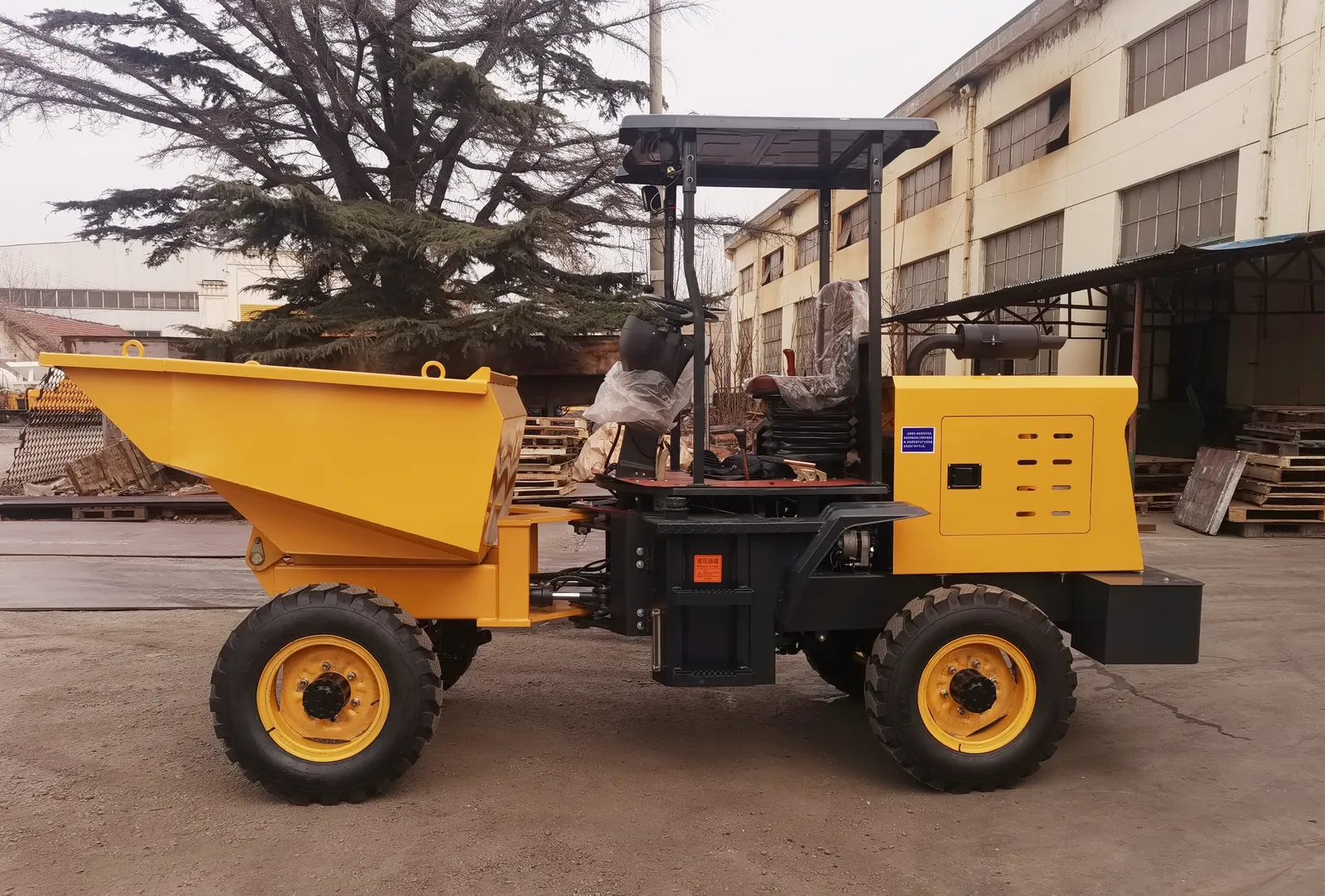
Four-wheel drive does not change the published slope limit. Every BOB-LIFT wheeled dumper, 4×2 or 4×4, is rated at 21° theoretical maximum, with 18° or less recommended in work. That is roughly a 38% grade at the limit and 32% for normal work. Plan routes around the 18° figure, not the 21° one.
What 4×4 changes is grip. With all four wheels driven, a dumper keeps pushing when the driven wheels of a 4×2 would start to spin: on wet clay, loose sand, mud or a rutted track. The extra traction helps you get moving and keep moving. It does not make a steep slope safe.
The 4×4 models also differ in other ways that help on rough ground:
- Tyres. The FY20-4, FY30, FY40 and FJZ30 run 12-16.5 tyres on all four wheels, and the FY50 runs 20.5/70-16 all round. The 4×2 models use 7.50-16 front and smaller 5.50-16 rear tyres.
- Ground clearance. The FJZ30 has 250 mm and the FY40 240 mm. Every other wheeled model, 4×2 or 4×4, has 200 mm.
- Power. The 4×4 models have 27.5–65 kW against 12.1–17 kW for the 4×2 models.
Overturning is the main danger with any site dumper. The UK Health and Safety Executive reports that “over 60% of dumper deaths involve the driver being crushed when the vehicle overturns” (HSE: Dumpers). HSE advises using dumpers only on gradients within their safe working capacity, keeping loads even and below the top edge of the skip, and fitting roll-over protection with seatbelts worn. Those rules apply whichever drive you choose.
Slopes are where training matters most; our dumper ticket and training guide covers safe tipping and edge protection.
FY20-2 vs FY20-4: same payload, different machine
The FY20-2 and FY20-4 are both rated at 2,000 kg (4,409 lb), but they are very different machines. The FY20-4 is the larger, heavier, more powerful one. The FY20-2 is the compact 4×2 option.

| Published figure | FY20-2 | FY20-4 |
|---|---|---|
| Drive | 4×2 | 4×4 |
| Steering | Hydraulic | Articulated |
| Rated load | 2,000 kg | 2,000 kg |
| Hopper capacity | 1.0 m³ | 1.2 m³ |
| Engine | L24, 17 kW | ZN490B, 27.5 kW |
| Machine weight | 900 kg | 2,100 kg |
| Wheelbase | 1,500 mm | 2,090 mm |
| Standard dimensions (L × W × H) | 3,000 × 1,600 × 1,480 mm | 4,200 × 1,700 × 1,800 mm |
| Height with roof / cab | 2,180 mm | 2,650 mm |
| Dump height | 2,000 mm | 2,200 mm |
| Tyres | 7.50-16 front, 5.50-16 rear | 12-16.5 front and rear |
| Operating voltage | 12 V | 24 V |
| Max travel speed | 22 km/h | 22 km/h |
| Ground clearance | 200 mm | 200 mm |
| Per 20GP / 40HQ (taken apart where possible) | ≈ 3 / ≈ 6 | ≈ 1 / ≈ 5 |
Read the table this way:
- Choose the FY20-4 for soft or uneven site ground and ramps. It has 62% more engine power, a 20% larger hopper and a 200 mm higher dump height, and it comes open, with a roof canopy or with a deluxe cab.
- Choose the FY20-2 for firm ground where 2 tonnes a trip is enough. It weighs less than half as much (900 kg, 1,984 lb), it is 1,200 mm shorter and 100 mm narrower, and it takes less container space: taken apart, three fit in a 20GP container, against one FY20-4.
Note the height. With a roof or cab, the FY20-4 stands 2,650 mm tall, taller than a container door. Our container figures count it with the cab or roof and the hopper removed, and our Support page explains how each model ships.
The filters supplied with the machine also differ. The FY20-2, like all the 4×4 models, comes with a set of diesel, oil and air filters. The FC10 and FY15 come with a diesel filter only.
When 4×2 is enough
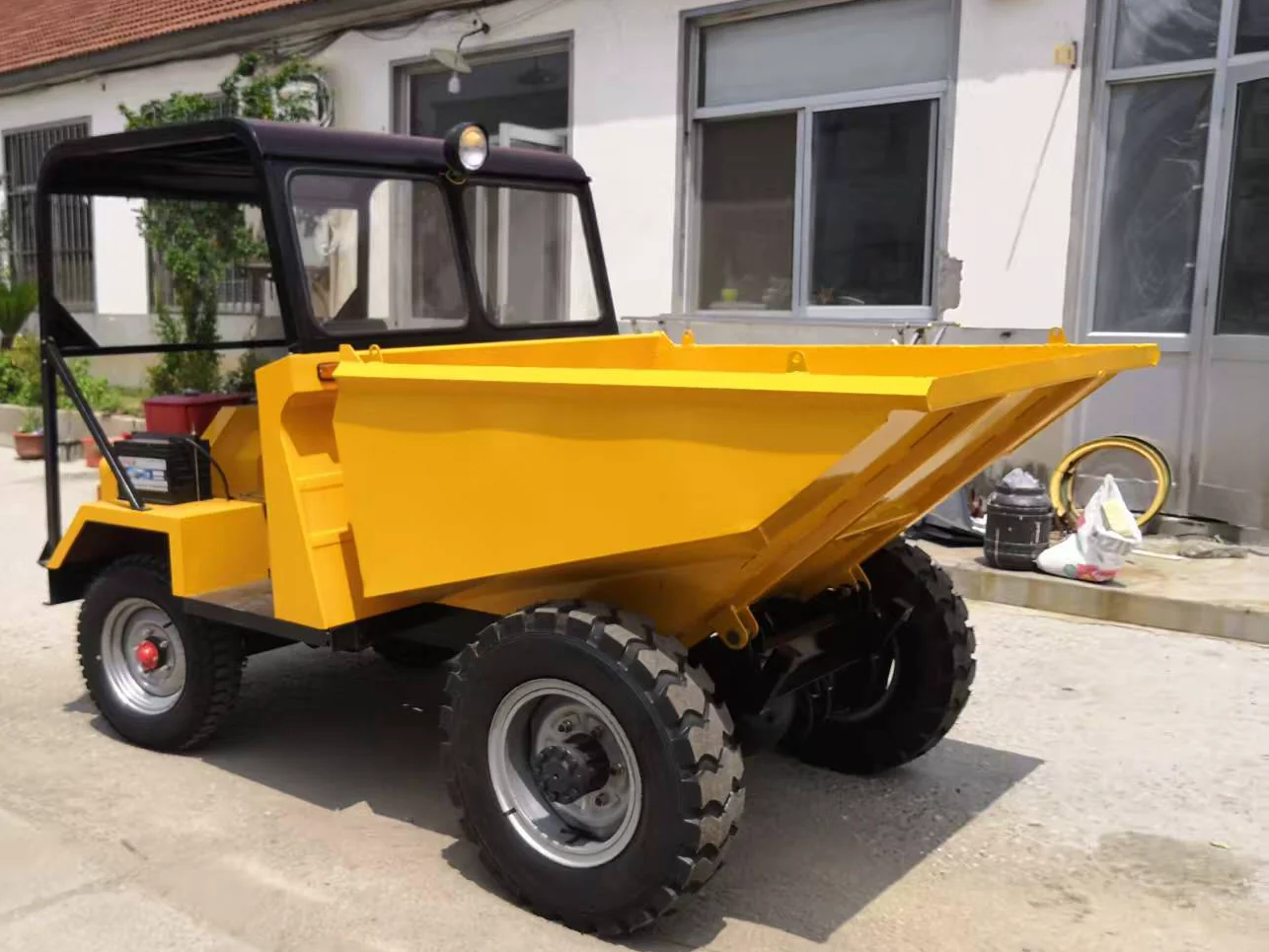
A 4×2 dumper is enough when the route is firm, the slopes are gentle and the load is 2 tonnes or less per trip. Farm tracks, concrete yards, orchards in dry weather and hard site roads all suit the FC10, FY15 and FY20-2. These are the models we list for farms and orchards.
The 4×2 models bring practical savings:
- Lighter machines. 800–900 kg, against 2,100–3,920 kg for the 4×4 models.
- Easier shipping. Taken apart, about 6 FC10 or FY15 fit in a 20GP container, against about 1 of any 4×4 model.
- A 12 V electrical system. All three run on 12 V; the 4×4 models use 24 V.
Choose 4×4 when the ground turns soft, when you carry more than 2 tonnes, or when the dumper must climb ramps and spoil heaps all day. Busy building sites moving sand, gravel and spoil are typical 4×4 work. If your route is a narrow garden path rather than a site road, a wheeled dumper may be the wrong tool altogether. See tracked vs wheeled mini dumpers.
Frequently asked questions
Is a 4×4 dumper better on slopes?
It grips better, but its published slope limit is the same. All BOB-LIFT wheeled dumpers are rated at 21° theoretical maximum and 18° or less in work, whether 4×2 or 4×4. Four-wheel drive helps on wet, loose or muddy slopes within that limit.
Can a 4×2 dumper be converted to 4×4?
Drive is set by the model, and no 4×4 option is listed for the FC10, FY15 or FY20-2. If you need four-wheel drive at 2 tonnes, choose the FY20-4 rather than the FY20-2.
Which BOB-LIFT 4×4 dumper has the most ground clearance?
The FJZ30, at 250 mm. The FY40 follows at 240 mm. The FY20-4, FY30 and FY50 have 200 mm, the same as the 4×2 models.
Are 4×4 dumpers faster?
The FY30, FY40, FY50 and FJZ30 reach 28 km/h (17.4 mph). The FY20-4 is published at 22 km/h (13.7 mph), the same as all three 4×2 models.
Choosing your drive
Start with the ground and the load per trip: firm routes up to 2 tonnes suit 4×2, and soft ground or bigger loads call for 4×4. Our guide to reading a mini dumper spec sheet shows where drive, steering and gradeability sit among the other lines to compare. Compare the specifications of all ten models on our mini dumpers page, or tell us about your route and loads and our team in Xuzhou will suggest the right drive.