


Buy a mini skid steer first if most of your work is carrying, loading, levelling and running attachments. Buy a mini excavator first if most of it is digging below ground: footings, drainage and service trenches. On landscaping, garden and site clearance jobs, the loader usually earns more days, because it carries spoil, loads skips, scrapes sub-bases and changes tools in a minute. We build mini skid steers in Xuzhou, China, not excavators, so this guide says plainly where an excavator is the better buy.
The guide is written for contractors, landscapers and equipment hire companies deciding which compact machine to add to their fleet first. It compares how the two machines work, lists the jobs each one suits, gives six questions to settle the choice, and shows where a backhoe attachment fits between them.
Key takeaways
- A mini skid steer is a carrying and loading machine that can dig a little. A mini excavator is a digging machine that carries very little.
- If most jobs end with moving material across the site, start with the loader. If most jobs are holes and trenches, start with the excavator.
- Access is often the deciding line. Our narrowest loader, the BL-T360-H, is 930 mm (about 37 inches) wide.
- A backhoe attachment lets a loader dig pits and short trenches, but it does not replace an excavator on deep or long digs.
- Our nine loaders carry a rated load of 200 to 500 kg (441 to 1,102 lb) and weigh 650 to 1,250 kg (1,433 to 2,756 lb).
- Contractors who dig regularly often run both machines: one digs, the other carries.
What is the difference between a mini skid steer and a mini excavator?
The two machines are designed to solve different problems. ISO 6165, the International Organization for Standardization vocabulary for earth-moving machinery, describes a loader as a machine designed mainly for loading with a bucket, which loads or digs through the forward motion of the machine [1]. A skid steer loader is a loader steered by varying the speed or direction of the traction drive on each side [1]. An excavator is a digging machine with a boom, a dipper arm and a bucket, and its upper structure can usually rotate through a full circle.
In practice, a loader travels to the material and carries it away, while an excavator stays in one position and reaches down into the ground. The table sets out the main differences.
| Factor | Mini skid steer | Mini excavator |
|---|---|---|
| Main job | Carry, load, push, grade and run attachments | Dig below ground level |
| How it digs | Forward motion with a bucket, or a backhoe attachment | Boom and dipper pull the bucket toward the machine |
| Moving material | Carries each bucket to a pile, skip or truck | Places spoil beside the hole; another machine usually carries it away |
| Swing | None; the whole loader turns | Upper structure swings, so it digs and dumps from one spot |
| Attachments | Forks, augers, trenchers, grapples, sweepers and more on one plate | Buckets, breakers, augers and grabs on the dipper |
| Hire demand | Landscaping, site clearance, loading and tidy-up | Footings, drainage, services and trenches |
| Width (our range) | 930 to 1,090 mm (37 to 43 in) | Varies widely; measure the access first |
| Weight (our range) | 650 to 1,250 kg (1,433 to 2,756 lb) | Check the trailer and towing limit |
| Rated load (our range) | 200 to 500 kg (441 to 1,102 lb) | Not designed to carry loads |
| Dumping height (our range) | 1,340 to 1,826 mm (53 to 72 in) | Swings to load a truck parked beside it |
Our mini skid steer vs compact track loader guide compares the loader with its larger ride-on relatives, if you are also weighing a full-size machine.
Which jobs suit each machine?
Look at your last twenty jobs, or the hire requests you turned away, and sort them by what the machine spent most of its time doing. Carrying and loading points to the loader; digging points to the excavator.
| Job | Better first machine | Why |
|---|---|---|
| Garden clearance and soil moving | Mini skid steer | Most of the work is carrying and loading |
| Patio or driveway sub-base | Mini skid steer | Shallow scrape, carry and level |
| Loading skips and trucks | Mini skid steer | Lifts and dumps over the side |
| Post holes and fence lines | Mini skid steer | An auger on the loader does it |
| Strip footings for an extension | Mini excavator | Deep, straight trenches with spoil to one side |
| Drainage runs and service trenches | Mini excavator | Depth and reach from one position |
| Small pits, tree pits, soakaways | Either | A backhoe attachment on a loader can do it |
On a typical garden project, the excavator might dig for a morning while the loader carries material for the remainder of the week. That is why landscapers often buy the loader first and hire an excavator for the few days of deep digging. Our guide to loading skips with a mini skid steer shows the carrying side of the work.
Six questions to decide which to buy first
Answer these six questions for your typical job. If four or more point the same way, you have your first machine.
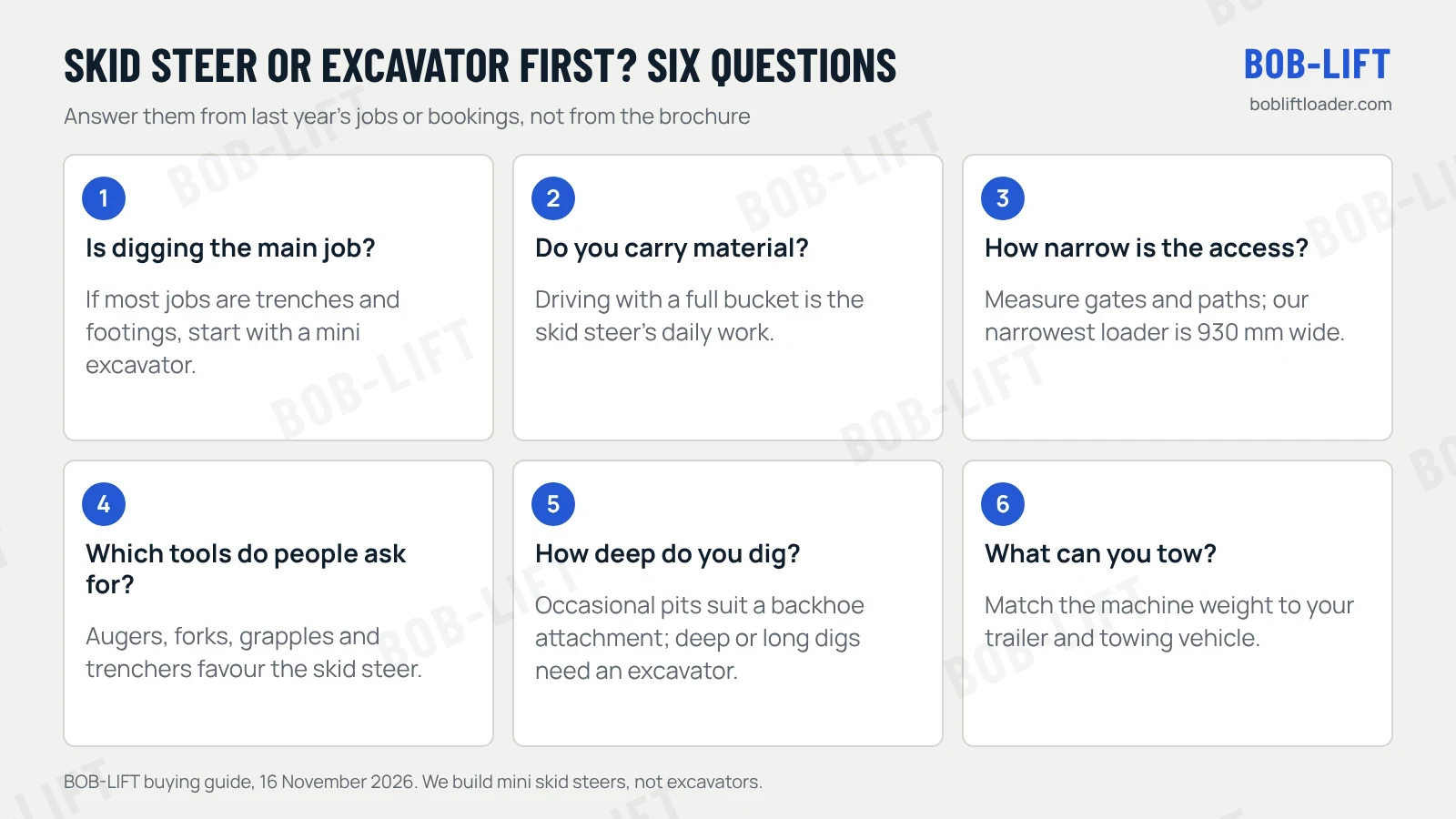
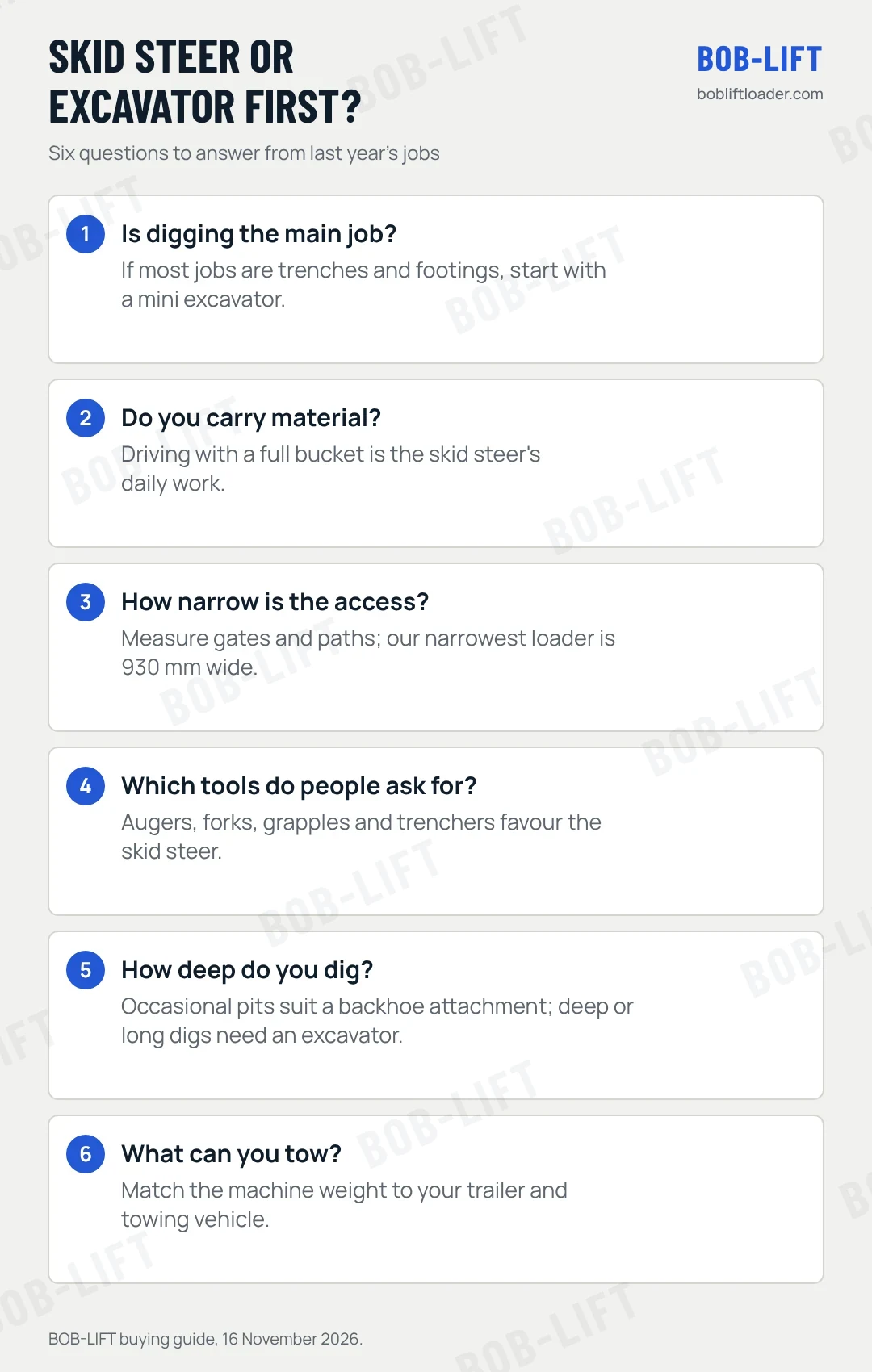
- Is digging the main job? If the machine spends more than half its hours digging, buy the excavator.
- Do you carry material? If soil, gravel or rubble has to travel across the site, buy the loader.
- How narrow is the access? Measure the narrowest gate or path. Our loaders run from 930 to 1,090 mm (about 37 to 43 inches) wide.
- Which tools do people ask for? Forks, augers, grapples and sweepers point to the loader. Our guide to 26 mini skid steer attachments lists them.
- How deep do you dig? Strip footings and drains are excavator work. Shallow scrapes and pits suit the loader.
- What can you tow? Check the machine weight against your vehicle and trailer before you choose. Our loaders weigh 650 to 1,250 kg (1,433 to 2,756 lb) before attachments.
For hire fleets and contractors: which earns more days?
For a hire fleet, the better first machine is the one your customers request most often, not the one with the most impressive specifications. Demand is still growing: the American Rental Association forecasts that US construction and general tool rental revenue will rise by more than 3 percent in 2026 and keep growing through 2028 [2]. Start from the enquiries you already receive. If callers want to clear gardens, move topsoil, lay patios or load skips, a loader with a bucket, forks and an auger covers most of them. If they want footings and drains, the excavator is the safer first buy.
A loader also lets you hire attachments with it, which can turn one machine into several hire lines. Track how many days each machine is out, what it costs to land and service, and which attachments go out with it. Our guide to starting a mini skid steer rental business covers fleet size, utilisation and the business plan.
The middle option: a backhoe attachment
A backhoe attachment is a digging arm that fits the loader’s quick-attach plate, so the loader can excavate small pits and short trenches. The one in our range is a fixed-arm hoe, with no swing and no stabilisers, so the loader itself moves between bites and carries the spoil away. It suits occasional digging when the loader is already on site, not daily trenching.
Weight matters here, because the bucket pulls the loader toward the hole. Our loaders weigh 650 to 1,250 kg (1,433 to 2,756 lb), and the tracked BL-T1000-H and BL-T750-H are the first to consider for backhoe work. They weigh 1,250 kg and 1,100 kg (2,756 and 2,425 lb) and run at 20 MPa and 18 MPa hydraulic pressure. Our backhoe attachment guide explains how it digs, and our auger and trencher guide covers the faster tools for post holes and cable runs.
Our nine mini skid steers by size
If the loader is your first machine, choose by access width and rated load first. The table lists all nine models we build, with the dumping height that matters for loading skips and trucks. Imperial values are converted from the metric figures and rounded.
| Model | Running gear and operator | Width | Rated load | Weight | Max dumping height | Engine |
|---|---|---|---|---|---|---|
| BL-T360-H | Tracks, stand-on | 930 mm (37 in) | 200 kg (441 lb) | 650 kg (1,433 lb) | 1,340 mm (53 in) | 7.6 kW, petrol or diesel |
| BL-T460-H | Tracks, stand-on | 1,090 mm (43 in) | 300 kg (661 lb) | 730 kg (1,609 lb) | 1,340 mm (53 in) | 16.8 kW, petrol or diesel |
| BL-S390-C | Tyres, seated | 959 mm (38 in) | 260 kg (573 lb) | 650 kg (1,433 lb) | 1,376 mm (54 in) | 7.6 kW, petrol or diesel |
| BL-T390-C | Tracks, seated | 955 mm (38 in) | 250 kg (551 lb) | 750 kg (1,653 lb) | 1,404 mm (55 in) | 7.6 kW, petrol or diesel |
| BL-S490-C | Tyres, seated | 1,089 mm (43 in) | 250 kg (551 lb) | 850 kg (1,874 lb) | 1,382 mm (54 in) | 16.8 kW, petrol or diesel |
| BL-T490-C | Tracks, seated | 1,089 mm (43 in) | 250 kg (551 lb) | 950 kg (2,094 lb) | 1,402 mm (55 in) | 16.8 kW, petrol or diesel |
| BL-S750-H | Tyres, stand-on | 985 mm (39 in) | 400 kg (882 lb) | 1,000 kg (2,205 lb) | 1,700 mm (67 in) | 18.6 kW, diesel |
| BL-T750-H | Tracks, stand-on | 985 mm (39 in) | 410 kg (904 lb) | 1,100 kg (2,425 lb) | 1,826 mm (72 in) | 18.6 kW, diesel |
| BL-T1000-H | Tracks, stand-on | 960 mm (38 in) | 500 kg (1,102 lb) | 1,250 kg (2,756 lb) | 1,522 mm (60 in) | 17.8 kW, diesel |
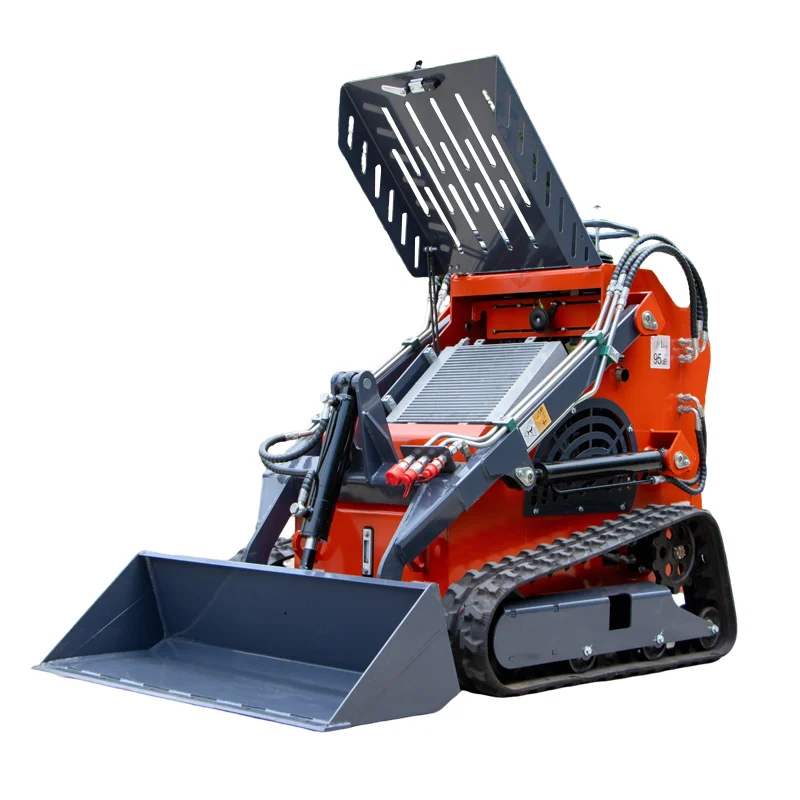
For access jobs through garden gates, start with the narrow tracked BL-T360-H. For heavier carrying and backhoe work, look at the stand-on diesel models. You can compare the full specifications on our mini skid steer loaders page.
Transport and towing
Both machines usually travel on a trailer, so the towing capacity of your vehicle is an essential part of the decision. Add the machine weight, the attachments you carry and the trailer itself, then compare the total with what your vehicle and licence allow. Our lightest loaders, the BL-T360-H and BL-S390-C, weigh 650 kg (1,433 lb); the BL-T1000-H weighs 1,250 kg (2,756 lb) before attachments. Our mini skid steer trailer guide shows how to match a trailer to each loader.
Dig safely with either machine
The same digging rules apply whichever machine holds the bucket. In the United States, call 811, the free call-before-you-dig number promoted by the Common Ground Alliance, so that buried utility lines can be located and marked [3]. The Occupational Safety and Health Administration (OSHA) requires a protective system for trenches unless they are in stable rock, or less than 5 feet deep with no sign of a cave-in found by a competent person [4]. OSHA also requires spoil, materials and equipment to be kept at least 2 feet from the edge of an excavation [5]. Never let anyone stand in a trench beside a working machine.
Frequently asked questions
Can a mini skid steer replace a mini excavator?
Not for regular deep digging. With a backhoe attachment a mini skid steer can dig small pits and short trenches, but footings, drains and long service trenches are faster and safer with an excavator.
Is a mini skid steer or a mini excavator better for landscaping?
For most landscaping work, the mini skid steer. Landscaping is mostly carrying soil, levelling, loading skips and running attachments such as augers and grapples. Hire an excavator for the days of deep digging.
Which is easier to get into a back garden?
It depends on the model, so measure the narrowest gate first. Our BL-T360-H is 930 mm (about 37 inches) wide and weighs 650 kg (1,433 lb). Our widest loaders, the BL-T460-H and the two 490 models, are 1,089 to 1,090 mm (about 43 inches) wide.
Do you sell mini excavators?
No. We build nine mini skid steers and a range of mini dumpers. For digging work, we offer a backhoe attachment for our loaders.
How we got these figures
Every loader figure in this guide comes from our nine product pages as published on 16 November 2026. Imperial values are our own conversions, rounded for easy reading. The definitions come from ISO 6165, and the safety rules link to Call 811 and OSHA. We do not quote excavator figures, because we do not build excavators. Read more about us and our factory.
Ask which loader fits your work
Tell us your typical jobs, the narrowest access on your sites, the attachments you need and your country. We reply with the loader that fits, its full spec sheet and a quotation. Send us your requirements.