


The best mini skid steer for farm use is the one that fits through your narrowest shed door and still carries a full bucket of your heaviest material within its rated load. For most small farms that points to a tracked stand-on loader rated around 300 kg, such as our BL-T460-H. Narrow poultry or calf sheds suit the 930 mm BL-T360-H, concrete yards suit the wheeled models, and sand bedding or feed pallets call for the 410 to 500 kg models. A mini skid steer will not handle a full-size round bale safely; most of those weigh more than any loader in our range is rated to carry.
We build nine mini skid steer loaders in Xuzhou, China, rated from 200 to 500 kg. This guide matches them to farm jobs using our own specification sheets and published agricultural data on manure, bedding, grain and hay. Every weight below is worked out from a cited figure; check your own material and doors against it before you choose.
Key takeaways
- Measure the narrowest door and the lowest beam on your daily route first. Our loaders are 930 to 1,090 mm wide across the body and 1,226 to 1,550 mm tall.
- Weigh the bucket, not the machine. Wet manure weighs about a tonne per cubic metre, sand bedding about 1.7 tonnes [1].
- Large round bales are beyond a mini skid steer. A 4 ft by 5 ft round bale holds about 320 to 427 kg of dry matter alone [3].
- Choose tracks for paddocks and wet ground, wheels for concrete yards and longer runs.
- Petrol engines do not belong in closed sheds; OSHA advises employers to prohibit them in poorly ventilated areas [5].
Five checks before you choose a farm mini skid steer
- Narrowest opening. Measure every door, gate and passage the loader must pass each day. Compare it with the wider of the body and the bucket: on most of our models the bucket is wider than the body. Only the BL-T360-H has a bucket (906 mm) narrower than its body (930 mm).
- Lowest overhead. Low beams, poultry house roofs and feeders matter as much as width. Overall height runs from 1,226 mm on the BL-T360-H to 1,550 mm on the 750 models. On stand-on models the operator stands on the rear platform, so check the clearance for the person as well as the machine.
- Heaviest bucketful. Rated load is the working load our specification sheet gives for each model, and it is the figure a full bucket must stay under. Bucket capacity is the volume the bucket holds when filled level. Multiply the bucket capacity by the density of your heaviest material and compare the result with the rated load. The table in the next section does this for six common farm materials.
- Ground. Rubber tracks spread the weight on pasture, mud and soft tracks. Wheels are faster on concrete, reaching 6 km/h on all three wheeled models against 5 to 6 km/h for the tracked ones.
- Air. If the loader will work inside closed buildings, plan the ventilation and the fuel before you order, as explained below.
How much does a bucket of farm material weigh?
The USDA Natural Resources Conservation Service gives 60 to 65 pounds per cubic foot as a working estimate for wet and moist manure. It also lists sand bedding at 105, soil at 75 and wood shavings at 9 pounds per cubic foot [1]. Grain is traded by the bushel, about 1.25 cubic feet, with wheat at 60 pounds and oats at 32 pounds per bushel [2]. Converted to metric and multiplied by our three bucket sizes:
| Material | Weight per m³ | 0.10 m³ bucket | 0.15 m³ bucket | 0.19 m³ bucket |
|---|---|---|---|---|
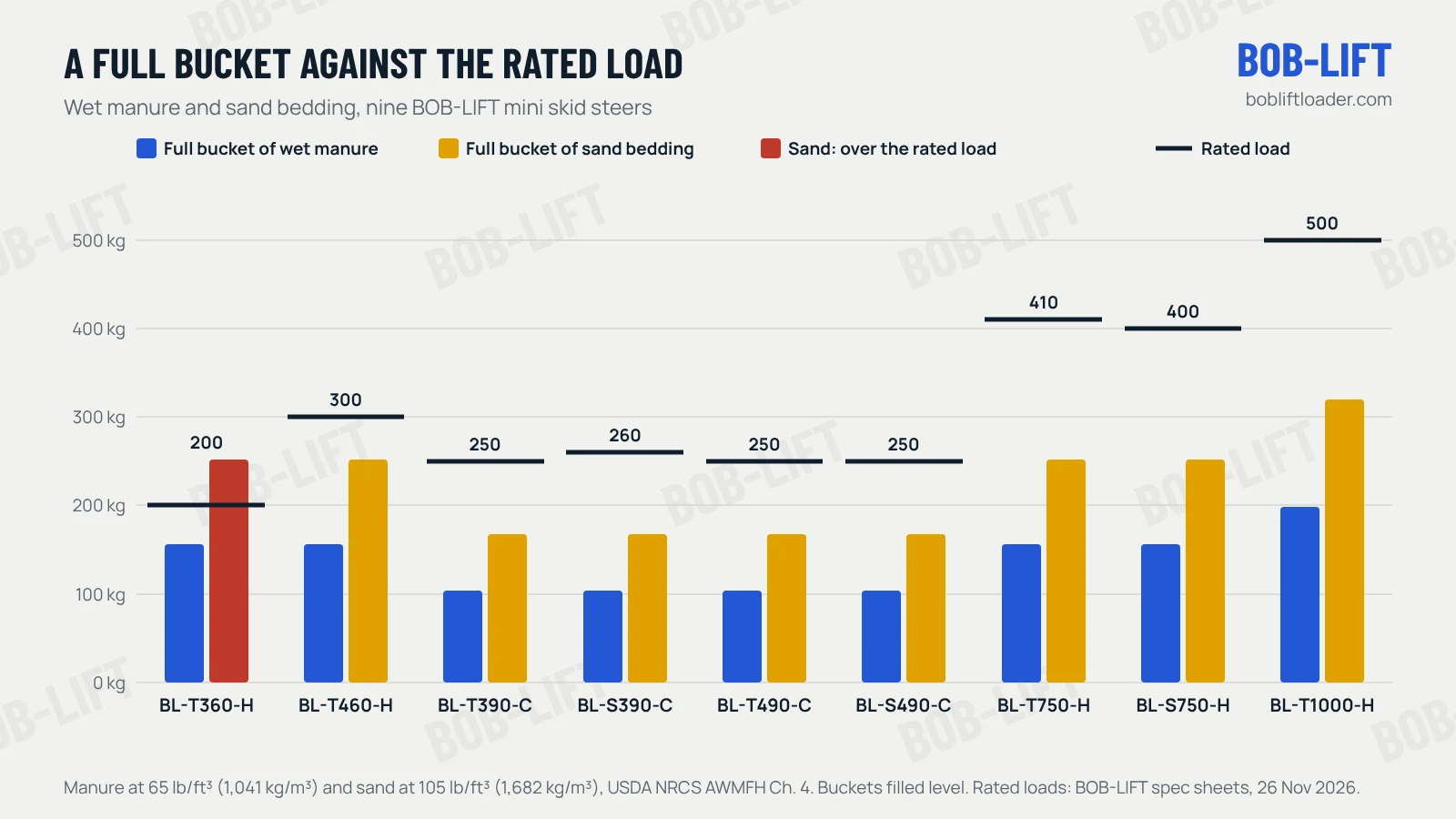
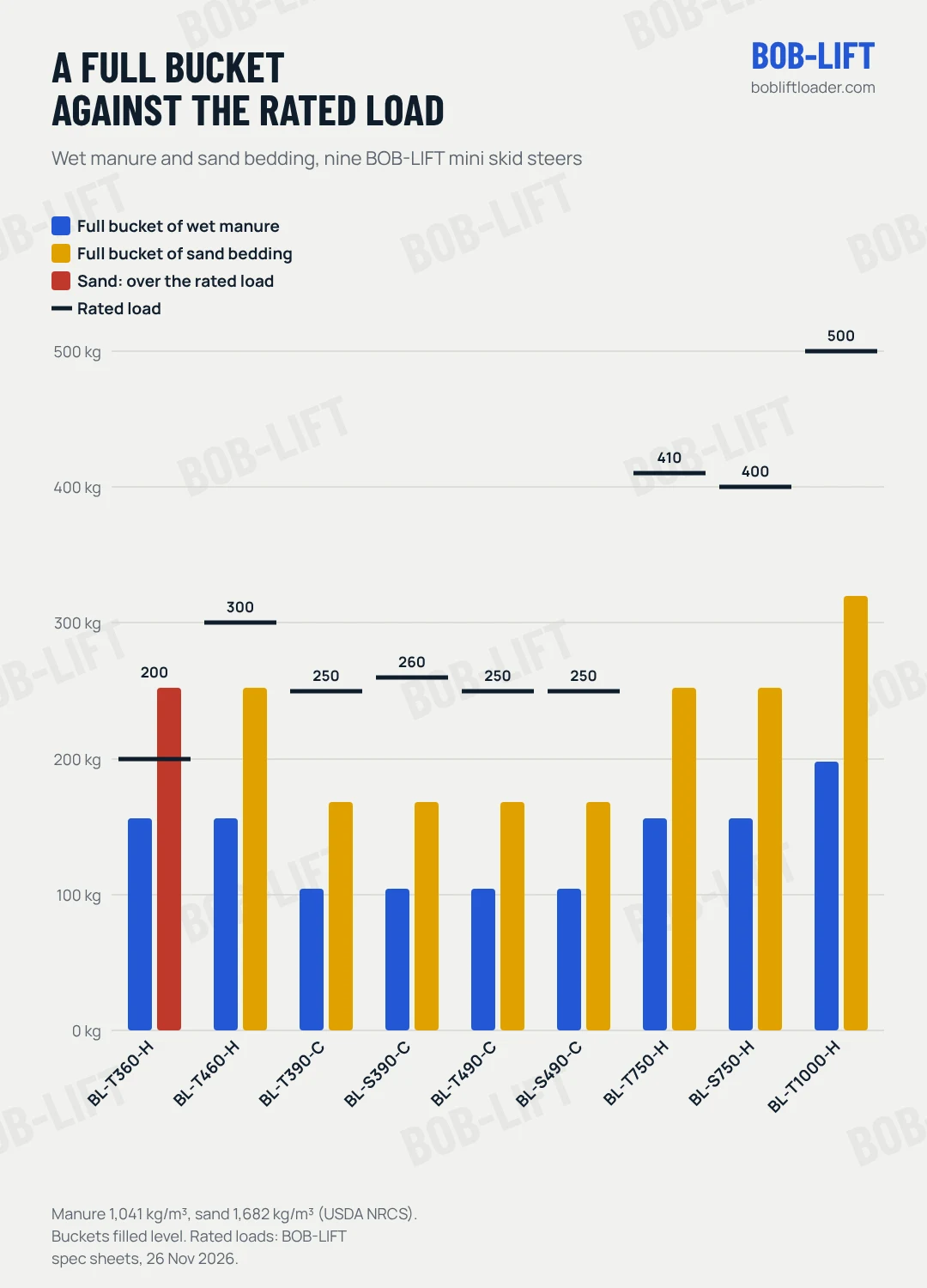
| Wet or moist manure | 961 to 1,041 kg [1] | 96 to 104 kg | 144 to 156 kg | 183 to 198 kg |
| Sand bedding | 1,682 kg [1] | 168 kg | 252 kg | 320 kg |
| Soil | 1,201 kg [1] | 120 kg | 180 kg | 228 kg |
| Wheat | 769 kg [2] | 77 kg | 115 kg | 146 kg |
| Oats | 410 kg [2] | 41 kg | 62 kg | 78 kg |
| Wood shavings | 144 kg [1] | 14 kg | 22 kg | 27 kg |
Bucket loads assume the bucket is filled level to its listed capacity. A heaped bucket carries more.
Manure, grain and shavings sit well inside every model’s rating. Sand bedding is the exception that catches buyers out: a full 0.15 m³ bucket of sand weighs about 252 kg, which is more than the 200 kg rated load of the BL-T360-H. The BL-T460-H (300 kg) carries the same bucket of sand within its rating, and the BL-T1000-H carries a full 0.19 m³ bucket of sand (about 320 kg) with room to spare.
Our bucket capacity guide works through soil, sand and gravel in more detail, and our lift capacity guide explains the difference between rated load and lifting capacity.
Can a mini skid steer lift hay and straw bales?
Small square bales, yes. Large round bales, generally no.
Dry matter is what remains of the hay once its water is removed, so a bale always weighs more than its dry matter. Penn State Extension describes a method from the U.S. Dairy Forage Research Center: work out the bale’s volume, then allow 9 pounds of dry matter per cubic foot for a loose bale and up to 12 pounds for a very tight one [3]. Applied to a small two-string bale of 14 × 18 × 36 inches (our example size; measure your own), that is 5.25 cubic feet and about 47 to 63 pounds, or 21 to 29 kg, of dry matter. A pallet fork or grapple load of several such bales stays within the rating of most of our loaders.
The same method puts a round bale 4 feet wide and 5 feet across at 78.5 cubic feet and 706 to 942 pounds of dry matter, about 320 to 427 kg [3]. The whole bale weighs more than that, because hay still holds moisture. University of Missouri Extension puts a loosely packed 5 × 5 bale at about 880 pounds of feed and a tightly packed one at nearly 1,200 pounds. It warns that guessed bale weights are often 15 to 20 percent too high [4]. Against those numbers, only our three heaviest models come close, and none of them is rated for a tight 5 × 5 bale. If round bales are a daily job, a compact tractor with a loader is the better tool; our mini skid steer vs tractor comparison covers where each one fits.
Which mini skid steer for which farm?
All nine models at a glance, with the dimensions that decide whether a loader fits your buildings:
| Model | Tracks or wheels | Operator | Body width | Bucket width | Overall height | Rated load | Bucket | Fuel |
|---|---|---|---|---|---|---|---|---|
| BL-T360-H | Tracks | Stand-on | 930 mm | 906 mm | 1,226 mm | 200 kg | 0.15 m³ | Petrol or diesel |
| BL-T460-H | Tracks | Stand-on | 1,090 mm | 1,100 mm | 1,267 mm | 300 kg | 0.15 m³ | Petrol or diesel |
| BL-T390-C | Tracks | Seated | 955 mm | 1,050 mm | 1,300 mm | 250 kg | 0.10 m³ | Petrol or diesel |
| BL-S390-C | Wheels | Seated | 959 mm | 1,050 mm | 1,300 mm | 260 kg | 0.10 m³ | Petrol or diesel |
| BL-T490-C | Tracks | Seated | 1,089 mm | 1,150 mm | 1,300 mm | 250 kg | 0.10 m³ | Petrol or diesel |
| BL-S490-C | Wheels | Seated | 1,089 mm | 1,150 mm | 1,300 mm | 250 kg | 0.10 m³ | Petrol or diesel |
| BL-T750-H | Tracks | Stand-on | 985 mm | 1,270 mm | 1,550 mm | 410 kg | 0.15 m³ | Diesel |
| BL-S750-H | Wheels | Stand-on | 985 mm | 1,270 mm | 1,550 mm | 400 kg | 0.15 m³ | Diesel |
| BL-T1000-H | Tracks | Stand-on | 960 mm | 1,240 mm | 1,548 mm | 500 kg | 0.19 m³ | Diesel |
From our specification sheets, checked on 26 November 2026. Overall height is the machine without an operator.
Small livestock and poultry sheds: BL-T360-H
The BL-T360-H is our narrowest and lowest loader, 930 mm wide and 1,226 mm tall, with a bucket that does not stick out past the tracks. At 650 kg it shares the lowest machine weight in the range with the wheeled BL-S390-C. Its 200 kg rating covers manure, litter and shavings, but not a full bucket of sand. Gradeability is the steepest slope a machine is rated to climb. The BL-T360-H has the highest in the range, 30°, a figure it shares with the BL-T460-H.
The all-round small farm machine: BL-T460-H
The BL-T460-H keeps the 30° gradeability and the 0.15 m³ bucket but raises the rated load to 300 kg and the engine to 15 to 17 kW, depending on the engine brand. It is 1,090 mm wide with a 1,100 mm bucket, so check your doors, and it is available with a petrol or diesel engine. For a smallholding that cleans out stalls, moves bedding, carries feed and drills fence posts, it is the model we suggest first.
Concrete yards and longer shifts: the seated models
The four seated loaders suit operators who spend hours on the machine. On concrete, the wheeled BL-S390-C (959 mm) and BL-S490-C (1,089 mm) travel at 6 km/h and do not wear rubber tracks on hard surfaces. Their tracked twins, the BL-T390-C and BL-T490-C, are the choice for wet yards and paddock gateways. All four carry a 0.10 m³ bucket and a 250 to 260 kg rating, so they handle manure and feed comfortably but take fewer cubic metres per trip than the 0.15 m³ machines.
Heavier work: BL-T750-H, BL-S750-H and BL-T1000-H
For sand bedding, feed pallets, loading spreaders and heavier clearing, the diesel 750 and 1000 models carry 400 to 500 kg. The BL-T750-H tips at up to 1,826 mm, the highest in our range, which helps when loading a trailer or muck spreader with tall sides. The BL-S750-H is the wheeled version for concrete. The BL-T1000-H carries the most, 500 kg in a 0.19 m³ bucket, and at 960 mm across the body it is narrower than the BL-T460-H.
Our tracked vs wheeled guide and our stand-on vs seated guide go deeper into those two choices.
Attachments that earn their keep on a farm
The attachments decide how much of the farm’s work one loader can take on. These are the ones from our list of 26 that we see asked for most for farm jobs:
| Farm job | Model to start with | Attachments to ask about |
|---|---|---|
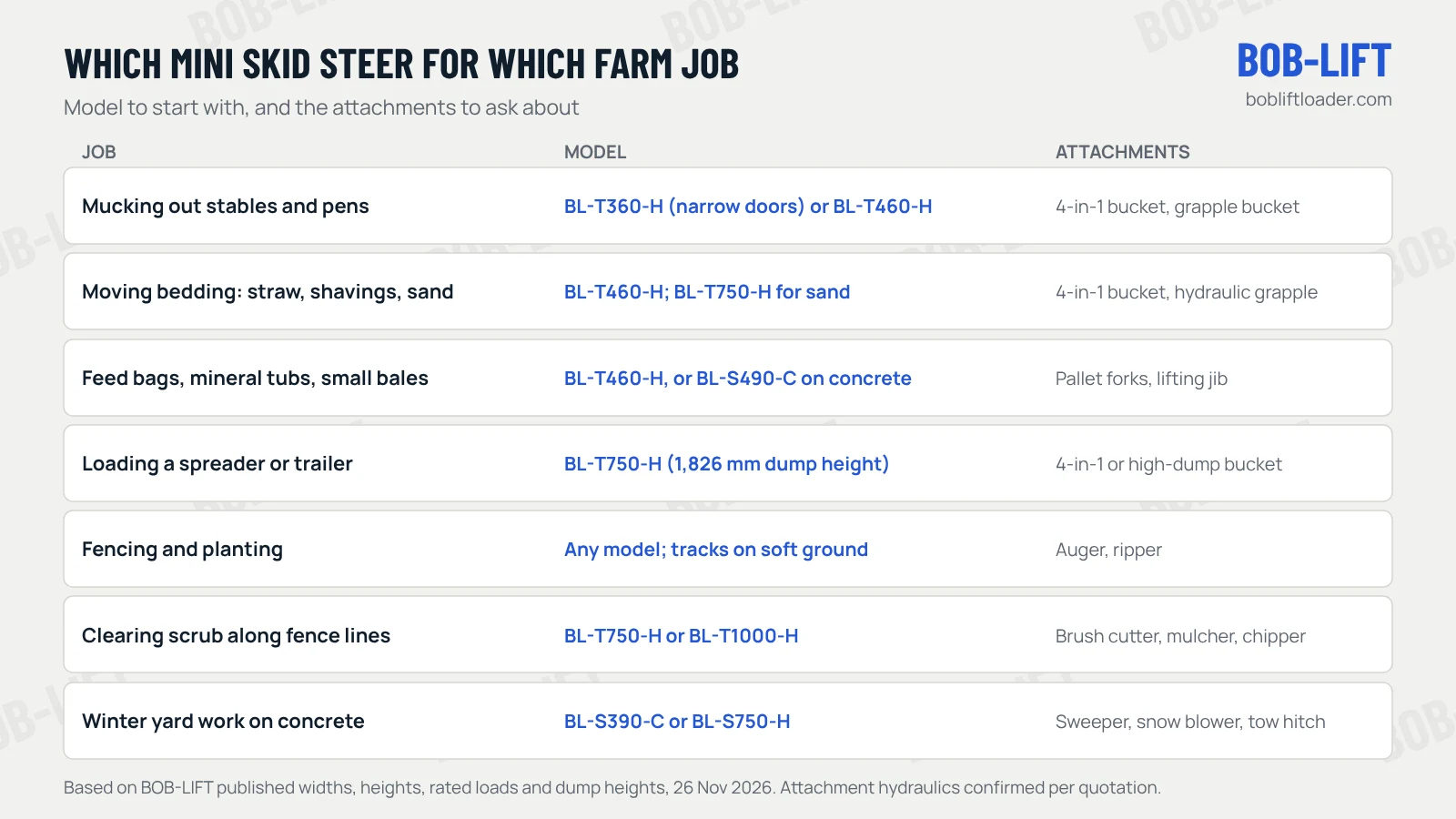
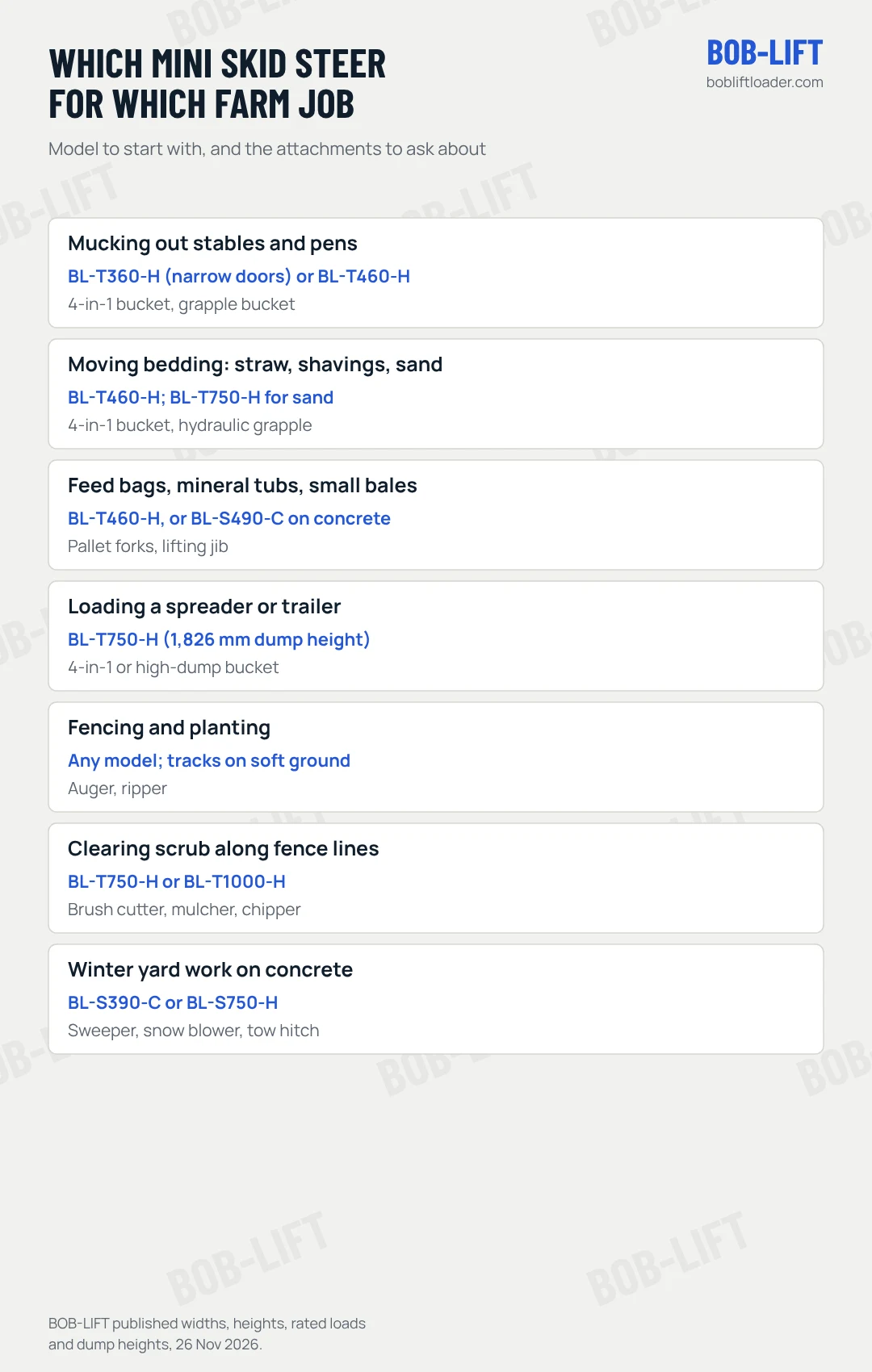
| Mucking out stables, pens and calf sheds | BL-T360-H where doors are narrow; BL-T460-H where they are 1.2 m or wider | 4-in-1 bucket, grapple bucket |
| Spreading and moving bedding (straw, shavings, sand) | BL-T460-H; BL-T750-H if you bed with sand | 4-in-1 bucket, hydraulic grapple for straw |
| Moving feed bags, mineral tubs and small bales | BL-T460-H or, on concrete yards, BL-S490-C | Pallet forks, lifting jib |
| Loading a muck spreader or trailer | BL-T750-H, the highest dump height in the range (1,826 mm) | 4-in-1 bucket, high-dump bucket |
| Fencing and planting | Any model; tracked models on soft ground | Auger, ripper |
| Clearing scrub along hedges and fence lines | BL-T750-H or BL-T1000-H | Brush cutter, mulcher, wood chipper |
| Yard work through the winter | BL-S390-C or BL-S750-H on concrete | Sweeper, snow blower, tow hitch |
Model suggestions follow the rated loads, widths and dump heights above. Powered attachments such as the auger, grapple and mulcher run from the loader’s auxiliary hydraulic lines, and hydraulic flow differs between models, so we confirm each attachment against your loader when we quote. See pallet forks, the grapple guide, the auger and trencher guide and the brush cutter and mulcher guide for details.
Working inside barns: exhaust and fuel
Engine exhaust is the hazard that is easiest to forget on a farm. OSHA’s carbon monoxide fact sheet names the internal combustion engine as one of the most common sources of workplace exposure and advises employers to prohibit gasoline-powered engines or tools in poorly ventilated areas [5]. Carbon monoxide has no smell, so you cannot rely on noticing it.
In practice, open the doors or work in open-sided buildings, keep engine running time indoors short, and consider a carbon monoxide monitor for enclosed sheds. Six of our models (the 360, 390, 460 and 490 series) can be ordered with a petrol or diesel engine; the 750 and 1000 models are diesel only. Diesel engines also produce carbon monoxide, so ventilation matters whichever fuel you choose. Our diesel vs petrol guide compares running costs and cold starting.
Safe use on the farm
NIOSH studied skid-steer loader deaths and found that in 29 of 37 work-related fatalities recorded between 1992 and 1997, the victim was pinned between the bucket or lift arm and the frame [6]. Its alert [6] sets out rules that apply on a farm as much as on a building site:
- “Never carry riders”.
- “Travel and turn with the bucket in the lowest position possible. Carry the load low”.
- “Never exceed the manufacturer’s recommended load capacity for the machine”.
- On slopes, avoid travelling across them and “travel straight up or down slopes with the heavy end of the machine pointed up hill”.
Keep children and animals out of the working area, lower the attachment to the ground before stepping off, and wear hearing protection: on some of our models, noise at the operator position can exceed 85 dB(A) at full engine speed.
Frequently asked questions
What size skid steer do I need for a small farm?
Start from the narrowest door and the heaviest material. For most small farms a tracked loader rated about 300 kg with a 0.15 m³ bucket, such as the BL-T460-H, covers stall cleaning, bedding, feed and fencing. Go up to 400 to 500 kg if you bed with sand or move palletised feed.
Can a mini skid steer move round bales?
Not safely in most cases. A 4 × 5 ft round bale holds about 320 to 427 kg of dry matter before moisture is counted [3], and a tight 5 × 5 bale can hold nearly 1,200 pounds of feed [4]. Our heaviest loader is rated at 500 kg. Weigh your bales before you plan around a mini skid steer.
Is a mini skid steer better than a compact tractor on a farm?
It is better inside buildings, between pens and anywhere narrow, because it turns on the spot and every model is under 1.1 m across the body (check the bucket width too). A tractor is better for towing, field work and heavy bales. Many farms use both.
Tracks or wheels for farm work?
Tracks for pasture, mud and soft ground; wheels for concrete yards, where they are faster and avoid track wear. Six of our nine models run on tracks.
Can I buy one machine direct from your factory?
Yes. One loader is enough to order. Loaders are built in 8 to 30 working days, ship by sea in a 20GP or 40HQ container, carry CE marking and come with a 12-month whole-machine warranty.
About these sources
- USDA Natural Resources Conservation Service, Agricultural Waste Management Field Handbook, Part 651, Chapter 4: Agricultural Waste Characteristics (2008).
- Ohio State University Extension, Grain Test Weight Considerations, AGF-503.
- Penn State Extension, How Much Does That Bale Really Weigh? Feeding and Fertilizer Implications.
- University of Missouri Extension, The skinny on what your hay bales really weigh (19 February 2025).
- Occupational Safety and Health Administration, Carbon Monoxide Poisoning fact sheet.
- NIOSH, Preventing Injuries and Deaths from Skid-Steer Loaders, Publication 2011-128.
Methodology. All sources were read on 26 November 2026. Every weight in the tables is the published unit weight multiplied by our listed level capacity. Imperial figures were converted at 1 lb/ft³ = 16.02 kg/m³ and rounded. Machine figures, lead times and warranty come from our own specification sheets and support page, checked the same day. This guide is general buying advice, not a substitute for the operator’s manual or local safety rules. Read more about us and our factory.
Ask which model suits your farm
Send us the width and height of your narrowest door, the materials you move and how much per day, whether you work on concrete or soil, and the attachments you have in mind. We reply with the model we suggest, its specification sheet, the attachments that match its hydraulics and a quotation on your trade terms. If you also move feed or manure over longer distances, our farm mini dumper guide shows which dumper covers the other half of the job, and our farms and orchards page lists the machines for both. Send us your enquiry.