


Choose a mini skid steer if most of your work is loading, carrying, digging and grading in tight spaces, with tools that change several times a day. Choose a compact tractor if most of your work is mowing, tilling, towing and running implements from a power take-off (PTO) or a three-point hitch across open ground. The two machines overlap at the front loader and almost nowhere else.
This guide compares the two on the points that decide a purchase or a hire-fleet order: how each one steers and carries its tools, size and weight, loader capacity, attachments and ground damage. For the numbers it sets our BL-T750-H tracked stand-on loader against a published sub-compact tractor of the same engine size, the LS MT125.
Key takeaways
- A skid steer is a loader first. It turns on the spot and runs every tool from one quick-attach plate and its auxiliary hydraulics [1].
- A tractor is an implement carrier first. Its rear three-point hitch and PTO drive mowers, tillers and other farm implements [2] [3]; the front loader is an add-on.
- At about 25 hp, the tractor is wider and lighter: 1,194 mm and 655 kg without ballast for the LS MT125, against 985 mm and 1,100 kg for our BL-T750-H [4].
- Loader ratings are not directly comparable, because skid steer and tractor makers rate their loaders in different ways.
- Buy for the job you do most hours.
How a skid steer and a tractor work
A skid steer is a compact loader with a rigid frame and lift arms that steers by turning the wheels or tracks on each side at different speeds. In 1957 the brothers Cyril and Louis Keller built the first three-wheeled front-end loader in Rothsay, Minnesota, to clean turkey manure out of a barn [1]. It has no steering wheels. Each side’s wheels or tracks are driven separately, and turning is done by differential steering: driving one side forward and the other in reverse turns the machine in its own length [1]. The loader arms carry a quick-attach plate, and the bucket can be swapped for “a variety of specialized buckets or attachments” [1], most of them powered by the machine’s auxiliary hydraulic lines. Our mini skid steer loaders are the compact, stand-on and small seated end of this design.
A compact tractor is a small farm tractor that steers with its front wheels and is built to pull and power implements. US workplace safety rules define an agricultural tractor as a wheeled or tracked vehicle “of more than 20 engine horsepower, designed to furnish the power to pull, carry, propel, or drive implements” [6]. “Almost every tractor today features Ferguson’s three-point linkage or a derivative of it,” the rear hitch for which Harry Ferguson applied for a British patent in 1926 [2]. A three-point hitch is the rear linkage of two lower arms and one top link that lifts and holds an implement. A power take-off (PTO) is a splined shaft, driven by the engine, that supplies rotary power to an implement. ISO 500 standardises agricultural PTOs: Type 1 turns at 540 rpm, Types 2 and 3 at 1,000 rpm, and Type 4 at 1,300 rpm [3]. A front loader is optional on most compact and sub-compact tractors.
In practice, that means the skid steer does its work with the front of the machine, close to where the operator stands, while the tractor does much of its work behind it, with the loader for occasional lifting.
Mini skid steer vs sub-compact tractor: the specifications
The table compares two machines with almost the same engine power. The tractor figures are as LS Tractor publishes them for the MT125 [4]; ours are from the BL-T750-H product page.
| Specification | BOB-LIFT BL-T750-H (mini skid steer) | LS MT125 (sub-compact tractor) |
|---|---|---|
| Engine power | 18.6 kW (24.9 hp), 3-cylinder diesel | 24.7 hp (18.4 kW) engine; 17.2 hp at the PTO |
| Overall width | 985 mm (38.8 in) | 47 in (1,194 mm) with tyres |
| Length | 2,836 mm (111.7 in) with bucket | 97 in (2,464 mm), frame to link |
| Weight | 1,100 kg (2,425 lb) | 1,444 lb (655 kg) without ballast |
| Front loader rating | 410 kg (904 lb) rated load; 525 kg lifting capacity | 1,008 lb (457 kg) loader lift capacity |
| Rear implements | None: all tools fit the front quick-attach plate | Category I three-point hitch, 992 lb (450 kg) hitch lift |
| Power take-off | None; attachments run on auxiliary hydraulics | Independent rear PTO at 540 rpm, mid PTO at 2,500 rpm |
| Steering | Skid steering on rubber tracks | Front-wheel steering |
| Operator position | Stand-on platform, joystick controls | Seated, with roll-over protective structure (ROPS) |
The tractor is about 210 mm wider, and it is the lighter machine, at 655 kg against 1,100 kg. A tractor gets its stability from its wheelbase and from rear ballast or a rear implement; LS lists the MT125’s weight without ballast [4]. A skid steer carries its counterweight in its own frame, because the loader is the whole machine.
The loader figures need care. Rated load is the weight a maker says the loader can carry in normal work, set below the load that would tip the machine. For the BL-T750-H it is 410 kg, below the 525 kg lifting capacity. LS gives the MT125 a loader lift capacity of 1,008 lb [5] without saying, on that page, at which point of the lift it is measured. Tractor and skid steer makers measure at different points and with different safety margins, so do not compare the two numbers directly. Our mini skid steer lift capacity guide explains how rated load and tipping load are defined.
Size: which one fits through the gate?
Width is often what decides the purchase for landscapers and builders working behind houses. Every mini skid steer we build is narrower than the LS sub-compact tractor, from 930 mm for the BL-T360-H to 1,090 mm for the BL-T460-H.

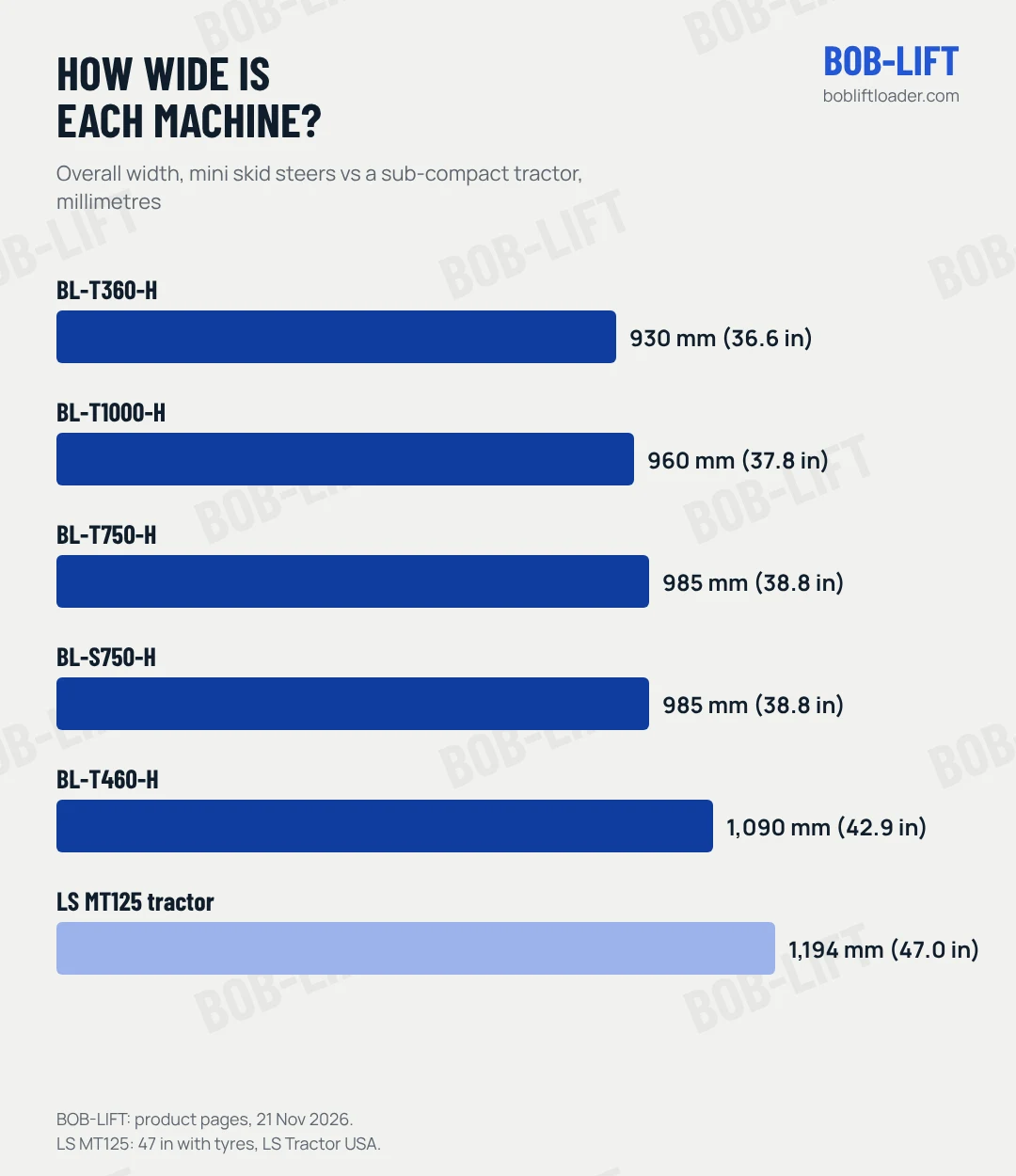
If a site has a narrow side passage, measure the narrowest point, then compare it with the machine width plus a margin on each side. Our mini skid steer weight and dimensions guide lists every model’s width, length and height for gates, trailers and shipping.
Attachments and implements
This is the real dividing line. A mini skid steer changes tools at the quick-attach plate in a few minutes, and hydraulic tools such as augers, trenchers, breakers and tillers run from its auxiliary lines. A tractor carries its main tools on the three-point hitch and drives them from the PTO: rotary tillers, finishing mowers, rear blades, post-hole diggers and spreaders. The front loader takes a bucket or pallet forks.
Some jobs can be done by either, through different tools. Soil can be tilled by a skid steer tiller or a PTO rotary tiller, and post holes can be drilled with a hydraulic auger on the loader or a PTO digger on the hitch. Others belong to one machine. Mowing a large lawn is a tractor job, and loading a skip all day is a skid steer job. The chart sets out the common jobs.

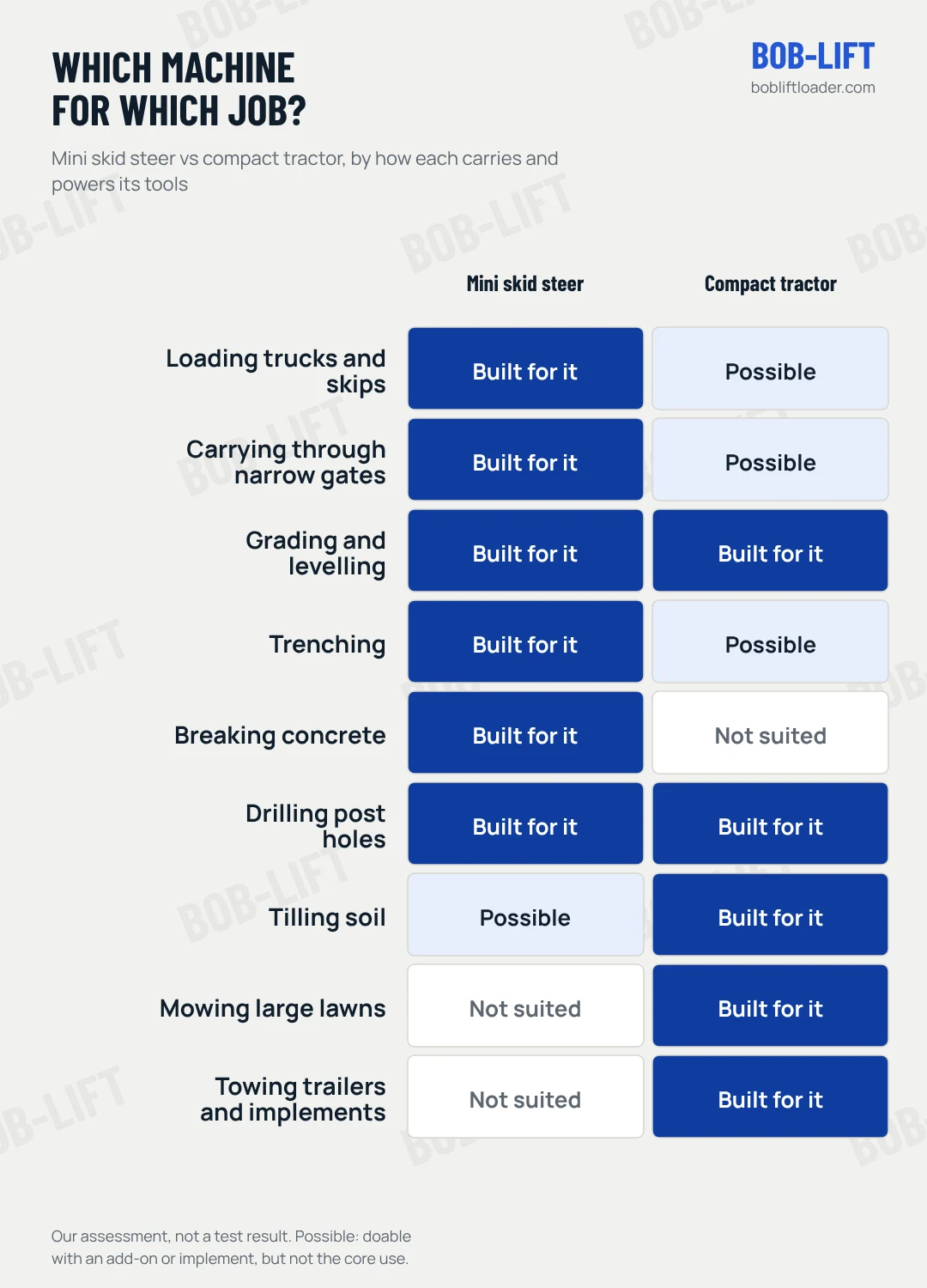
For a dealer or hire fleet, the attachment line also decides the stock. Mini skid steer tools share one mount, so one set of attachments fits a whole fleet of the same plate; our mini skid steer quick-attach plate guide explains the interface. Tractor implements are matched to the hitch category and the PTO. The LS MT125 has a Category I hitch [4], so it takes Category I implements.
Turf, terrain and the operator
Skid steering is hard on lawns. Because the machine turns by skidding one side against the other [1], a tight turn on wet grass scuffs the surface. A tractor steers its front wheels, so its turns roll rather than scrub. On a finished lawn or a sports field, a tractor on turf tyres usually leaves fewer marks. On mud, sand and soft ground, a tracked mini skid steer spreads its weight over a longer footprint; our tracked vs wheeled mini skid steer guide covers that choice.
The operator’s day differs too. On a stand-on loader such as the BL-T750-H the operator steps on and off in a moment, which suits jobs with frequent stops: opening gates, hand-raking or checking levels. A tractor operator sits higher, behind the steering wheel, with a roll-over protective structure, which suits long passes across a field. In the United States, agricultural tractors built after 25 October 1976 need a roll-over protective structure and a seatbelt when an employee drives them [6].
Which should you buy?
- Landscaping, groundworks and building sites: a mini skid steer. The work is mostly loading, carrying and grading, often through gates and around buildings. Our mini skid steer for landscaping guide lists the widths and attachments by job.
- Acreage, pasture and hobby farms: a compact tractor, because mowing, tilling and towing need the hitch and the PTO. Add a mini skid steer if you also clean out barns, move feed or dig often.
- Hire fleets: the two serve different customers. Mini skid steers rent to builders and landscapers by the day; tractors rent with implements for seasonal field work.
- Snow and yard clearing: either machine can push or blow snow with the right attachment, so decide by the size of the area and where the machine has to fit.
If the loader matters more than anything else, also compare a mini skid steer with larger loading machines. Our mini skid steer vs wheel loader comparison covers steering, size and capacity.
Frequently asked questions
Can a skid steer do everything a tractor can?
No. A skid steer has no three-point hitch and no PTO, so it cannot run PTO mowers, PTO tillers or three-point implements. It can do many of the same jobs with hydraulic attachments of its own, such as a tiller, a brush cutter or an auger.
Is a compact tractor or a skid steer better for moving dirt?
A skid steer. Moving dirt is loader work, and a skid steer is built around its loader: it turns in its own length [1] and works close to the pile without three-point turns.
Which is easier to transport?
Weight and size both count. Our BL-T750-H weighs 1,100 kg and is 985 mm wide; the LS MT125 weighs 655 kg without ballast and is 1,194 mm wide [4], but a tractor with a front loader and rear ballast or an implement weighs more. Check the combined weight against your trailer’s rating.
Can a mini skid steer mow grass?
With a brush cutter attachment it can cut rough grass and scrub, but it does not leave a lawn finish. For regular mowing of large lawns, a tractor with a finishing mower is the better tool.
About these sources
- Wikipedia, Skid-steer loader.
- Wikipedia, Tractor.
- Wikipedia, Power take-off, citing ISO 500.
- LS Tractor USA, MT125 sub-compact tractor specifications.
- LS Tractor USA, Sub-compact tractor class.
- US Code of Federal Regulations, 29 CFR 1928.51, Roll-over protective structures (ROPS) for tractors used in agricultural operations, eCFR.
All sources were read on 21 November 2026. BOB-LIFT figures come from our own product pages on the same date. The job grid is our assessment, not a test result. LS Tractor is named only as a published example of a sub-compact tractor; we have no connection with it. Read more about us and our factory.
Get the right mini loader for your jobs
Tell us the jobs, the narrowest gate or passage on your sites and the attachments you need. We will suggest a model and send the specifications and a quotation. Send us your enquiry.