


Key takeaways
- “Mini dump truck” covers three different machines: the Japanese kei truck with a tipping bed, the site dumper (a mini dumper with the skip in front of the driver), and the tracked dumper. They share a name, not a job.
- A kei mini dump truck is a road vehicle built to Japan’s light-vehicle limits: no more than 3.4 m long, 1.48 m wide and 660 cc, with a 350 kg (772 lb) cargo limit in Japan. Whether it can use public roads in the US depends on its age and your state.
- A site dumper is an off-road machine made to be loaded by an excavator or loader. Our wheeled range carries 1,000 to 5,000 kg (2,205 to 11,023 lb) and tips at the front, from 1.5 to 1.8 m wide.
- Choose by where the load travels. Public roads point to a road-registered truck; soft ground and narrow gates point to a tracked dumper; bulk material moved around a site points to a wheeled site dumper sized by rated load.
What people mean by a mini dump truck
Search for a mini dump truck in the United States and the results mix three machines. Some show a small Japanese pickup with a bed that tips. Others show a yellow four-wheel machine with a big open skip in front of the driver, which builders in the UK and Europe call a dumper or site dumper. A third group shows a petrol machine on rubber tracks with a small hopper, sometimes called a tracked dump truck, crawler dumper or power barrow. Some sellers list any of the three as a compact dump truck. All three tip a load, but they are built for different ground, different distances and different rules.
We build the second and third kinds at our factory in Xuzhou: eight wheeled site dumpers from 1 to 5 tons and two tracked models. We do not build kei trucks. This guide sets out what each type is good at, so you can tell which one your job actually needs before you compare offers.
| Feature | Kei mini dump truck | Wheeled site dumper | Tracked dumper |
|---|---|---|---|
| Built for | Roads and farm tracks | Off-road site work | Soft ground and tight access |
| Where the load sits | Bed behind the cab | Skip in front of the driver | Hopper in front of the operator |
| Typical payload | 350 kg (772 lb) legal limit in Japan | 1,000–5,000 kg (2,205–11,023 lb) in our range | 500 kg (1,102 lb) on our BL-T500-HD |
| Width | Up to 1,480 mm (58 in) | 1,500–1,800 mm (59–71 in) in our range | 880 mm (35 in) on our two tracked models |
| Loaded by | Hand, forklift or loader over the bed sides | Excavator or loader straight into the skip | Shovel, small loader, or its own self-loading shovel |
| Public roads | Depends on age, country and state rules | Not as supplied; road use needs local registration | Not as supplied; check local rules |
Kei mini dump trucks: road vehicles with a tipping bed
A kei truck is a Japanese light commercial vehicle, and the dump version adds a bed that tips. Japan’s Ministry of Land, Infrastructure, Transport and Tourism defines a light vehicle as one with an engine of 660 cc or less, no more than 3.4 m long, 1.48 m wide and 2.0 m high (MLIT Tohoku District Transport Bureau, light vehicles, retrieved 20 October 2026). The Japanese encyclopedia Nipponica adds that a light goods vehicle may carry no more than 350 kg (Kotobank, 軽自動車, retrieved 20 October 2026). That 350 kg is the legal cargo limit in Japan, so treat it as the design payload, not a figure to stretch.
These trucks reach the US mostly as used imports. US federal law exempts “a motor vehicle that is at least 25 years old” from the rule that imported vehicles must meet federal safety standards (49 U.S.C. § 30112, Cornell LII, retrieved 20 October 2026), which is why most kei trucks for sale in the US are older models. After import, each state decides whether they can use public roads. Florida, for example, allows a mini truck only on streets where the posted speed limit is 35 mph or less, and it must be registered and insured (Florida Statutes § 316.2122, retrieved 20 October 2026). Check your own state before you buy one for road use.
Where a kei dump truck shines is distance. It drives at road speeds, carries a driver and a passenger in a closed cab, and can move small loads between fields, plots or buildings along farm tracks and lanes. Where it falls short is loading and payload. An excavator has to lift material over the bed sides, and at 350 kg a load you make many trips on any earthworks job.
Site dumpers: built to be loaded by an excavator
A site dumper puts the skip at the front, low and wide, so an excavator or loader can drop material straight in, and the driver sits behind it. When the skip is full, the driver drives to the tipping point and tips forward over the front wheels, or to the side on a swivel model. That layout is why a small site dumper outcarries a kei truck of similar width by a wide margin: our smallest wheeled dumper, the FC10, is 1,500 mm (59 in) wide, only 20 mm wider than the kei limit, and is rated for 1,000 kg (2,205 lb), almost three times the kei cargo limit.


Our eight wheeled site dumpers step up in rated load. For help choosing between 1 and 5 tons, see our site dumper sizes guide.
| Dumper | Rated load | Skip | Width | Drive | Dump height |
|---|---|---|---|---|---|
| FC10 | 1,000 kg (2,205 lb) | 0.8 m³ | 1,500 mm (59 in) | 4×2 | 1,800 mm (5 ft 11 in) |
| FY15 | 1,500 kg (3,307 lb) | 0.8 m³ | 1,500 mm (59 in) | 4×2 | 1,800 mm (5 ft 11 in) |
| FY20-2 | 2,000 kg (4,409 lb) | 1.0 m³ | 1,600 mm (63 in) | 4×2 | 2,000 mm (6 ft 7 in) |
| FY20-4 | 2,000 kg (4,409 lb) | 1.2 m³ | 1,700 mm (67 in) | 4×4, articulated | 2,200 mm (7 ft 3 in) |
| FY30 | 3,000 kg (6,614 lb) | 1.5 m³ | 1,700 mm (67 in) | 4×4, articulated | 2,400 mm (7 ft 10 in) |
| FJZ30 | 3,000 kg (6,614 lb) | 1.5 m³ | 1,700 mm (67 in) | 4×4, articulated, self-loading bucket | 2,700 mm (8 ft 10 in) |
| FY40 | 4,000 kg (8,818 lb) | 1.5 m³ | 1,700 mm (67 in) | 4×4, articulated | 2,400 mm (7 ft 10 in) |
| FY50 | 5,000 kg (11,023 lb) | 1.5 m³ | 1,800 mm (71 in) | 4×4, articulated | 2,500 mm (8 ft 2 in) |
All eight run on diesel and top out at 22 to 28 km/h (14 to 17 mph). That is quick across a site and slow on a road. Gradeability is 21° in theory, and we recommend working on slopes of 18° or less. The 4×4 vs 4×2 comparison covers drive and steering on slopes and mud. If tipping to the side matters, see front tip vs swivel dumpers.
Site dumpers are not road vehicles as we supply them. In the UK, for example, a vehicle used on public roads must meet insurance, tax and registration requirements and the Road Vehicles (Construction and Use) Regulations 1986, while a works truck is designed “for use in private premises” (GOV.UK, Works trucks, retrieved 20 October 2026). Other countries have their own rules. If you need to drive a dumper between sites on public roads, check your local registration rules before you order, and tell us so we can discuss lights and other fittings you may need.
The site dumper’s main risk is overturning. The UK Health and Safety Executive says “over 60% of dumper deaths involve the driver being crushed when the vehicle overturns”, and asks site managers to check “that dumpers are provided with roll-over protection and that drivers use their seatbelts” (HSE, Dumpers, retrieved 20 October 2026). Keep the skip low when travelling, drive straight up and down slopes, and keep people clear. Our dumper ticket and training guide explains what operators need in the UK.

Tracked dump trucks for soft ground and narrow access
A tracked dumper trades payload and speed for ground contact. The New South Wales government describes tracked dumpers as machines that “carry materials on steep, wet, or unfavourable sites due to their low centre of gravity and low ground pressure” (NSW Government, carrier conditional registration sheet, retrieved 20 October 2026). On ours, the operator stands on a rear footplate or walks behind; there is no cab.
Our BL-T500-HD carries 500 kg (1,102 lb) in a 0.2 m³ hopper, and the BL-T200-HJ tracked mixer dumper mixes and carries concrete in a 200-litre drum, filling itself with its own loading shovel. Both are 880 mm (35 in) wide, narrow enough for many garden gates and side passages, run on a petrol engine and travel at up to 3 km/h (1.9 mph). They suit back gardens, landscaping and renovation, where a wheeled dumper cannot get in. Our power barrow guide and tracked vs wheeled mini dumper comparison go further.
How to choose a small dumper truck
Three questions decide the type: does the load use public roads, how narrow is the way in, and what ground does it cross? Volume and tipping height then decide the model.
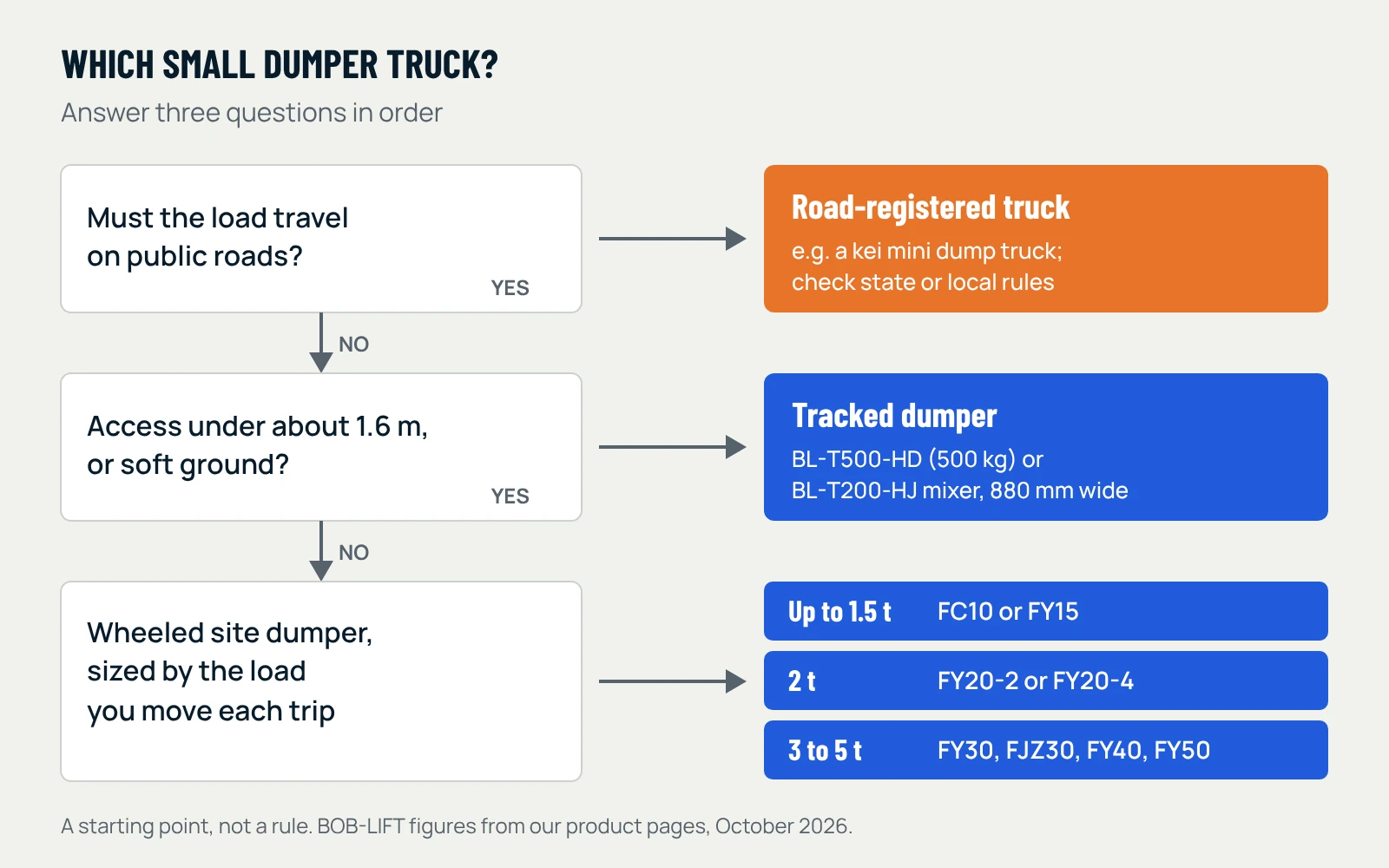
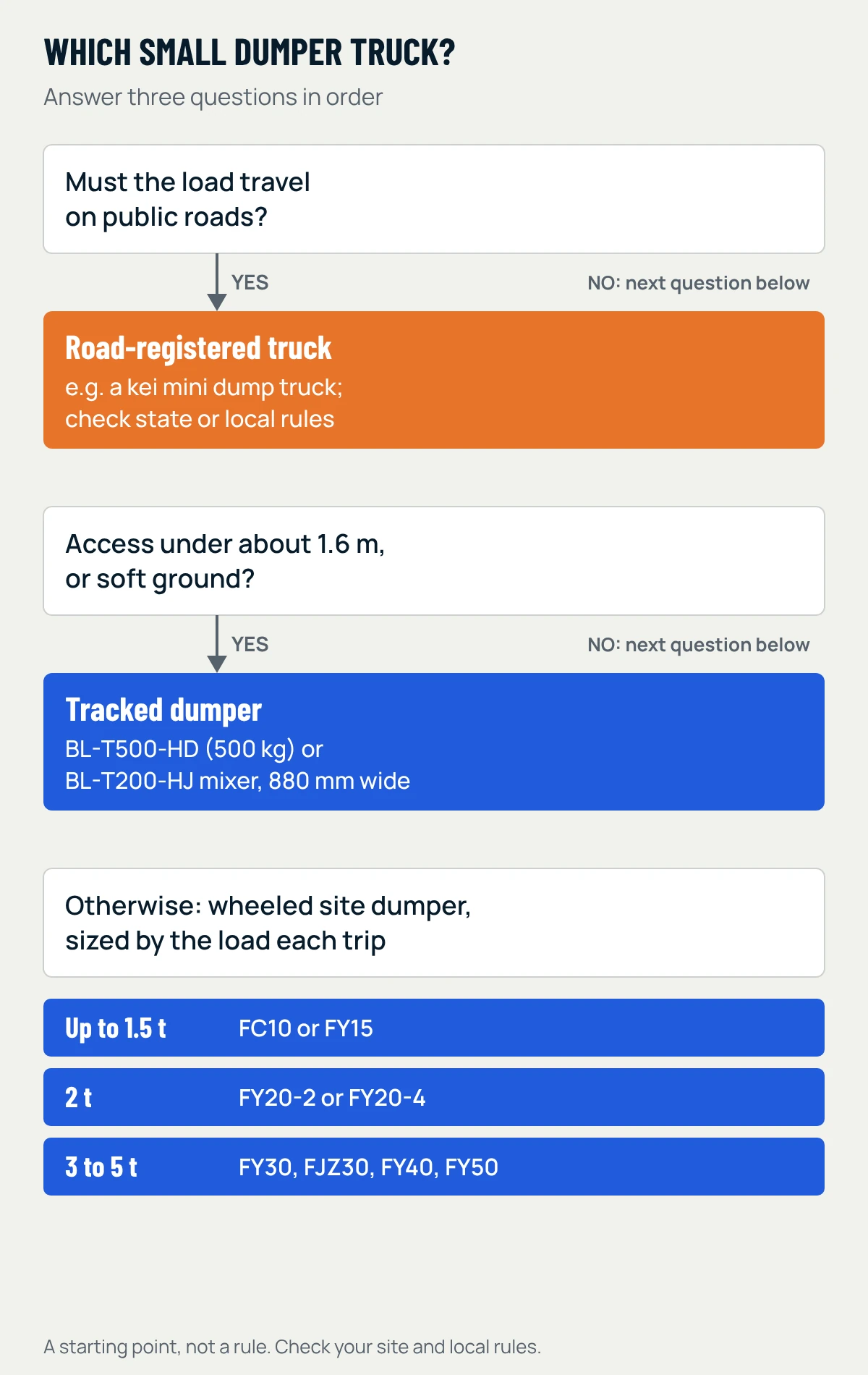
- Public roads. If every load has to travel between plots along public roads, a road-registered vehicle is the legal choice. A site dumper can do the work at each end.
- Ground and access. If the way in is narrower than about 1.6 m (63 in), which leaves our narrowest wheeled dumper too little clearance, or the ground is lawn, wet clay or sand, look at a tracked dumper first.
- Volume. If an excavator is digging footings or a pond, size a wheeled site dumper so the excavator fills it in a few passes. A 1.5 m³ skip on the FY30 holds almost twice the 0.8 m³ of the FC10.
- Tipping point. If you tip into skips or onto heaps, check the dump height. Ours run from 1,800 mm on the FC10 to 2,700 mm on the FJZ30.
Many sites end up with two machines: a mini skid steer to load and a dumper to carry. Our self-loading dumper guide explains when one machine that loads itself is enough.
Buying a small dumper truck direct from the factory
When you search for a small dumper truck for sale, you are comparing machines with very different payloads, so compare like with like: rated load, skip volume, width, drive and tipping. Nine of our ten dumpers are usually ready to ship about 10 working days after the order, and the FJZ30 takes about 30. Every machine has a 12-month whole-machine warranty. From our factory’s loading plans, a 40HQ container takes about 24 tracked dumpers on steel racks, but only 2 to 5 of the larger wheeled models, so the type you choose also changes the freight cost per machine. Our guide to buying a mini dumper from the factory covers options, container loads and trade terms.
Frequently asked questions
Is a mini dumper the same as a mini dump truck?
Often, yes. In the UK a mini dumper means a small site dumper with the skip in front of the driver. In the US, mini dump truck can mean that machine, a Japanese kei truck with a tipping bed, or a tracked dumper. Ask the seller which type they mean.
Can a mini dump truck be driven on the road?
It depends on the type and where you are. A kei truck is a road vehicle in Japan, but in the US its road use depends on its age and your state’s rules. Site dumpers and tracked dumpers are off-road machines as we supply them; road use needs local registration.
How much can a mini dump truck carry?
A kei truck’s legal cargo limit in Japan is 350 kg (772 lb). Our tracked BL-T500-HD carries 500 kg (1,102 lb), and our wheeled site dumpers carry 1,000 to 5,000 kg (2,205 to 11,023 lb).
What is the smallest dumper truck you build?
By width, the tracked BL-T500-HD at 880 mm (35 in). Among wheeled models, the FC10 and FY15, at 1,500 mm (59 in) wide and 2,600 mm (8 ft 6 in) long.
Do I need a licence or training to drive a site dumper?
Rules vary by country and employer. In the UK, many sites ask for an NPORS or CPCS dumper card, as the training guide linked in the site dumper section above explains.
Next step: match a dumper to your job
Start with where the load goes. Road trips point to a road-registered truck, soft ground and narrow gates to a tracked dumper, and bulk moves around one site to a wheeled site dumper sized by its rated load. Compare all ten models on our mini dumper range page. When you ask for a quote, tell us what you move, how much a day, the ground, your narrowest opening and the height you tip into, and we suggest the dumper to match.
Specifications checked against our product pages on 20 October 2026.