


A mini skid steer trailer has to carry considerably more than the machine itself. Begin with the machine weight on the specification sheet, add the attachment and fuel you intend to carry, and then add the empty weight of the trailer. Our lightest loader, the BL-T360-H, weighs 650 kg (1,433 lb) and our heaviest, the BL-T1000-H, weighs 1,250 kg (2,756 lb), so every BOB-LIFT mini skid steer needs a trailer rated well above the 750 kg (1,653 lb) unbraked limit used in the UK and Australia.
We build mini skid steer loaders at our factory in Xuzhou, China. We do not make or sell trailers. This guide is intended for buyers, fleet operators and importers who need to choose a suitable trailer for a mini skid steer they are purchasing from us, and it presents the calculations for every loader we manufacture, wheeled and tracked.
Key takeaways
- Our nine mini skid steers weigh 650 to 1,250 kg (1,433 to 2,756 lb). Add 200 kg for an attachment, fuel and chains, and the payload runs from 850 to 1,450 kg.
- With an example 500 kg trailer, the loaded trailer weighs 1,350 to 1,950 kg. That is above the 750 kg limit for trailers without brakes, so plan on a braked trailer for every model.
- The widest point is often the bucket, not the body. Our BL-T750-H and BL-S750-H have 1,270 mm (50.0 in) buckets on a 985 mm body.
- The longest machine is the BL-T750-H at 2,836 mm (9 ft 4 in) with its bucket, so a deck of about 3 m (10 ft) or more leaves room to place the load.
- US cargo rules ask for tiedowns with a combined working load limit of at least half the cargo weight [1]. With four direct straps, each one should be rated for at least a quarter of the load.
What is a mini skid steer trailer?
A mini skid steer trailer is a road trailer with a flat deck, ramps or a tilt bed, and a gross rating high enough to carry a compact loader, its attachments and the trailer’s own weight. It is not a specialised product: most are general equipment, plant or utility trailers, selected because their ratings and dimensions suit the particular loader.
Three numbers on the trailer plate decide whether a trailer fits the job:
- GVWR is the gross vehicle weight rating: the maximum the trailer may weigh when fully loaded. In the UK the equivalent figure is called MAM, the maximum authorised mass.
- Tare is the empty weight of the trailer on its own, including the ramps, the mudguards and any fixed toolbox.
- Payload is the GVWR minus the tare, and it must cover the loader, the attachment and every other item carried on the deck.
A trailer advertised as a small skid steer trailer may still be too light once you add an attachment, such as an auger, a breaker or a grapple, so do the calculation for the specific machine and equipment you actually order.
Step 1: Work out the weight your trailer carries
The table lists the machine weight, overall width and length from the specification sheet of each loader on this site. The payload column adds a 200 kg (441 lb) planning allowance for one attachment, fuel and chains. That allowance is our assumption, not a measured attachment weight, because attachment weights vary by tool; ask us for the weight of the attachments you order. The loaded trailer column adds an example 500 kg (1,102 lb) trailer tare, which is also an assumption: use the figure on your own trailer plate.
| Model | Running gear | Machine weight | Widest point (body / bucket) | Length with bucket | Payload with 200 kg allowance | Loaded trailer with 500 kg tare |
|---|---|---|---|---|---|---|
| BL-T360-H | Tracks | 650 kg (1,433 lb) | 930 / 906 mm | 1,906 mm | 850 kg (1,874 lb) | 1,350 kg (2,976 lb) |
| BL-S390-C | Tyres | 650 kg (1,433 lb) | 959 / 1,050 mm | 2,281 mm | 850 kg (1,874 lb) | 1,350 kg (2,976 lb) |
| BL-T460-H | Tracks | 730 kg (1,609 lb) | 1,090 / 1,100 mm | 2,200 mm | 930 kg (2,050 lb) | 1,430 kg (3,153 lb) |
| BL-T390-C | Tracks | 750 kg (1,653 lb) | 955 / 1,050 mm | 2,281 mm | 950 kg (2,094 lb) | 1,450 kg (3,197 lb) |
| BL-S490-C | Tyres | 850 kg (1,874 lb) | 1,089 / 1,150 mm | 2,573 mm | 1,050 kg (2,315 lb) | 1,550 kg (3,417 lb) |
| BL-T490-C | Tracks | 950 kg (2,094 lb) | 1,089 / 1,150 mm | 2,573 mm | 1,150 kg (2,535 lb) | 1,650 kg (3,638 lb) |
| BL-S750-H | Wheels | 1,000 kg (2,205 lb) | 985 / 1,270 mm | 2,700 mm | 1,200 kg (2,646 lb) | 1,700 kg (3,748 lb) |
| BL-T750-H | Tracks | 1,100 kg (2,425 lb) | 985 / 1,270 mm | 2,836 mm | 1,300 kg (2,866 lb) | 1,800 kg (3,968 lb) |
| BL-T1000-H | Tracks | 1,250 kg (2,756 lb) | 960 / 1,240 mm | 2,691 mm | 1,450 kg (3,197 lb) | 1,950 kg (4,299 lb) |
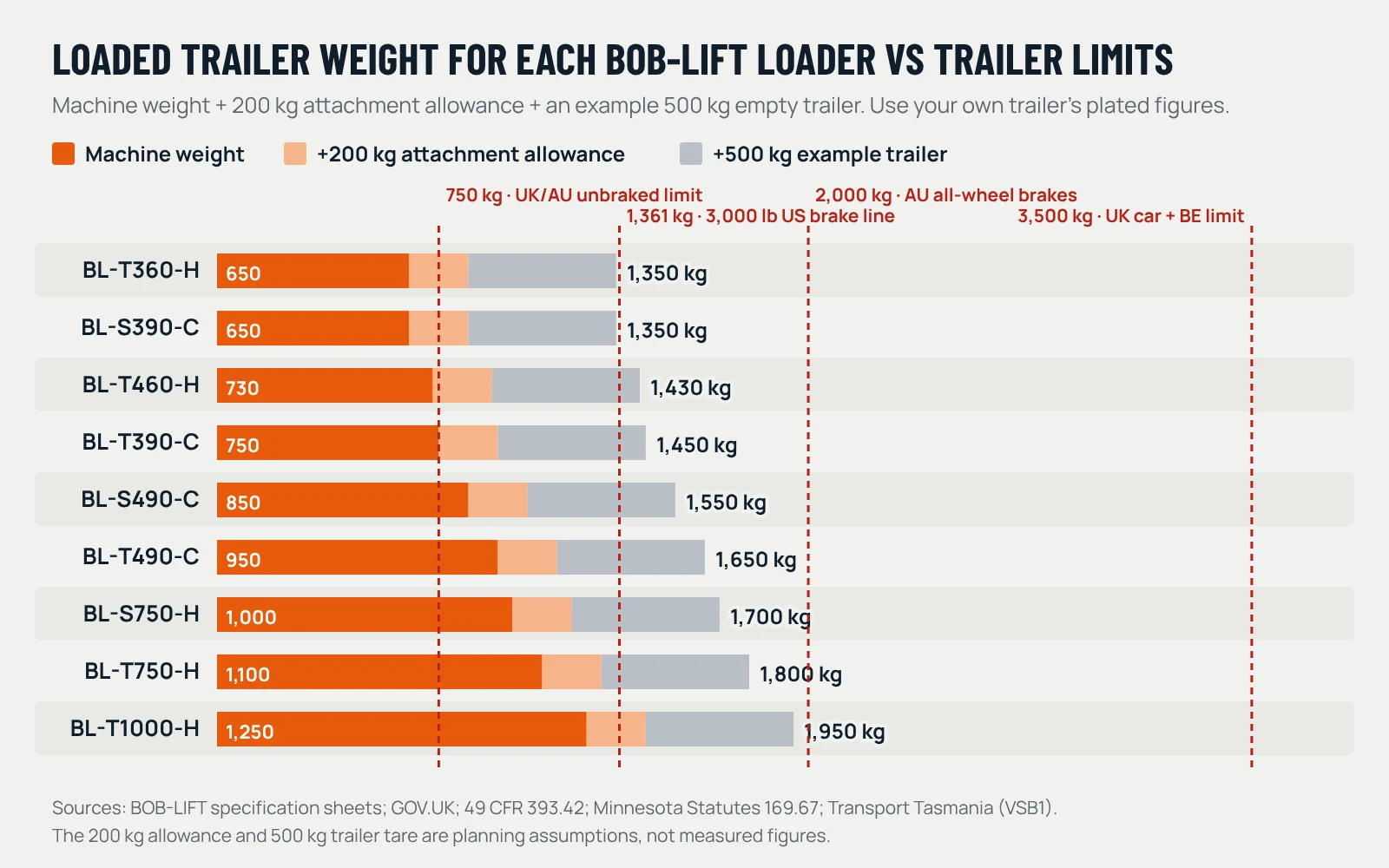
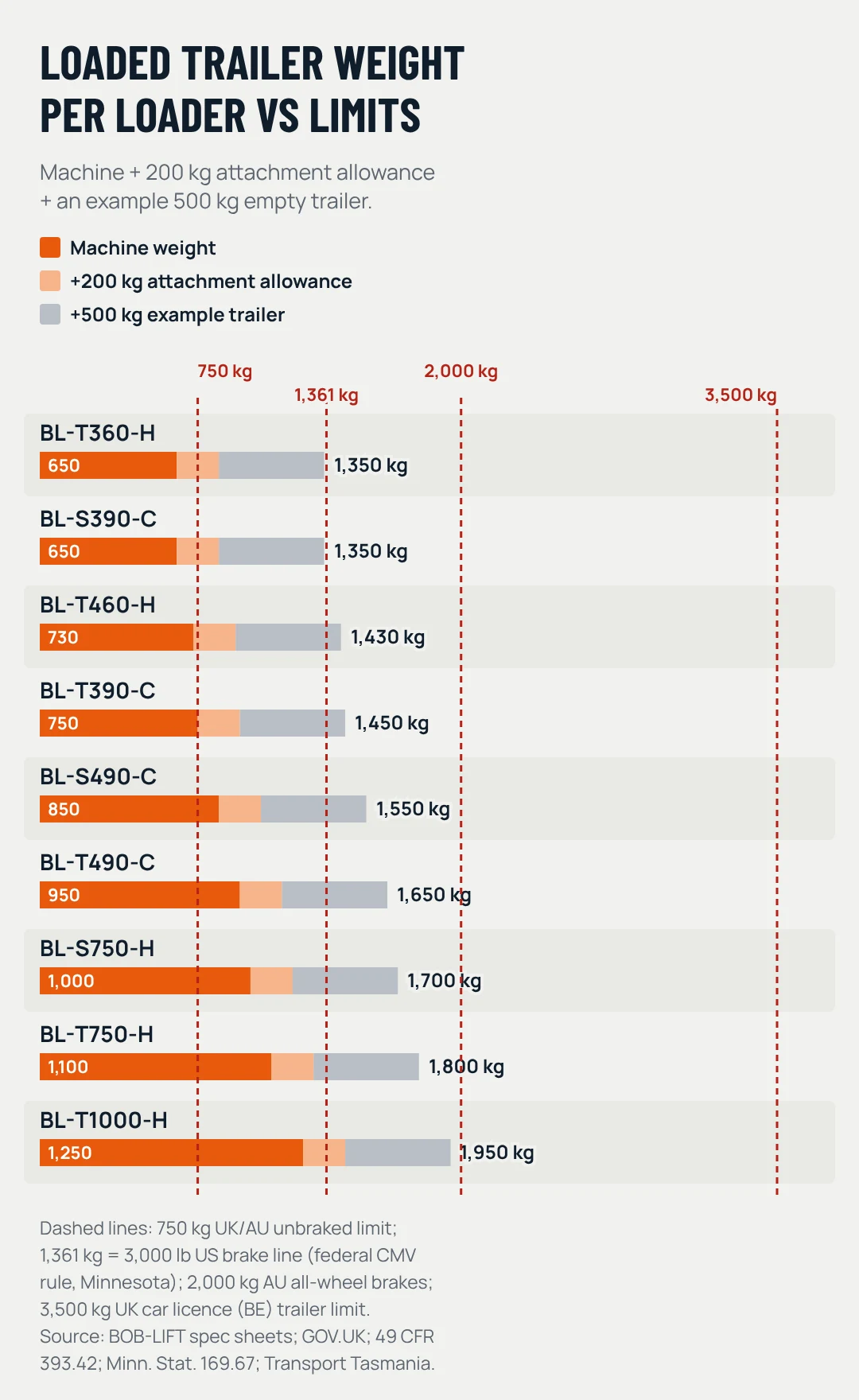
Two observations stand out. First, no BOB-LIFT loader is suitable for an unbraked 750 kg trailer: even the 650 kg BL-T360-H would leave only 100 kg for the trailer structure itself. Second, the tracked models weigh 100 kg more than their wheeled twins (BL-T390-C against BL-S390-C, for example), which becomes important if your combination is operating close to a legal limit. Our mini skid steer weight and dimensions guide has the full size table, heights and gate widths for each loader, and our tracked vs wheeled guide explains when tracks are worth the extra weight.
Step 2: Check trailer GVWR, payload and the towing vehicle
A trailer for a mini skid steer passes the weight check when two sums both work:
- Trailer: tare + machine + attachment + extras must be at or below the trailer GVWR.
- Towing vehicle: the loaded trailer must be within the vehicle’s towing limit, and the loaded vehicle plus the loaded trailer must be within its gross train weight.
GOV.UK explains that the gross train weight is the weight of the fully loaded car plus the fully loaded trailer, and that it must not be exceeded [2]. It also says that drivers who passed their test from 1 January 1997 can tow a trailer of up to 3,500 kg MAM with a car licence [3]. The DVSA safety-check guidance adds that a trailer with no braking system must not weigh over 750 kg loaded and should not weigh more than 50% of the car’s weight [4].
Example scenario (an illustration, not a customer record): a contractor plans to tow a BL-T750-H with an auger. The machine weighs 1,100 kg; with our 200 kg allowance the payload is 1,300 kg. A trailer plated at 2,000 kg GVWR with a 450 kg tare has 1,550 kg of payload, so it passes with 250 kg in hand. The towing vehicle must then be rated to tow at least 1,750 kg, the real loaded trailer weight, and the combined weight must stay within its gross train weight. If the contractor later swaps the auger for a heavier tool, the sum has to be done again.
Also check the nose weight (tongue weight) limit of the towing vehicle and of the trailer coupling. The position of the loader on the deck alters this figure considerably, which is why the trailer manufacturer’s recommended loading position is important.
Step 3: Match deck length and width to the machine
Check width at the widest point, for example the bucket edges. On our seated models and the 750 and 1000 series, the bucket is wider than the body, so the bucket decides the deck width you need. On the BL-T360-H, the 906 mm bucket sits inside the 930 mm body.
- Width between the fenders. On a trailer with the wheels beside the deck, measure the clear width between the wheel arches. The BL-T750-H needs more than 1,270 mm (50.0 in) with its bucket fitted, and more than 985 mm (38.8 in) with the bucket off.
- Deck over the wheels. A deck that sits above the trailer wheels gives more width, but it is higher off the ground, so it needs longer ramps. Our widest bucket is 1,270 mm, well inside the 2.55 m maximum trailer width that GOV.UK gives for any towing vehicle [2].
- Deck length. Our loaders measure 1,906 to 2,836 mm with the bucket fitted. Leave room to set the machine where the trailer maker advises for correct nose weight, plus space for the operator to step off and fit the straps. A deck of about 3 m (10 ft) covers our longest machine; the 2,691 mm BL-T1000-H fits a similar length.
Can two mini skid steers share one trailer? Only if the deck length, the GVWR and the towing vehicle all allow it. Two BL-T360-H loaders weigh 1,300 kg before attachments and need at least 3.8 m of deck, so in most cases one machine per trailer is the practical choice, with attachments on the same deck.
Step 4: Choose ramps by angle and capacity
Ramps usually fail in one of two ways: either they are too steep for the machine, or they are not rated for its operating weight. The ramp angle depends entirely on the deck height and the ramp length. The figures below are calculated as the arcsine of deck height divided by ramp length.
| Deck height | 1.5 m ramp | 2.0 m ramp | 2.5 m ramp | 3.0 m ramp |
|---|---|---|---|---|
| 400 mm (15.7 in) | 15.5° | 11.5° | 9.2° | 7.7° |
| 500 mm (19.7 in) | 19.5° | 14.5° | 11.5° | 9.6° |
| 600 mm (23.6 in) | 23.6° | 17.5° | 13.9° | 11.5° |
Gradeability is the steepest working slope a machine is rated for on firm ground, and our loaders carry ratings of 25° or 30°. It is not a ramp rating, so do not plan a ramp anywhere near that figure. A shallower ramp is safer, because a short, steep ramp also increases the probability of the machine grounding at the top edge. Ground clearance runs from 160 mm on the BL-T360-H and BL-T460-H to 240 mm on the BL-S750-H.
For capacity, confirm whether the rating applies to each ramp or to the pair, and make sure it covers the machine plus any attachment it carries up the ramp. Tracked machines need ramps wide enough to support the full track width. Secure the ramps to the trailer so they cannot separate during loading.
Step 5: Brakes by region
Brake regulations depend on where the trailer is registered and operated. The limits below come from official government sources; confirm the regulations in your own state or country before you purchase a trailer.
- United Kingdom: your trailer must have a working brake system if it weighs over 750 kg when loaded, and you must use a breakaway cable or secondary coupling [5].
- United States, federal: for commercial motor vehicles, 49 CFR 393.42 requires brakes on all wheels, with an exception for some trailers with a gross weight of 3,000 lb (1,361 kg) or less [6]. A commercial motor vehicle in interstate commerce includes one with a GVWR or GCWR of 10,001 lb or more [7].
- United States, state example: Minnesota says a trailer with a gross vehicle weight of 3,000 lb or more must have brakes, and one over 3,000 lb needs brakes that stop and hold it if it breaks away [8]. Other states set different limits.
- Australia: Transport Tasmania’s guide to VSB1 says single-axle trailers up to 750 kg gross trailer mass need no brakes, trailers up to 2,000 kg need brakes on at least one axle, and trailers over 2,000 kg need brakes on all wheels with a breakaway system [9].
With our example figures, every BOB-LIFT loader needs a braked trailer under the UK and Australian rules. The BL-T360-H and BL-S390-C come in just under 3,000 lb loaded, but only with a 500 kg tare and nothing extra on the deck, so a braked trailer is the sensible choice for them too.
Step 6: Tie down to the cargo securement rules
Read 49 CFR 393.130 before you assume it applies. It covers wheeled and tracked machinery that individually weighs 10,000 lb (4,536 kg) or more, and it says lighter machines may be secured under that section, under 393.128, or under the general rules in 393.100 to 393.114 [10]. Every BOB-LIFT loader is far below that line, but the 393.130 method is still a clear model to follow:
- Lower accessory equipment completely and secure it to the vehicle.
- Restrain the machine against forward, rearward, sideways and vertical movement with at least four tiedowns.
- Fix each tiedown as close as practicable to the front and rear of the machine, or to mounting points designed for that purpose [10].
Under the general rules, the combined working load limit (WLL) of the tiedowns must be at least half the weight of the cargo, and a tiedown that runs from the trailer to an anchor point on the machine counts at half its WLL [1]. In practice, with four direct tiedowns, each one should be rated for at least a quarter of the load. For our heaviest set-up, a 1,250 kg BL-T1000-H plus a 200 kg attachment, that is at least 363 kg (799 lb) WLL per strap or chain. The minimum number rule in 393.110 asks for two tiedowns for an article longer than 1.52 m and up to 3.04 m [11]; four is the better plan for a loader.
Secure any attachments that travel separately on the deck as individual items of cargo. A bucket or attachment that remains on the machine should be lowered flat to the deck before you tension the straps.
How to load a mini skid steer onto a trailer safely
Loading is where the trailer job is most exposed. A Washington State FACE investigation of a fatal backhoe loading incident found that wet, muddy tyres may have slipped on metal ramps, and it recommends seatbelt use during loading, a spotter, and a written job hazard analysis for loading and unloading [12]. A sound routine looks like this:
- Park the towing vehicle and trailer on firm, level ground, with the trailer coupled, the parking brake on and the trailer wheels chocked.
- Clean mud, oil and snow from the ramps, the deck and the machine’s tracks or tyres. Avoid loading in the rain when you can.
- Secure the ramps to the trailer and set them to match the machine’s track or wheel spacing.
- Use a spotter who stands clear of the ramps and the machine’s path.
- Drive straight on and off at low speed with the bucket low, and never turn on the ramps.
- Stop, lower the attachment to the deck, switch the engine off and remove the key before you fit the tiedowns.
University of Wisconsin-Extension safety guidance advises moving up and down slopes with the heavy end of the loader pointed uphill, and notes that with no load, most of the weight is on the rear [13]. A ramp is a short, steep slope, so follow the same rule and the operator’s manual for your machine.
Flat deck, tilt bed or mini skid steer dump trailer?
- Flat deck with ramps: a widely used choice and straightforward to load, as long as the ramps are long enough for a low angle.
- Tilt bed: the whole deck tips to form a long, low ramp, which suits stand-on loaders with low ground clearance.
- Dump trailer: some owners carry the loader in a dump trailer and use the trailer to haul soil or rubble afterwards. The sides narrow the usable width, so check the inside width against the bucket width, and check that the floor and ramps are rated for a tracked machine.
The best trailer for a mini skid steer is the one whose plated payload, deck size and brakes cover the exact machine and attachments you will move, with margin to spare. If you also run small dumpers, our mini skid steer vs mini dumper guide compares how each one moves material on site.
Frequently asked questions
What size trailer do I need for a mini skid steer?
For our range, plan on a braked trailer with at least 850 to 1,450 kg (1,874 to 3,197 lb) of payload, a deck of about 2.5 to 3 m (8 to 10 ft), and clear width above the widest point of the machine, which is up to 1,270 mm with the bucket fitted.
Can I use a small utility trailer for a small skid steer?
Only if its plated payload covers the machine plus attachments and it is equipped with brakes wherever your local regulations require them. A trailer plated at 750 kg loaded cannot carry any of our loaders, because the lightest model weighs 650 kg before the trailer’s own weight is counted.
How many tie-downs does a mini skid steer need?
Use four, one at each corner, fixed at the machine’s tie-down points. With four direct tiedowns, each should have a WLL of at least a quarter of the machine plus attachment weight.
Does BOB-LIFT sell trailers?
No. We manufacture and export mini skid steer loaders and mini dumpers. Purchase the trailer locally, so that it complies with the regulations where it will be registered.
Which BOB-LIFT loader is easiest to trailer?
The BL-T360-H is the lightest and shortest tracked model at 650 kg and 1,906 mm with its bucket. The heaviest is the BL-T1000-H at 1,250 kg, and the longest is the BL-T750-H at 2,836 mm.
About these figures
We compiled the machine weights, widths, lengths, gradeability and ground clearance from the specification sheets of our nine loaders on this site on 30 October 2026. Imperial figures are converted from metric and rounded. The 200 kg attachment allowance and the 500 kg trailer tare are planning assumptions, not measured figures. Ramp angles are calculated from deck height and ramp length. Legal limits are quoted from the official pages linked above as read on 30 October 2026; rules change, so check them where you drive. You can read more about our company and factory.
Ask for a mini skid steer quotation
Tell us the loader model you are interested in, the attachments you need, your country and the trailer and towing vehicle you plan to use. We will send the specification sheet with the machine weight and dimensions, the weights of the attachments you choose, and a quotation on your trade terms. Send us your requirements.