


A skid steer log splitter is a hydraulic cylinder on a steel beam that mounts on the front of the loader and pushes each round of wood onto a wedge. It runs on oil from the loader’s auxiliary hydraulic lines. On a mini skid steer, its force depends on two numbers: the loader’s hydraulic pressure and the bore of the splitter’s cylinder. Our nine loaders are rated at 16 to 20 MPa. At those pressures, an 80 mm bore pushes with about 9 to 11 US tons in theory, and a 100 mm bore with about 14 to 18.
We build nine mini skid steers at our factory in Xuzhou, China (read more about us), and a log splitter is one of the 26 attachments we quote with them. This guide shows how to work out the splitting force on each model, why a bigger cylinder is slower, which of our loaders suits firewood work, and what to tell us so the splitter we quote matches your loader.
Key takeaways
- Force = pressure × piston area. Pressure is force per unit area [1], so the loader sets the pressure and the splitter’s cylinder sets the area.
- Our loaders run at 16, 17, 18 or 20 MPa. The BL-T1000-H has the highest pressure in the range, 20 MPa (2,901 psi).
- Bigger bore, more force, slower stroke. On the same oil flow, a 100 mm cylinder pushes about 2.5 times harder than a 63 mm one and takes about 2.5 times longer.
- Home splitters are mostly rated around 10 tons, and professional hydraulic models at 30 tons or more [2]. A mini skid steer splitter sits in the first group unless the cylinder is large.
- We match the splitter when we quote. Hydraulic flow and the quick-attach plate differ between models, so tell us the loader and your largest logs.
How a skid steer log splitter works
A log splitter uses a hydraulic cylinder to force a piece of wood between a steel wedge and a plate [3]. On a skid steer, the cylinder does not need its own engine or pump. Instead, it runs from the loader’s auxiliary hydraulics. Auxiliary hydraulics are the extra pair of hose couplers at the front of the loader that power attachments. The splitter frame mounts on the quick-attach plate in place of the bucket.

Its performance comes from the loader: the pressure decides the push, and the oil flow decides the speed.
How much splitting force can a mini skid steer give?
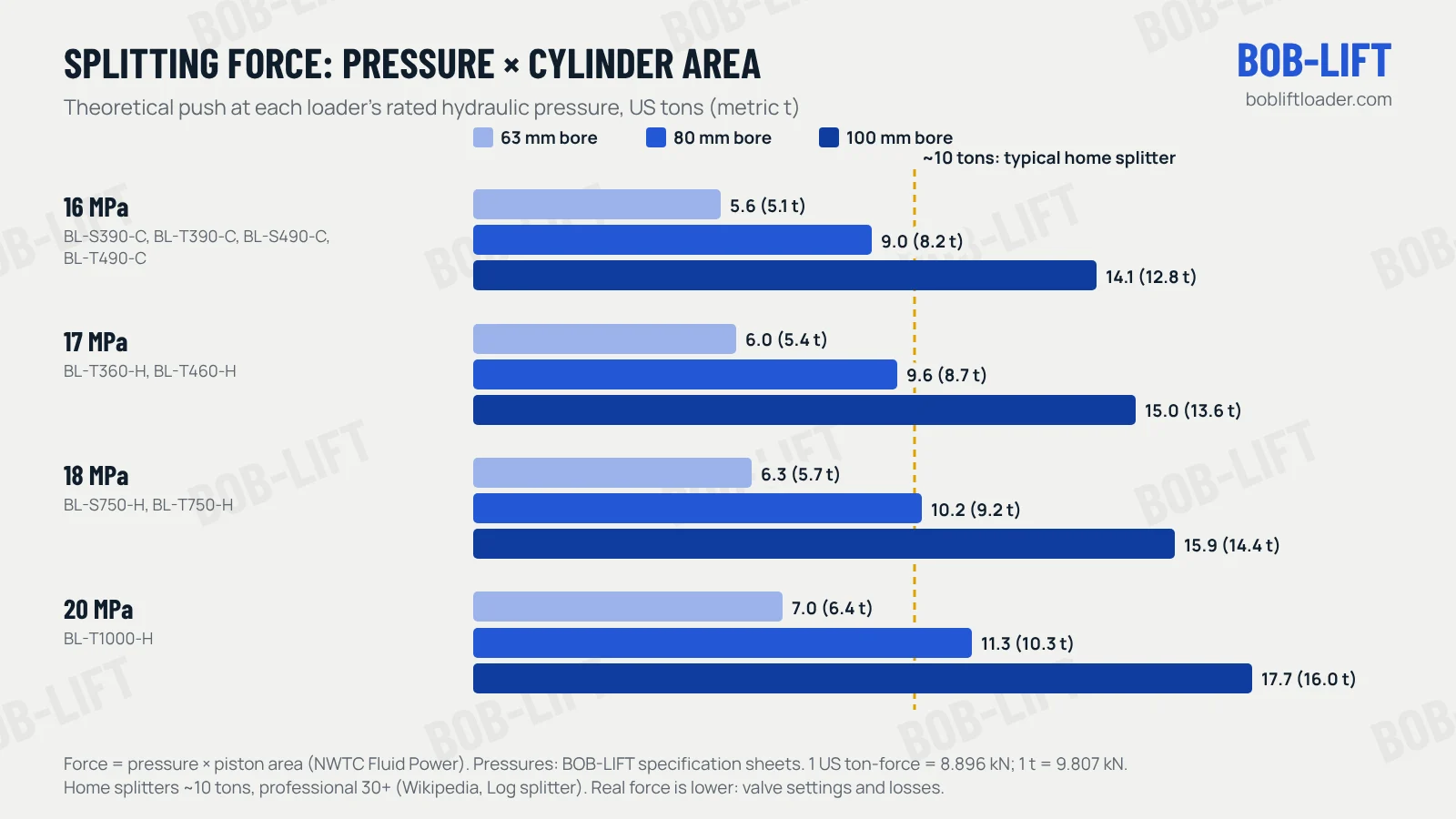
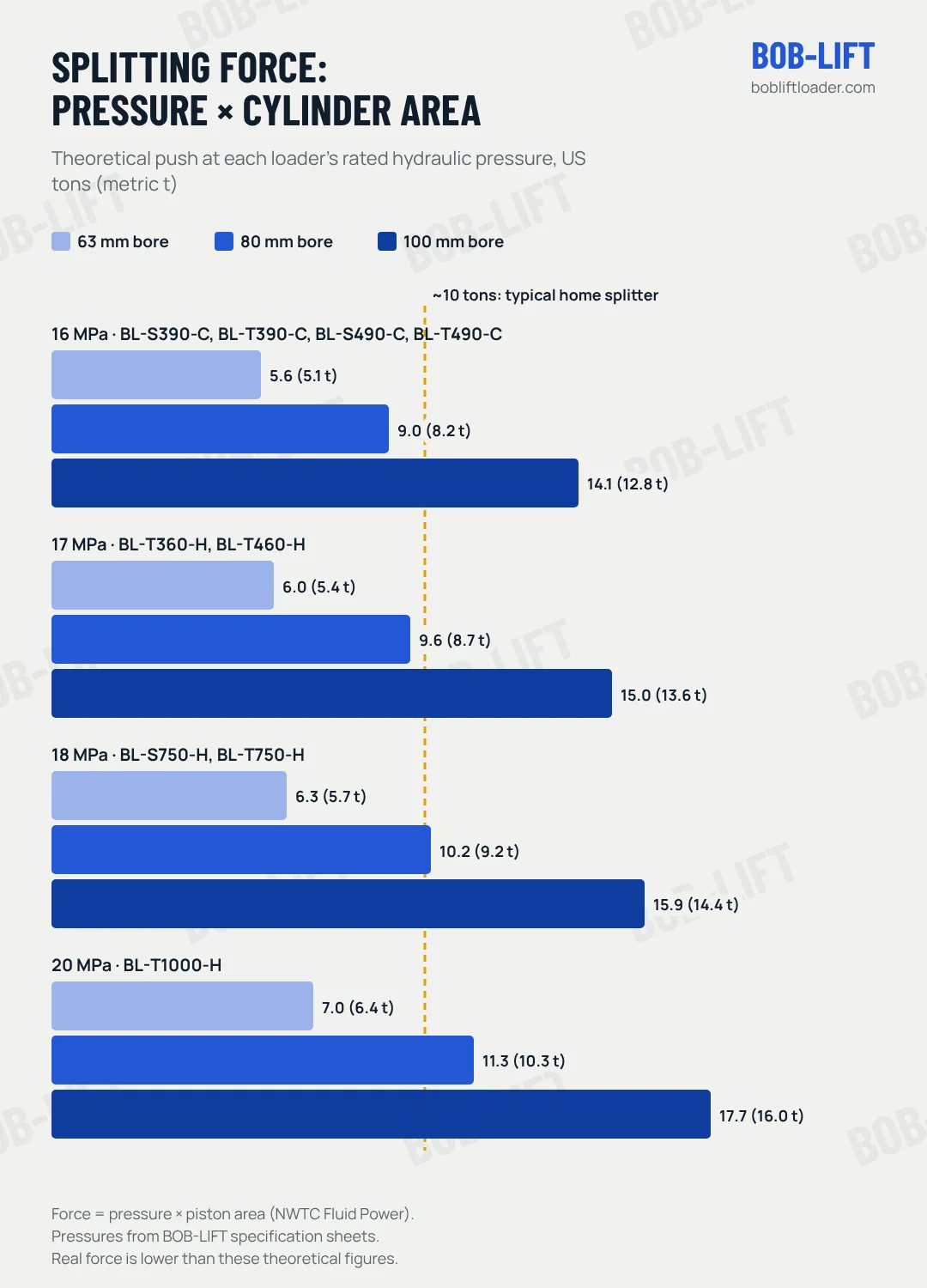
Multiply the hydraulic pressure by the area of the cylinder’s piston. Pressure is defined as force per unit area [1], so force is pressure times area. The bore is the inside diameter of the cylinder, and the piston area is π × bore² ÷ 4. For example, an 80 mm bore has an area of 5,027 mm². At 16 MPa that gives 80.4 kN. That is 8.2 metric tons-force, or 9.0 US tons.
The chart works this out for the four pressures in our range and three common cylinder bores.
| Loader | Rated pressure | 63 mm bore | 80 mm bore | 100 mm bore |
|---|---|---|---|---|
| BL-S390-C, BL-T390-C, BL-S490-C, BL-T490-C | 16 MPa (2,321 psi) | 5.6 US tons (5.1 t) | 9.0 US tons (8.2 t) | 14.1 US tons (12.8 t) |
| BL-T360-H, BL-T460-H | 17 MPa (2,466 psi) | 6.0 US tons (5.4 t) | 9.6 US tons (8.7 t) | 15.0 US tons (13.6 t) |
| BL-S750-H, BL-T750-H | 18 MPa (2,611 psi) | 6.3 US tons (5.7 t) | 10.2 US tons (9.2 t) | 15.9 US tons (14.4 t) |
| BL-T1000-H | 20 MPa (2,901 psi) | 7.0 US tons (6.4 t) | 11.3 US tons (10.3 t) | 17.7 US tons (16.0 t) |
These are theoretical figures. The table uses the loader’s rated system pressure. In practice, the relief valve setting, losses in hoses and couplers, and the splitter’s own valve all bring the real push below it. So use the table to compare set-ups, not as a rating for the beam.
For scale, most log splitters for home use are rated at around 10 tons, and professional hydraulic models can exert 30 tons or more [2]. The higher the rating, the thicker or longer the rounds a splitter can handle [2]. A mini skid steer with an 80 mm cylinder lands close to the home figure. By contrast, a 100 mm cylinder on the BL-T1000-H reaches about 17.7 US tons in theory. That is more than most home units, but well short of a professional model.
Why a bigger cylinder splits more slowly
The same oil has to fill a larger piston, so a bigger bore moves more slowly. The time for one stroke is the cylinder’s volume divided by the oil flow. For example, the chart uses a 500 mm stroke and two example flows, 10 and 20 L/min.
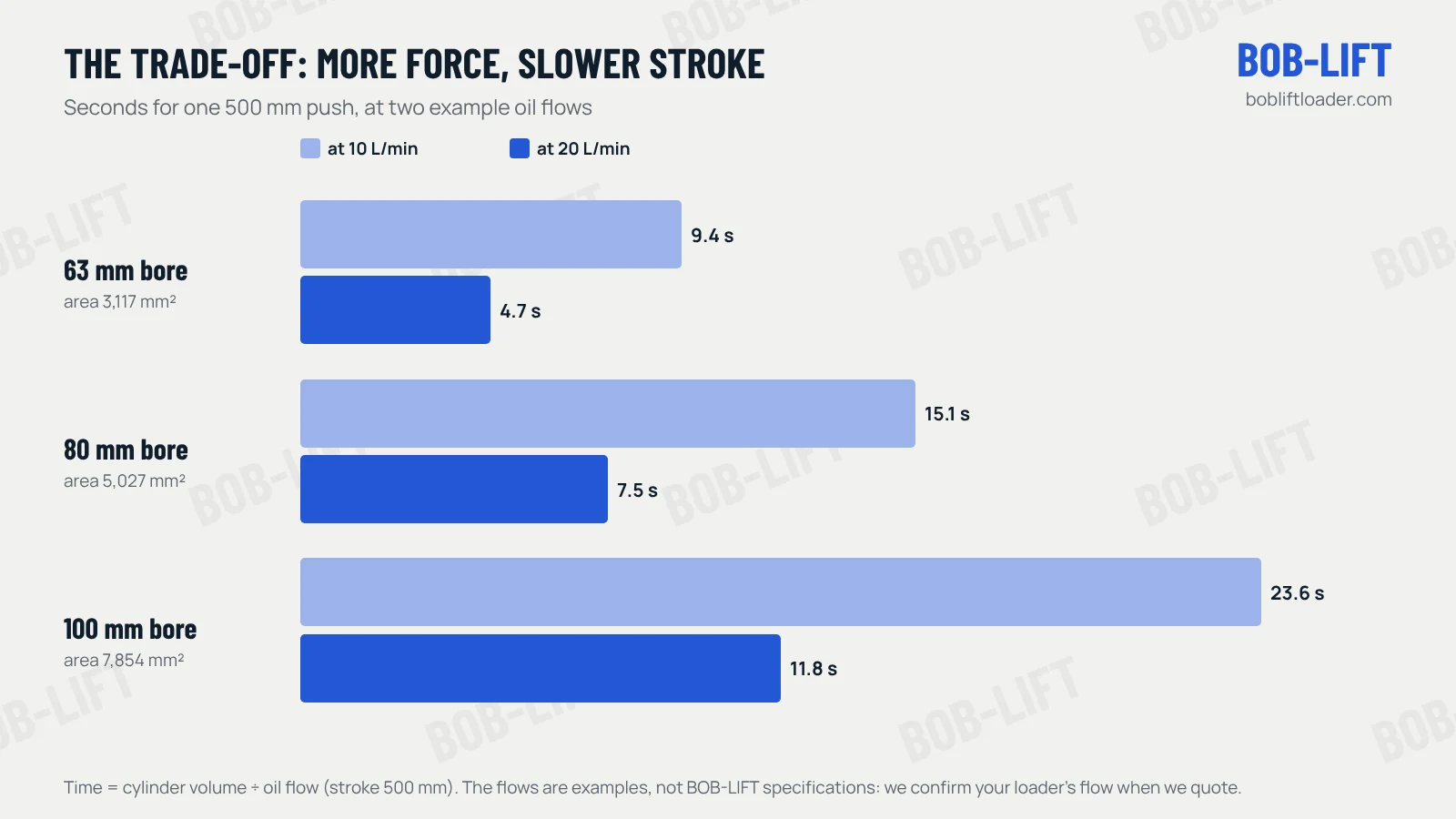
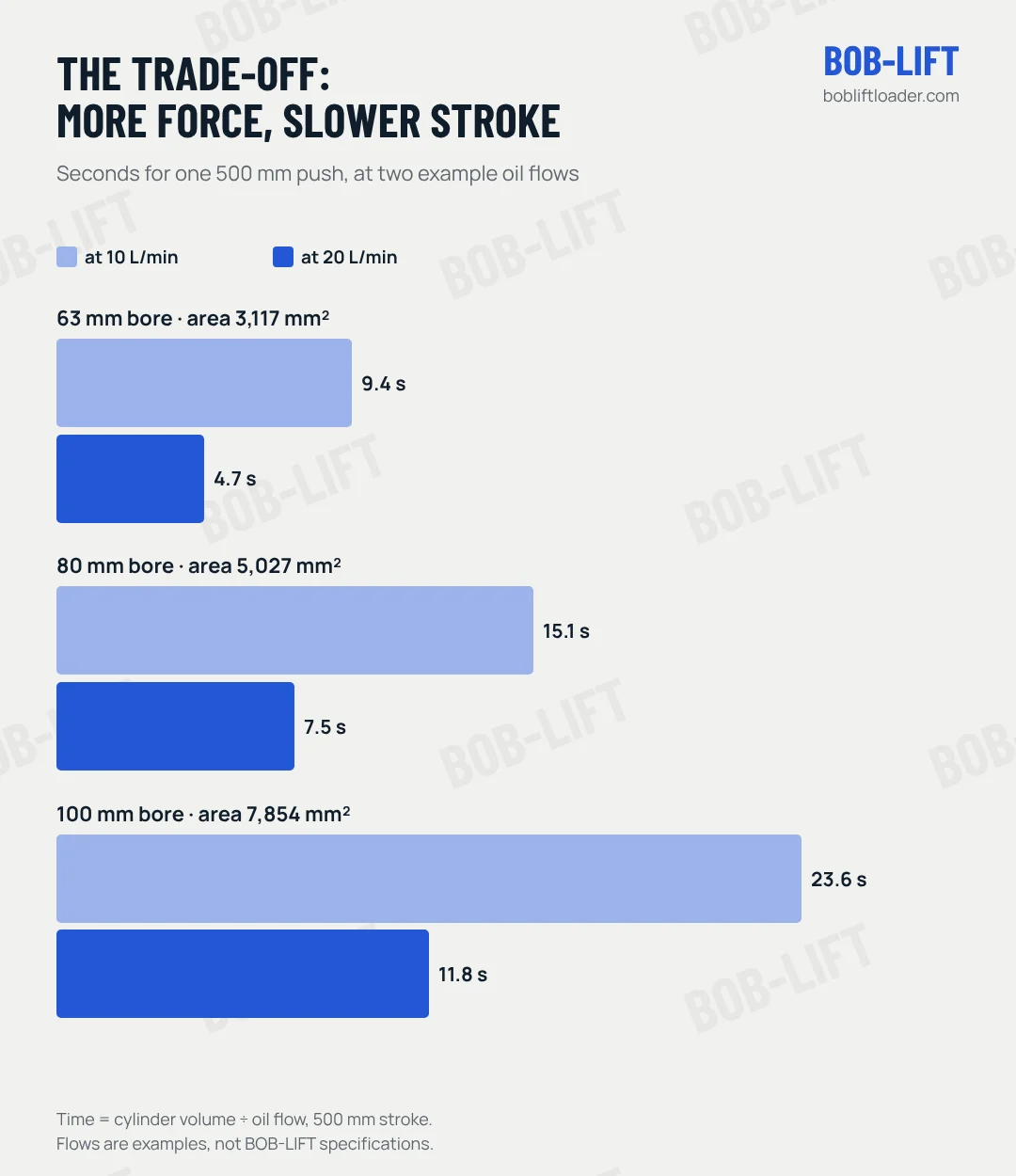
At 10 L/min, the 63 mm cylinder finishes its push in 9.4 seconds. The 100 mm cylinder takes 23.6 seconds, plus the return stroke. Doubling the flow halves both times. Therefore, the right splitter is the smallest bore that still opens your hardest rounds, because extra bore costs time on every log.
Hydraulic flow differs from model to model across our range. For that reason, we confirm the flow on the model you choose and size the splitter’s cylinder to it in the quotation.
Which mini skid steer suits a log splitter?
Any of our nine loaders can drive a splitter, but they suit different amounts of wood.
| Model | Operator, running gear | Rated load | Engine | Pressure | Width |
|---|---|---|---|---|---|
| BL-T360-H | Stand-on, tracks | 200 kg (441 lb) | 7.6 kW, petrol or diesel | 17 MPa | 930 mm |
| BL-T460-H | Stand-on, tracks | 300 kg (661 lb) | 16.8 kW, petrol or diesel | 17 MPa | 1,090 mm |
| BL-S390-C | Seated, tyres | 260 kg (573 lb) | 7.6 kW, petrol or diesel | 16 MPa | 959 mm |
| BL-T390-C | Seated, tracks | 250 kg (551 lb) | 7.6 kW, petrol or diesel | 16 MPa | 955 mm |
| BL-S490-C | Seated, tyres | 250 kg (551 lb) | 16.8 kW, petrol or diesel | 16 MPa | 1,089 mm |
| BL-T490-C | Seated, tracks | 250 kg (551 lb) | 16.8 kW, petrol or diesel | 16 MPa | 1,089 mm |
| BL-S750-H | Stand-on, tyres | 400 kg (882 lb) | 18.6 kW, diesel | 18 MPa | 985 mm |
| BL-T750-H | Stand-on, tracks | 410 kg (904 lb) | 18.6 kW, diesel | 18 MPa | 985 mm |
| BL-T1000-H | Stand-on, tracks | 500 kg (1,102 lb) | 17.8 kW, diesel | 20 MPa | 960 mm |
From our specification sheets, checked on 26 November 2026.
For a farm, estate or small firewood business: the BL-T750-H, BL-S750-H or BL-T1000-H
These three diesel stand-on loaders have the highest pressures in our range, 18 to 20 MPa, and rated loads of 400 to 500 kg. The load rating matters because the splitter hangs on the lift arms. In addition, the same machine will move rounds and crates of split wood. Choose the BL-T1000-H for the most force from a given cylinder. For a concrete or gravel yard, choose the wheeled BL-S750-H. For soft woodland tracks, choose the tracked BL-T750-H.
For occasional splitting: the 390 and 490 seated models or the BL-T460-H
If firewood is a few days’ work a year, a 16 or 17 MPa loader with a modest cylinder will do. The seated BL-S490-C and BL-T490-C have the 16.8 kW two-cylinder engine. Our stand-on vs seated guide explains the difference for the operator.
Light duty only: the BL-T360-H
Our smallest loader has a 7.6 kW single-cylinder engine and a 200 kg rated load. It can run a small splitter for kindling and thin rounds. However, it is the wrong choice if splitting will be its main job.
On every model, the splitter’s weight counts against the rated load, just like a full bucket. Our lift capacity guide explains what the rated load covers.
Set up the whole firewood job
A splitter does one step. The rest of the job uses other attachments on the same loader. If you buy them with the machine, they all match one quick-attach plate and one set of couplers.
- Grapple bucket for picking up rounds and awkward logs; our grapple guide compares the two grapples we offer.
- Pallet forks for moving crates or pallets of split wood to the store; see our pallet forks guide.
- Wood chipper for branches and prunings that are too thin to split.
If you are clearing land before cutting firewood, our brush cutter vs mulcher guide and stump grinder guide cover the earlier steps.
Safety when splitting with a skid steer
The UK Health and Safety Executive has investigated serious hand injuries, including finger amputations, on firewood processing machines [4]. It names the trapping points: between the ram and the log, the ram and the splitting plate, and the log and the plate [4]. Similarly, Ontario’s labour ministry calls wood splitters a significant cause of workplace injuries in forestry and farming [3]. Its alert requires controls that cannot be operated by accident and covers guarding, and it notes that some newer models have two-hand controls [3].
Purdue University’s farm safety programme gives the basic rules for anyone splitting firewood: follow the operator’s manual, keep others away, wear safety goggles, and stay clear of moving parts and pinch points [5]. On a loader-mounted splitter, that means:
- Agree before you start who places the round and who works the control, and never move the cylinder while anyone’s hands are on the beam. Where more than one worker runs a splitter, the ministry notes that additional controls or other safeguards may be needed [3].
- Lower the splitter to the ground and stop the engine before clearing a jammed log.
- Keep bystanders, children and animals away from the beam while it is working.
- Wear gloves, safety goggles and hearing protection [5]. At full engine speed, noise at the operator position can exceed 85 dB(A) on some of our models.
How we got these figures
Methodology: hydraulic pressures, rated loads, engines and widths are from our specification sheets for the nine loaders, checked on 26 November 2026. Forces use F = p × πd²/4, since pressure is force per unit area [1], converted at 1 US ton-force = 8.896 kN and 1 metric ton-force = 9.807 kN. Stroke times use cylinder volume divided by flow, with a 500 mm stroke and two example flows that are not the specifications of any of our loaders. The 63, 80 and 100 mm bores are examples of common cylinder sizes, not the bore of our splitter; we confirm the cylinder with your quotation.
Frequently asked questions
Can a mini skid steer run a log splitter?
Yes. The splitter runs from the loader’s auxiliary hydraulic lines and mounts on the quick-attach plate. All nine of our loaders can drive one; the force depends on the loader’s pressure and the splitter’s cylinder bore.
How many tons is a skid steer log splitter?
Work it out from the pressure and the bore. At 16 to 20 MPa, an 80 mm bore gives about 9.0 to 11.3 US tons in theory and a 100 mm bore about 14.1 to 17.7, before losses.
Which BOB-LIFT loader gives the most splitting force?
The BL-T1000-H, because it has the highest rated pressure in our range, 20 MPa. With the same cylinder, it pushes 25 % harder than a 16 MPa loader.
Is a bigger cylinder always better?
No. A bigger bore pushes harder but moves more slowly on the same oil flow, so you wait longer on every log. Choose the smallest bore that opens your hardest rounds.
Can I use a log splitter I already own?
Send us its mounting dimensions, cylinder size and the hose couplers it uses. We check whether it suits the plate and hydraulics of the loader you are ordering.
Do you sell the log splitter on its own?
We quote attachments together with a loader, so that the plate and the hydraulics are matched. Tell us which loader you have if you need a splitter for an existing BOB-LIFT machine.
About these sources
- Georgia State University, HyperPhysics, Pressure.
- Wikipedia, Log splitter.
- Ontario Ministry of Labour, Immigration, Training and Skills Development, Alert: wood splitters (updated 15 September 2026).
- UK Health and Safety Executive, Risks to users from firewood processing machines, bulletin OPSTD 2-2011.
- Purdue University, Indiana Rural Safety and Health Council, Preventing injuries getting firewood.
All sources were read on 26 November 2026.
Ask for a loader and log splitter quotation
Tell us the loader you want, or the BOB-LIFT model you already own, the largest diameter and length of round you split, and whether the wood is mostly hardwood or softwood. We reply with the splitter we suggest, its cylinder size, the other attachments that suit your firewood job and the shipping plan. Send us your enquiry, or see all 26 attachments first.