


A used mini dumper is a good buy when four things check out: the hours match the service records, the skip tips and holds a full load without creeping, the brakes hold on a slope, and the roll-over frame and seat belt are intact. If any of those fails, budget for the repair before you agree a price. A new dumper costs more on the day, but you choose the size, drive and cab, and it comes with a 12-month whole-machine warranty.
This guide is for contractors, landscapers, farmers and hire companies comparing a second hand mini dumper with a new one. It gives a 12-point inspection you can do in about an hour, the questions to put to the seller, the emission rule that catches people who import a used machine, and a side-by-side comparison. We build 10 mini dumpers at our factory in Xuzhou, China, so the new side of the comparison comes from our own mini dumper range. We do not sell used machines, and the checklist works on any brand.
Key takeaways
- Check the safety items first. The UK Health and Safety Executive (HSE) says over 60% of dumper deaths involve the driver being crushed when the dumper overturns, and says to check that dumpers have roll-over protection and that drivers use their seat belts [1].
- Do the tip test with a load. A loaded skip that creeps down with the lever in neutral points to worn ram seals or a leaking valve.
- On articulated 4×4 dumpers, rock the centre joint. Play in the articulation pins makes the dumper wander and wears the steering rams.
- Importing a used diesel dumper into the US is risky. An engine without a US Environmental Protection Agency (EPA) certificate of conformity counts as new on import if built after the federal dates, and importing it is generally prohibited [3] [4].
- New from our factory: 500 to 5,000 kg rated load, one-machine minimum order, ready in about 10 working days (30 for the FJZ30), 12-month warranty.
Is a used mini dumper worth buying?
Yes, if it passes an inspection and the seller can show where it has worked. A mini dumper is a compact site carrier with a tipping skip in front of the driver, and mechanically it is a straightforward machine consisting of an engine, a transmission, a hydraulic skip and a frame. Because it is that simple, its condition depends far more on previous use than on age: a dumper that carried topsoil across a lawn and one that transported wet concrete and broken brick every day can display identical hours and be worth very different amounts.
Treat every statement in the listing as a claim to verify. If the seller refuses to let you start the engine from cold, load the skip or look underneath the covers, that refusal is your answer.
The 12-point used mini dumper inspection
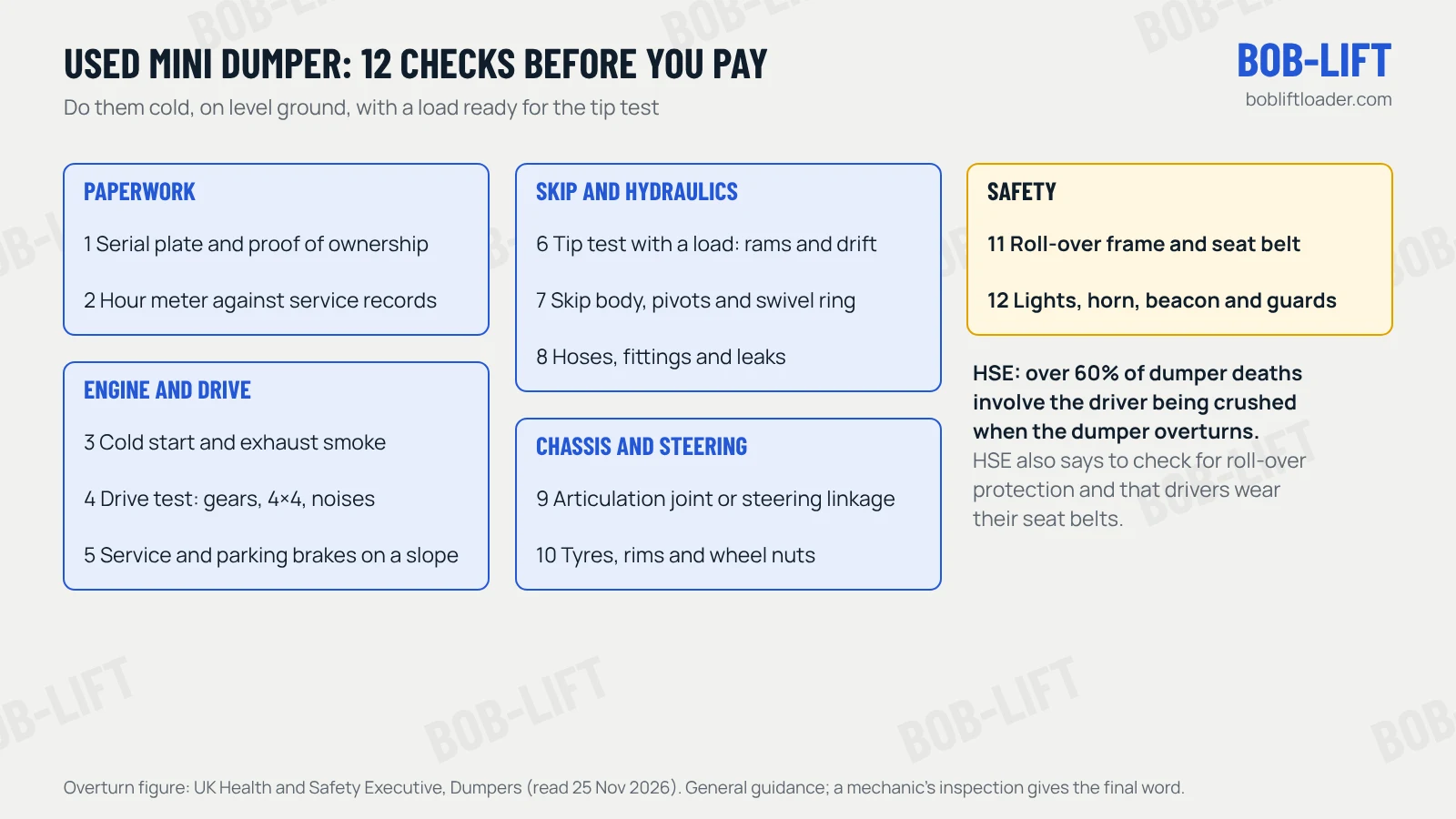
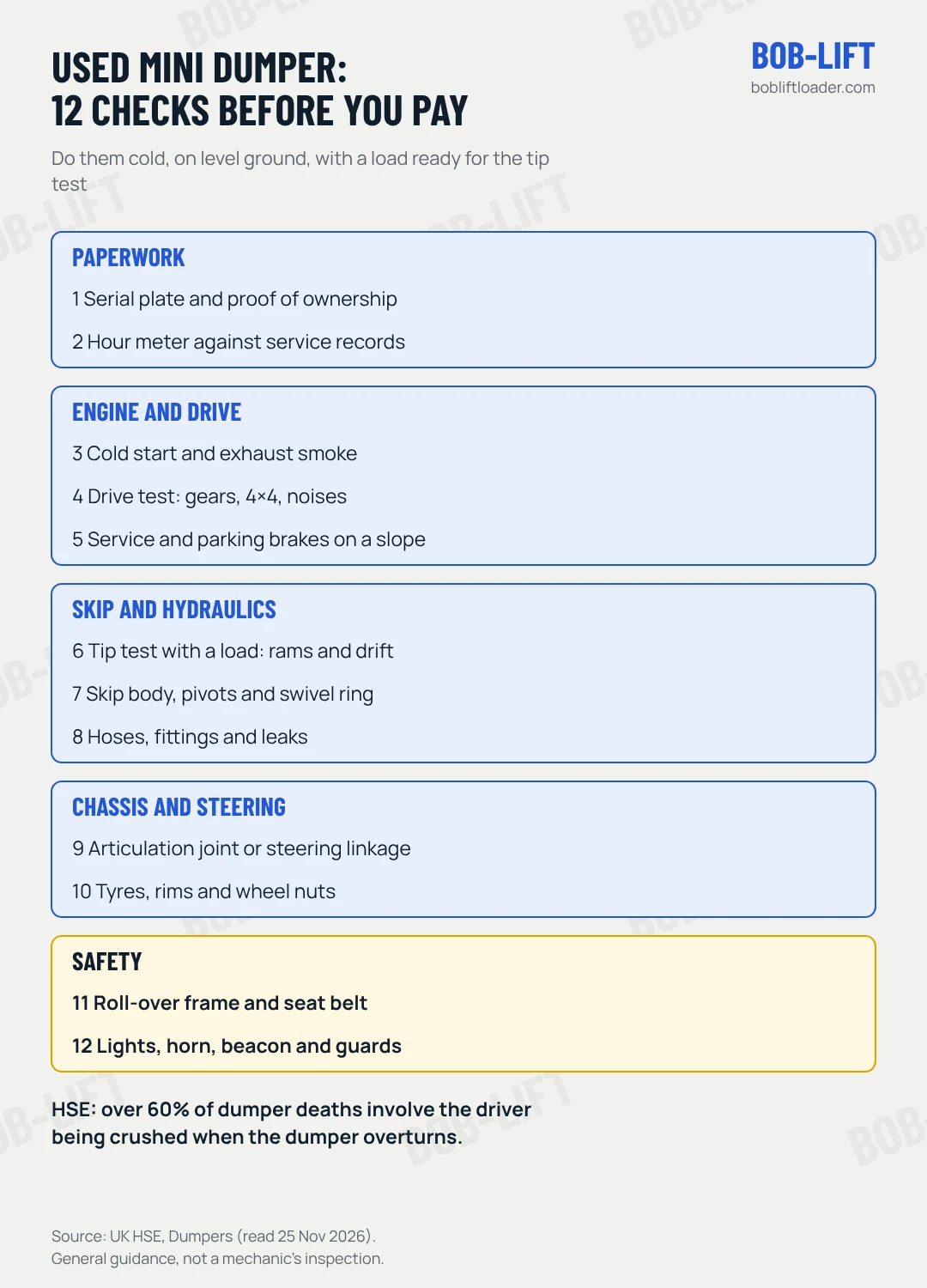
Test setup: do the checks with the engine cold, on level ground first and then on a gentle slope, with a skip load of soil or gravel ready, such as a full load of damp topsoil. Wear gloves and eye protection, and check for hydraulic leaks with a piece of card, never your hand.
Paperwork (checks 1 and 2)
- Serial plate and proof of ownership. Compare the serial number stamped on the frame plate with the bill of sale, and ask for written evidence that the seller owns the machine outright, because a financed or hired dumper may not be theirs to sell.
- Hour meter against service records. The hours should increase steadily across dated oil and filter receipts. A low reading on a machine with a polished seat, worn pedals and a shiny steering wheel suggests a replaced or disconnected meter. If the dumper came off a hire fleet, ask for the fleet’s service history.
Engine and drive (checks 3 to 5)
- Cold start and exhaust smoke. Touch the engine block before anyone starts it, because a warm engine can hide difficult starting. Some smoke at start-up is normal for a diesel, but persistent blue smoke indicates the engine is burning oil. Inspect the coolant for traces of oil and the air intake for dust that has passed the filter.
- Drive test. Drive forwards and in reverse through every gear, listening for whining or knocking from the axles and gearbox. On a 4×4 machine, drive across loose ground and confirm that all four wheels deliver traction. A healthy dumper should approach its rated top speed on level ground, which is 22 or 28 km/h for our wheeled models when new.
- Service and parking brakes on a slope. Stop on a gentle incline with a load in the skip, well inside the 18° working limit that our specification sheets recommend for new wheeled dumpers. The service brake should hold without the pedal gradually sinking, and the parking brake should hold the machine securely once your foot is off the pedal.
Skip and hydraulics (checks 6 to 8)
- Tip test with a load. Skip drift is the slow fall of a raised skip with the control in neutral. To test for it, raise a full skip about half way, return the lever to neutral, switch off the engine and observe for 5 minutes; a skip that creeps downwards indicates internal leakage in the tipping rams or the control valve. Then tip completely: the skip should reach its full angle smoothly and return without hesitation or jerking.
- Skip body, pivots and swivel ring. Examine the skip pivots and the skip lip for cracks, distortion and recent welding. On a swivel dumper, rotate the skip in both directions and feel for knocking or excessive movement in the slewing ring. Our front tip vs swivel dumper guide explains how each arrangement operates.
- Hoses, fittings and leaks. Look for damp fittings, cracked hose covers and hoses chafing against the frame, then examine the ram rods for scoring or corrosion, which gradually destroys the seals.
Chassis and steering (checks 9 and 10)
- Articulation joint or steering linkage. On an articulated dumper, ask someone to turn the steering wheel while you watch the centre joint: the front and rear frames should move together without any audible knock. On a rigid dumper with mechanical steering, check the linkage and the track-rod ends for excessive play. Our 4×4 vs 4×2 mini dumper guide explains the two layouts.
- Tyres, rims and wheel nuts. Inspect the tread depth, sidewall cuts and bulges, cracked rims and missing wheel nuts. Record the tyre sizes, because a mixed set means some tyres have been replaced, so ask why, and the size determines which replacements you will need. Our own wheeled models use 3 sizes: 7.50-16 front and 5.50-16 rear on the FC10, FY15 and FY20-2, 12-16.5 on the FY20-4, FY30, FY40 and FJZ30, and 20.5/70-16 on the FY50. Our dumper tyre guide explains what to stock.
Safety (checks 11 and 12)
- Roll-over frame and seat belt. A roll-over protective structure (ROPS) is the frame that keeps a survivable space around the driver if the machine turns over. Inspect it for cracks, bends, missing bolts and repair welds, and confirm that the seat belt latches and retracts properly, because a ROPS that has been welded or drilled may no longer protect the driver. A roof or cab is not equivalent to roll-over protection; our dumper with cab guide explains the difference.
- Lights, horn, beacon and guards. Test every light, the horn and any beacon or reversing alarm, and confirm that the protective guards over the engine fan and drive belts are present and secure.
Once the dumper is yours, the HSE advises not filling above the top edge of the skip and planning work so that dumpers are used on gradients within their safe working capacity [1].
Questions to ask the seller
- What did it carry? Heavy, abrasive loads, for example wet concrete, demolition rubble and stone, wear a skip faster than soil or mulch.
- Was it operated on hire by many different drivers, or used by a single owner on their own projects?
- When were the engine oil, the filters and the hydraulic oil last changed, and can you show the dated receipts?
- Has the dumper ever overturned, and has the ROPS, the chassis or the skip been repaired or modified?
- Which components have been replaced, and were they original manufacturer parts or aftermarket alternatives?
- Will you allow a demonstration in which I tip a full load and drive it up a slope before I pay?
The emission rule for used dumpers in the US
If the dumper has a diesel engine, as all our wheeled models do, the US federal rules for nonroad diesel engines apply. For a machine already in the country, leave the emission controls alone: under 40 CFR 1068.101, you may not remove or render inoperative a device or element of design installed for emission compliance before the engine is sold, or knowingly do so after the sale, apart from narrow exceptions such as repair [2]. Compare the engine with its emission label before you buy.
Importing a used diesel dumper is stricter. The definition of a new nonroad diesel engine says an imported engine with no EPA certificate of conformity counts as new if it was built on or after the dates in the rule, and that importing such an engine, or equipment containing one, is generally prohibited [3]. The import rules in 40 CFR 1068.301 require imported engines and equipment to be covered by a certificate of conformity, apart from limited exemptions [4]. A cheap used dumper from overseas may not clear customs at all.
The same question applies to a new dumper from China. Our standard diesel engines do not carry an EPA certificate; a US EPA-certified engine is an option on every wheeled model at extra cost, so name it when you ask for a quotation. Our US mini dumper import guide walks through the steps, and our UK guide covers the British rules.
Used or new: which suits your job?
Price is one line in the decision, and we do not publish ours. Ask for a quotation and set it against the used machines on your list.
| Point | Used mini dumper | New from our factory |
|---|---|---|
| Hours and history | Depends on the records; often unknown | Zero hours, run-tested before dispatch |
| Warranty | Usually sold as seen, unless a dealer adds cover | 12 months on the whole machine |
| Availability | Today, if one is for sale near you | Ready in about 10 working days (FJZ30: about 30), then sea freight |
| Specification | Whatever was fitted | Choose 4×2 or 4×4, open, roof or cab, front or swivel tip |
| Emission paperwork | Check the engine label is still there | Standard diesel engine, or a US EPA-certified engine (and Euro V on 2 ton and larger) at extra cost |
| Parts | Local dealer, if the brand has one | Original parts by model and serial number, shipped from China |
| Matching units | Hard to find several of one model | One machine minimum; repeat orders built to the same specification |
Our side of the table comes from our factory terms and specification sheets, checked on 25 November 2026.
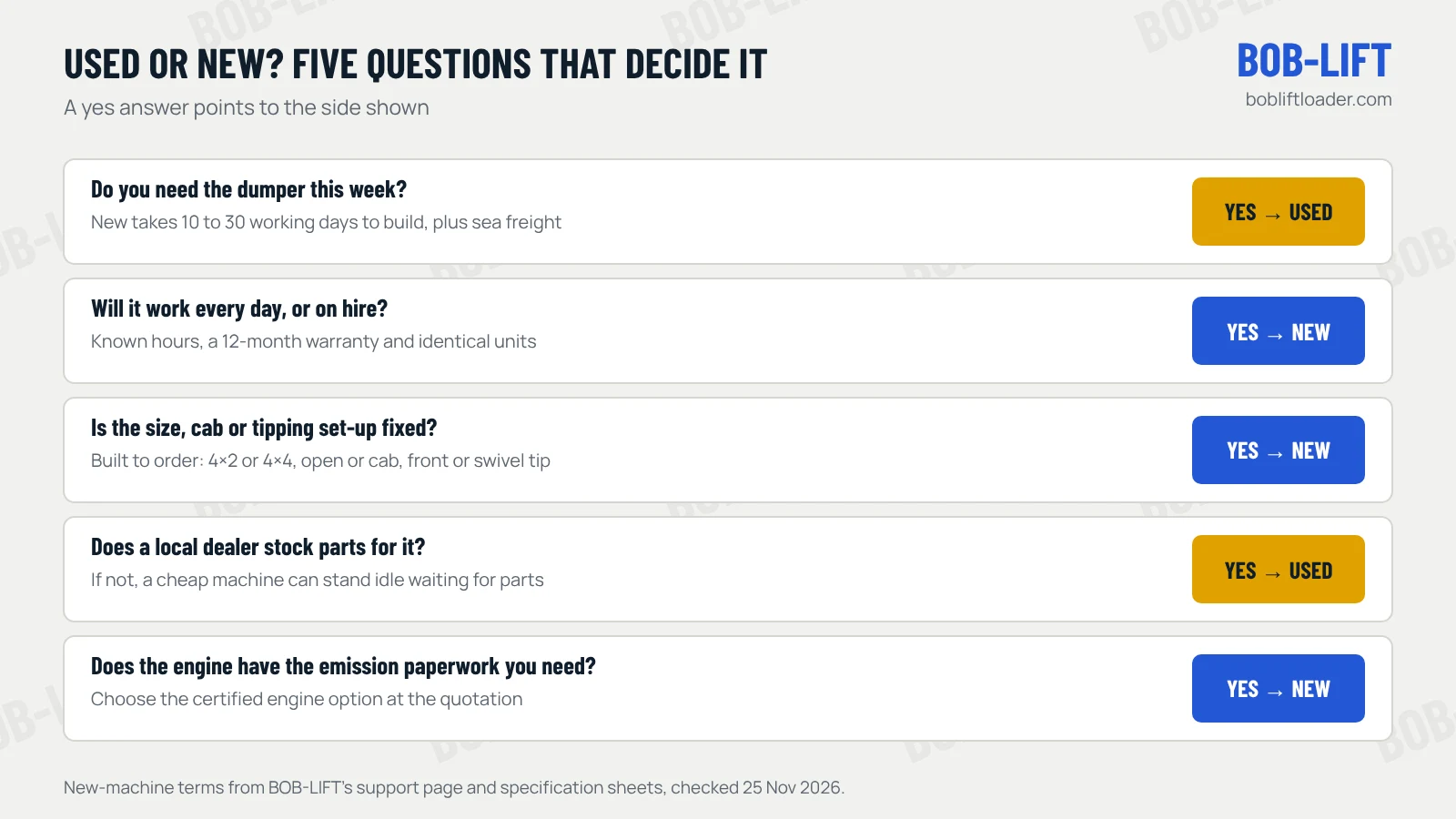
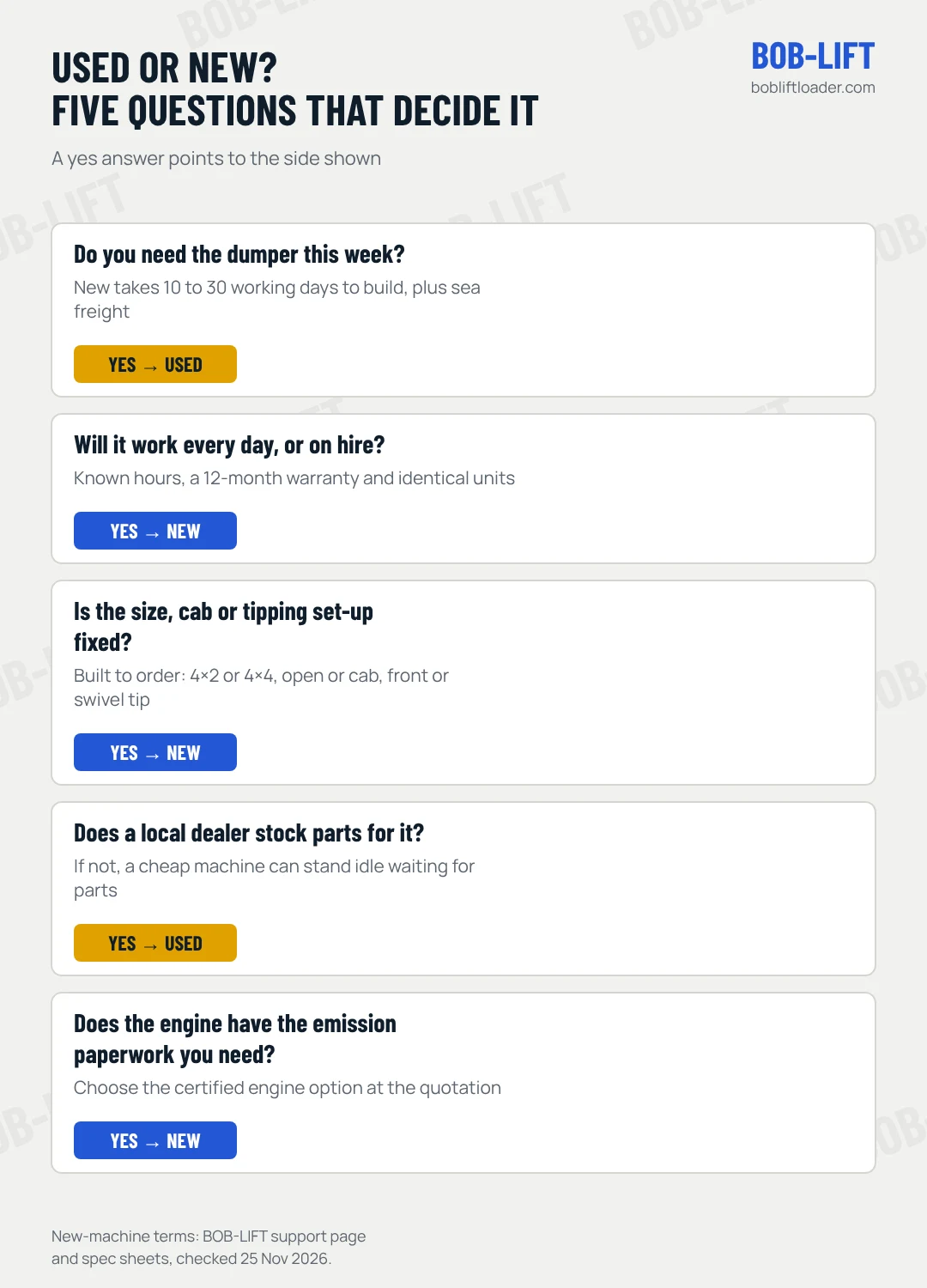
A used dumper makes sense when you need one machine this week, a local dealer stocks parts for that brand, and the inspection comes back clean. A new one makes sense when it will work every day or go out on hire, when you need a particular width, drive or cab, or when you want several identical machines with one set of spare parts. Our guide to mini dumpers for hire fleets covers that last case.
What a new BOB-LIFT mini dumper gives you
We build one tracked dumper, one tracked mixer and eight wheeled dumpers, rated from 500 to 5,000 kg. All wheeled models tip hydraulically to the front except the FC10, which tips mechanically as standard; a swivel side-tip skip is an option on every wheeled model.
| Model | Drive | Rated load | Hopper | Width | Tip angle | Dump height | Top speed |
|---|---|---|---|---|---|---|---|
| BL-T500-HD | Tracks | 500 kg | 0.2 m³ | 880 mm | 100° | Not listed | 3 km/h |
| FC10 | 4×2 | 1,000 kg | 0.8 m³ | 1,500 mm | 45° | 1,800 mm | 22 km/h |
| FY15 | 4×2 | 1,500 kg | 0.8 m³ | 1,500 mm | 45° | 1,800 mm | 22 km/h |
| FY20-2 | 4×2 | 2,000 kg | 1.0 m³ | 1,600 mm | 45° | 2,000 mm | 22 km/h |
| FY20-4 | 4×4 | 2,000 kg | 1.2 m³ | 1,700 mm | 45° | 2,200 mm | 22 km/h |
| FY30 | 4×4 | 3,000 kg | 1.5 m³ | 1,700 mm | 45° | 2,400 mm | 28 km/h |
| FJZ30 | 4×4 | 3,000 kg | 1.5 m³ | 1,700 mm | 45° | 2,700 mm | 28 km/h |
| FY40 | 4×4 | 4,000 kg | 1.5 m³ | 1,700 mm | 45° | 2,400 mm | 28 km/h |
| FY50 | 4×4 | 5,000 kg | 1.5 m³ | 1,800 mm | 45° | 2,500 mm | 28 km/h |
From our specification sheets, checked on 25 November 2026. All 4×4 models have articulated steering. Dump height is measured from the ground to the lower edge of the skip lip when tipped, and every wheeled model lists 21° as its theoretical maximum slope, with 18° or less recommended in work. The tracked BL-T200-HJ mixer (200 L drum, 880 mm wide) is left out because it mixes concrete rather than carrying a hopper load.
Use these figures as a yardstick: when a used listing quotes a payload, tipping angle or speed, compare it with a new machine of the same size, because a dumper that cannot tip a full load to its full angle, or falls well short of its top speed on level ground, is worn somewhere.
Example: a used 3 ton listing against a new FY30
This example is illustrative, not a real listing. Suppose a seller offers a 3 ton articulated 4×4 dumper with 2,600 hours, a 1.5 m³ skip and no service receipts. Using the FY30 figures above as the yardstick, you would check five numbers during the visit:
- Does the loaded skip tip to roughly 45° and hold half way for 5 minutes without creeping?
- Does the machine approach 28 km/h on level ground in top gear, with all 4 wheels pulling on loose ground?
- Do the 12-16.5 tyres, or whatever size is fitted, match on all 4 wheels, with tread left on each?
- Does the parking brake hold a full 3,000 kg load on a slope well inside 18°?
- Do the 2,600 hours fit the wear you can see on the seat, pedals, pivots and articulation joint?
If the answers are mostly yes and the price leaves room for a full service, the used machine may be worth it; if two or more answers are no, compare the repair estimate with a quotation for a new FY30, which is ready in about 10 working days.
Before each dumper leaves the factory we inspect the hoses and tanks, start the engine and test every function and the travel drive, then check for leaks and cooling and inspect the hoses again. You can order one machine, pay by T/T and buy on FOB, CIF, EXW, DDP, FCA or DAP terms. Each FC10 and FY15 ships with a diesel filter, and the larger wheeled models with a set of diesel, oil and air filters. Our mini dumper parts guide lists what else to keep on the shelf.
Frequently asked questions
How many hours is too many on a used mini dumper?
There is no universal limit. A dumper with higher hours, documented oil changes, a skip that holds its position and tight pivots can be a better purchase than a low-hour machine without records, because the tip test, the drive test and the brake test reveal more about its condition than the hour meter.
Are ex-hire dumpers a good buy?
They can be, if the fleet serviced them on schedule and can show the records. They have also been driven by many different operators. Ask for the service history and do the full 12-point check, paying most attention to the skip, the pivots and the brakes.
What costs the most to fix on a used mini dumper?
The engine, the transmission and axles, and the hydraulic pump are large, costly assemblies to replace, as are a full set of tyres and a cracked or worn skip, which is why the cold start, the drive test and the loaded tip test deserve the most attention.
Can I import a used mini dumper into the United States?
Only if its engine is covered by an EPA certificate of conformity or qualifies for a limited exemption. An uncertified diesel engine built after the federal dates counts as new on import, and importing it is generally prohibited [3].
Do you sell used or refurbished mini dumpers?
No. We manufacture and sell only new machines from our factory in Xuzhou, China, each with a 12-month warranty covering the whole machine.
How fast can a new one arrive?
Most of our dumpers are ready in about 10 working days and the FJZ30 in about 30, then the container goes by sea. Our guide to buying a mini dumper from the factory covers the steps and the container options.
About these sources
- UK Health and Safety Executive, Dumpers, construction safety topics.
- Electronic Code of Federal Regulations, 40 CFR 1068.101, General prohibitions.
- Electronic Code of Federal Regulations, 40 CFR 1039.801, Definitions (new nonroad engine).
- Electronic Code of Federal Regulations, 40 CFR 1068.301, General provisions for importing engines and equipment.
All sources were read on 25 November 2026. Machine figures, warranty, build times, factory tests and trade terms come from our own specification sheets and support page, checked the same day. The inspection checklist is general guidance for buyers, not a substitute for a mechanic’s inspection or legal advice. Read more about us and our factory.
Ask for a quote on a new mini dumper
Tell us the job, the load and the narrowest gap on site, 4×2 or 4×4, open or cab, and how many machines you need. If you are weighing a used listing, send us its details too, and we will reply with the closest new model, its specification sheet, the build time and a quotation on your trade terms. Send us your enquiry.