


A commercial invoice is the seller’s bill for the goods, and customs uses it to assess duty. A packing list is the list of what is in each package, with weights, marks and dimensions. On a mini skid steer or mini dumper order from China, the bill of lading, the certificate of origin and your import declaration all repeat their details, so a mistake in one can carry into the others.
Written for dealers and hire fleets from our factory in Xuzhou, Jiangsu Province, this guide covers what each document must show, how customs values the machines, and which details must agree.
Key takeaways
- Two documents, two jobs. The invoice states what you bought and pay; the packing list, what is in each package [1].
- Customs values the machines from the invoice. The WTO Customs Valuation Agreement starts from the price paid or payable, plus Article 8 adjustments [3].
- Itemise the charges. 19 CFR 141.86(a)(8) asks for freight, insurance, commission and packing by name and amount [2].
- Weights and package counts must agree on the packing list, bill of lading and certificate of origin.
What is a commercial invoice?
The US International Trade Administration (ITA) calls the commercial invoice “a legal document between the exporter and the buyer” that “clearly states the goods being sold and the amount the customer is to pay”. It is “one of the main documents used by customs in determining customs duties”, and governments that use it to control imports “will often specify its form, content, number of copies, language to be used and other characteristics” [1].
Proforma invoice or commercial invoice?
The proforma invoice comes first. The ITA describes it as a negotiating tool the seller uses “to quote at the beginning of an export transaction”, which “will eventually become the final commercial invoice used when goods are cleared through customs” [1]. You pay the deposit against the proforma; the commercial invoice is issued at shipment. Our guide to paying a Chinese supplier by T/T explains why the payment split should be written on the proforma.
If an engine option or attachment changed after the order, the commercial invoice shows what actually shipped.
What a commercial invoice must show
Each importing country sets its own rules. The US rule, 19 CFR 141.86, is a detailed public example [2]:
| Item on the invoice | What 19 CFR 141.86 asks for | What to check on a machinery order |
|---|---|---|
| Parties, place and date of sale | Time, place, seller and buyer (a)(2) | Names as on the contract and the bill of lading |
| Description | Name, grade or quality of each item; package marks and numbers (a)(3) | The full model name, such as BL-T360-H tracked stand-on mini skid steer loader, not just “loader”; engine option if more than one is offered |
| Quantity | In the weights and measures of the exporting country or the US (a)(4) | Machines, attachments and spare parts on separate lines |
| Price and currency | Purchase price of each item, in the purchase currency (a)(5) | Unit price and total in the currency on your proforma invoice |
| Charges | Freight, insurance, commission and packing, by name and amount (a)(8) | Trade term, such as FOB Shanghai or CIF Manila, and what it includes |
| Discounts | Every discount from list or base price, in detail (g) | Dealer or volume discounts shown |
| Country of origin | Country of origin (a)(10) | China, matching the certificate of origin |
| Assists | Dies, moulds, tools or engineering work supplied for production and not in the price (a)(11) | Tooling paid separately on an OEM order |
| Language | English, or with an accurate English translation (d) | Same English model names on every document |
Two items are easy to miss. “Mini loader” on the invoice and “BL-T360-H” on the packing list read as two products. And on an OEM order, moulds or tooling paid for separately can count as assists that must be declared [2] [3].
How customs uses the invoice to value your machines
Customs value is the amount the duty rate is applied to. The WTO Agreement on Customs Valuation bases it on “the actual price of the goods to be valued, which is generally shown on the invoice”. That price, plus the adjustments listed in Article 8, equals the transaction value, the first and most important method of valuation [3].
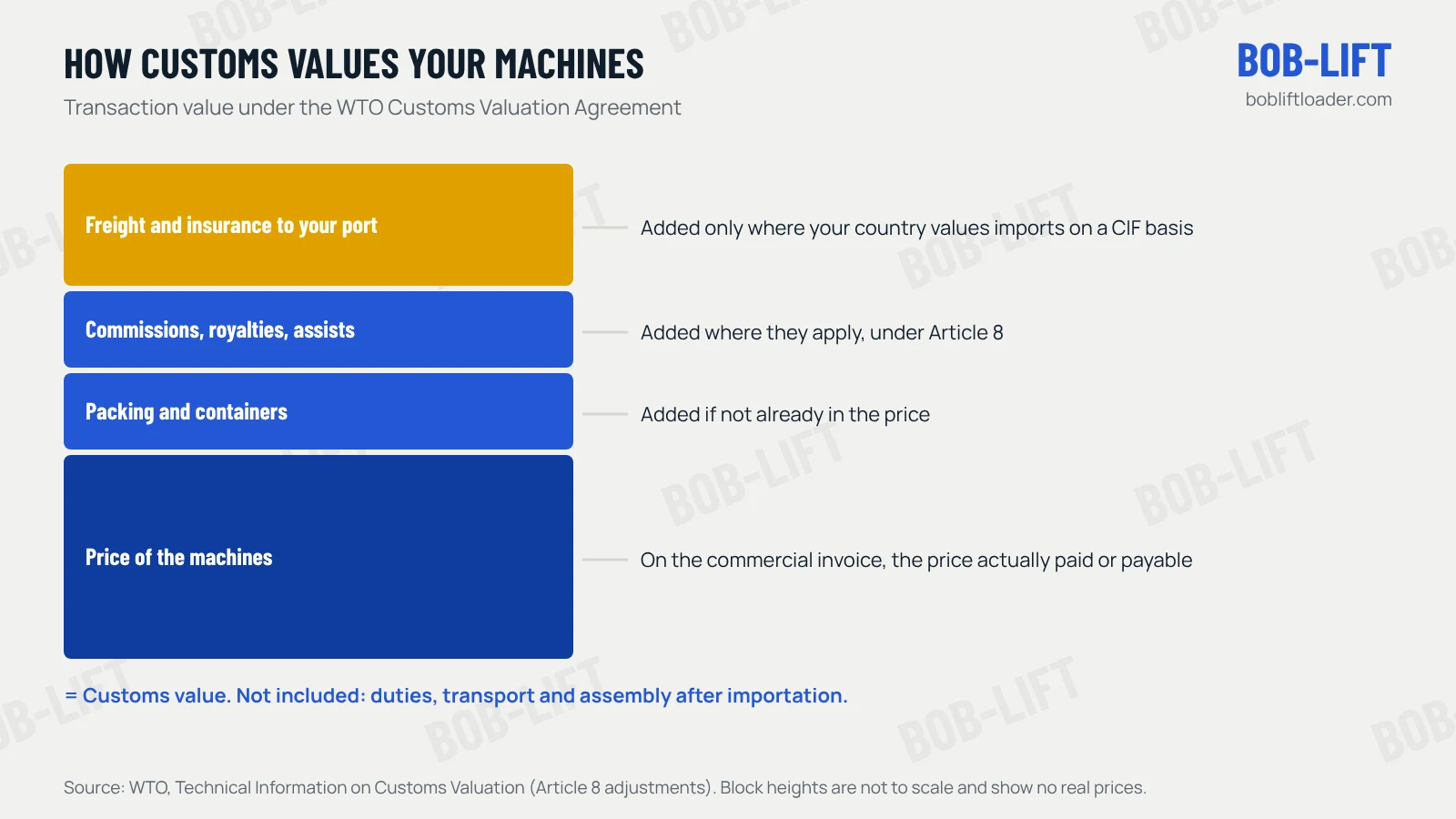

According to the WTO, the Article 8 adjustments include commissions and brokerage (except buying commissions), packing and container costs, assists, royalties and licence fees, and “the cost of transport, insurance and related charges up to the place of importation if the Member bases evaluation on a C.I.F. basis”. Costs incurred after importation, such as duties, transport and assembly, are not included [3].
Here the trade term matters. Incoterms are a set of eleven three-letter trade terms published by the International Chamber of Commerce, and the current version, Incoterms 2020, entered into force on 1 January 2020 [4]. An FOB price excludes sea freight; a CIF-basis country adds freight and insurance to the customs value anyway. Our FOB vs CIF guide compares the two terms for a machinery order.
Can the invoice show less than you paid? No. Customs starts from the price actually paid or payable [3], which must match your payments and contract.
What is a packing list?
The ITA describes an export packing list as “considerably more detailed and informative than a standard domestic packing list”. It lists the seller, buyer, shipper, invoice number, date of shipment, mode of transport and carrier, and itemises the quantity, description, type of package, number of packages, total net and gross weight in kilograms, package marks and, where appropriate, dimensions. Customs officials may use it to check the cargo, “so the commercial invoice should reflect the information shown on the packing list” [1].
It “is not a substitute for a commercial invoice” [1]. The US rule adds that each invoice must state in adequate detail what merchandise is in each package (19 CFR 141.86(e)), and that if the weight or measure needed to assess duty is missing, the consignee pays for weighing or measuring before release (141.86(f)) [2].
Illustrative example: six BL-T360-H loaders in one 20GP
Not a past order: 6 per 20GP is from our loading plans, and the 650 kg and 1,906 × 930 × 1,226 mm from the published specification.
| Package | Contents | Marks | Net weight | Dimensions (L × W × H) |
|---|---|---|---|---|
| 1 to 6 | 1 × BL-T360-H tracked stand-on mini skid steer loader each, standard bucket fitted | Order no. / package no. 1-6 to 6-6, model, serial no. | 650 kg each, 3,900 kg in total | 1,906 × 930 × 1,226 mm each |
A real list also carries the seller, buyer, invoice number and date, vessel and ports [1]. Gross weight includes wrapping, so it is weighed at loading, when the 20GP’s container and seal numbers are added too. Parts taken off to fit more machines into a container, as on some mini dumper loads, are listed too. Our photo guide to how mini dumpers are packed for container shipping shows what that looks like.
Wooden packaging and ISPM 15
If anything in the container is made of raw wood, a second set of rules applies. ISPM 15, the international standard published by the International Plant Protection Convention (IPPC), covers wood packaging material made from raw wood, and it includes dunnage, the timber used to brace or support cargo [5]. Wood processed so that it is free from pests, such as plywood, is excluded [5].
On our November 2026 mini dumper load, the machines shipped wrapped and strapped without crates, but the front axles rested on timber blocks. Does a timber block count? Under ISPM 15 it can, so tell us at quotation if your country enforces it.
Keep all four documents consistent
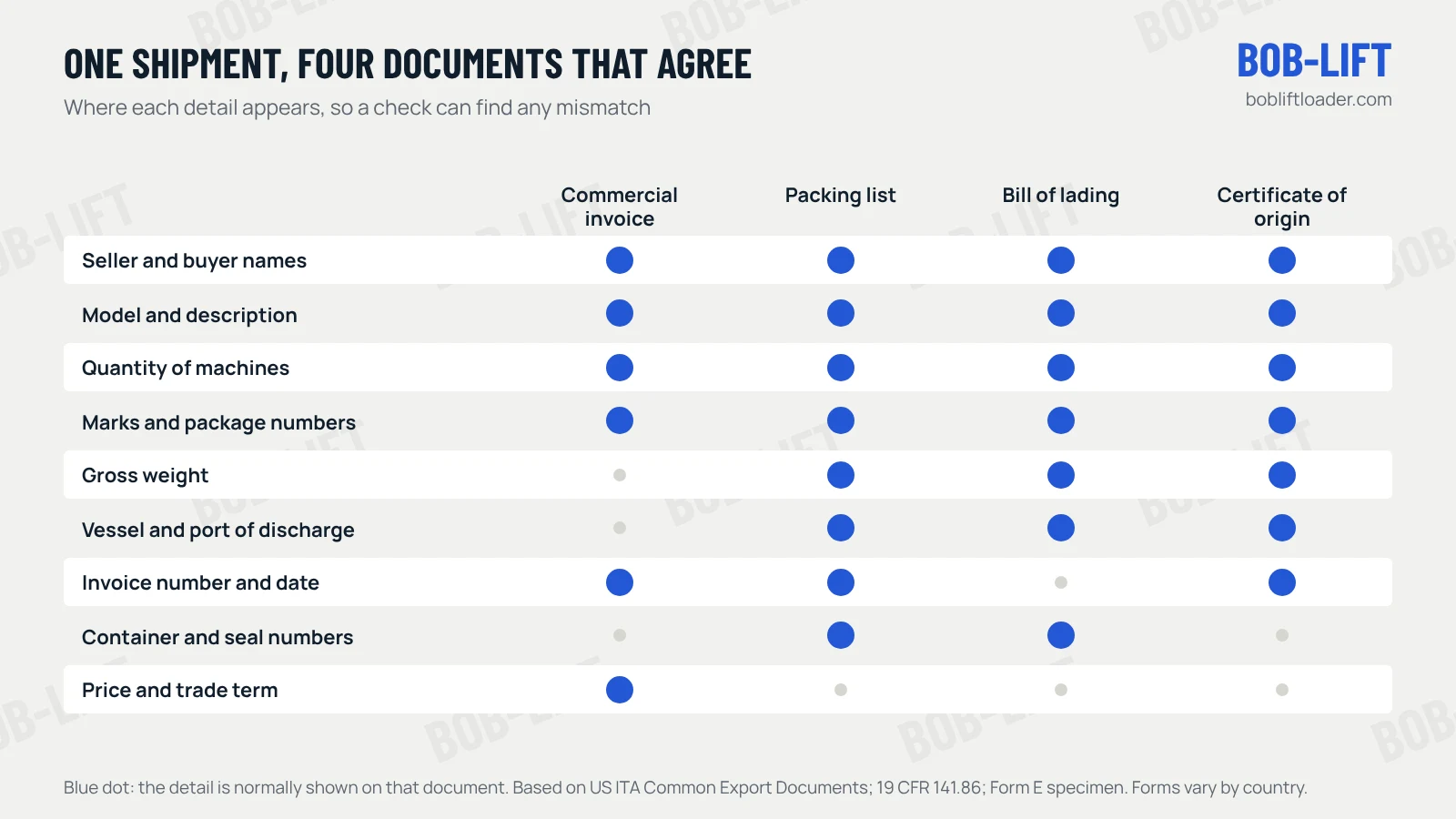

- Names. The invoice buyer is the consignee on the bill of lading, unless a credit requires a bill made out to order.
- Description. Use the same model names on every document, and the HS code your broker will declare. A Form E carries the description and the six-digit HS number of each product [6].
- Weights and packages. Gross weight and package count on the packing list must match the bill of lading and the certificate of origin.
- Invoice number and date. A Form E records the invoice it relates to [6], so a reissued invoice with a new number can mean a reissued certificate too.
- Letter of credit wording. Under a letter of credit, the bank checks every document against the credit.
What to send us with your enquiry
| Tell us | Why it matters |
|---|---|
| Your company’s exact legal name and address | Must match the bill of lading and certificate of origin |
| The trade term and the named port | Decides which charges belong on the invoice [4] |
| Wording your broker or bank requires | Some countries set form, copies and language [1] |
| The HS code your broker will declare | The same code appears on a Form E certificate of origin [6] |
| Attachments or spare parts in the same container | Each gets its own line |
| Whether your country enforces ISPM 15 | Timber blocks may need treated, marked wood [5] |
Frequently asked questions
Is a proforma invoice the same as a commercial invoice?
No. The proforma is the quotation; it becomes the final commercial invoice at shipment [1].
Does the packing list show prices?
Not normally. The ITA’s list covers parties, transport, packages, weights, marks and dimensions, not prices [1].
Does the commercial invoice have to be in English?
It depends on the importing country. In the US, 19 CFR 141.86(d) requires English or an attached English translation [2], and other governments specify the language they accept [1]. Ask your broker.
Should freight be on the commercial invoice?
Under CIF or CFR, yes, itemised as 19 CFR 141.86(a)(8) asks [2]. Under FOB it is not in the price, and a CIF-basis country adds it to the customs value [3].
Who prepares the packing list?
The seller, from the loading plan, finalised at loading with gross weights and container and seal numbers. Check it against our pre-shipment inspection checklist before the container is closed.
About these sources
- US International Trade Administration, Common Export Documents, trade.gov.
- US Code of Federal Regulations, 19 CFR 141.86, Contents of invoices and general requirements, via Cornell Law School Legal Information Institute.
- World Trade Organization, Technical Information on Customs Valuation.
- International Chamber of Commerce, Incoterms rules.
- International Plant Protection Convention, ISPM 15: Regulation of wood packaging material in international trade.
- ASEAN, Certificate of Origin Form E specimen and overleaf notes, Annex 1, Attachment C.
All sources were read on 24 November 2026. Weights, dimensions and container counts come from our own specifications and loading plans. This guide is general information, not legal or customs advice; your customs broker decides what your import declaration needs. Read more about us and our factory.
Get the paperwork right first time
Send your country, trade term, models and any required wording; we put it on the proforma for your mini dumpers or mini skid steer loaders. Send us your enquiry.