


Our wheeled mini dumpers use three tyre sizes. The 1 to 2 tonne 4×2 models (FC10, FY15 and FY20-2) run 7.50-16 tyres at the front and 5.50-16 at the rear. The 4×4 FY20-4, FY30, FY40 and FJZ30 run 12-16.5 on all four wheels, and the 5 tonne FY50 runs 20.5/70-16. All of them are pneumatic industrial (engineering) tyres, whereas the tracked BL-T500-HD operates on rubber tracks instead.
This guide is written for dealers, hire fleets and contractors who stock or replace dumper tyres. It identifies the tyre specification on every model, explains how to interpret a dumper tyre size, and shows how to plan a spare tyre inventory across a fleet. It also covers the information to send us with a replacement order, recommended tyre pressure practice and the safety regulations for changing industrial tyres in a workshop. We build these dumpers at our factory in Xuzhou, China.
Key takeaways
- We fit three tyre sizes across eight wheeled dumpers: 7.50-16 with 5.50-16, 12-16.5, and 20.5/70-16.
- On the FC10, FY15 and FY20-2, front and rear tyres differ, so they are not interchangeable between axles.
- One tyre size, 12-16.5, covers four models from 2,000 to 4,000 kg (4,409 to 8,818 lb) of rated load.
- Order replacements by model, serial number and the full sidewall marking, not by the size alone.
- Only trained staff should demount, mount or inflate an industrial tyre, using the correct restraint.
Which tyres does each BOB-LIFT dumper use?
The table lists the tyre sizes on each model as published on our product pages, together with the rated load and machine width. Rated load matters because a heavier model needs a tyre with a higher load capacity, and machine width matters because it determines which gates, paths and trailers the dumper can use.
| Model | Rated load | Drive | Front tyres | Rear tyres | Machine width |
|---|---|---|---|---|---|
| FC10 | 1,000 kg (2,205 lb) | 4×2 | 7.50-16 | 5.50-16 | 1,500 mm (59 inches) |
| FY15 | 1,500 kg (3,307 lb) | 4×2 | 7.50-16 | 5.50-16 | 1,500 mm (59 inches) |
| FY20-2 | 2,000 kg (4,409 lb) | 4×2 | 7.50-16 | 5.50-16 | 1,600 mm (63 inches) |
| FY20-4 | 2,000 kg (4,409 lb) | 4×4 | 12-16.5 | 12-16.5 | 1,700 mm (67 inches) |
| FY30 | 3,000 kg (6,614 lb) | 4×4 | 12-16.5 | 12-16.5 | 1,700 mm (67 inches) |
| FJZ30 | 3,000 kg (6,614 lb) | 4×4 | 12-16.5 | 12-16.5 | 1,700 mm (67 inches) |
| FY40 | 4,000 kg (8,818 lb) | 4×4 | 12-16.5 | 12-16.5 | 1,700 mm (67 inches) |
| FY50 | 5,000 kg (11,023 lb) | 4×4 | 20.5/70-16 | 20.5/70-16 | 1,800 mm (71 inches) |
The three 4×2 models use a larger tyre at the front, underneath the hopper and its load, and a narrower tyre at the rear. By contrast, every 4×4 model uses an identical size on all four wheels. Our 4×4 vs 4×2 mini dumper guide explains why the drive line matters on soft ground, and our mini dumper spec sheet guide explains every other line of the specification.
How do you read a dumper tyre size?
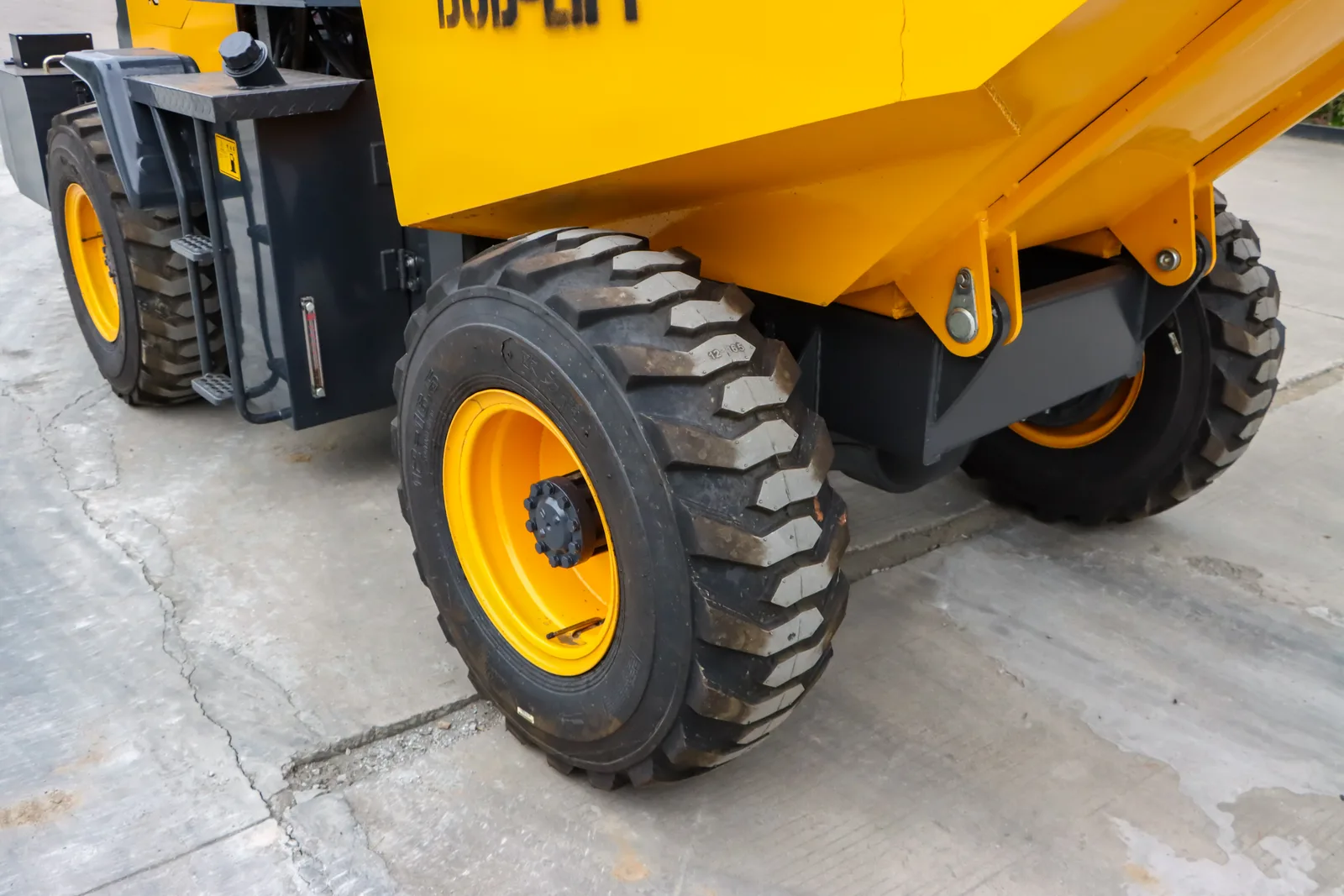
A dumper tyre size is a code moulded on the sidewall that gives the tyre’s nominal width and the rim it fits. In a code such as 7.50-16, the first number is the section width in inches and the last is the rim diameter in inches. The dash shows a bias (cross-ply) construction, while an R in the same place would mean a radial tyre [1].
A code with a slash adds an aspect ratio, which is the sidewall height as a percentage of the section width [1]. So 20.5/70-16 on the FY50 is a tyre about 20.5 inches (521 mm) wide whose sidewall is 70 percent as high as it is wide, on a 16-inch rim. The 16.5-inch rim on the 12-16.5 is a separate rim size from a 16-inch rim, so a 12-16.5 tyre will not fit a 16-inch wheel.
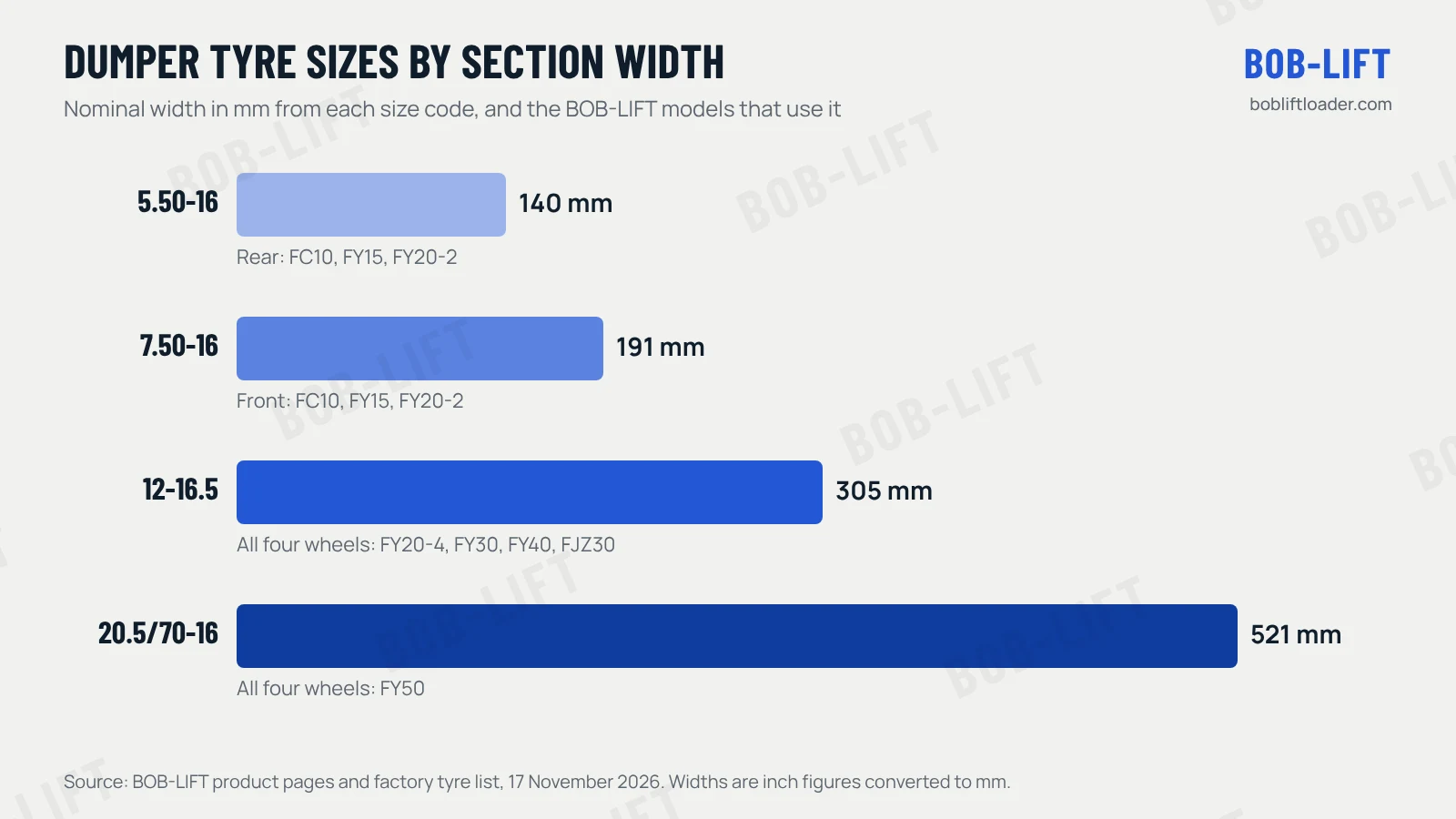

| Size on the sidewall | Nominal section width | Aspect ratio | Rim diameter | Fitted to |
|---|---|---|---|---|
| 5.50-16 | 5.50 in (about 140 mm) | Not marked (conventional) | 16 in (406 mm) | Rear axle of FC10, FY15, FY20-2 |
| 7.50-16 | 7.50 in (about 191 mm) | Not marked (conventional) | 16 in (406 mm) | Front axle of FC10, FY15, FY20-2 |
| 12-16.5 | 12 in (about 305 mm) | Not marked (conventional) | 16.5 in (419 mm) | All four wheels of FY20-4, FY30, FY40, FJZ30 |
| 20.5/70-16 | 20.5 in (about 521 mm) | 70 percent | 16 in (406 mm) | All four wheels of FY50 |
Ply rating, load index and other sidewall marks
The size code alone does not indicate how much weight a particular tyre can safely carry. A ply rating is the mark on a bias tyre that indicates its maximum load capacity at maximum air pressure and speed, and a load index gives the same information as a number read from a load index chart [1]. Some industrial tyres use a star rating instead.
We do not publish a ply rating or load index for each model. Therefore, when you purchase a replacement, read the markings on the tyre currently fitted to the machine and match or exceed them. For example, a tyre with the correct size but a lower load marking could be under-specified for a fully loaded 3 to 5 tonne dumper.
Planning a tyre stock for a dealer or hire fleet
For a dealer’s parts department, the number of different tyre sizes matters more than the number of individual machines. A depot that stocks the FY20-4, FY30, FY40 and FJZ30 deals with one tyre size, 12-16.5, on 16 wheel positions across four machines. Adding the FC10, FY15 or FY20-2 brings in two more sizes, and the FY50 adds a fourth.
- 4×2 models: keep front and rear tyres as separate stock lines. A 5.50-16 cannot replace a 7.50-16 at the front.
- 4×4 models: one 12-16.5 line covers four models. Before swapping complete wheels between models, confirm the rim and wheel-bolt pattern with us.
- FY50: the 20.5/70-16 is used only on this model, so stock it only if you sell or hire the FY50.
Our guide to choosing mini dumpers for a hire fleet shows how engines, tyres and electrics line up across the range, and our mini dumper parts guide covers filters, engines and the rest of a first-order spares kit.
Tyre pressure and dumper stability
We do not publish a single inflation pressure for every model, because the correct pressure depends on the specific tyre fitted. Use the pressure indicated on the tyre sidewall and in the electronic operator’s manual supplied with each machine. Tyre pressure is one of the six checks in our factory inspection before each wheeled dumper ships.
Keep the pressures equal across each axle, particularly on machines such as the FY40 and FY50 that carry heavier loads. The UK Health and Safety Executive notes that over 60% of dumper deaths involve the driver being crushed when the vehicle overturns [2]. Anything that affects stability, including an under-inflated tyre on one side, deserves a check before work starts. Our dumper with cab guide covers roof and cab options.
Changing dumper tyres safely
An inflated industrial tyre stores considerable energy, so demounting, mounting and inflation belong in a properly equipped workshop. In the United States, OSHA’s rule on servicing rim wheels covers large vehicles and off-road machines. It requires employers to train every employee who services rim wheels and to provide a restraining device for inflating tyres on multi-piece wheels [3].
The same rule requires a restraining device or barrier for single-piece wheels unless the wheel is bolted to the vehicle during inflation [3]. Other countries have their own rules, so dealers should follow local workshop regulations. On a construction site, the practical approach is straightforward: lift and support the dumper securely, exchange the complete wheel, and leave the tyre fitting itself to a qualified tyre technician.
What to send us when ordering replacement tyres
Ordering a tyre by its size alone is a common way to receive an incorrect part. Send us the following information, and we will confirm the specification before anything ships:
- The dumper model and serial number.
- The wheel position: front or rear, left or right.
- A clear photo of the sidewall showing the size and the load or ply marking.
- Whether you need the tyre only or a complete wheel with rim.
- The quantity, and whether the tyres can ship together with a machine order.
The same details work for any fault. Send us the model, the serial number and a photo or short video, and our team guides the repair remotely and ships the parts under the 12-month whole-machine warranty. Our pre-shipment inspection checklist shows what to check on the tyres and wheels before a new dumper leaves the factory.
Buying a second hand dumper instead? Check that the tyres match on each axle and still have tread, because a mixed set means some have been replaced. Our used mini dumper inspection checklist covers the tyres and 11 other checks.
Frequently asked questions
What size tyres are on a 1 ton dumper?
Our 1 ton FC10 uses 7.50-16 tyres at the front and 5.50-16 tyres at the rear, the same sizes as the FY15 and FY20-2.
Are front and rear dumper tyres the same?
On our 4×4 dumpers, yes: every wheel uses the same size. On the 4×2 FC10, FY15 and FY20-2, no: the front tyres are larger than the rear ones.
What does 12-16.5 mean on a dumper tyre?
It means a nominal section width of 12 inches (about 305 mm) on a 16.5-inch rim. The dash shows a bias construction.
Does the tracked BL-T500-HD use tyres?
No. The BL-T500-HD runs on rubber tracks. Ask us for the track size when you order spares, and see our tracked vs wheeled mini dumper guide for how the two compare.
How we got these figures
Tyre sizes come from our product pages as published on 17 November 2026 and from our factory’s tyre list. Earlier FY30 documents listed a 20.5-size tyre; current FY30 machines use 12-16.5 front and rear. Millimetre widths are our own conversions of the nominal inch figures, rounded. Read more about us and our factory.
Ask for a tyre and parts list
Tell us which models you plan to stock or already run, and how many. We reply with the tyre sizes, the parts list for each model and a quotation. Send us your model list.