


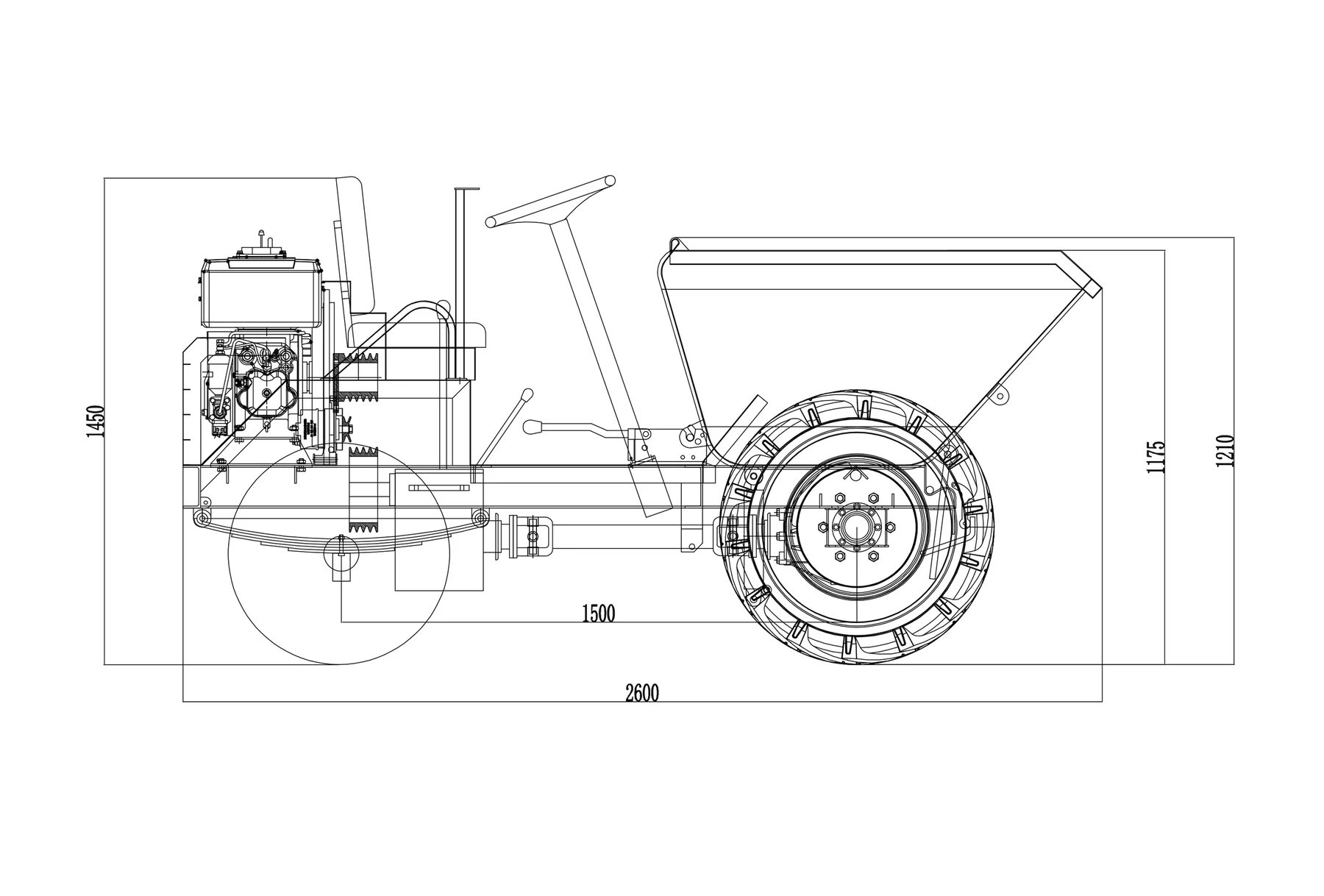
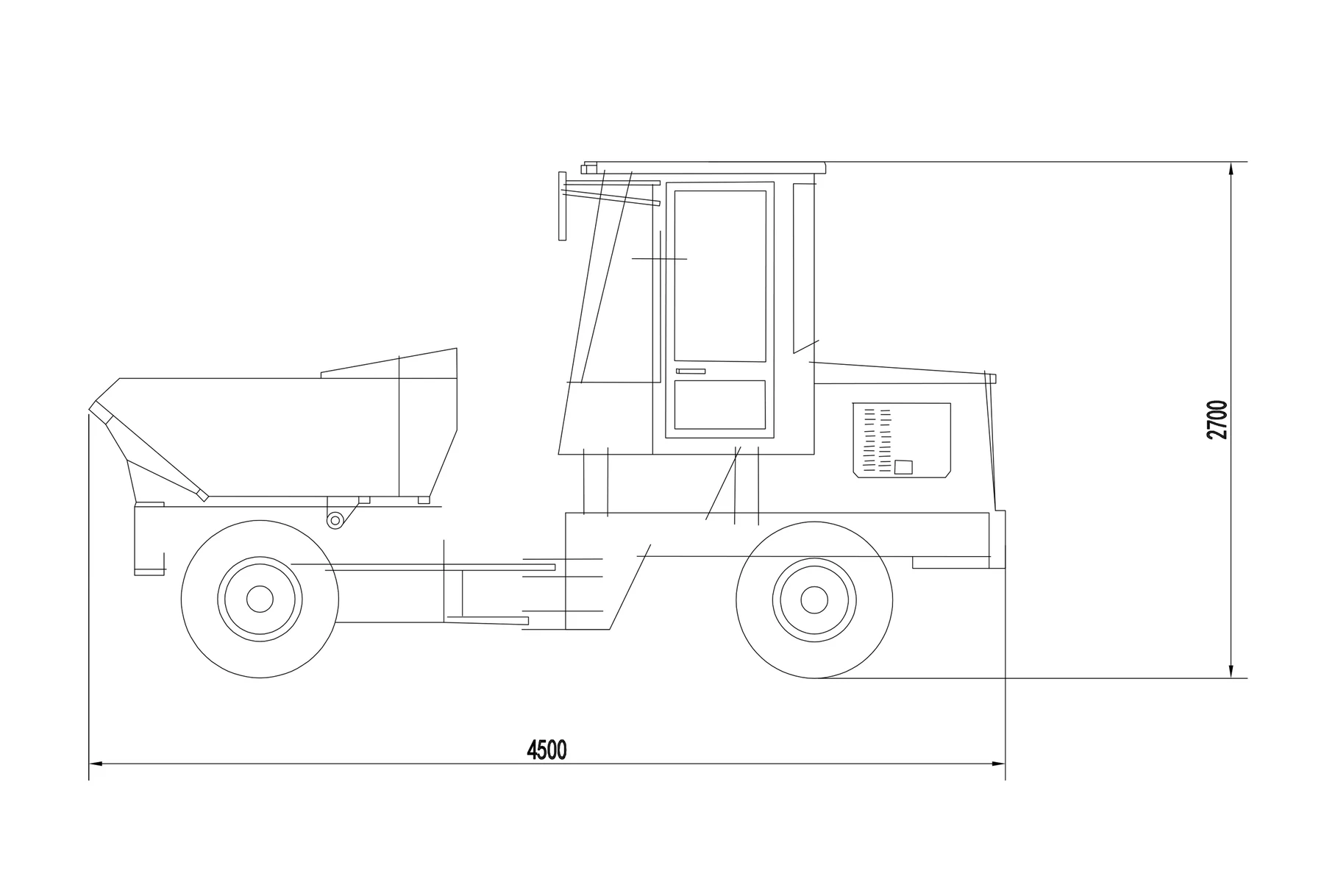
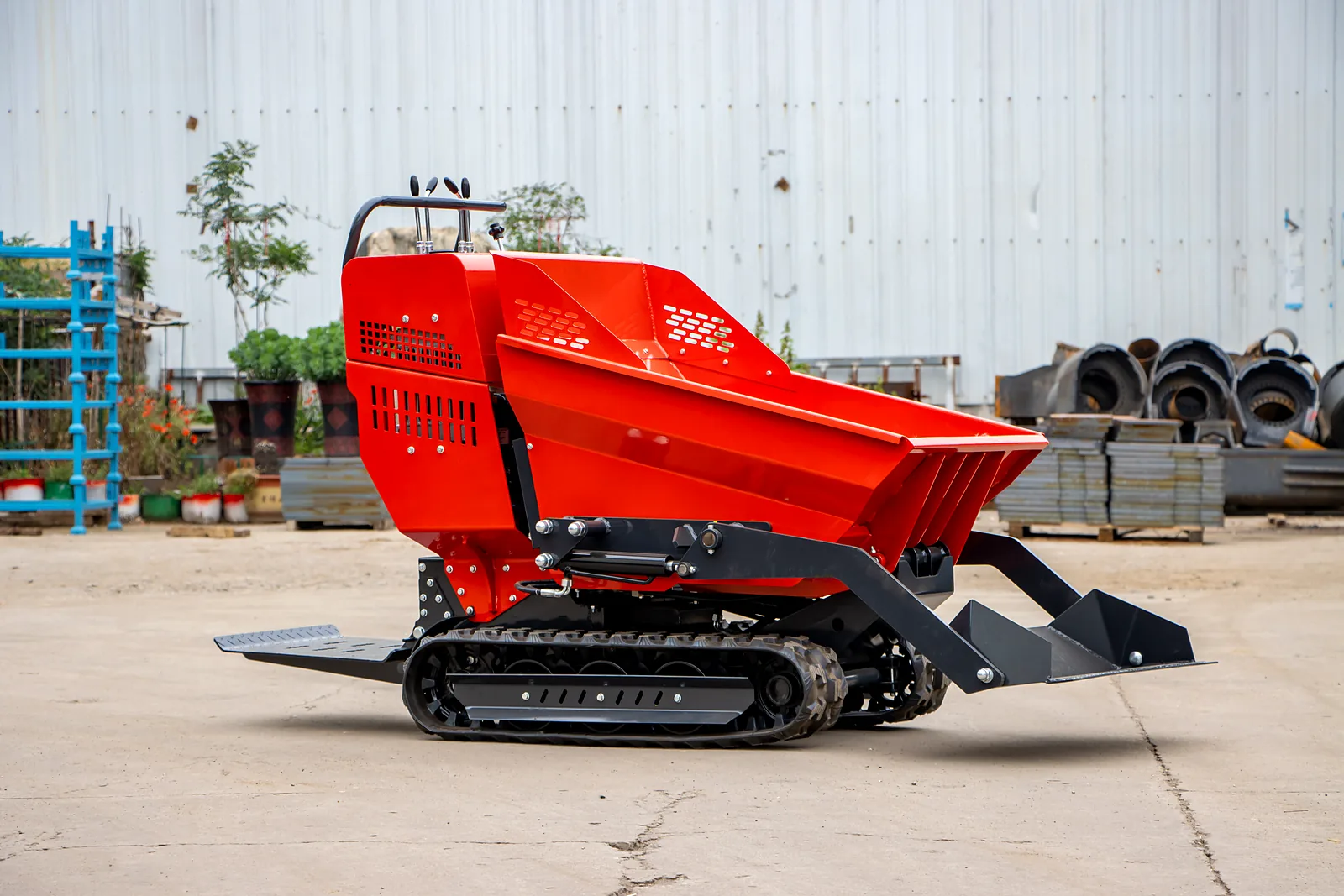
A 1 ton dumper is typically around 2.6 m long, 1.5 m wide and 1.45 m high. Our FC10 measures exactly 2,600 × 1,500 × 1,450 mm (102.4 × 59.1 × 57.1 in), and 2,150 mm high with a roof canopy. A 3 ton dumper such as our FY30 measures 4,500 × 1,700 × 1,800 mm, and the largest 5 ton FY50 is 4,500 × 1,800 × 1,850 mm. The narrowest machine in our range is the tracked BL-T500-HD at 880 mm (34.6 in) wide.
This guide lists the length, width, height, cab height, wheelbase, ground clearance and dump height of every dumper we build in Xuzhou, China. It also shows how to check those figures against a gate, a doorway, a trailer and a container. It is written for contractors, hire fleets and dealers. The question here is not what a dumper can carry, but whether it will physically fit the job.
Key takeaways
- Our dumpers range from 880 to 1,800 mm wide (34.6 to 70.9 in) and 1,570 to 4,500 mm long (61.8 to 177.2 in).
- The 1 and 1.5 ton models (FC10 and FY15) share one 2,600 × 1,500 × 1,450 mm body. The 2 ton FY20-2 is 3,000 × 1,600 mm.
- Going to 4×4 articulated steering adds length rather than width: the FY20-4 is 4,200 mm long but only 100 mm wider than the FY20-2.
- A roof or cab adds 700 to 900 mm of height, so check the overhead clearance of every doorway, beam and container on the route.
- No dumper in our range fits through a standard house door. Plan access around a gate or opening at least 100 mm wider than the machine on each side.
What are the dimensions of a mini dumper?
Standard dimensions are the overall length, width and height of the dumper without a roof, as given on the factory spec sheet. Wheelbase is the distance between the front and rear axles, and ground clearance is the lowest point of the chassis above level ground. The table gives all of them for our nine dumpers, plus the height with a roof canopy or cab.
| Model | Rated load | Length × width × height | Height with roof / cab | Wheelbase | Ground clearance |
|---|---|---|---|---|---|
| BL-T500-HD | 500 kg | 1,570 × 880 × 1,300 mm | No roof option | Tracks | 100 mm |
| FC10 | 1,000 kg | 2,600 × 1,500 × 1,450 mm | 2,150 mm | 1,500 mm | 200 mm |
| FY15 | 1,500 kg | 2,600 × 1,500 × 1,450 mm | 2,150 mm | 1,500 mm | 200 mm |
| FY20-2 | 2,000 kg | 3,000 × 1,600 × 1,480 mm | 2,180 mm | 1,500 mm | 200 mm |
| FY20-4 | 2,000 kg | 4,200 × 1,700 × 1,800 mm | 2,650 mm | 2,090 mm | 200 mm |
| FY30 | 3,000 kg | 4,500 × 1,700 × 1,800 mm | 2,700 mm | 2,130 mm | 200 mm |
| FJZ30 | 3,000 kg | 4,500 × 1,700 × 1,800 mm | 2,700 mm | 2,280 mm | 250 mm |
| FY40 | 4,000 kg | 4,500 × 1,700 × 1,800 mm | 2,700 mm | 2,130 mm | 240 mm |
| FY50 | 5,000 kg | 4,500 × 1,800 × 1,850 mm | 2,750 mm | 2,210 mm | 200 mm |
The BL-T500-HD measures 2,050 mm long with its rear standing platform down. Figures are from our product pages on 19 November 2026; a roof canopy or cab is an option on each wheeled model.


For buyers who work in feet and inches, the same figures converted and rounded are below.
| Model | Length | Width | Height (open) | Height (roof / cab) |
|---|---|---|---|---|
| BL-T500-HD | 61.8 in (5 ft 2 in) | 34.6 in | 51.2 in | — |
| FC10 | 102.4 in (8 ft 6 in) | 59.1 in | 57.1 in | 84.6 in |
| FY15 | 102.4 in (8 ft 6 in) | 59.1 in | 57.1 in | 84.6 in |
| FY20-2 | 118.1 in (9 ft 10 in) | 63.0 in | 58.3 in | 85.8 in |
| FY20-4 | 165.4 in (13 ft 9 in) | 66.9 in | 70.9 in | 104.3 in |
| FY30 | 177.2 in (14 ft 9 in) | 66.9 in | 70.9 in | 106.3 in |
| FJZ30 | 177.2 in (14 ft 9 in) | 66.9 in | 70.9 in | 106.3 in |
| FY40 | 177.2 in (14 ft 9 in) | 66.9 in | 70.9 in | 106.3 in |
| FY50 | 177.2 in (14 ft 9 in) | 70.9 in | 72.8 in | 108.3 in |
What are the dimensions of a 1 ton dumper?
Our 1 ton FC10 is 2,600 mm long, 1,500 mm wide and 1,450 mm high. It has a 1,500 mm wheelbase and 200 mm of ground clearance. The 1.5 ton FY15 uses the same body, so its dimensions are identical. The two differ in rated load, and the FY15 tips hydraulically as standard.
At 1.5 m wide, a 1 ton wheeled dumper needs a gateway rather than a doorway. If your narrowest opening is under about 1.7 m, the FC10 is too tight once you allow a working margin. In that case the tracked BL-T500-HD, which needs about 1.08 m, is the only model in our range that fits. The HSE also suggests considering tracked dumpers where slopes are significant or the ground is poor [1]. Our tracked vs wheeled mini dumper guide covers what you give up in speed and payload.
How big are 2 ton to 5 ton dumpers?
The 2 ton class splits in two. The FY20-2 is a rigid 4×2 dumper at 3,000 × 1,600 × 1,480 mm. The FY20-4 is an articulated 4×4 at 4,200 × 1,700 × 1,800 mm. The extra 1.2 m of length is the articulation joint and the second driven axle, which our 4×4 vs 4×2 dumper guide explains.
From 3 tons upwards, the body length stays at 4,500 mm. The FY30, FY40 and the FJZ30 self-loader all measure 4,500 × 1,700 × 1,800 mm. The FY50 grows to 1,800 mm wide and 1,850 mm high to take its 20.5/70-16 tyres. As a result, a 3 ton dumper needs the same gate as a 4 ton one. The choice between them comes down to the load and the ground, as our site dumper sizes guide sets out.
Height with a roof or cab, and dump height
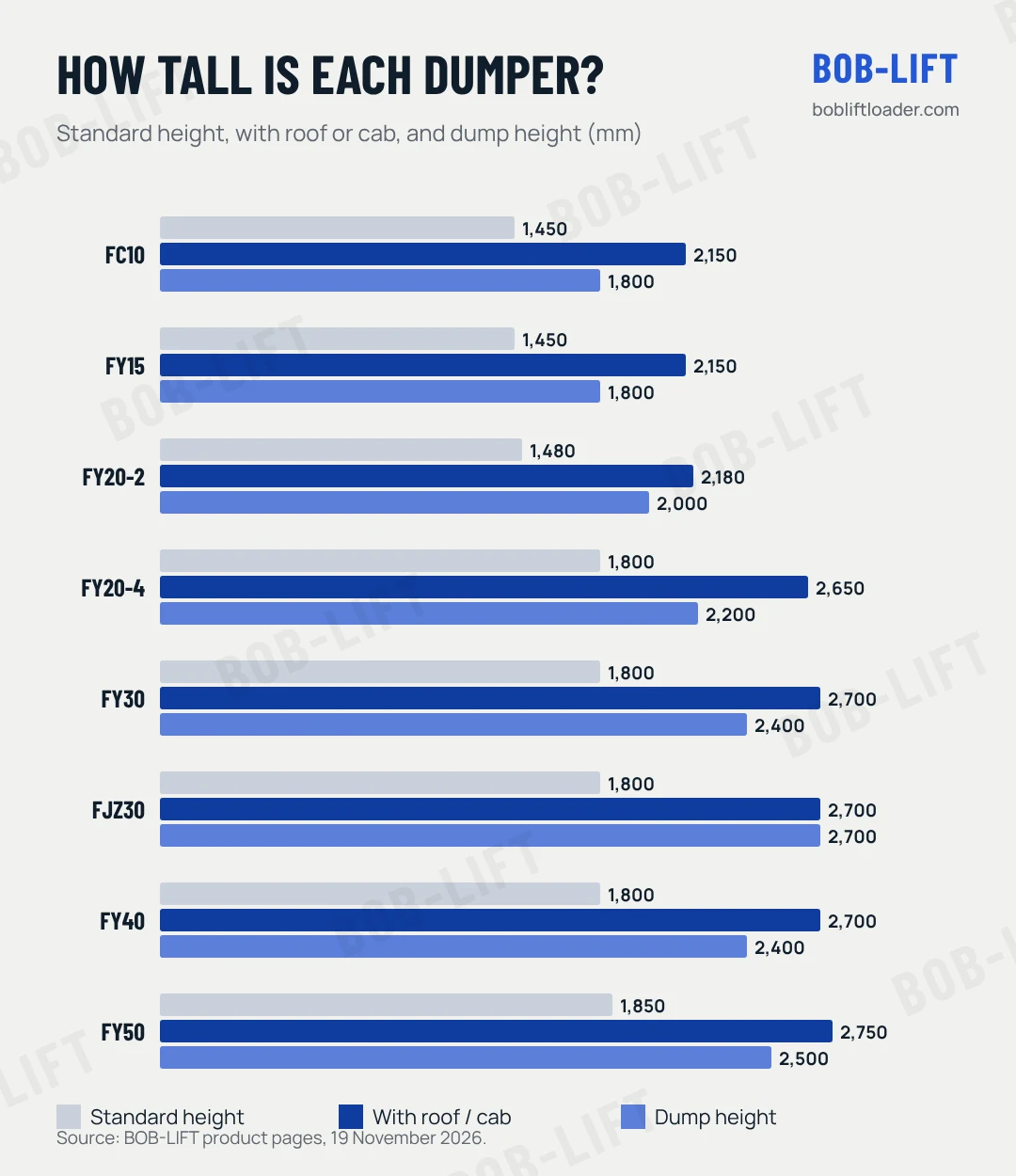
Height changes more than any other dimension when you add options. A roof canopy lifts the FC10 and FY15 from 1,450 to 2,150 mm (84.6 in). A cab takes the 3 to 5 ton models to 2,700 or 2,750 mm (108.3 in). For example, an FY30 with a cab needs 2.7 m of headroom at every door frame and beam on its route. The HSE asks site managers to check that dumpers have roll-over protection and that drivers wear seatbelts [4], so treat the roof or cab height as the real working height. Our dumper with cab guide compares the three operator covers.
Dump height is the height of the hopper lip when the hopper is fully tipped. It matters when you tip into a skip, a trench box or a truck body, and it rises with machine size.
| Model | Dump height | Tipping | Steering |
|---|---|---|---|
| BL-T500-HD | Hopper tips to 100° | 100° hydraulic | Tracked |
| FC10 | 1,800 mm | 45° front | Mechanical |
| FY15 | 1,800 mm | 45° front | Mechanical |
| FY20-2 | 2,000 mm | 45° front | Hydraulic |
| FY20-4 | 2,200 mm | 45° front | Articulated |
| FY30 | 2,400 mm | 45° front | Articulated |
| FJZ30 | 2,700 mm | 45° front | Articulated |
| FY40 | 2,400 mm | 45° front | Articulated |
| FY50 | 2,500 mm | 45° front | Articulated |

How to check a dumper fits your site
Dimensions on a spec sheet only help if you compare them with the real openings on your route. We suggest measuring four things before you choose a model:
- The narrowest opening on the route. Measure the clear width between posts, frames or walls, not the gate leaf. As a working margin, add at least 100 mm (4 in) on each side of the machine width so the driver is not steering to the millimetre.
- The lowest overhead point. Doorway heads, beams, hedges and container door frames all count. Compare them with the height with roof or cab, not the standard height.
- Turns and kerbs. Articulated 4×4 dumpers turn about their middle joint, so check where the rear section will swing on a tight corner. Ground clearance of 200 to 250 mm rules out high kerbs without a ramp.
- Slopes on the way in. The UK Health and Safety Executive advises avoiding slopes, including slopes across the direction of travel. Where they cannot be avoided, check with the supplier [1].
Access matters for safety as well as for fit. According to the HSE, over 60% of dumper deaths involve the driver being crushed when the dumper overturns [4]. A route that forces the driver along an edge or across a slope to squeeze past an obstacle raises that risk.
Doorways are where most plans fail. In England, Approved Document M sets minimum clear door widths for new dwellings of 750 to 800 mm, depending on the corridor [2]. For straight-on doors in other new buildings, the minimum is 800 mm. In the United States, the ADA Standards require a clear width of at least 32 inches, or 813 mm [3]. Even our narrowest dumper, at 880 mm, is wider than those minimums. Plan to bring dumpers in through a gate, a garage door or a removed fence panel instead. The HSE also notes that a folding roll-over protection frame lowered for a doorway must be raised again on the other side [1].
Transport and shipping dimensions
For a trailer, first compare the deck length and width with the standard dimensions. Then add the deck height to the machine height and check the total against any bridge or gate on the road. Our dumper weight guide gives the empty weights you need for the trailer’s payload.
For export, the same dimensions decide how many machines fit in a container. For example, the FC10 and FY15 ship six to a 20GP and twelve to a 40HQ. The 4,500 mm models ship one to a 20GP and up to five to a 40HQ. Our container packing article shows how we wrap and load them.
Frequently asked questions
How wide is a 1 ton dumper?
Our 1 ton FC10 is 1,500 mm (59.1 in) wide. Allow an opening of about 1.7 m to drive it through comfortably.
How wide is a 3 ton dumper?
Our 3 ton FY30 is 1,700 mm (66.9 in) wide and 4,500 mm long. The FJZ30 self-loader has the same width.
What is the narrowest dumper you build?
The tracked BL-T500-HD, at 880 mm (34.6 in) wide. It carries 500 kg and tips its hopper hydraulically to 100°.
Do dimensions change with a cab?
Only the height. Length and width stay the same; height rises by 700 mm on the FC10, FY15 and FY20-2, by 850 mm on the FY20-4 and by 900 mm on the 3 to 5 ton models.
How we got these figures
All dimensions come from the spec tables on our product pages as published on 19 November 2026, which match the factory dimension drawings shown above. Every figure in this article went through a fact-check against those pages before publication. Imperial values are our rounded conversions, and the 100 mm access margin is our own working rule rather than a regulation. Read more about us and our factory.
Ask for drawings and a quotation
Send us the narrowest opening and lowest overhead point on your site, and the loads you need to move. We reply with dimension drawings and a quotation for the models that fit. Send us your dumper enquiry.