


A tracked mini dumper is a small dumper that runs on rubber tracks instead of wheels, so it can cross soft ground, lawns and slopes that would bog down a wheeled machine. Our BL-T500-HD carries 500 kg (1,102 lb) in a 0.2 m³ hopper, weighs 410 kg and is 880 mm (34.6 in) wide. Its two tracks spread that weight over 0.36 m², giving an average ground pressure of about 11.2 kPa empty and 24.8 kPa fully loaded, and it is rated for slopes up to 20°.
This guide explains how ground pressure is worked out, what those figures mean on grass and soft soil, and how to treat a 20° slope rating in practice. It also lists the specifications to check when you compare tracked dumpers, also sold as mini crawler dumpers or mini track dump trucks, from different factories. It is written for hire fleets, landscapers and dealers stocking narrow-access equipment.
Key takeaways
- Our BL-T500-HD averages about 11.2 kPa empty and 24.8 kPa loaded, less than a person exerts when walking.
- Ground pressure is simply weight divided by track contact area. Ask any supplier for the contact length and width so you can check it.
- The load decides most of the pressure. Half a load cuts it from 24.8 to about 18 kPa, so lighter loads protect soft ground.
- A 20° gradeability rating is a maximum, not a working limit. The HSE asks you to reduce it on rough ground and to avoid crossing slopes.
- At 880 mm wide, both of our tracked dumpers fit garden gates, but not standard house doors.
What is a tracked mini dumper?
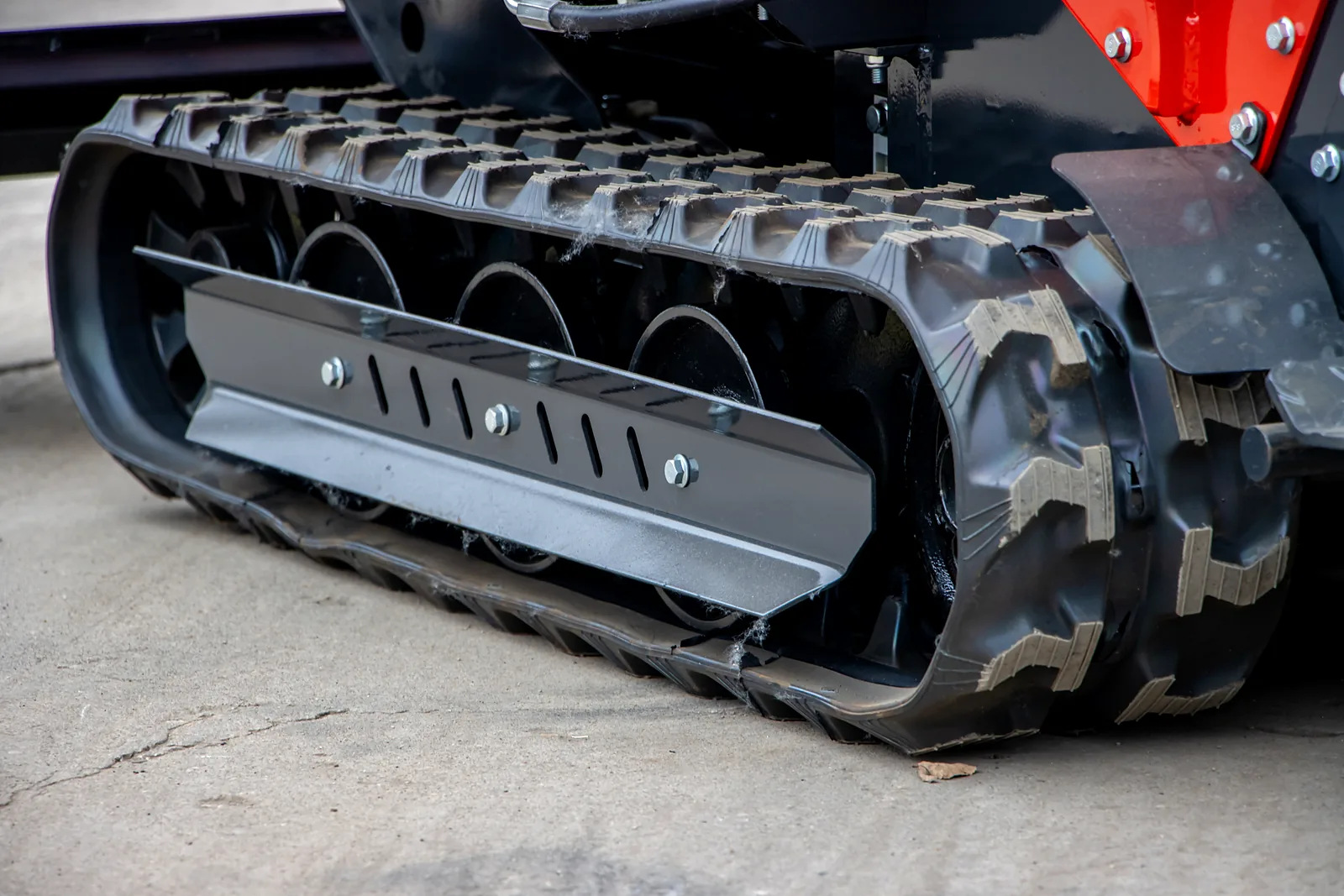
A tracked mini dumper is a compact dumper on rubber crawler tracks, driven from a standing platform at the rear with handlebar or joystick controls. The tracks trade speed for grip: our models travel at 3 km/h (1.9 mph), compared with 22 km/h for our smallest wheeled dumper. In return, they carry loads across ground that a wheeled machine would rut or slide on.
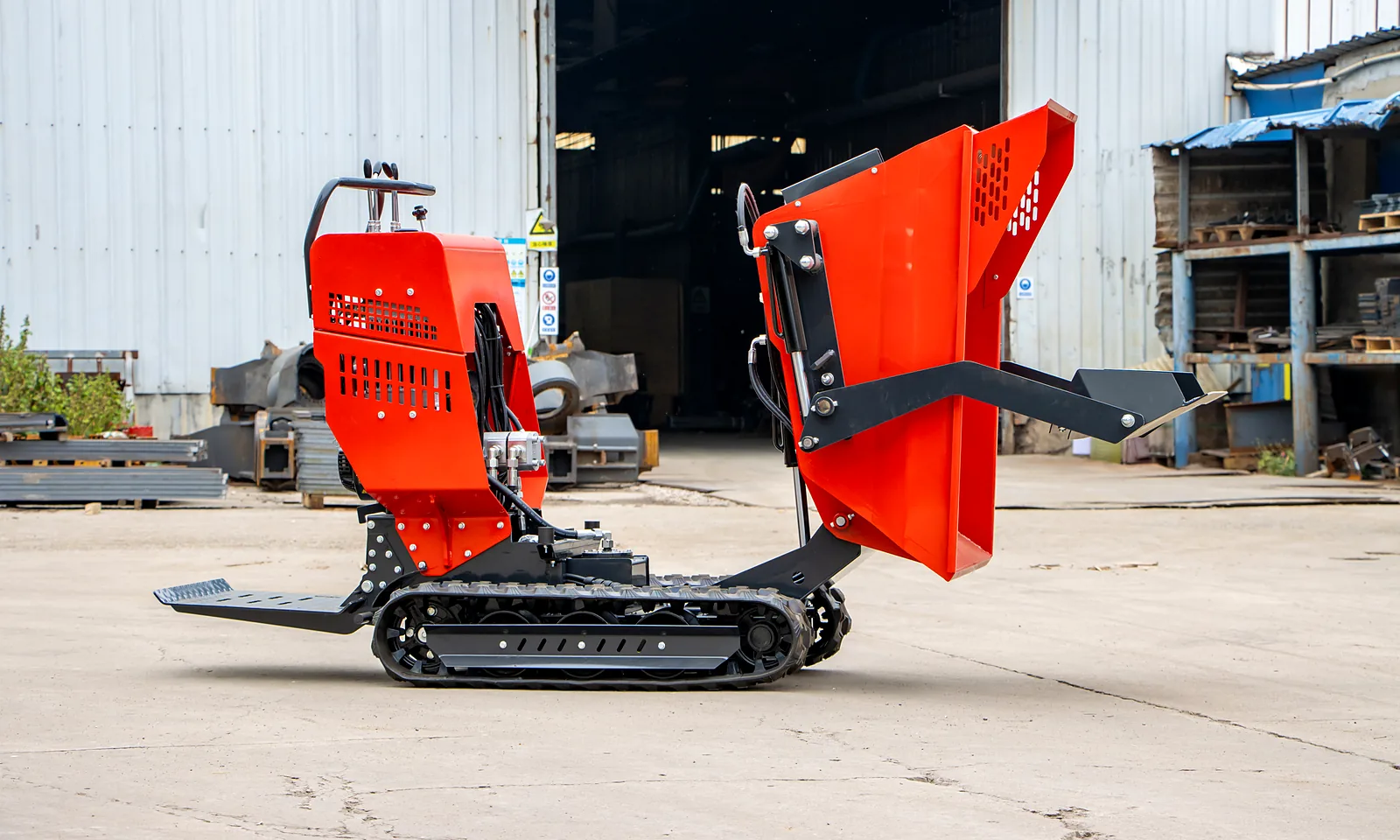
We build two tracked models. The BL-T500-HD has a tipping hopper and a front shovel plate. The BL-T200-HJ carries a 200 L mixing drum on the same 880 mm width, for mixing and placing small concrete pours.
| Specification | BL-T500-HD tracked dumper | BL-T200-HJ tracked mixer dumper |
|---|---|---|
| Carries | 500 kg (1,102 lb) in a 0.2 m³ hopper | 200 L (7.1 ft³) mixing drum |
| Machine weight | 410 kg (904 lb) | 465 kg (1,025 lb) |
| Width | 880 mm (34.6 in) | 880 mm (34.6 in) |
| Length × height | 1,570 × 1,300 mm (2,050 mm with footplate) | 2,250 × 1,470 mm (2,450 mm with footplate) |
| Track contact (each) | 1,000 × 180 mm | Not published |
| Ground pressure | About 11.2 kPa empty, 24.8 kPa loaded | Not published |
| Gradeability | 20° | 20° |
| Tipping | Hydraulic, to 100° | Hydraulic, to 45° |
| Engine | 4.8 kW petrol, Rato or Briggs & Stratton | 4.8 kW petrol, Rato or Briggs & Stratton |
| Travel speed | 3 km/h (1.9 mph) | 3 km/h (1.9 mph) |
| Ground clearance | 100 mm | 110 mm |
Figures are from our product pages on 19 November 2026. Our tracked vs wheeled mini dumper guide compares the BL-T500-HD with our 1 and 1.5 ton wheeled dumpers.
How is ground pressure calculated?
Ground pressure is the force a machine applies to the ground divided by the area in contact with it, measured in kilopascals (kPa) [1]. For a tracked dumper, the contact area is the length of track on the ground multiplied by the track width, times two tracks. For example, each BL-T500-HD track touches the ground over 1,000 × 180 mm, so the two tracks cover 0.36 m².
The empty machine weighs 410 kg, which is about 4.0 kN of force. Divided by 0.36 m², that gives 11.2 kPa. With a 500 kg load the total is 910 kg, and the pressure rises to 24.8 kPa.
| Load case | Total weight | Average ground pressure |
|---|---|---|
| Empty | 410 kg | 11.2 kPa (1.6 psi) |
| Half load (250 kg) | 660 kg | 18.0 kPa (2.6 psi) |
| Full rated load (500 kg) | 910 kg | 24.8 kPa (3.6 psi) |
These are averages. Real pressure is higher under each roller and at the front of the tracks when the hopper is full, and it rises again while tipping. Use the figures to compare machines on the same basis, not as a guarantee for a particular lawn.
What does 11 to 25 kPa mean on soft ground?
The useful comparison is with things you already know. The human foot can exert 60 to 80 kPa while walking, and a wheeled all-terrain vehicle about 13.8 kPa [1]. The same source gives about 5.2 kPa for a rubber-tracked ATV and recommends 14 kPa or less for fragile ground such as marshes [1].
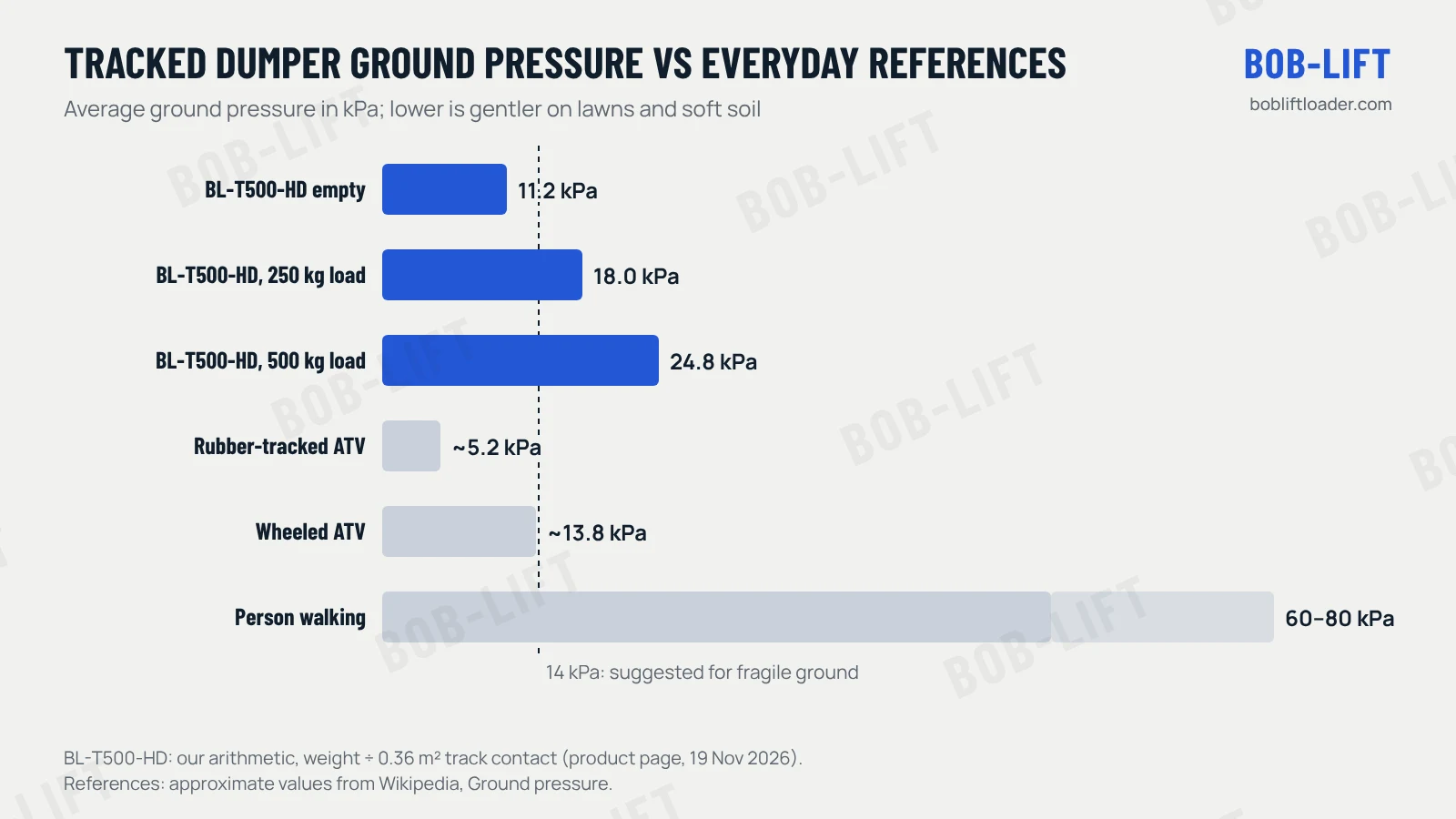

On a firm lawn or a gravel path, all three load cases are gentle. On wet turf, a soft bed or fresh topsoil, the load matters more than the machine. To stay at or below 14 kPa, the BL-T500-HD can carry only about 100 kg, so plan more, lighter trips on the softest ground. Lay boards or ground protection mats on the route where repeated passes would rut.
Track width also matters. Narrow tracks concentrate the same weight on a smaller area, so two dumpers of similar weight can differ widely in ground pressure. Always compare the contact area, not only the weight.
How steep a slope can a tracked mini dumper climb?
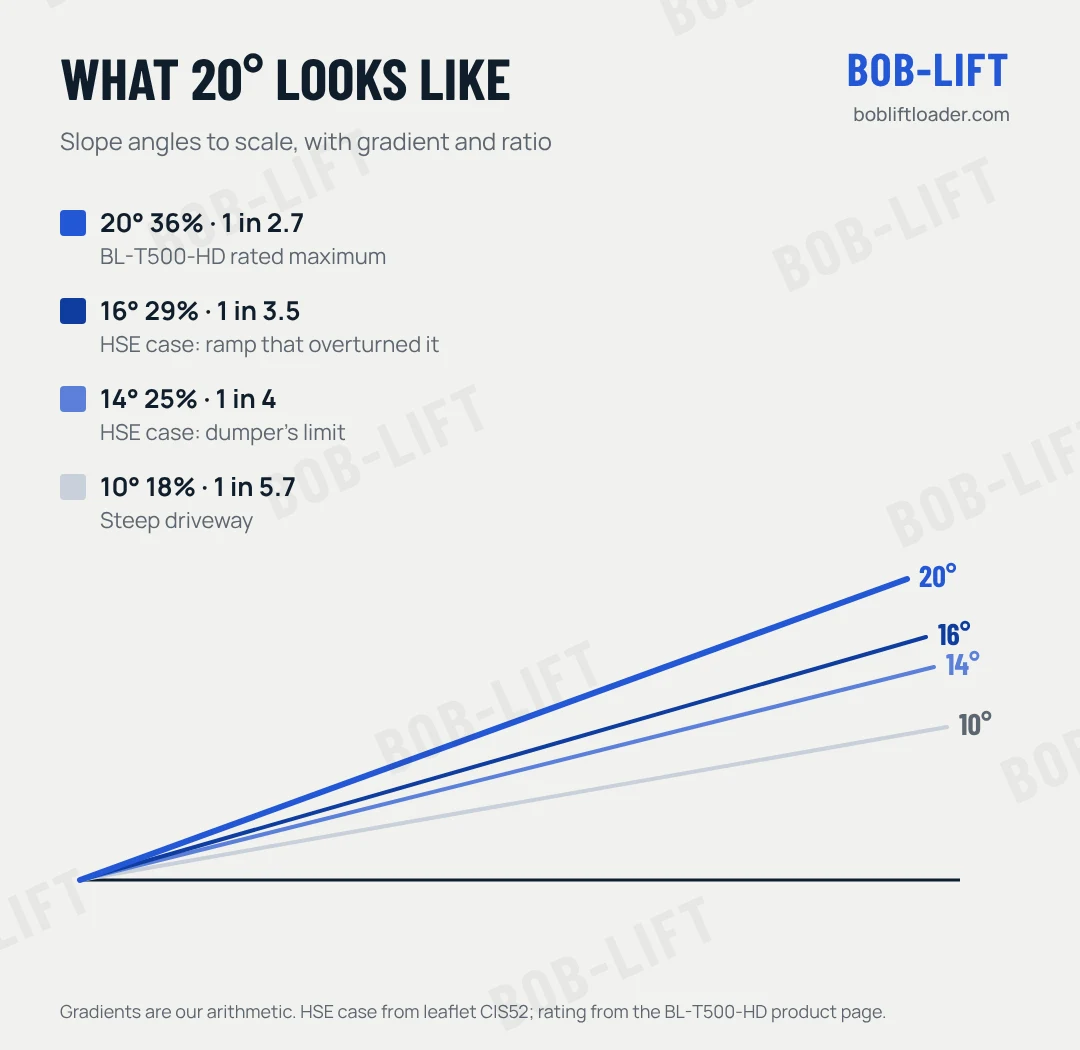
Gradeability is the steepest slope a machine can climb under test conditions. Our BL-T500-HD and BL-T200-HJ are both rated at 20°, which is a gradient of 36 per cent, or about 1 in 2.7. That figure is a capability, not a safe working limit for every site.
| Slope angle | Gradient | Ratio | What it means |
|---|---|---|---|
| 10° | 18 per cent | 1 in 5.7 | A steep driveway or garden bank |
| 14° | 25 per cent | 1 in 4.0 | The 1 in 4 limit in the HSE case study below |
| 16° | 29 per cent | 1 in 3.5 | The ramp where that dumper overturned |
| 20° | 36 per cent | 1 in 2.7 | The BL-T500-HD’s rated gradeability |
The HSE’s guidance on site dumpers shows why the difference matters. It advises avoiding slopes, including slopes across the direction of travel, and reducing the manufacturer’s slope figure where the ground is rough [2]. It also recommends considering tracked dumpers where slopes are significant or the ground is poor [2]. In one case it describes, a ramp that averaged 1 in 3.5 was steeper than the 1 in 4 limit for the dumper in use, and the contractor was fined £150,000 [2].

On a slope, we suggest these working rules, drawn from the same guidance:
- Travel straight up and down, never across. If you must turn on a slope, turn uphill [2].
- With a loaded hopper, reverse down slopes so the load stays uphill of the tracks [2].
- Keep the hopper down while moving, and tip only on level, firm ground.
- Do not overfill: the HSE asks that loads stay below the top edge of the skip [3].
What to check when you compare tracked dumpers
Tracked dumpers from different factories can look alike in photos. These are the figures that tell them apart:
- Track contact length and width. Without them you cannot check the ground pressure claim. Ask for both, and for the pressure empty and loaded.
- Rated load and hopper size. Our hopper measures 1,070 × 730 × 730 mm. Compare like with like, struck or heaped.
- Gradeability and how it was rated. Ask whether the figure is with or without load.
- Tipping angle. A 100° hydraulic tip empties sticky material, whereas a shallow tip leaves it in the hopper.
- Engine and emissions. Ours is a 4.8 kW petrol engine from Rato or Briggs & Stratton, with electric start, built to the EPA and Euro 5 emission standards listed on the product page.
- Spare tracks and parts. Rubber tracks wear, so confirm part numbers and supply. Our mini dumper parts guide covers what to stock.
For export, the tracked models pack small: ten fit in a 20GP container and 24 in a 40HQ. The lead time on our product page is 10 working days.
Frequently asked questions
Will a tracked dumper damage a lawn?
At 11 to 25 kPa, the BL-T500-HD presses on the ground less than a walking person does. On wet turf, though, repeated passes and tight turns can still scuff it. Use lighter loads and boards on the route.
Is a mini crawler dumper the same as a tracked mini dumper?
Yes. Mini crawler dumper, mini track dump truck and tracked barrow are all names for the same class of small dumper on rubber tracks.
How wide is a tracked mini dumper?
Our two tracked models are both 880 mm (34.6 in) wide. Our dumper dimensions guide compares them with our wheeled range.
Can a tracked dumper carry concrete?
Yes, within its rated load. Normal concrete weighs 2,240 to 2,400 kg/m³ [4], so a level 0.2 m³ hopper holds about 450 to 480 kg, close to the 500 kg rating. A heaped hopper can exceed it, so fill by weight. Our concrete buggy vs mini dumper guide compares the options for moving concrete.
How we got these figures
Machine figures come from our product pages on 19 November 2026. Ground pressures, the 14 kPa load and the slope conversions are our own arithmetic, and every figure went through a fact-check against those pages. Read more about us and our factory.
Ask about our tracked dumpers
Tell us about your ground, your slopes and the loads you move. We reply with the specifications and a quotation for the BL-T500-HD or BL-T200-HJ. Send us your dumper enquiry.