


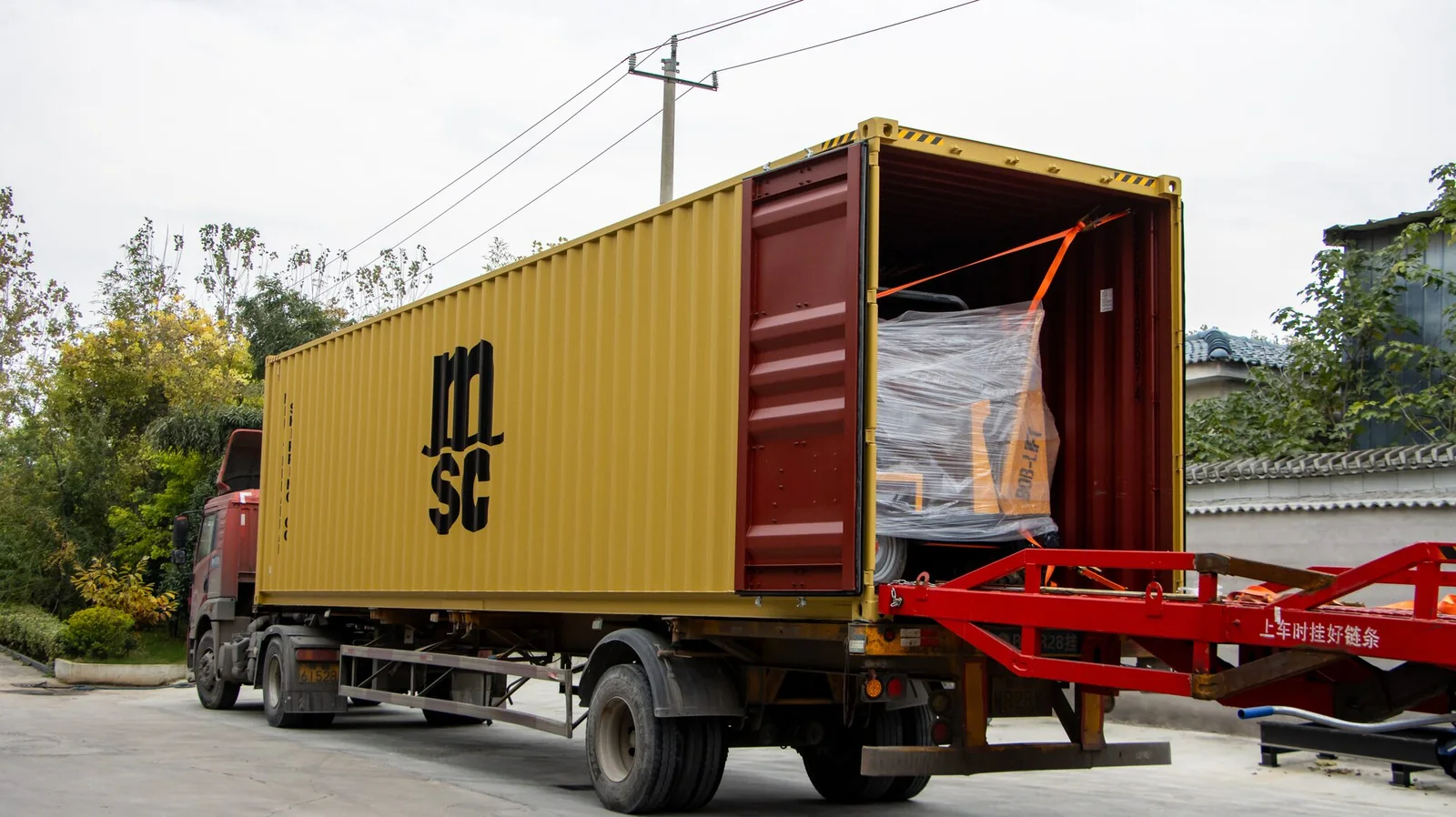
Every wheeled mini dumper we ship is run and checked first. We then wrap it in bubble wrap and stretch film, and take the front wheels off so the axle rests on timber blocks. A forklift then drives it up a ramp and inside, where it is strapped down. The photos in this article come from one of our container loadings in November 2026, so you can see what will arrive at your door.
This article is for buyers, dealers and hire companies ordering mini dumpers from China for the first time. It explains each packing step and why we do it, and what to check when you open the container doors. For how many machines fit in each container, see our guide to how many mini skid steers and mini dumpers fit in a container.
Key takeaways
- Every dumper is run and checked before it is packed, against the checks listed on its product page.
- Each machine gets two layers of wrapping to keep dust, rain and scuffs off its paint and controls.
- On this load the front wheels came off, and each front axle rested on timber blocks set on its own tyres.
- Machines are loaded by forklift over a mobile ramp and held down with ratchet straps.
- Most of our wheeled dumpers ship in about 10 working days from order; the FJZ30 takes about 30 working days.
Step 1: Run and check the machine before packing
We do not wrap a dumper until it has been run and checked. The checks for each model are listed on its product page, and on every wheeled dumper they cover:
- Appearance: the finish and assembly of the whole machine.
- Engine and fluids: the engine, coolant, hydraulic oil and engine oil.
- Tyre pressure: the pressure in every tyre.
- Lights, horn and gauges: each one is checked before packing.
- Hydraulics: the tipping action, or the hydraulic speed and oil circuit, depending on the model.
On some models, such as the FY20-2 and FY30, the checks also include a rated load test. The hopper is loaded to its rated payload and run, and the turning radius and gradient are checked against the specification. After a continuous run, the tester and quality controller record the factory and engine numbers and sign the outgoing quality control record. On others, such as the FC10 and FY50, the list also covers the screws and bolts across the whole machine.
Checking first matters because a fault found after wrapping means unpacking the machine again, and a fault found after loading means a delayed container. If you want your own inspector at the factory before loading, our pre-shipment inspection checklist explains when to book one and what they should look at.
Step 2: Wrap each machine in bubble wrap and stretch film
Each dumper is wrapped in two layers. The inner layer is bubble wrap, which cushions the hopper, canopy and controls against knocks. Over it goes clear stretch film, pulled tight so the wrap cannot flap or tear loose in the container. Stretch film is a thin plastic film that clings to itself when it is pulled around a load, so it holds the bubble wrap in place without tape or glue.
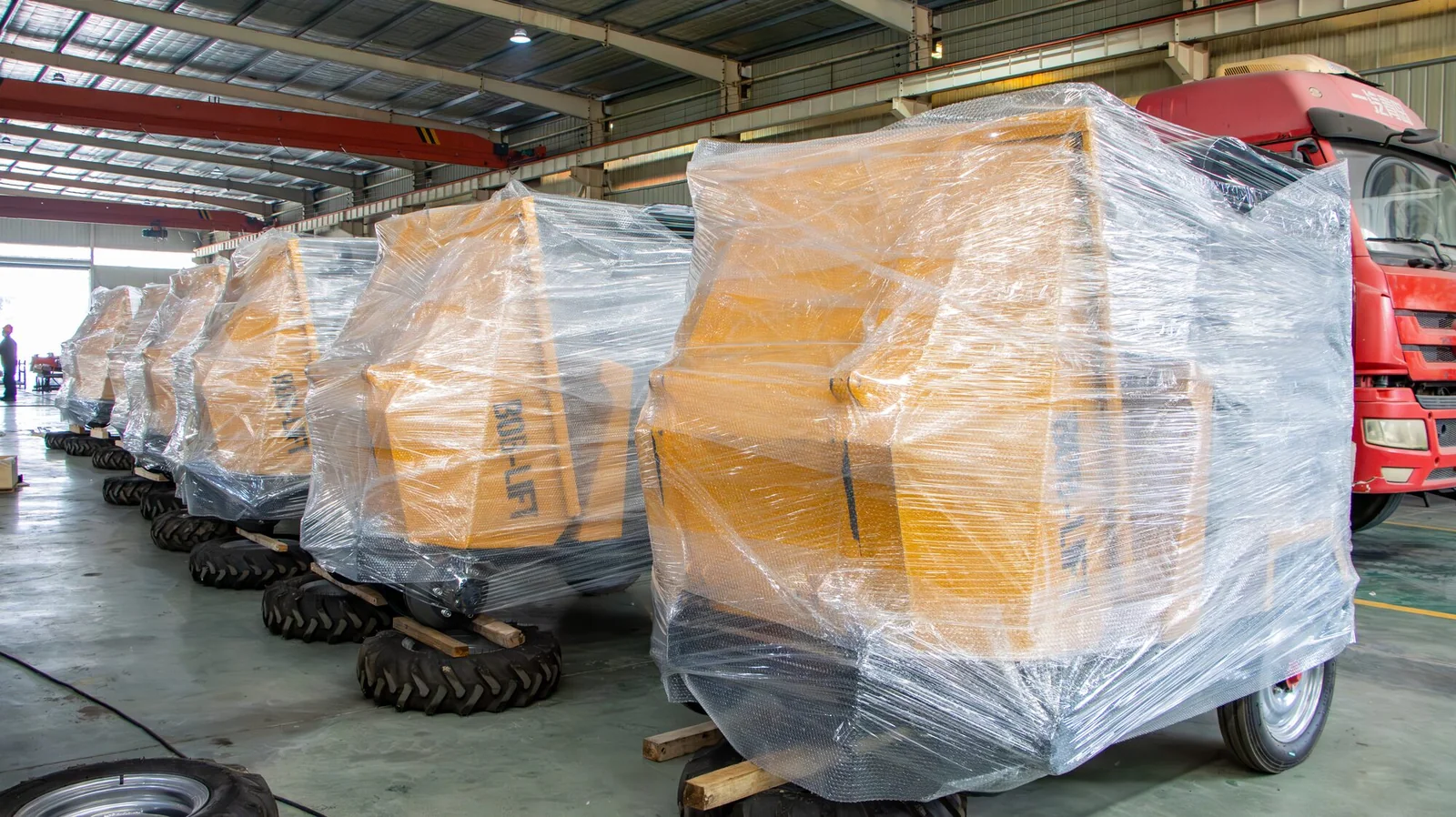
Because the film is clear, the machine can still be seen and identified without cutting the wrap open. The wrap also keeps rain and dust off while machines wait in the yard, and stops painted surfaces rubbing against the straps.
Step 3: Take the front wheels off and set the axle on blocks
On this load, the large front wheels were removed from every dumper. Each front axle was set on timber blocks, and the blocks sat on the machine’s own front tyres. The small rear wheels stayed on, so the dumper could still be rolled and lifted as one piece. Blocking a load with timber so it cannot roll or shift is one of the securing methods described in the CTU Code for packing cargo transport units.
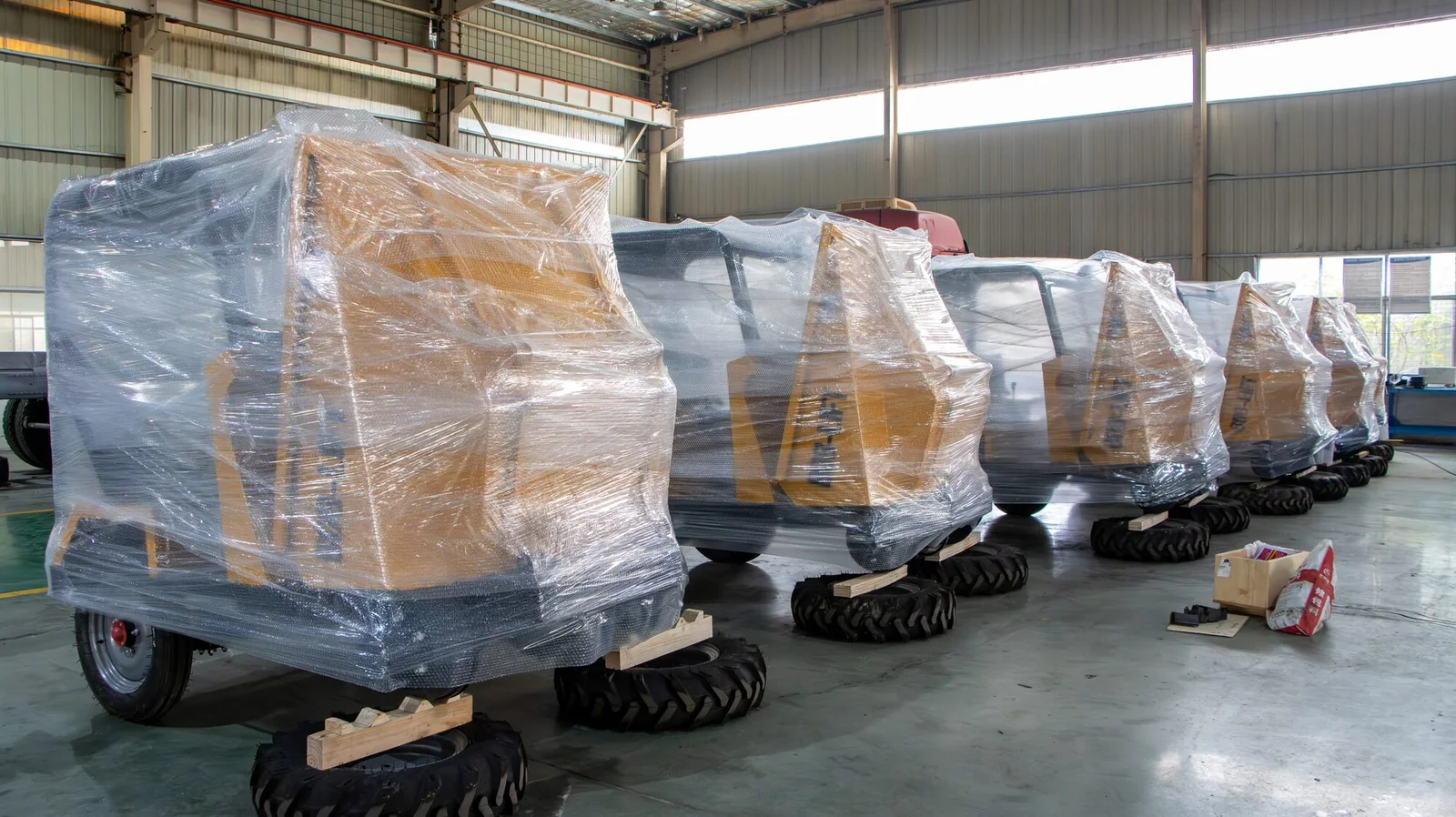
Taking parts off a dumper lowers it and shortens it, which is how a container takes more machines. Our loading plans therefore give two figures for each wheeled model: one for complete machines and a higher one for machines that are partly dismantled. A taken-apart figure is the number of machines that fit when parts such as wheels, the canopy or the hopper come off for shipping. For example, a 20GP takes 4 complete FC10 or FY15 dumpers, or 6 when they are taken apart. Which parts come off depends on the model and on the plan for your order, and we confirm that plan with you before loading.
| Wheeled dumper | Rated load | Complete (20GP / 40HQ) | Taken apart (20GP / 40HQ) |
|---|---|---|---|
| FC10, FY15 | 1 t, 1.5 t | 4 / 8 | 6 / 12 |
| FY20-2 | 2 t | 2 / 4 | 3 / 6 |
| FY20-4 | 2 t | 1 / 2 | 1 / 5 |
| FY30, FY40 | 3 t, 4 t | 1 / 3 | 1 / 5 |
| FY50 | 5 t | 1 / 3 | 1 / 3 |
| FJZ30 | 3 t | 1 / 2 | No taken-apart figure |
Machine height matters most at the container door. The table gives the published size of each wheeled dumper, standard and with the roof or cab fitted. For comparison, Hapag-Lloyd lists a door opening 2,597 mm high on its 40-foot high cube container. Other lines’ containers can differ slightly, so your forwarder should confirm the figure for the container you book.
| Wheeled dumper | Standard L × W × H (mm) | Height with roof or cab (mm) | Machine weight |
|---|---|---|---|
| FC10 | 2,600 × 1,500 × 1,450 | 2,150 | 800 kg (1,764 lb) |
| FY15 | 2,600 × 1,500 × 1,450 | 2,150 | 830 kg (1,830 lb) |
| FY20-2 | 3,000 × 1,600 × 1,480 | 2,180 | 900 kg (1,984 lb) |
| FY20-4 | 4,200 × 1,700 × 1,800 | 2,650 | 2,100 kg (4,630 lb) |
| FY30 | 4,500 × 1,700 × 1,800 | 2,700 | 2,200 kg (4,850 lb) |
| FY40 | 4,500 × 1,700 × 1,800 | 2,700 | 2,400 kg (5,291 lb) |
| FY50 | 4,500 × 1,800 × 1,850 | 2,750 | 2,600 kg (5,732 lb) |
| FJZ30 | 4,500 × 1,700 × 1,800 | 2,700 | 3,920 kg (8,642 lb) |
Putting a taken-apart machine back together needs some assembly experience, and we give technical guidance for it. Count the removed parts against the packing list on delivery.
Step 4: Load by forklift over a yard ramp
The container stays on its trailer at the factory, so we use a mobile yard ramp to bridge the gap between the ground and the container floor. A mobile yard ramp is a wheeled steel ramp that a forklift can drive up from ground level into a container. A forklift lifts each wrapped dumper from under the chassis, drives it up the ramp and sets it down inside.
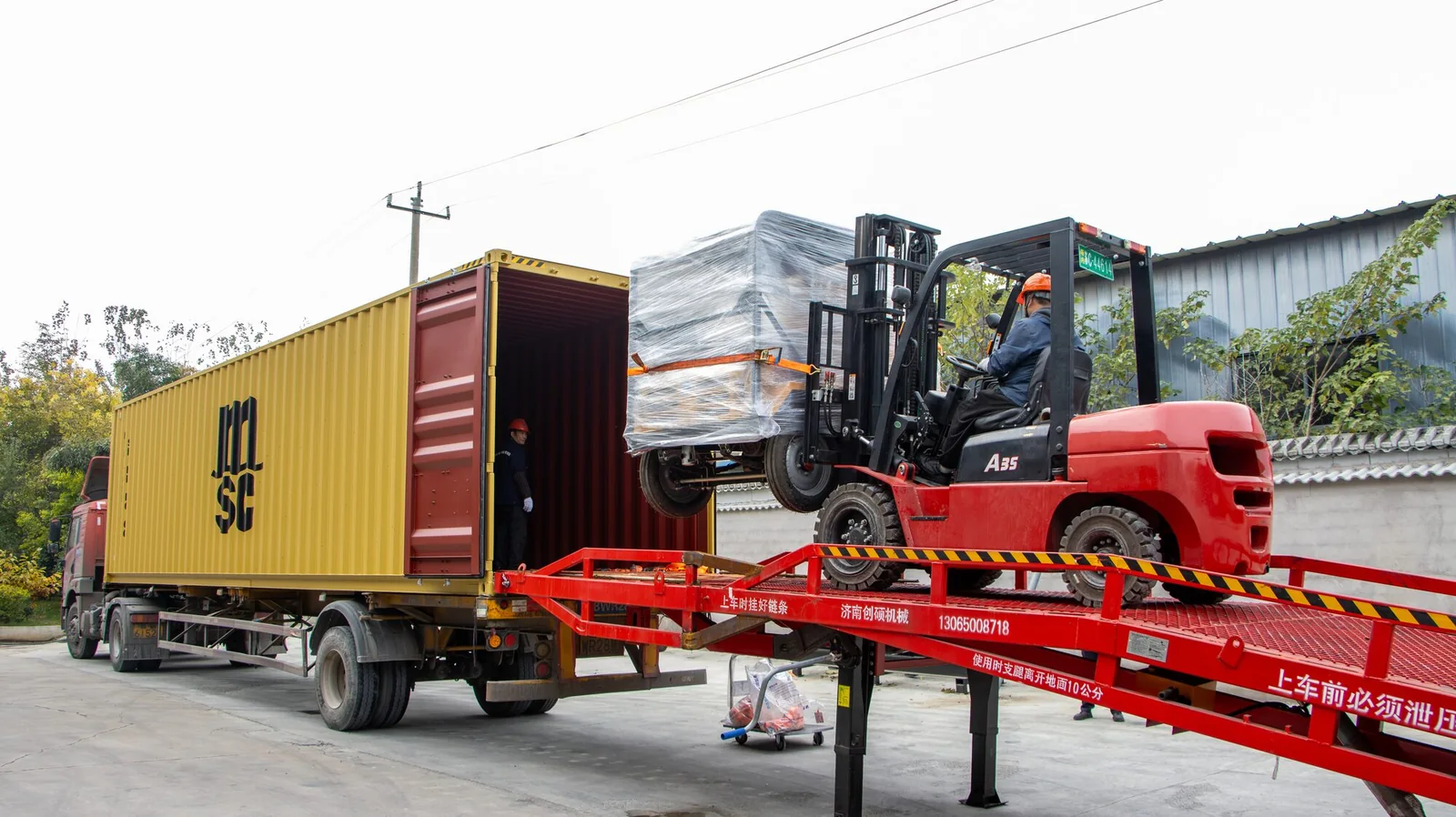
Lifting from the chassis keeps the forks away from the hopper, canopy and controls.
Step 5: Strap the dumper down inside the container
Once a dumper is in place, it is held down with orange ratchet straps tensioned over the top of the machine and down to the container on each side. A machine that can slide or tip in transit can damage itself, its neighbours and the container walls.
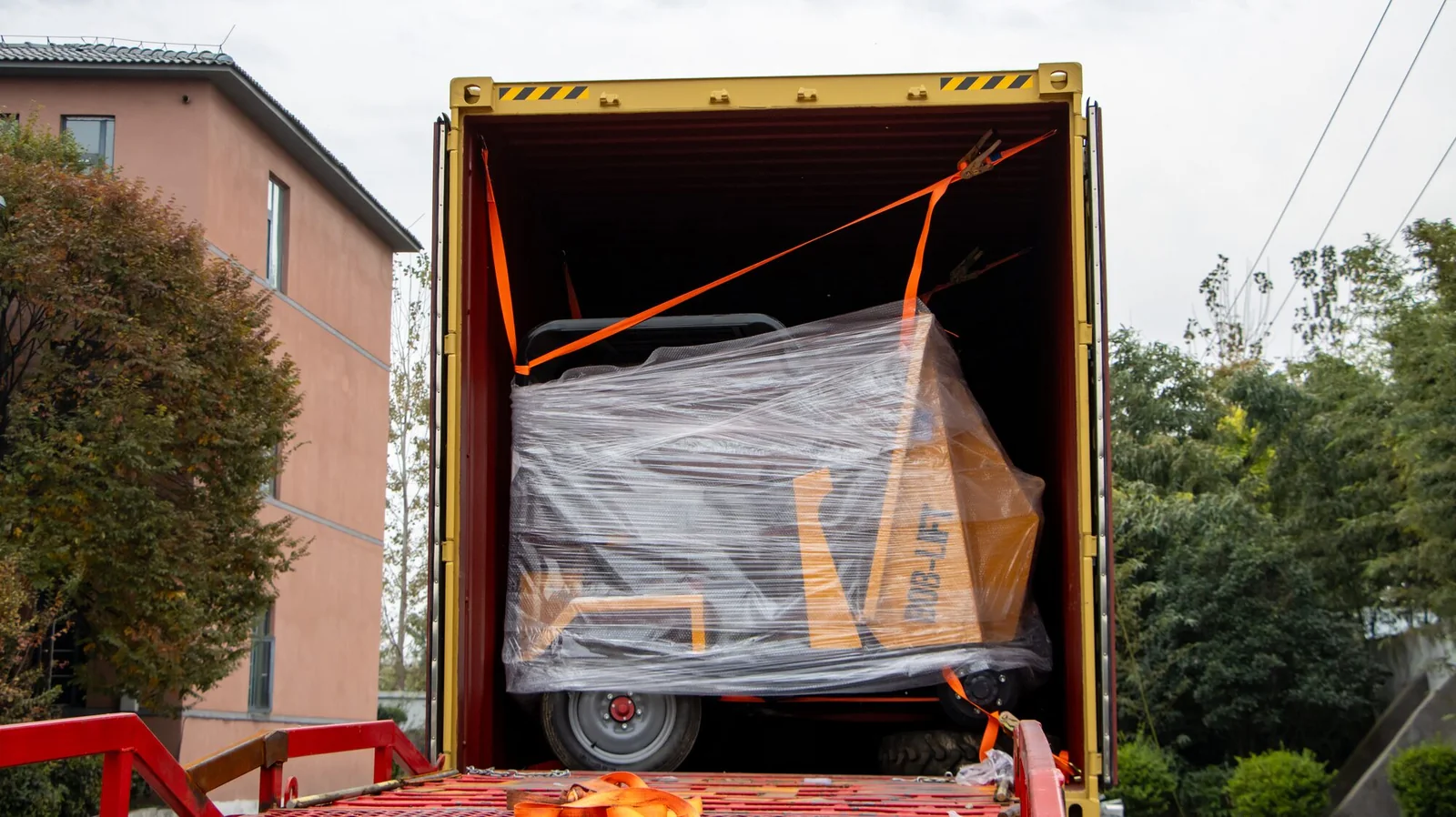
The CTU Code is the international code of practice for packing cargo into containers and other cargo transport units. It was published jointly by the International Maritime Organization, the International Labour Organization and the United Nations Economic Commission for Europe. It covers how cargo should be placed, blocked and lashed so that it cannot move during sea and road transport. Your forwarder can tell you if the destination port or carrier has extra requirements.
What to check when the container arrives
Transit damage is much easier to settle with the carrier or insurer if you record it before anything is moved. When your container arrives:
- Photograph the seal and the closed doors before you open them.
- Open the doors slowly, because SafeWork NSW’s guidance on unpacking shipping containers warns against assuming the load is still secure. It advises opening the right-hand door cautiously first and checking whether goods have shifted while the doors are only partly open.
- Photograph the load as soon as the doors open, before you cut any strap.
- Check the straps and film, because signs such as loose straps or torn film are worth a closer look at the machine underneath.
- Count the machines and any parts taken off for loading against the packing list.
- Before the first run, refit any removed parts, check the engine oil, coolant and hydraulic oil, and set the tyre pressures.
If you find a problem, send us the model, the serial number and a photo or video. Every wheeled dumper is covered by a 12-month whole-machine warranty, and our team guides the fix and ships the parts.
Frequently asked questions
Are mini dumpers shipped in wooden crates?
Not on this load: the dumpers went in wrapped and strapped, without crates. Tell us if your market or forwarder needs a different packing method, and we will include it in your plan.
Do I have to reassemble the dumper when it arrives?
If parts were taken off to fit more machines in, yes, and on this load that meant refitting the front wheels. We tell you before loading which parts will come off, and we give technical guidance for putting them back.
How long until my dumpers are loaded?
Most of our wheeled dumpers usually ship in about 10 working days from order. The FJZ30 takes about 30 working days, and you can order from a single machine.
Can I mix different dumper models in one container?
Yes, as long as you tell us the models and quantities, plus any parts you want with them, so that we can work out one loading plan for the whole order.
Methodology and sources
The photos were taken at our factory during a container loading in November 2026. The pre-packing checks, lead times, warranty terms and container figures come from our product pages and support page; the container figures were confirmed by our factory in October 2026. Every figure went through a fact-check against those pages before publishing, and you can read more about our factory and company.
Plan your container with us
Tell us which mini dumpers you want, how many, and where the container is going. We reply with a quotation and a loading plan showing how each machine will be packed and how many go in each container. You can compare our wheeled and tracked mini dumpers first, read our guide to buying a mini dumper direct from the factory, or send us your order details now.