


A bill of lading is the document a shipping line issues when it takes your goods on board. It does three jobs: it is the carrier’s receipt for the cargo, it records the terms of carriage, and, in its negotiable form, it is a document of title to the goods [1]. For a container of mini skid steers or mini dumpers from China, the type of bill of lading decides who can collect the container at your port and when. That makes it part of your payment terms as much as your shipping paperwork.
This guide is for dealers, hire fleets and contractors importing machinery by sea, written from our factory in Xuzhou, Jiangsu Province. It explains the three ways a container is released (against an original bill, by telex release or under a sea waybill) and how to check the draft before the ship sails.
Key takeaways
- A bill of lading is a receipt, a contract record and, in negotiable form, a title document. A sea waybill does the first two jobs but is not a document of title [1] [3].
- A container is released in one of three ways. The buyer hands in an original bill, the shipper hands the originals back at origin for a telex release, or a sea waybill names who collects [6] [7].
- Match the document to your payment: if the balance is due against a bill of lading copy, the originals stay with the seller until the money arrives. Under a letter of credit, the bill of lading must be made out exactly as the credit requires, usually to order.
- Check the draft before it is issued: names, ports, model descriptions, weights and freight terms must match the invoice and packing list, and a bill with remarks about damage can be refused by a bank [1].
- Confirm every release instruction through a known channel. TT Club reports cargo released on forged or misread telex release emails [6].
What is a bill of lading?
A bill of lading (B/L or BOL) is issued by the carrier, or its agent, to acknowledge that it has received cargo for shipment [1]. It serves three functions:
- Receipt. It confirms what was loaded, including the number of packages, the weight and the description, and customs and insurers use it as proof of shipment [1].
- Evidence of the contract of carriage. The booking is usually made earlier by email or online; the bill of lading records the terms the carrier applies [1].
- Document of title. Whoever lawfully holds a negotiable bill can claim the goods from the carrier. Under the UK Carriage of Goods by Sea Act 1992, the lawful holder also takes over “all rights of suit under the contract of carriage” [5].
The idea is old. In Coventry v Gladstone (1867), Lord Justice Blackburn defined a bill of lading as a writing signed for the shipowner, “acknowledging the receipt of the Goods, and undertaking to deliver them at the end of the voyage” [1]. Most sea shipments today fall under the Hague Rules, the Hague-Visby Rules or the Hamburg Rules, which require the carrier to issue a bill identifying the nature, quantity and marks of the goods [1]. In Glyn Mills & Co v East and West India Dock Co (1882), the court treated the bill as a document that is “a symbol of the right of property in the goods” [1].
The US International Trade Administration (ITA) puts the practical point for importers in one line. “The customer usually needs an original bill of lading as proof of ownership to take possession of the goods from the ocean carrier” [2]. Until you hold that original, or the carrier has been told to release without it, your machines stay at the terminal.
The bill is issued by the shipping line, or by a freight forwarder issuing its own house bill, while the trade term decides who books the freight. Under FOB, you or your forwarder book the ship; under CIF, we book it and pay the freight to your port. Our guide to choosing FOB or CIF for loaders and dumpers covers who pays what.
Straight bill, order bill or sea waybill?
The consignee box on the document tells you which kind you have. The ITA describes two common types of ocean bill: a straight bill of lading, which is non-negotiable, and a negotiable or shipper’s order bill, which can be used to trade the goods while they are in transit [2]. US law draws the same line: under 49 U.S.C. 80103, a bill is negotiable if it states the goods are to be delivered “to the order of” a consignee, and nonnegotiable if it names a consignee [4].
| Document | Consignee box reads | Can it be traded? | How the container is released |
|---|---|---|---|
| Straight bill of lading | A named company, for example your company | No. US law treats a bill consigned to a named person as nonnegotiable [4] | To the named consignee, normally against an original [2] |
| Order bill of lading | “To order”, or “to the order of” a bank or the shipper | Yes, by endorsement [1] [4] | To whoever holds the endorsed original |
| Sea waybill | A named company | No. It is a receipt and contract evidence, not a document of title [3] | To the named consignee without any original [1] |
A sea waybill is a different document. The UK Act defines it as a document that is not a bill of lading but is a receipt containing or evidencing the contract of carriage, which identifies the person to whom delivery is to be made [3]. Because no original has to be presented, the named consignee collects the goods with proof of identity. Under Article III of the Hague-Visby Rules, a carrier must issue a bill of lading on demand, but the shipper may agree to accept a sea waybill instead [1]. Some people call it an “express” bill of lading, a name TT Club warns against because it is easily confused with a telex release [6].
House bill or master bill?
When a freight forwarder books the shipment, two bills of lading can exist for the same container. The shipping line issues a master bill of lading, which can name the forwarder or its destination agent as consignee, and the forwarder issues its own house bill of lading to the shipper. TT Club describes the arrangement: the forwarder’s agent, named consignee on the ocean carrier’s master bill, releases the goods to the final consignee against the forwarder’s house bill [6]. For an importer, the practical consequence is that the release comes from the forwarder’s destination agent, not directly from the shipping line.
Three ways your container is released
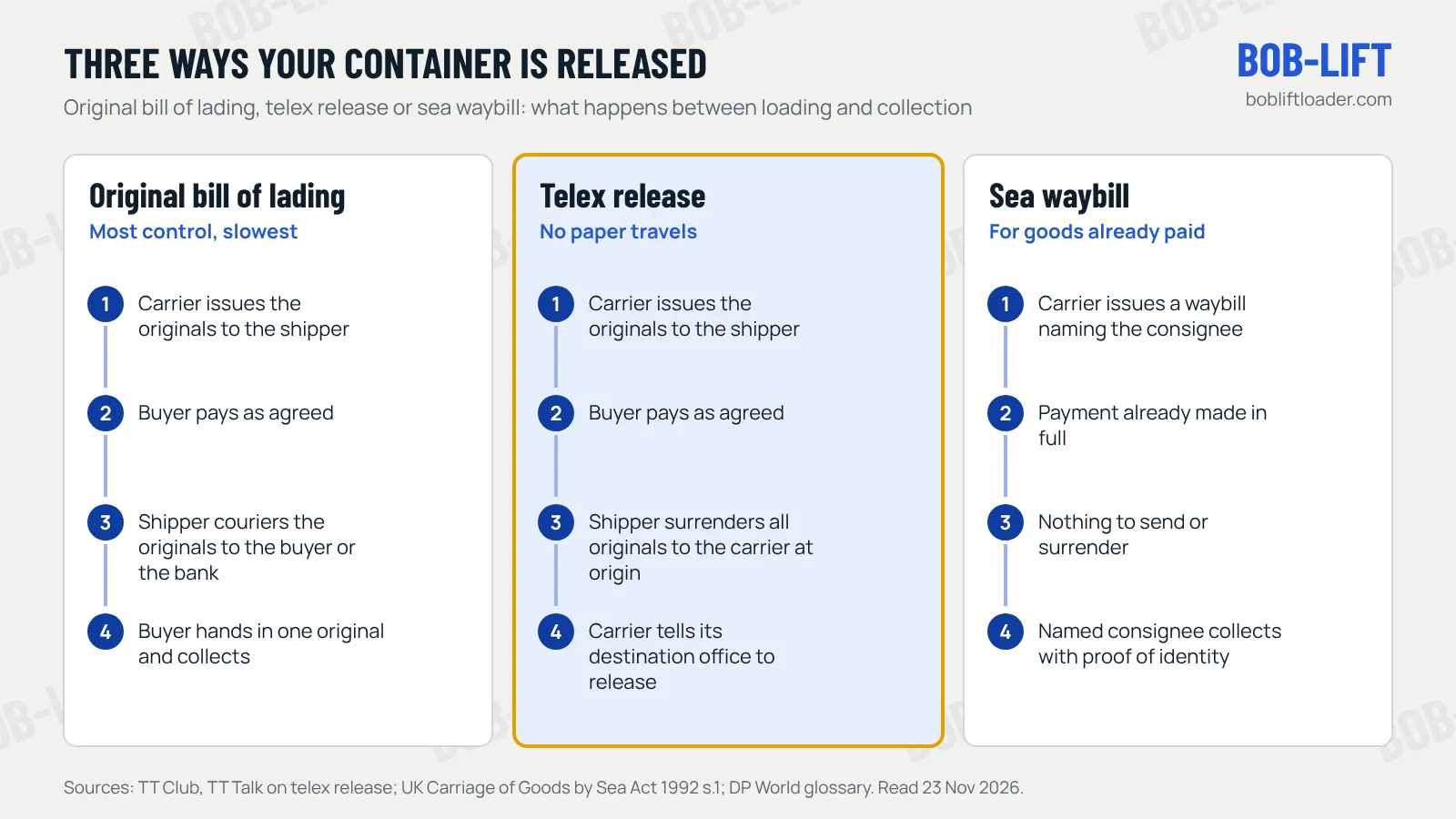
At the port of discharge, the carrier’s local office issues a delivery order only when it is satisfied that the person asking is entitled to the container, which happens in one of three ways.

1. Against an original bill of lading
The carrier issues a set of originals to the shipper. Once the agreed payment is made, the shipper couriers the originals to the buyer, or to the buyer’s bank under a letter of credit or a documentary collection. The buyer, or their broker, hands one original to the carrier’s office at destination and receives a delivery order. This route gives the most control, but the paper has to arrive before the ship does. If it is late, the container waits at the terminal and demurrage charges can build up [7].
2. Telex release
A telex release removes the courier step. TT Club describes the classic case: after receiving payment, the shipper does not post the bill to the consignee but returns all the originals to the carrier, typically at the port of loading. The carrier then tells its office at the place of delivery to release the goods to the consignee named in the shipper’s instructions [6]. The returned originals are stamped “surrendered” or “telex release”, and despite the name, the instruction now travels by email or through the carrier’s own computer system [6].
TT Club also gives the reason the practice exists: some countries do not recognise sea waybills for certain dealings, or sea waybills are not customary in some trades [6]. Telex release keeps a bill of lading on file while avoiding the risks of posting originals.
3. Sea waybill
With a sea waybill there are no originals to surrender. The carrier delivers to the consignee named on the waybill [1] [3]. It suits a shipment that is already paid for in full, where there is no reason for the seller to keep control of the goods during the voyage. TT Club is clear that a telex release “always concerns bills of lading, never sea waybills” [6].
Which document fits your payment terms?
The release method should follow from when the money moves. If you pay before the bill of lading is issued, the seller has no reason to hold an original. If part of the price is still due when the ship sails, the original bill is what secures it.
| How you pay | Document that usually fits | Why |
|---|---|---|
| T/T, full amount before loading | Sea waybill, or a bill of lading released by telex | The seller has been paid, so nothing is left to secure with an original |
| T/T deposit, balance against a copy of the bill of lading | Bill of lading, then telex release or courier of the originals once the balance arrives | The originals stay with the seller until the balance is paid |
| Letter of credit | Order bill of lading, full set of originals, made out as the credit requires | Banks pay against the documents, and the bill of lading is what gives control of the goods |
| Documentary collection | Order bill of lading, originals sent through the banks | Your bank releases the originals when you pay or accept the bill of exchange [9] |
On a T/T order, the balance usually falls either before loading or against a copy of the bill of lading. Our guide to paying a machinery supplier in China by T/T explains both. In the second case, you receive a scan of the issued bill, check it, send the balance, and we then arrange the release. Under a letter of credit, which most banks issue subject to the ICC rules known as UCP 600, the bill of lading is one of the documents the bank examines before it pays [8]. Under UCP 600 sub-article 20(a)(ii), a bill presented under a credit must indicate that the goods have been shipped on board a named vessel at the port of loading stated in the credit [8]. Pre-printed wording can do this, or an on board notation with the date. Trouble starts when the bill shows a place of receipt, such as an inland depot, that differs from the port of loading. The ICC Banking Commission recommendations of 22 April 2010 (Document 470/1128rev) explain when the notation must then name the vessel and the port [8].
How to check a draft bill of lading
Ask to see the draft before the final bill is issued. Corrections are simple at that stage; once originals exist, a change can mean returning and reissuing the whole set. Check these fields against your contract, the commercial invoice and the packing list.
| Field on the draft | What to check |
|---|---|
| Shipper | Our company name as on the commercial invoice |
| Consignee | Your company, “to order”, or a bank, exactly as your contract or credit requires |
| Notify party | The company your carrier or broker will contact on arrival, with a working phone number and email |
| Port of loading and port of discharge | The ports named in the contract and in the trade term, for example FOB with the Chinese port named |
| Vessel, voyage and on board date | Present on a shipped bill of lading; an L/C presentation needs the on board date [8] |
| Container and seal numbers | The same numbers as the packing list and the container photos |
| Description of goods | Model names and quantities that match the commercial invoice, for example “3 units mini dumper FY30” |
| Gross weight and packages | The packing list figures, including racks or frames used for loading |
| Freight | “Prepaid” under CIF or CFR, “collect” under FOB, unless agreed otherwise |
| Number of originals | Printed on the bill; under a telex release every one of them is surrendered [6] |
| Clauses | No remark on the condition of the goods. A bill with such a remark is a claused bill, which a buyer’s bank is entitled to reject [1] |
The description is worth slowing down for. Your customs broker classifies the goods from the invoice and the bill of lading, so a vague line such as “machinery parts” on a container of complete mini dumpers invites questions at the border. Our guide to importing a mini skid steer from China into the US lists the other documents to request before you pay the deposit.
Two remarks on the draft are normal for a sealed container. The carrier cannot inspect the goods, so the description is recorded as the container number “said to contain” the declared cargo, often shortened to STC [1]. What you do not want is a claused bill, one that notes damaged or missing goods: a bank is entitled to reject it, so ask for a clean bill [1].
Example: one 40HQ of mini dumpers paid against a bill of lading copy
This example is illustrative, not a past order. A buyer orders three FY30 mini dumpers on FOB terms with a 30 percent deposit and the balance against a copy of the bill of lading. Three complete FY30 machines fit a 40-foot high-cube container; our mini dumper container packing guide shows how they are loaded.
- The buyer’s forwarder books the ship, and we load and seal the container and deliver it for loading at the Chinese port named in the contract.
- After loading, the carrier issues the bill of lading. It shows our company as shipper and the buyer’s company as consignee. The description reads “3 units mini dumper FY30”, as on the invoice, and the weight is that of three 2,200 kg machines plus packing.
- We email a scan of the issued bill, and the buyer checks it against the draft before paying the 70 percent balance.
- When the balance arrives, we either surrender all originals to the carrier for a telex release or courier the originals to the buyer, as agreed in the contract.
- At the port of discharge, the buyer’s broker obtains the delivery order and clears the machines through customs.
Agree the release method when you sign the contract, not when the ship is already sailing. If you would rather pay the full amount before loading, ask for a sea waybill or a telex release from the start.
Protect the release from email fraud
Because a telex release is now an instruction sent by email or computer system, it can be forged. TT Club quotes the International Transport Intermediaries Club (ITIC) on two failures [6]. One was a carelessly worded release message that a carrier’s agent misread. The other is fraudsters sending emails that appear to come from the carrier, so that the cargo is released to an accomplice. In one case it reports, a shipper cancelled a telex release request, nobody updated the system, and the agent released cargo worth US$250,000 [6]. In Ahmad v Mitsui OSK Lines (Federal Court of Australia, 2005), a carrier’s Sydney office handed out a delivery order without the bill of lading because a colleague had written “telex release” on the freight slip [6].
For a buyer, the practical rules are the same as for any payment instruction. Confirm changes to bank details or release instructions by phone on a number you already hold. Ask the carrier, not the email sender, to confirm that a telex release is on its system before you send a truck. And never pay a balance to an account that appears for the first time in an email about the bill of lading.
Electronic bills of lading
An electronic bill of lading has to do everything the paper version does: act as a receipt, evidence the contract of carriage and work as a document of title [1]. In the UK, the Electronic Trade Documents Act 2023, in force since 20 September 2023, lists bills of lading among the trade documents that can exist in electronic form [10]. Section 1(2) of the Act names 8 examples, from bills of exchange to cargo insurance certificates, alongside the bill of lading [10]. Whether you can use one depends on the carrier, your bank and the law that governs your contract, so ask before you write it into an order.
Frequently asked questions
What is the difference between a bill of lading and a sea waybill?
A negotiable bill of lading is a document of title: the holder of an original can claim the goods. A sea waybill is a receipt and evidence of the contract of carriage that names who the carrier must deliver to, so no original is needed [1] [3].
Can I collect my container without the original bill of lading?
Yes, if the shipper has arranged a telex release or the goods travel under a sea waybill. Otherwise the carrier’s office at destination expects an original [2] [7].
What does “surrendered” on a bill of lading mean?
It means the originals were handed back to the carrier, usually at the port of loading, so that the goods can be released at destination without them under a telex release [6].
Who issues the bill of lading under FOB?
The shipping line, or a forwarder issuing a house bill, that carries the goods. Under FOB the buyer chooses and pays that carrier; the seller still appears as the shipper and receives the bill after loading.
How many originals are there?
The number of originals issued is printed on the bill. For a telex release, every original issued has to be surrendered to the carrier [6].
About these sources
- Wikipedia, Bill of lading.
- US International Trade Administration, Common Export Documents, trade.gov.
- UK Carriage of Goods by Sea Act 1992, section 1, legislation.gov.uk.
- 49 U.S. Code § 80103, Negotiable and nonnegotiable bills, Legal Information Institute, Cornell Law School.
- UK Carriage of Goods by Sea Act 1992, section 2, legislation.gov.uk.
- TT Club, TT Talk: ‘Telex release’ by email. TT Club is a mutual insurer for the transport and logistics industry.
- DP World, What Is a Telex Release?, glossary.
- ICC Banking Commission, Recommendations in respect of the requirements for an On board Notation, Document 470/1128rev final, 22 April 2010.
- US International Trade Administration, Documentary Collections, trade.gov.
- UK Electronic Trade Documents Act 2023, section 1, legislation.gov.uk.
All sources were read on 23 November 2026. Container loading figures come from our own packing records. This guide is general information, not legal advice; for a specific shipment, follow your carrier’s terms and your contract. Read more about us and our factory.
Plan your shipment with us
Tell us the models and quantity, your destination port, the trade term and how you plan to pay. We will agree the release method with you before loading, so the bill of lading matches the way you pay. Send us your enquiry.