


To import a mini skid steer from China into the United States, you need four things in place before the machine leaves the factory. First, the engine must be covered by a valid EPA certificate of conformity and carry an English EPA label. Second, you need a named importer of record with a customs bond. Third, an Importer Security Filing must be lodged at least 24 hours before the container is loaded onto the ship. Fourth, a customs broker should be ready to file the entry and the EPA declaration, Form 3520-21. Get those right and the rest is routine paperwork.
We build mini skid steers at our own factory in Xuzhou, China, and ship them by container to dealers, rental fleets and contractors. This guide follows the import in the order the work happens. It quotes the official US rules at each step and lists the documents to ask any Chinese factory for before you pay a deposit. It is a buyer’s checklist, not legal advice, so confirm the final details with your own licensed customs broker.
Key takeaways
- EPA rules come first. Engines or equipment you import “must be covered by a certificate of conformity”. If they are not, US Customs and Border Protection may stop the import [3].
- Ask the factory for the engine’s EPA certificate and a photo of its English EPA label. Do it before you order, not after the container sails.
- The importer files EPA Form 3520-21 with customs for nonroad engines, including engines built into a loader. Keep it for five years [2].
- For sea freight, the Importer Security Filing is due 24 hours before the cargo is loaded onto the ship in China [4].
- Any wood packaging must be treated and carry the ISPM 15 mark, or the shipment can be refused entry [5]. Our loaders ship on steel loading racks.
- The cost of skipping Step 2 is high: the Clean Air Act (42 U.S.C. 7524) allows civil penalties of up to $55,808 per engine, and EPA can also claim the bond under 40 CFR 1068.335.
- Duties and the tariff classification are your broker’s job to confirm on the day you order, because rates on goods from China change.
What does importing a mini skid steer from China involve?
Importing a mini skid steer from China is the process of buying a compact loader from a Chinese factory and bringing it through US customs as its legal importer. That means meeting three sets of rules: EPA emission rules for the engine, US Customs and Border Protection (CBP) rules for filing and bonds, and plant health rules for any wood packaging. A mini skid steer is a small loader rated for a few hundred kilograms. It turns by running its left and right tracks or wheels at different speeds.
The person or company that carries the legal duty is the importer of record. US customs rules describe the importer of record as “the entity liable for payment of all duties and responsible for meeting all statutory and regulatory requirements” for the goods [4]. If that is you, the EPA declaration, the security filing and the duty bill are yours. The factory and your broker still do much of the work.
Still deciding whether a Chinese loader suits you? Start with our guide to checking a Chinese mini skid steer before you buy. This article assumes you have chosen a machine and now need to get it home.
Step 1: Agree who the importer of record will be
The trade term in your contract decides who handles each stage. We quote on FOB, CIF, EXW, DDP, FCA or DAP terms. Under FOB and CIF terms, the factory delivers the goods onto the ship in China. The buyer, usually working with a customs broker, is then the importer of record in the US. Under DDP, the seller takes on delivery to your door including import clearance, so the seller or its agent acts for the import instead.
Whichever term you choose, write down three names before you pay. Who is the importer of record? Which licensed broker files the entry and the EPA declaration? Who files the Importer Security Filing? Confusion over these three is the most common reason a first container sits at the port.
First-time importers also need a customs bond. Under 19 CFR 149.5(b), the ISF importer “must possess a basic importation and entry bond” with the provisions of 19 CFR 113.62 [4]. Your broker can arrange a single-entry bond for one shipment or a continuous bond if you will import regularly.
Step 2: Confirm the engine is EPA certified before you pay
The engine decides whether the loader can enter the country at all. The US Environmental Protection Agency says the Clean Air Act “prohibits importation into the United States” of nonroad engines and equipment “that does not conform to the EPA emission standards and requirements” [1].
The import rules in 40 CFR 1068.301 apply to anyone who imports engines or equipment subject to EPA emission standards. Paragraph (b) says the engines or equipment you import “must be covered by a certificate of conformity”. Under paragraph (c), if you do not meet the requirements, CBP “may prevent you from importing engines or equipment” [3].
In practice, ask the factory for these items for the exact engine on your quotation:
- The EPA certificate of conformity for the engine family, issued to the engine maker.
- A clear photo of the EPA emission control label, in English, on an engine of the same model. Form 3520-21 describes the standard case as an engine “covered by a valid EPA certificate of conformity” and “bearing an EPA emission control label in English” [2].
- The engine model and output on the quotation, matching the certificate, not “brand engine”.
Do not ship a machine and hope to sort the paperwork out later. For a nonconforming engine, EPA says importers must act before shipping. They either arrange certification through an Independent Commercial Importer or get EPA pre-approval for an exemption. Without one, CBP “can seize and/or export any goods” [1].
Fuel type matters too. Form 3520-21 lists diesel engines under category D, “Other nonroad compression-ignition engines”, regulated by 40 CFR Part 1039 and Part 1068. Small petrol (gasoline) engines fall under category G, “Other nonroad spark-ignition engines at or below 19 kW” [2]. Gasoline machines also face fuel-system emission rules, which our Chinese mini skid steer checklist covers along with California’s separate engine certification. Our diesel vs gas mini skid steer guide shows which of our nine loaders take each fuel.
Our loaders are built with engines certified to EPA Tier 4 and EU Stage V. We do not publish the certificates on our website, but we send the certificate for the engine brand you choose, with a label photo, before you place the order.
Step 3: Prepare EPA Form 3520-21
EPA Form 3520-21 is the declaration an importer gives customs for each imported nonroad engine, “including engines incorporated into vehicles or equipment” [2]. A mini skid steer is nonroad equipment with an engine built in, so the form applies to it.
Four points from the form and the regulation are worth knowing before your broker asks you for the details:
- Who files. The form “must be submitted to the U.S. Customs and Border Protection (Customs) by the importer”. It is not needed for new products covered by a certificate and bearing an EPA label “if the original manufacturer is the importer” [2]. When a dealer or contractor imports from a factory, that exception usually does not apply, so plan to file it and let your broker confirm.
- Which declaration. For a new loader with a certified, labeled engine, the relevant declaration is code 1: a “U.S. certified engine or engine installed in a certified vehicle, covered by a valid EPA certificate of conformity” and “bearing an EPA emission control label in English” [2].
- When. Paragraph (d) of 40 CFR 1068.301 says to “complete the appropriate EPA declaration before importing any engines or equipment” [3]. EPA also publishes guidance on filing the declaration electronically through CBP’s Automated Commercial Environment (ACE) [6].
- Records. The form “must be retained for five years from the date of entry” under 19 CFR 163.4, and the regulation says importers must make these records “available promptly upon request” [3].
The penalties explain why this step deserves care. The form states that anyone who illegally imports an engine “may be fined up to $55,808 per engine” under 42 U.S.C. 7524, and may also forfeit the importation bond under 40 CFR 1068.335 [2]. On a container of twenty loaders, a paperwork gap is not a small risk.
Step 4: Book the shipment and file the ISF on time
For goods arriving by ship, US customs requires an Importer Security Filing, often called “10+2”. The ISF importer is “the party causing goods to arrive” at a US port by vessel. In practice, that is “the goods’ owner, purchaser, consignee, or agent such as a licensed customs broker” [4].
Under 19 CFR 149.2(b), most of the data must reach CBP “no later than 24 hours before the cargo is laden aboard the vessel at the foreign port” [4]. That deadline falls while the container is still in China, so your broker needs details from the factory several days before the ship sails. The ten elements listed in 19 CFR 149.3(a) are:
- (1) Seller and (2) Buyer
- (3) Importer of record number
- (4) Consignee number
- (5) Manufacturer or supplier, meaning the entity that “last manufactures, assembles, produces, or grows the commodity”
- (6) Ship-to party
- (7) Country of origin
- (8) Commodity HTSUS number, to at least 6 digits and up to 10
- (9) Container stuffing location and (10) Consolidator, which are due no later than 24 hours before arrival in a US port
Plan the container at the same time, because the container count goes into the freight quote and the ISF. The table below shows our factory figures for all nine loaders.
| Model | Type | 20GP | 40HQ on racks |
|---|---|---|---|
| BL-T360-H | Tracked, stand-on | 6 | 30 |
| BL-T460-H | Tracked, stand-on | 6 | 24 |
| BL-S390-C | Wheeled, seated | 6 | 22 |
| BL-T390-C | Tracked, seated | 6 | 22 |
| BL-S490-C | Wheeled, seated | 6 | 22 |
| BL-T490-C | Tracked, seated | 6 | 22 |
| BL-S750-H | Wheeled, stand-on | 6 | 22 |
| BL-T750-H | Tracked, stand-on | 6 | 22 |
| BL-T1000-H | Tracked, stand-on | 4 | 10 |
Our guide to how many mini skid steers fit in a container gives the figure for every model, which you need for the freight quote and the ISF.
Step 5: Check the packing for ISPM 15
US plant health rules apply to the packing, not only the machine. The Animal and Plant Health Inspection Service (APHIS) sets the rule. Importers must ensure all wood packaging material (WPM) is “pest-free, debarked,” and “heat-treated or fumigated, and marked with an ISPM 15 logo” [5].
The mark must show 4 things: the IPPC logo, a two-letter country code (CN for China), a unique facility number and the treatment type, HT for Heat Treatment or MB for Methyl Bromide. APHIS is blunt: “Shipments containing noncompliant WPM will not be allowed to enter the country.” Inspectors can order the wood destroyed or the shipment sent back [5].
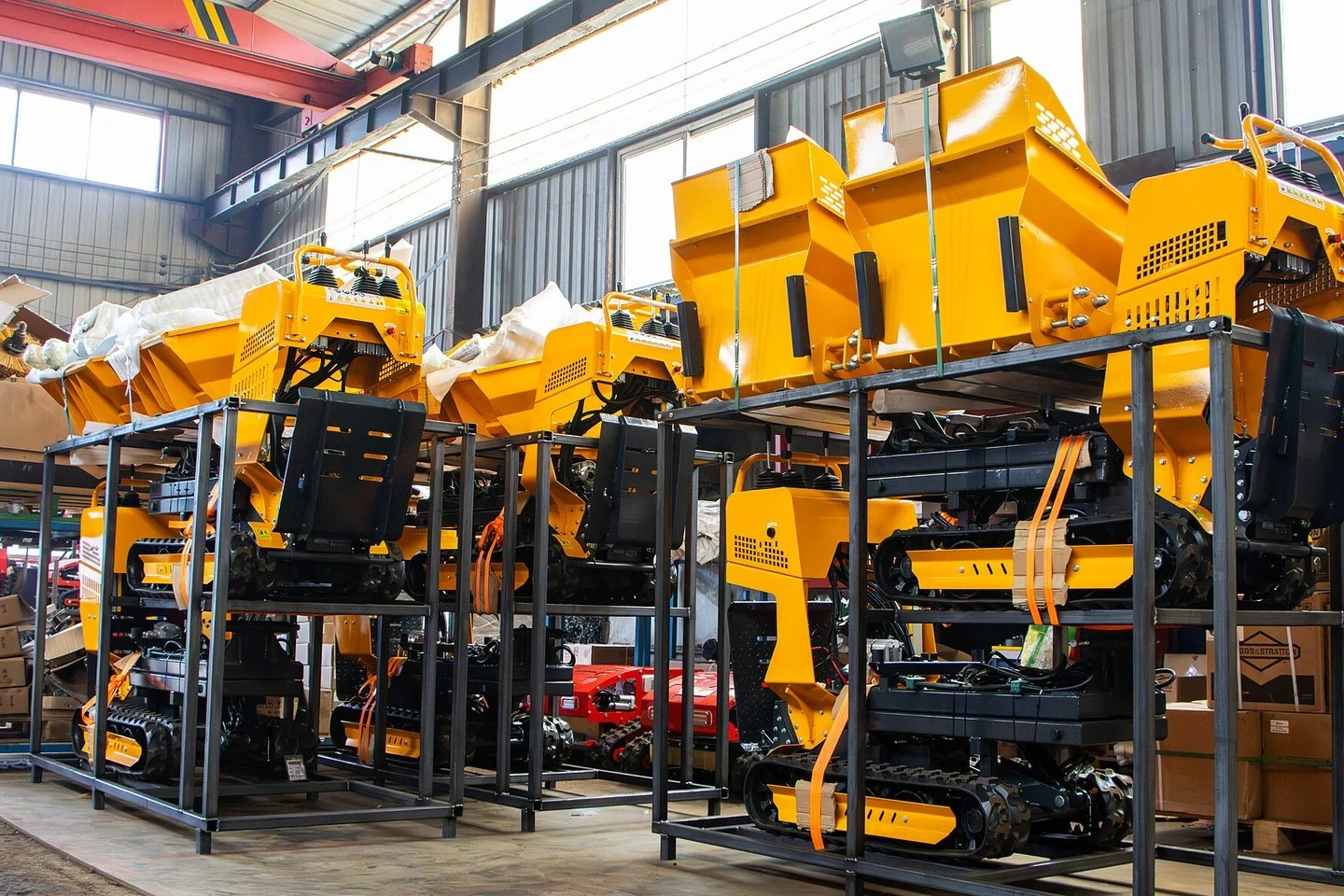
Ask the factory how the machines will be secured in the container. Ours are strapped on steel loading racks, which carry a second tier in a 40HQ. If any wooden blocks, skids or crates are added for attachments or spare parts, ask for photos of the ISPM 15 mark on them before loading.
Step 6: Customs entry, classification and duties
When the ship arrives, your broker files the customs entry, submits the EPA declaration and pays the duties on behalf of the importer of record. Two parts of this are worth discussing with the broker before you order rather than after.
Classification. Every import is declared under a Harmonized Tariff Schedule (HTSUS) number, which sets the duty rate and must appear in the ISF to at least six digits. Choosing the exact ten-digit number for your loader and each attachment is the broker’s call, so give the broker the specification sheet early.
Duty rates. Rates on goods from China, including any additional duties, can change at short notice. Ask your broker for the current total rate on the day you finalize the order, and build it into your landed cost. We do not publish prices, and the landed cost depends on your trade term, freight, duties and the attachments you choose.
Attachments in the same container, for example pallet forks or an auger, are separate lines on the commercial invoice. They may have their own classification. Listing each one clearly with its quantity saves questions at entry.
Documents to ask the factory for
Ask for these before you pay the deposit, and check that every model, engine and serial number matches across them. A supplier that cannot produce them before the sale is unlikely to produce them after.
| Document | Why you need it | When |
|---|---|---|
| EPA certificate of conformity for the engine family | Proves the engine is certified; supports Form 3520-21, code 1 | Before the order |
| Photo of the English EPA emission label | Shows the label your engine will carry | Before the order, then on your own machine before packing |
| Specification sheet and quotation naming the engine model | Lets the broker classify the goods and matches the certificate | Before the order |
| Commercial invoice | Values each machine and attachment for the entry | Before shipping |
| Packing list with machine and engine serial numbers | Matches each engine to its paperwork | Before shipping |
| ISF data: manufacturer, stuffing location, consolidator | Needed for the Importer Security Filing | At least several days before loading |
| Bill of lading | Releases the container to you at the US port | After the ship sails |
| ISPM 15 mark photos, if any wood is used | Avoids refusal of the shipment | At loading |
| Operator’s manual and parts list | Safe operation and future parts orders | With the machine |
When each step happens
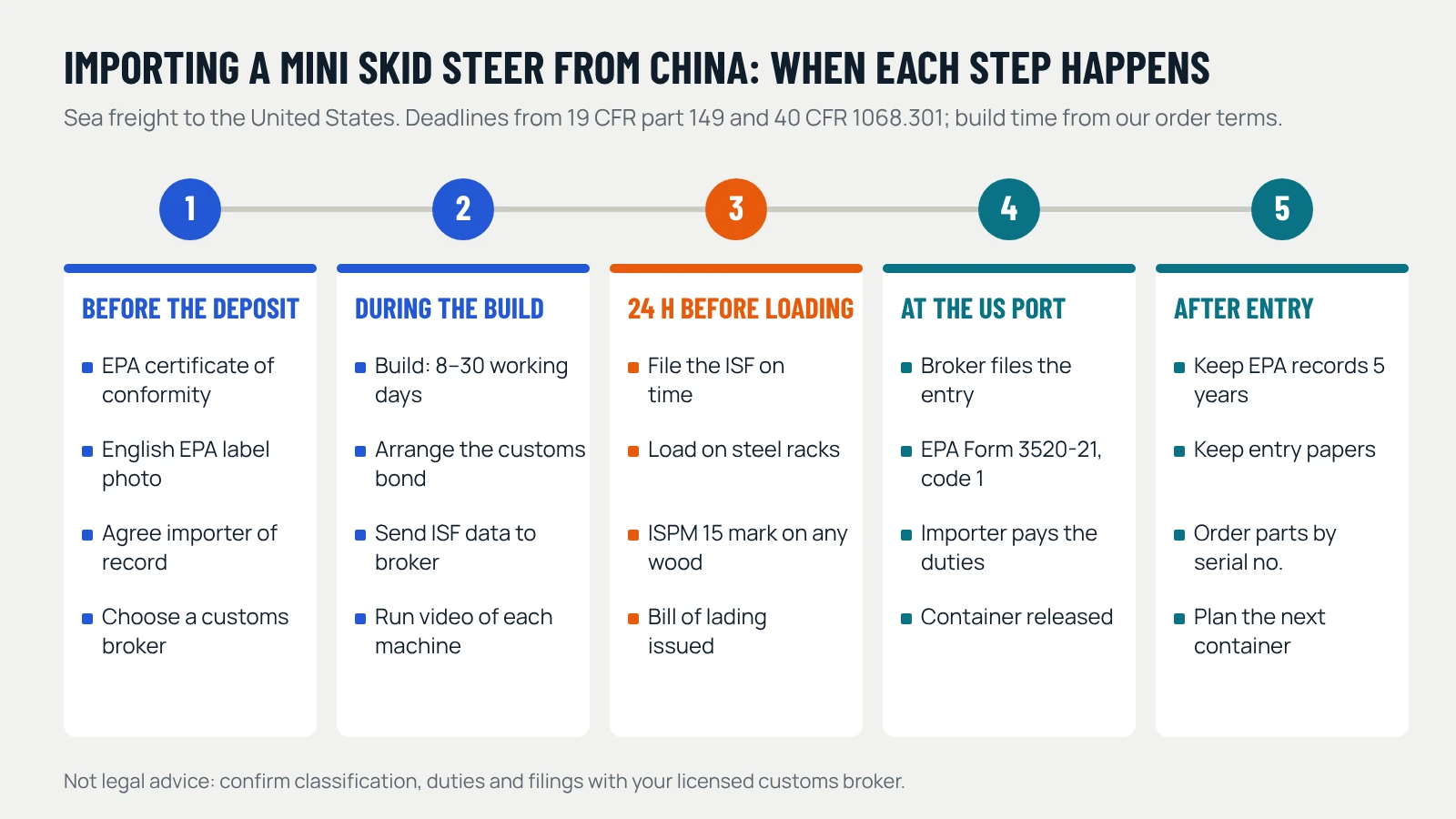
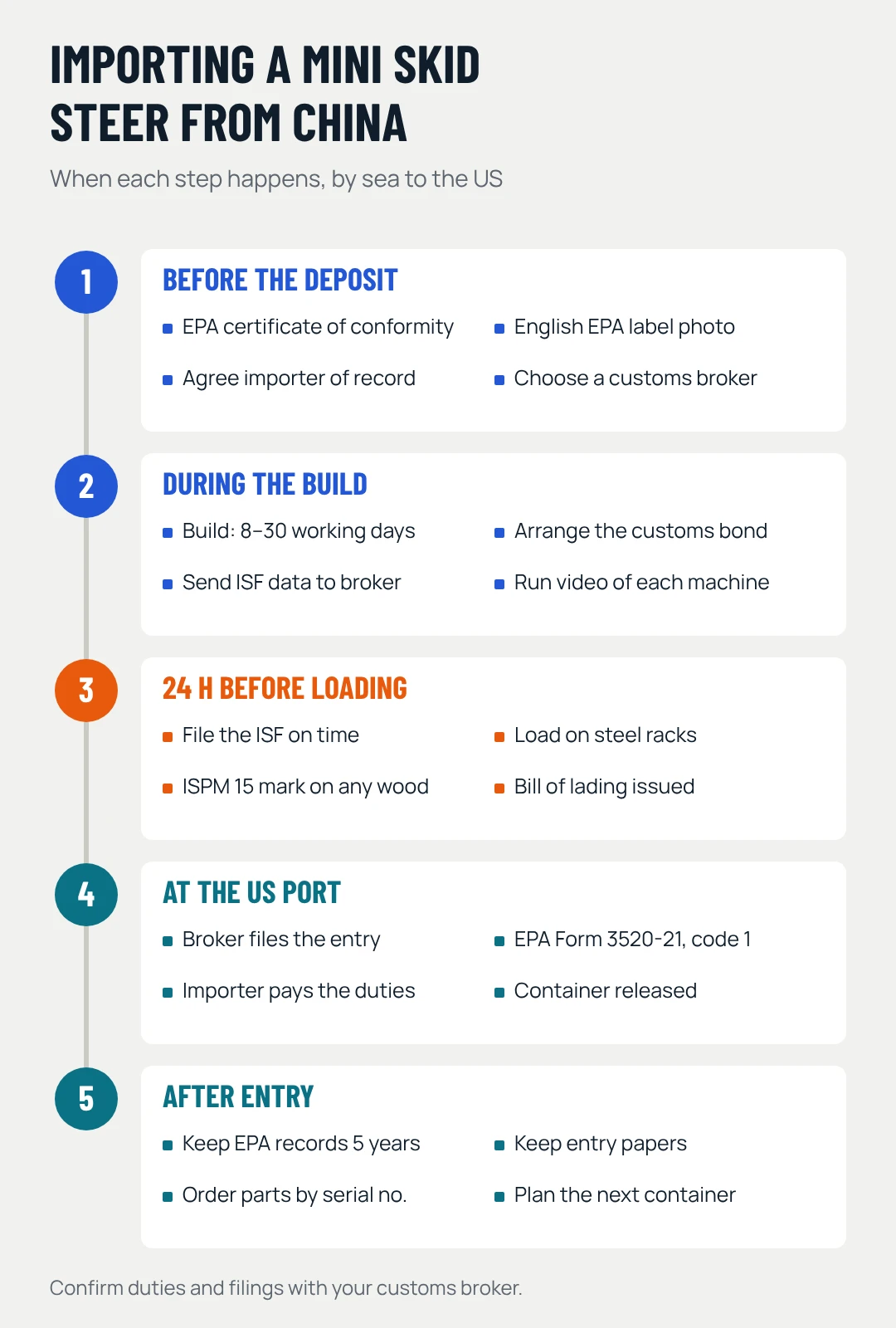
Most delays come from doing a step too late, so it helps to see the order. The chart below sets out the sequence from the quotation to the five-year record-keeping period, with the regulation behind each deadline.
Example scenario: a first container for a Texas dealer
Example scenario (an illustration, not a customer record). A small equipment dealer in Texas wants six BL-T390-C tracked seated loaders for its rental fleet, shipped FOB from China, so the dealer will be the importer of record.
- Before the deposit. The dealer chooses the engine brand for the BL-T390-C and receives the EPA certificate and a label photo. It sends both to its customs broker, who confirms the classification and the current duty rate.
- During the build. While the six machines are built, the broker arranges a single-entry bond and collects the seller, manufacturer and stuffing-location details for the ISF.
- Before loading. All six fit in one 20GP container. The broker files the ISF at least 24 hours before loading. The factory sends a running video of each machine with its serial number in shot.
- At the US port. The broker files the entry and Form 3520-21 under code 1, the dealer pays the duties, and the container is released against the bill of lading.
- Afterwards. The dealer keeps the declaration and supporting records for five years and orders a starter set of filters with the next shipment.
A dealer planning a fleet should also think about moving the machines once they land. Our mini skid steer trailer guide lists the loaded weight of each model, and our mini skid steer parts guide suggests what a first spares kit should hold.
Frequently asked questions
Can I import a mini skid steer from China into the US?
Yes, if the engine meets EPA rules. The engine must be covered by a valid EPA certificate of conformity and carry an English EPA emission label, and the importer files EPA Form 3520-21 with the customs entry. Shipments by sea also need an Importer Security Filing and a customs bond.
What is EPA Form 3520-21 used for?
It is the importer’s declaration to US customs that an imported nonroad engine meets EPA requirements or qualifies for an exemption. That includes an engine built into a loader. A new loader with a certified, labeled engine is normally declared under code 1. The importer keeps the form for five years.
Do I need a customs broker?
The ISF rules let the owner or purchaser file. Even so, most first-time importers use a licensed customs broker. The broker files the ISF, the entry and the EPA declaration electronically, and advises on duties.
What happens if the engine is not EPA certified?
EPA says nonconforming engines must be handled through an Independent Commercial Importer or an approved exemption before shipping. Without one, CBP can seize or export the goods, and fines apply per engine. Check the certificate before you order.
How long does it take to get a loader from your factory?
Our mini skid steers are usually ready to ship 8 to 30 working days after the order, depending on the model, quantity and configuration. Sea transit and customs clearance come on top, and your forwarder can quote the transit time for your port.
About these sources
We compiled the import rules in this guide from the official texts and quote them directly. The sources are EPA’s page on importing vehicles and engines, EPA Form 3520-21 (August 2024 edition), EPA’s publications page, 40 CFR 1068.301 and 19 CFR part 149, and the APHIS page on wood packaging. We read all of them on 2 November 2026. Machine figures, container counts, build times and trade terms come from our own specification sheets and support page. You can read more about our company and factory. Rules and duty rates change, so confirm the current position with your customs broker before you order.
Plan your first import with us
Tell us which loader you are considering, how many units, your nearest US port and the trade term you prefer. We will reply with the specification sheet, the EPA certificate and label photo for your chosen engine, the container plan and the documents your broker will need. You can compare our nine mini skid steer loaders first, or send us your import questions.