


Pair a 1.5 to 2 tonne mini digger with a 1 to 1.5 tonne dumper, a 3 tonne digger with a 1.5 to 2 tonne dumper, and a 5 to 6 tonne digger with a 3 tonne dumper or larger. With a middle-size bucket, those pairings fill the dumper in about 8 to 18 passes. A much smaller dumper leaves the digger waiting between loads; a much larger one takes 30 or more passes to fill.
This guide is written for contractors, groundworkers and plant hire companies choosing a digger and dumper combination. We manufacture mini dumpers, not excavators, so the excavator figures come from a published manufacturer’s range [3] and the dumper specifications from our own product pages; the calculation itself applies to any make. Our full mini dumper range covers rated loads from 500 kg to 5 tonnes.
Key takeaways
- Match the dumper to the digger’s bucket, not its weight. Divide the dumper’s load per trip by the bucket size to get the number of passes.
- Load per trip is the smaller of two limits: the hopper volume, or the rated load divided by the density of the material.
- Aim for roughly 5 to 20 passes with mini plant. The four-to-six-pass rule from large earthmoving is a starting point, and research shows it undervalues small loaders filling bigger haulers [4].
- Count dumpers as well as size them. The number of dumpers needed is approximately the dumper’s round-trip time divided by its loading time.
- The dumper driver gets off while the digger loads, and the load stops at the top edge of the hopper [2].
How to match a dumper to a digger
Three specifications determine the pairing: the excavator’s bucket capacity, the dumper’s hopper volume and the dumper’s rated load. Bucket and hopper capacities are volumes, whereas rated load is a weight, so the density of the excavated material is what connects them.
- Find the digger’s bucket capacity on its specification sheet, in cubic metres or litres (1,000 L = 1 m³).
- Work out the dumper’s load per trip. Divide the rated load by the material density. If the answer is bigger than the hopper volume, the hopper fills first; if it is smaller, the rated load is reached first.
- Divide the load per trip by the bucket size and round up. A partly filled last bucket takes about as long as a full one [4], so it counts as a whole pass.
- Allow for buckets that come up short. Our sums assume each bucket is filled to its rated capacity. The Alberta study below used fill factors of 80% for light topsoil and 95% for subsoil [4]; if your buckets come up short, divide the pass count by your own fill factor.
Passes = load per trip ÷ bucket capacity, where load per trip = the smaller of hopper volume and (rated load ÷ density).
Our calculations use two materials listed by Engineering ToolBox [5]: loose moist dirt at 1,250 kg/m³ for ordinary excavation, and wet clay at 1,760 kg/m³ for the heavy case. Struck capacity is the volume of a hopper or bucket filled level with its top edge, without a heaped load above it; every hopper capacity we publish is a struck figure.
Mini digger bucket sizes by class
Bucket capacities vary by manufacturer and by bucket type, so always check the figure for your own machine. As a published reference, Volvo’s compact excavator range lists the bucket capacities below for each operating weight class [3], and we use the middle of each range in the calculations that follow.
| Digger class | Example models in Volvo’s range | Operating weight (kg) | Bucket sizes offered (m³) | Middle of the range (m³) |
|---|---|---|---|---|
| 1.5 to 2 t | EC15E / EC18E / EC20E | 1,556 to 1,965 | 0.014 to 0.078 | 0.046 |
| 2.5 to 3 t | EC27D / ECR25D | 2,400 to 2,960 | 0.034 to 0.119 | 0.076 |
| 3.5 to 4 t | EC35D / ECR35D / ECR40D | 3,385 to 4,460 | 0.052 to 0.15 | 0.101 |
| 5 to 7 t | ECR50 / ECR58 / EC60E | 5,050 to 6,800 | 0.07 to 0.265 | 0.168 |
| 8 to 10 t | ECR88D | 8,810 to 9,714 | 0.079 to 0.333 | 0.206 |
The ranges are wide because each excavator accepts both narrow trenching buckets and wide general-purpose buckets. On Volvo’s 1.8 tonne EC18E, the smallest listed bucket needs more than three times as many passes as the largest, so if you excavate footings with a narrow bucket all day, use that capacity in the calculation.
How much each of our dumpers carries per trip
The table applies the load-per-trip rule to every dumper we manufacture. With moist soil, the hopper fills before the rated load is reached on every model except the FC10, where a full hopper of soil weighs exactly its 1,000 kg rating. With wet clay, the FC10 and FY20-4 reach their rated load before the hopper is completely full.
| Dumper | Rated load | Hopper (struck) | Moist soil, 1,250 kg/m³ | Wet clay, 1,760 kg/m³ | Width |
|---|---|---|---|---|---|
| BL-T500-HD | 500 kg | 0.2 m³ | 0.20 m³ (250 kg) | 0.20 m³ (352 kg) | 880 mm |
| FC10 | 1,000 kg | 0.8 m³ | 0.80 m³ (1,000 kg) | 0.57 m³ (1,000 kg) | 1,500 mm |
| FY15 | 1,500 kg | 0.8 m³ | 0.80 m³ (1,000 kg) | 0.80 m³ (1,408 kg) | 1,500 mm |
| FY20-2 | 2,000 kg | 1.0 m³ | 1.00 m³ (1,250 kg) | 1.00 m³ (1,760 kg) | 1,600 mm |
| FY20-4 | 2,000 kg | 1.2 m³ | 1.20 m³ (1,500 kg) | 1.14 m³ (2,000 kg) | 1,700 mm |
| FY30 | 3,000 kg | 1.5 m³ | 1.50 m³ (1,875 kg) | 1.50 m³ (2,640 kg) | 1,700 mm |
| FY40 | 4,000 kg | 1.5 m³ | 1.50 m³ (1,875 kg) | 1.50 m³ (2,640 kg) | 1,700 mm |
| FY50 | 5,000 kg | 1.5 m³ | 1.50 m³ (1,875 kg) | 1.50 m³ (2,640 kg) | 1,800 mm |
Ratings and hopper volumes come from our product pages on 21 November 2026. The FY30, FY40 and FY50 share the same hopper, so with soil they carry an identical volume; their higher ratings become relevant with wet gravel, crushed stone and other dense materials. Our site dumper sizes guide sets out that trade-off model by model.
How many bucket passes fill each dumper?
Dividing each load by the middle bucket capacity for each excavator class produces the matrix below. A bucket pass is one complete dig, swing and tip cycle of the excavator into the dumper. Read across a row to see how one dumper suits different excavators, or down a column to compare dumpers for a single excavator.
| Dumper | 1.5 to 2 t digger, 0.046 m³ bucket | 2.5 to 3 t digger, 0.076 m³ bucket | 3.5 to 4 t digger, 0.101 m³ bucket | 5 to 7 t digger, 0.168 m³ bucket | 8 to 10 t digger, 0.206 m³ bucket |
|---|---|---|---|---|---|
| BL-T500-HD | 5 | 3 | 2 | 2 | 1 |
| FC10 | 18 | 11 | 8 | 5 | 4 |
| FY15 | 18 | 11 | 8 | 5 | 4 |
| FY20-2 | 22 | 14 | 10 | 6 | 5 |
| FY20-4 | 27 | 16 | 12 | 8 | 6 |
| FY30 | 33 | 20 | 15 | 9 | 8 |
| FY40 | 33 | 20 | 15 | 9 | 8 |
| FY50 | 33 | 20 | 15 | 9 | 8 |
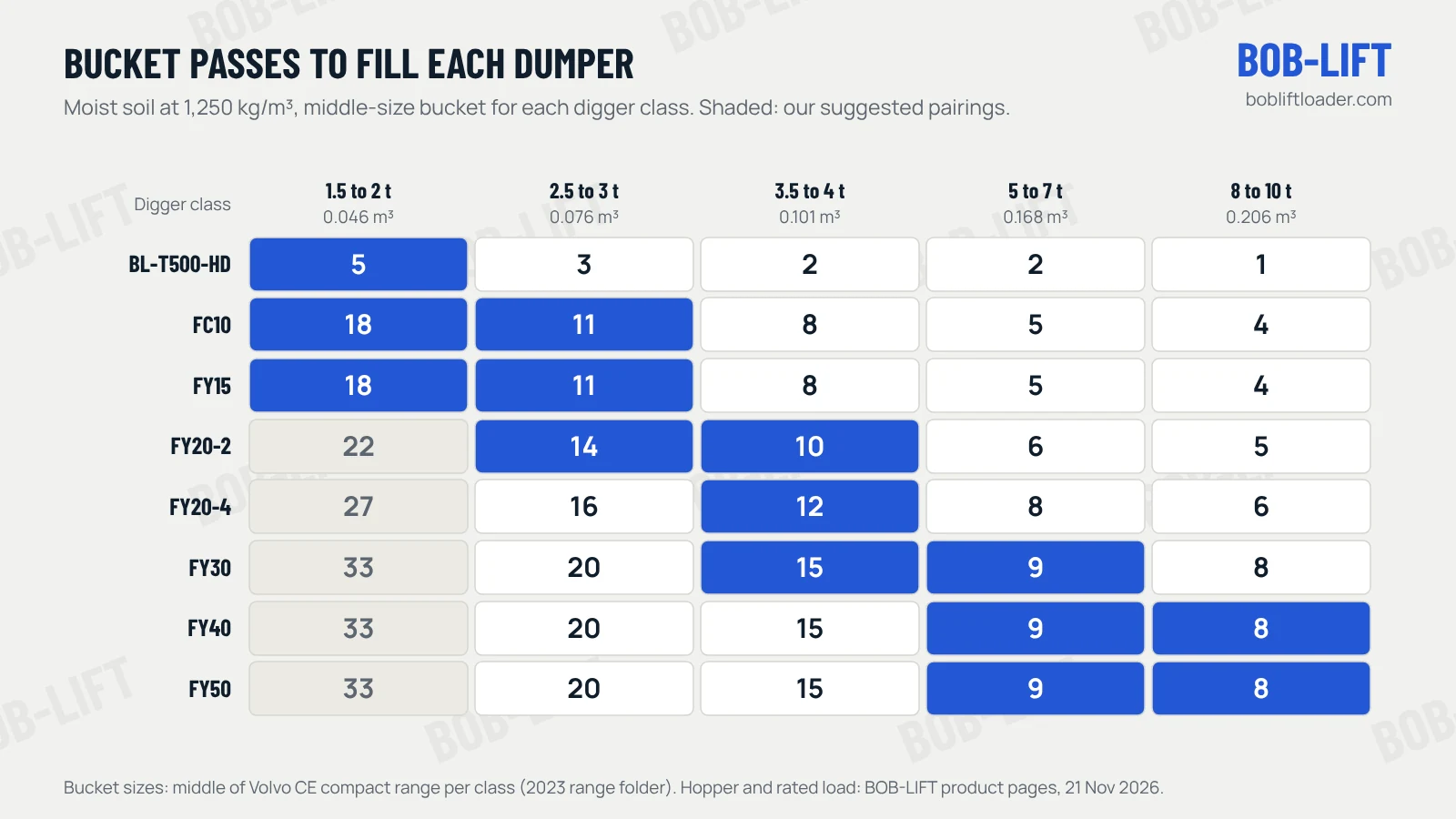
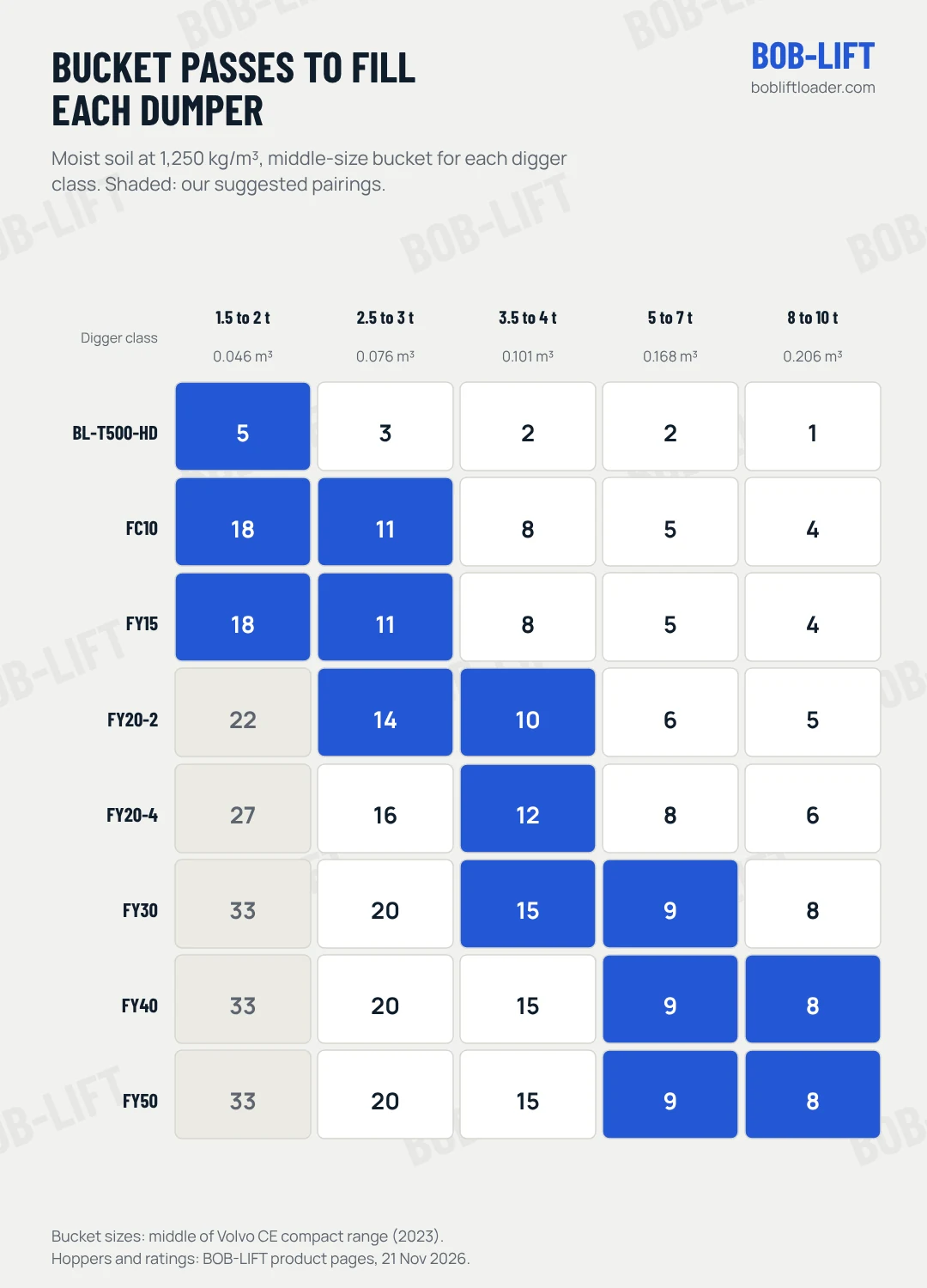
Two patterns are worth noting: a small excavator needs 33 passes to fill a 3 tonne dumper, which means slow loading for a machine designed to carry considerably more. At the other extreme, an 8 tonne excavator fills our BL-T500-HD in a single pass, so almost the entire cycle consists of the dumper travelling.
The four-to-six-pass rule and mini plant
Large earthmoving operations often select haul trucks so that the excavator fills each one in four to six passes. Researchers at the University of Alberta tested that rule by simulating mining-size excavators and haul trucks. They concluded that it “seriously underestimates the efficiency of using smaller excavators with larger trucks”: pairings that needed far more than six passes still gave a lower direct cost per unit moved [4].
Their machines were considerably larger than ours, so the study provides a direction rather than specific numbers for compact equipment. With our wheeled dumpers, most practical pairings fall between 5 and 20 passes. A higher count is acceptable on a long haul, because the dumper spends most of its cycle travelling anyway, whereas a low count of 1 to 3 passes suits only short hauls, since otherwise the excavator stands idle waiting for the next dumper.
Our suggested digger and dumper pairings
The table is our starting recommendation, based on the pass counts above, typical haul distances on small construction sites and the available access width. Other combinations can work, and the following section explains how to check the figures for your own site.
| Digger class | Dumpers we would pair with it | Bucket passes, moist soil (middle-size bucket) |
|---|---|---|
| 1.5 to 2 t | BL-T500-HD, FC10, FY15 | BL-T500-HD 5, FC10 18, FY15 18 |
| 2.5 to 3 t | FC10, FY15, FY20-2 | FC10 11, FY15 11, FY20-2 14 |
| 3.5 to 4 t | FY20-2, FY20-4, FY30 | FY20-2 10, FY20-4 12, FY30 15 |
| 5 to 7 t | FY30, FY40, FY50 | FY30 9, FY40 9, FY50 9 |
| 8 to 10 t | FY40, FY50 | FY40 8, FY50 8 |
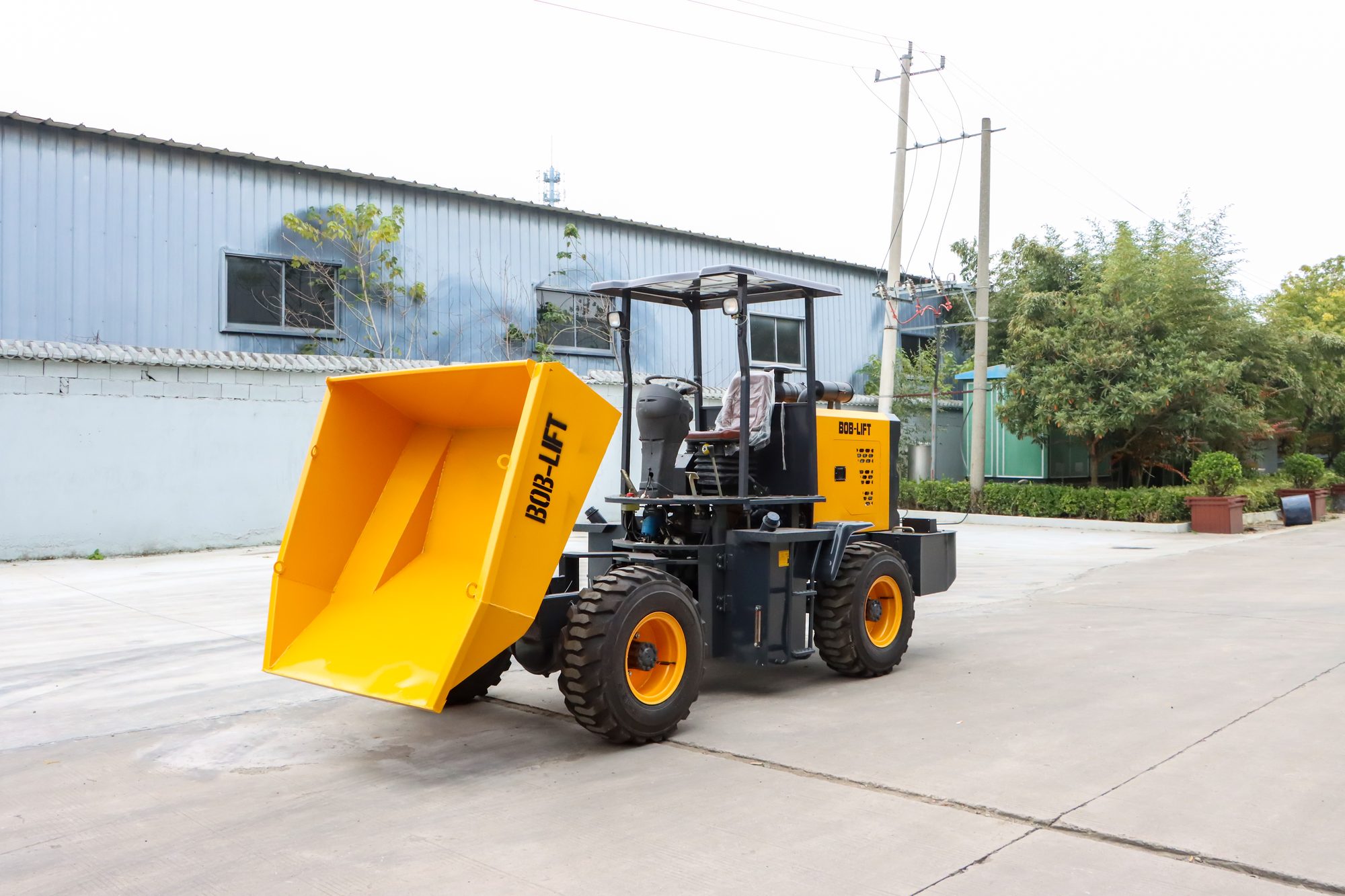
- 1.5 to 2 tonne diggers typically work behind houses and in gardens. The BL-T500-HD, at 880 mm wide, follows the excavator through a garden gate, while the FC10 and FY15, at 1,500 mm wide, need a wider opening but carry four times the volume, and our dumper dimensions guide lists every width and height.
- 2.5 to 3 tonne diggers fill the FC10 or FY15 in about 11 passes with a middle-size bucket. Choose the FY20-2 if the haul is long enough to make a larger load worthwhile.
- 3.5 to 4 tonne diggers suit the FY20-4 and FY30: 12 to 15 passes, with four-wheel drive for soft ground on foundation and drainage projects.
- 5 to 7 tonne diggers fill our largest hopper in about 9 passes. The FY40 and FY50 retain the same hopper but add rated load for wet gravel and broken concrete.
- 8 to 10 tonne diggers fill our largest hopper in about 8 passes with a middle-size bucket. That is the upper limit of our range, and for a larger excavator a bigger site dumper would waste less excavator time.
How many dumpers does one digger need?
Dumper size is only half of the answer; the other half is the number of dumpers, which depends on the distance each one travels. Divide the dumper’s round-trip time by its loading time to estimate how many dumpers one excavator can keep busy [4]. In the table below, match factor is the number of dumpers multiplied by the loading time, divided by the dumper’s round-trip time: below 1, the excavator waits for dumpers, and above 1, dumpers queue at the excavator.
The worked example below uses a 3 tonne excavator, a mid-size bucket and an FY15 on a 150 m haul. The pass time, travel speed and tipping time are illustrative assumptions, so time several loads on your own site with a stopwatch before relying on the result.
| Step | Figure | How we got it |
|---|---|---|
| Bucket passes to fill an FY15 with moist soil | 10 | 0.8 m³ ÷ 0.08 m³ bucket |
| Digger time per pass | 20 s | Example figure: time your own digger |
| Loading time per dumper | 200 s | 10 passes × 20 s |
| Haul 150 m out and 150 m back at 8 km/h | 135 s | Example route and average site speed |
| Tip, turn and position | 60 s | Example figure |
| Dumper round trip | 395 s | Loading + haul + tip |
| Dumpers working with one digger | Match factor | Digger busy | Soil moved per hour |
|---|---|---|---|
| 1 | 0.51 | 51% | 7.3 m³ |
| 2 | 1.01 | 100% | 14.4 m³ |
| 3 | 1.52 | 100% | 14.4 m³ |
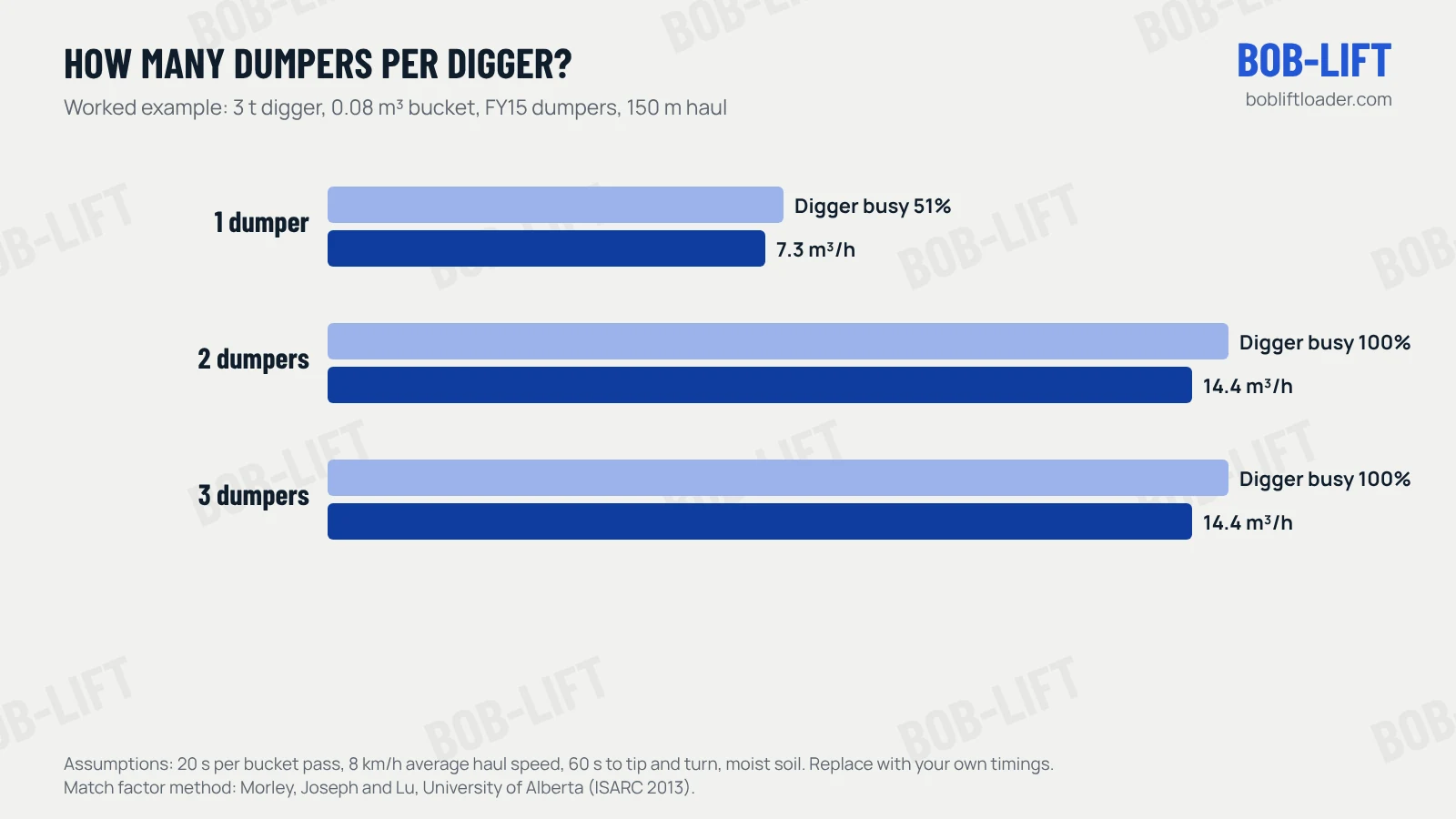

With one dumper, the excavator stands idle for about half of each cycle. A second dumper doubles the output, and a third adds nothing because the excavator has become the limiting machine. On a shorter haul of 50 m, a single dumper almost keeps pace; on a longer haul of 300 m, a third dumper begins to justify its cost. In practice, queuing and operational delays mean actual output falls short of these calculations [4], so treat them as a planning estimate.
Loading height and reach
Mini excavators clear a dumper hopper without difficulty: Volvo lists a maximum dump height of 2,444 to 2,588 mm for its 1.8 tonne EC18 Electric [3], while the overall height of our wheeled dumpers without a roof is 1,450 to 1,850 mm, with the hopper edge below that. Height becomes relevant only with a roof or cab, which raises our range to 2,150 to 2,750 mm. Always load over the hopper from the front or side, never across the canopy or cab.
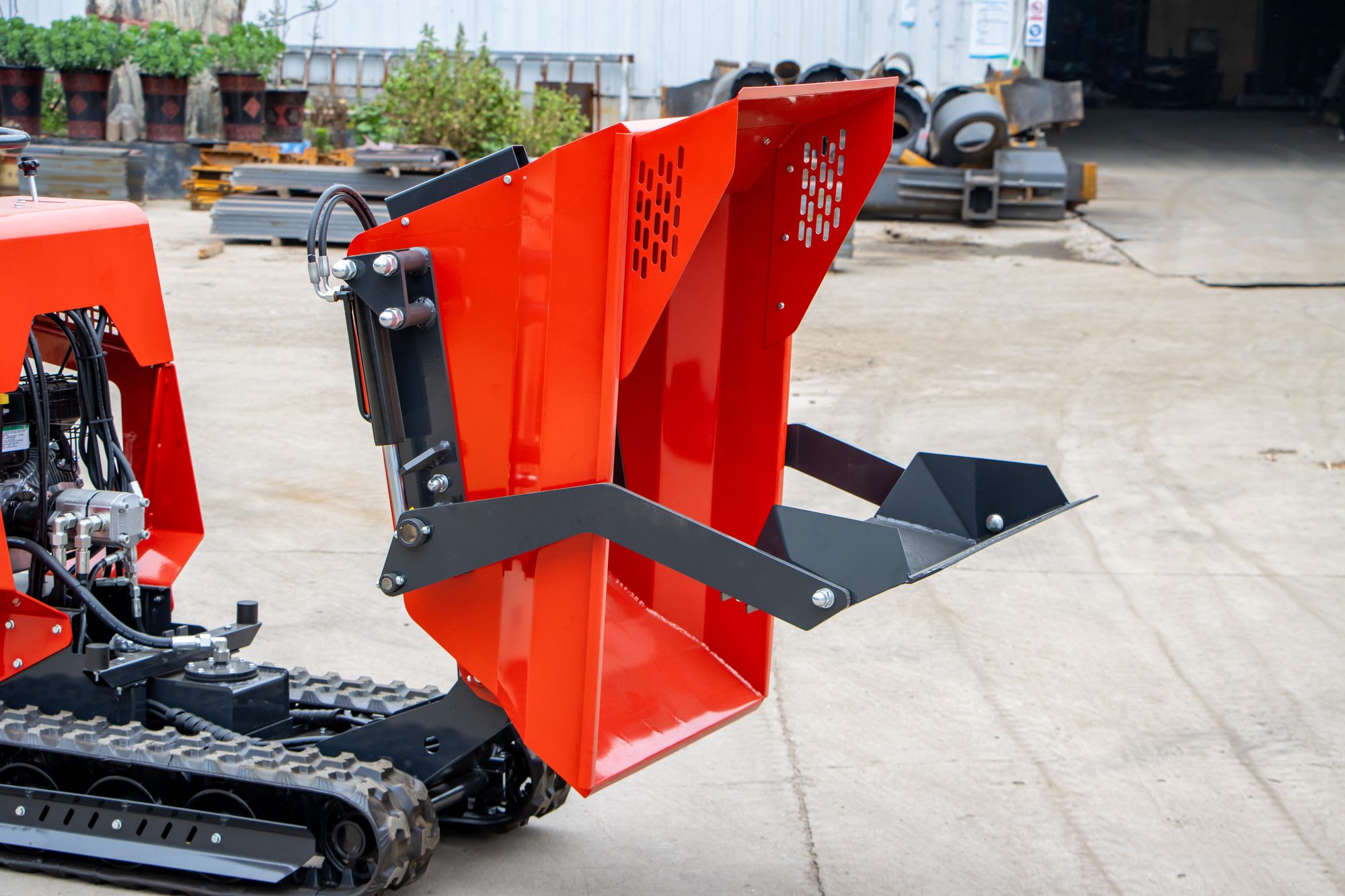
Reach is more important on restricted sites, so position the dumper so the excavator can tip without tracking, ideally with the hopper inside the excavator’s slew arc and the dumper standing on level ground. Keep stop blocks in place for any dumper tipping into an excavation [2].
Safety while the digger loads
Over 60% of dumper deaths involve the driver being crushed when the dumper overturns, according to the UK Health and Safety Executive (HSE) [1]. Its site dumper sheet sets out the loading rules [2]:
- Get off the dumper while it is being loaded.
- Load only on level ground with the parking brake applied.
- Do not overload the hopper, and spread the load evenly so it does not block the driver’s view.
- Use stop blocks a safe distance from the edges of excavations and spoil heaps.
- Wear the seat belt where roll-over protection is fitted.
HSE also warns against using a dumper that is too small for the job, because it is likely to be overloaded, which increases the risk of overturning and reduces its braking ability [2]. Following the load-per-trip table above, rather than filling the hopper to the brim, keeps a dense material such as wet clay within the rated load.
Moving the pair between jobs
A digger and dumper often travel together on a single plant trailer. Add the two operating weights and compare the total with the payload on the trailer’s plate, rather than with its gross vehicle weight. As an example, a 1.8 tonne class digger listed at 1,732 kg with a canopy [3] plus our FC10 at 800 kg is 2,532 kg of machinery before buckets and fuel. Our dumper weight guide lists the empty and loaded weight of every model.
If the material is a loose stockpile rather than an excavation, a self-loading dumper may remove the need for an excavator on that task. Our FJZ30 carries its own front bucket, and the self-loading dumper guide explains where that saves a machine and where it does not.
Frequently asked questions
What size dumper do I need for a 1.5 ton digger?
A 1 to 1.5 tonne dumper such as our FC10 or FY15, which a 1.5 tonne excavator fills in about 18 passes with a middle-size bucket. Where garden access is narrow, the 880 mm wide BL-T500-HD is the practical alternative and fills in about 5 passes.
How many buckets does it take to fill a 1 ton dumper?
For our FC10, approximately 10 passes with an 80-litre bucket in moist soil. With wet clay, the 1,000 kg rating is reached before the hopper is full, after approximately 8 passes.
Can a mini digger load a 3 ton dumper?
Yes, even a 1.5 tonne excavator has sufficient reach and dump height, but it needs about 33 passes to fill the hopper with a middle-size bucket, so a 3.5 tonne excavator or larger is a more efficient match for our FY30.
Should the dumper driver stay in the seat while the digger loads?
No, according to HSE guidance the driver should get off the dumper while it is being loaded by an excavator [2].
Do you sell mini diggers?
No, we manufacture mini dumpers and mini skid steer loaders at our factory in Xuzhou, China, designed to work alongside the excavator you already operate. Our mini skid steer vs mini excavator guide covers the loader side of that choice.
How we got these figures
Dumper ratings, hopper volumes, widths, weights and heights come from our product pages as published on 21 November 2026; hopper volumes are struck. Digger bucket ranges, weights and dump height come from Volvo Construction Equipment’s 2023 compact range folder [3], used only as a published reference for each class, while material densities are taken from Engineering ToolBox [5]. The four-to-six-pass rule, the partial-bucket point and the match factor are described in Morley, Joseph and Lu, University of Alberta [4]. Safety rules are quoted from HSE [1] [2]. Pass counts and the fleet example are our own calculations; the cycle times in the example are assumptions, not measurements. Read more about us and our factory.
Ask which dumper suits your digger
Send us your digger’s size and bucket capacity, the material you dig, the haul distance and the narrowest access on site. We reply with the dumper we would pair with it, its specification sheet and a quotation. Send us your enquiry.