


Choose FOB if you have a freight forwarder and want to control the shipping. Choose CIF if you want the seller to book the ship and include freight and basic insurance in one price. Under both rules the risk of damage passes to you in China, when the machine is on board the ship, so the difference is who arranges and pays for the voyage, not who carries the risk.
For a container load of mini loaders or dumpers, FCA (Free Carrier) usually fits better than FOB, because the container is handed over at the factory or terminal, before it reaches the ship [3]. This guide compares FOB and CIF, the four other terms we quote and their effect on your import duty, for dealers, hire fleets and contractors importing their first machines from China.
Key takeaways
- FOB: the seller clears export and loads the ship; you pay the sea freight and everything after.
- CIF: the seller also pays the freight to your port and buys cargo insurance, but only the minimum Institute Cargo Clauses (C) unless the contract asks for more [3].
- Risk moves at the same point under both: when the goods are on board the vessel at the port of loading [3].
- Duty does not follow the trade term. The United States, Canada and Australia charge duty on roughly the FOB value; the European Union and United Kingdom on roughly the CIF value, whichever term you buy on.
- Compare quotes on one term and one named place, then add the same freight, insurance and import costs to each.
What are FOB and CIF?
FOB and CIF are two of the Incoterms rules, the set of eleven three-letter trade terms first published by the International Chamber of Commerce in 1936 [1]. Of the 11 rules, 7 cover any mode of transport and 4 are for sea and inland waterway transport only: FAS (Free Alongside Ship), FOB, CFR (Cost and Freight) and CIF [2]. The current version, Incoterms 2020, entered into force on 1 January 2020 [1].
FOB (Free On Board) means the seller delivers the goods on board the vessel at the named port of shipment. Risk passes when the goods are on board, the buyer bears all costs from that moment, and the seller clears the goods for export only [3].
CIF (Cost, Insurance and Freight) means the seller also contracts and pays for the freight to the destination port and buys insurance against the buyer’s risk during carriage. Delivery and risk still happen on board the vessel at the port of shipment [3].
FOB vs CIF at a glance
| FOB (Free On Board) | CIF (Cost, Insurance and Freight) | |
|---|---|---|
| Named place | Port of loading in China, e.g. FOB plus the port name | Port of destination, e.g. CIF plus your port name |
| Export clearance in China | Seller | Seller |
| Loading on board the ship | Seller | Seller |
| Sea freight to your port | Buyer | Seller |
| Cargo insurance for the voyage | Not required of either party; the buyer insures its own risk | Seller, minimum Institute Cargo Clauses (C) |
| Risk of loss or damage at sea | Buyer, from the moment the goods are on board | Buyer, from the moment the goods are on board |
| Import clearance, duty and tax | Buyer | Buyer |
| Who picks the shipping line | Buyer or its forwarder | Seller |
Where the risk passes, and why CIF insurance needs checking
The most common misunderstanding is that CIF protects the buyer until the goods arrive. It does not. Under CIF, as under FOB, the risk of loss or damage passes when the goods are on board the vessel [3]. What CIF adds is an insurance policy the seller must buy for your benefit, and if a container is damaged at sea, you are the one who claims on it.
That policy only has to meet Institute Cargo Clauses (C). Incoterms 2020 raised the requirement for CIP to the wider clauses (A) but kept CIF at clauses (C) [3]. The insurer’s guide advises that the contract should state when more cover is needed [3]. For a machine shipment, ask for clauses (A) in writing, or buy your own cover under FOB.
FOB or FCA for a container?
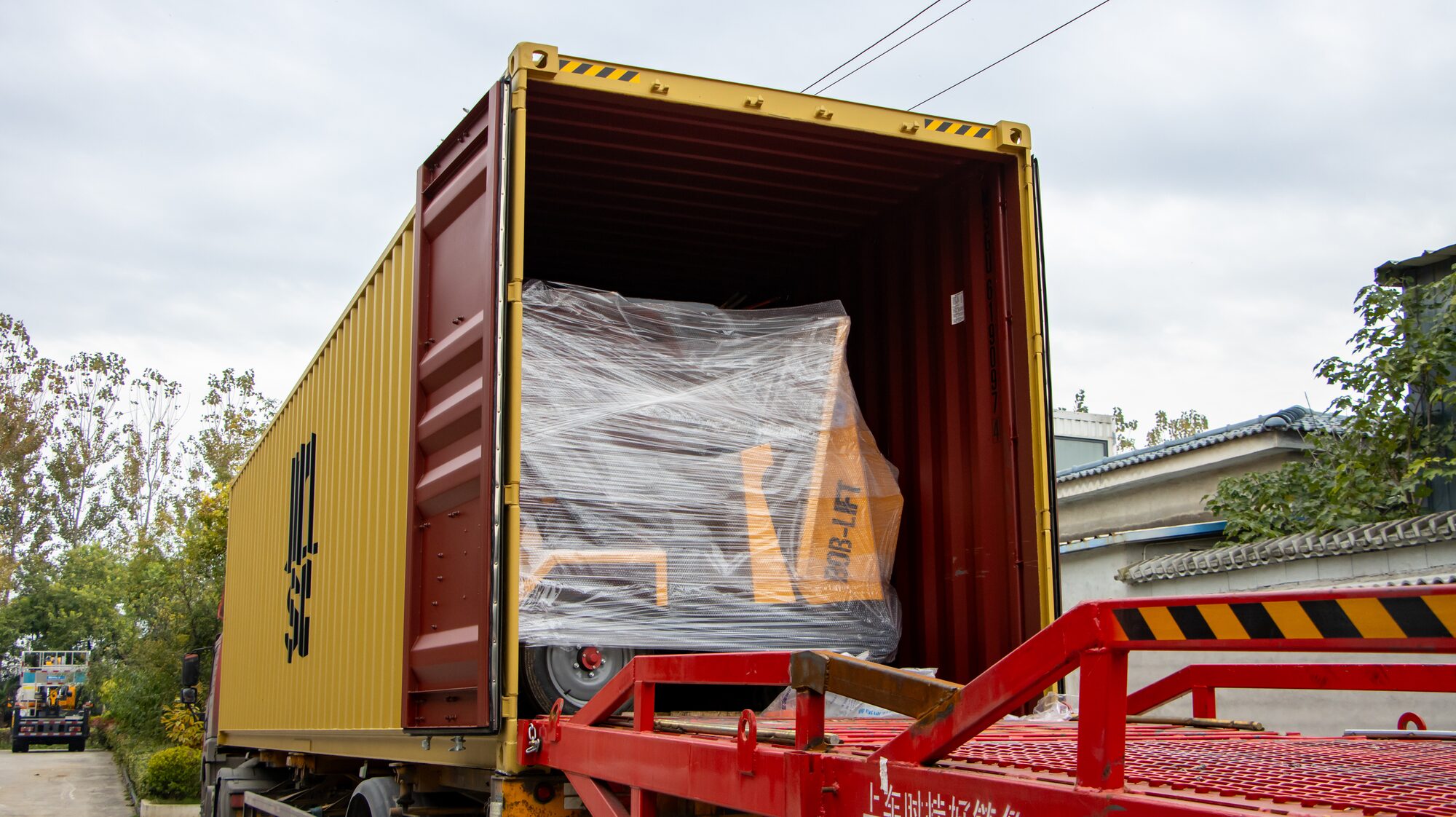
Mini skid steers and mini dumpers ship in containers. A container is usually handed to the carrier at a terminal, or loaded at the factory, long before it is lifted on board. That leaves a gap between the moment you lose control of the goods and the moment FOB says delivery happens. The insurer’s guide is direct: FOB “is not suitable for containers”, which are usually delivered to a terminal, “when FCA is more appropriate”. It says CIF is usually not appropriate in the same situation either, and CIP should be used instead [3].
Under FCA, delivery and risk transfer happen when the goods are handed to your nominated carrier at the named place. If that place is the seller’s premises, it happens once the goods are loaded on your transport [3]. You can still agree FOB or CIF for container cargo; the point is to know where your risk starts. If you want the risk point to match where the container really changes hands, ask for FCA.
The six terms we quote
We quote on FOB, CIF, EXW, FCA, DAP and DDP. The grid shows who pays for, or bears, each step under each rule, summarised from the insurer’s guide [3]. Read the ICC text for the full split of costs [1].
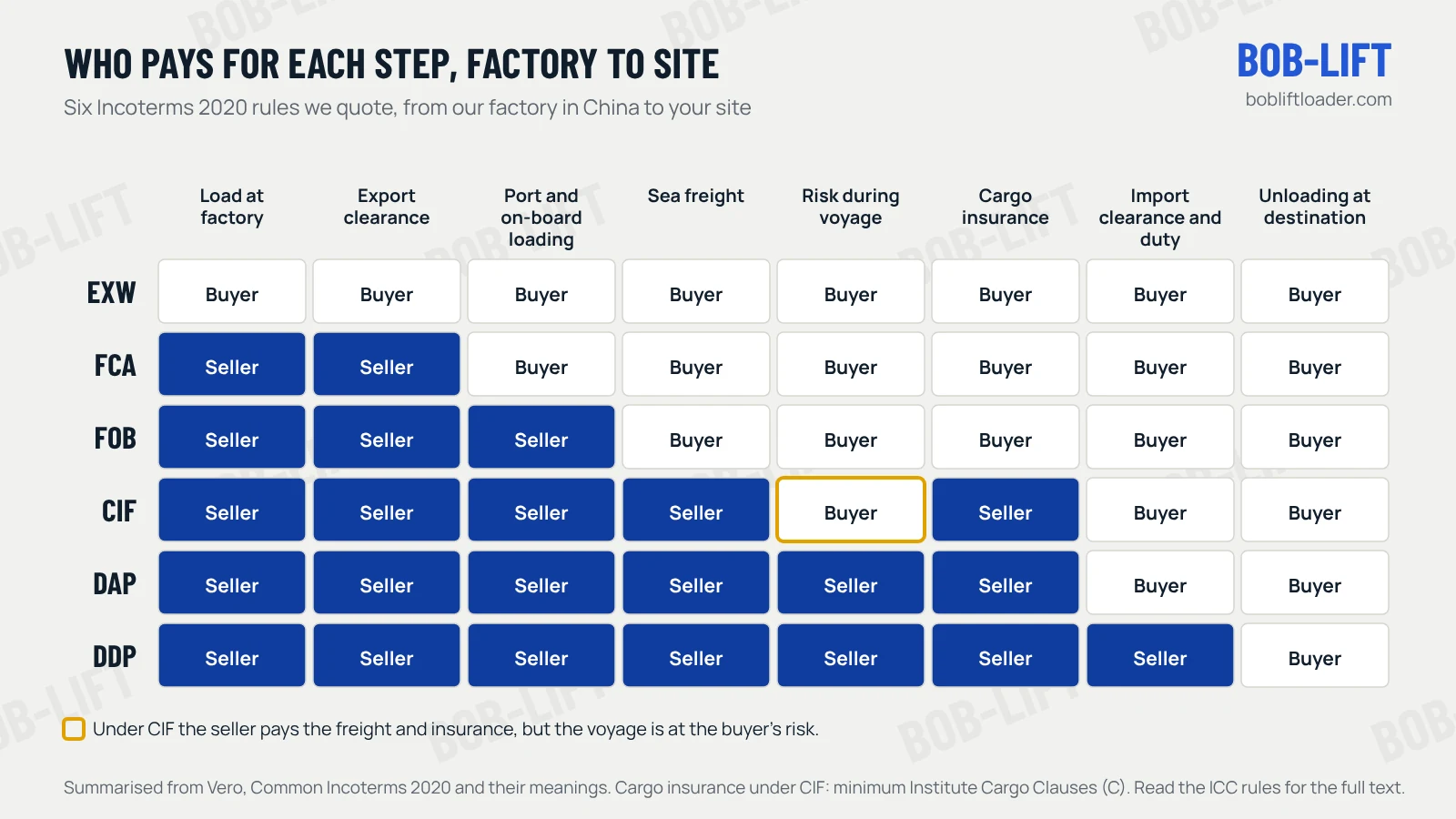
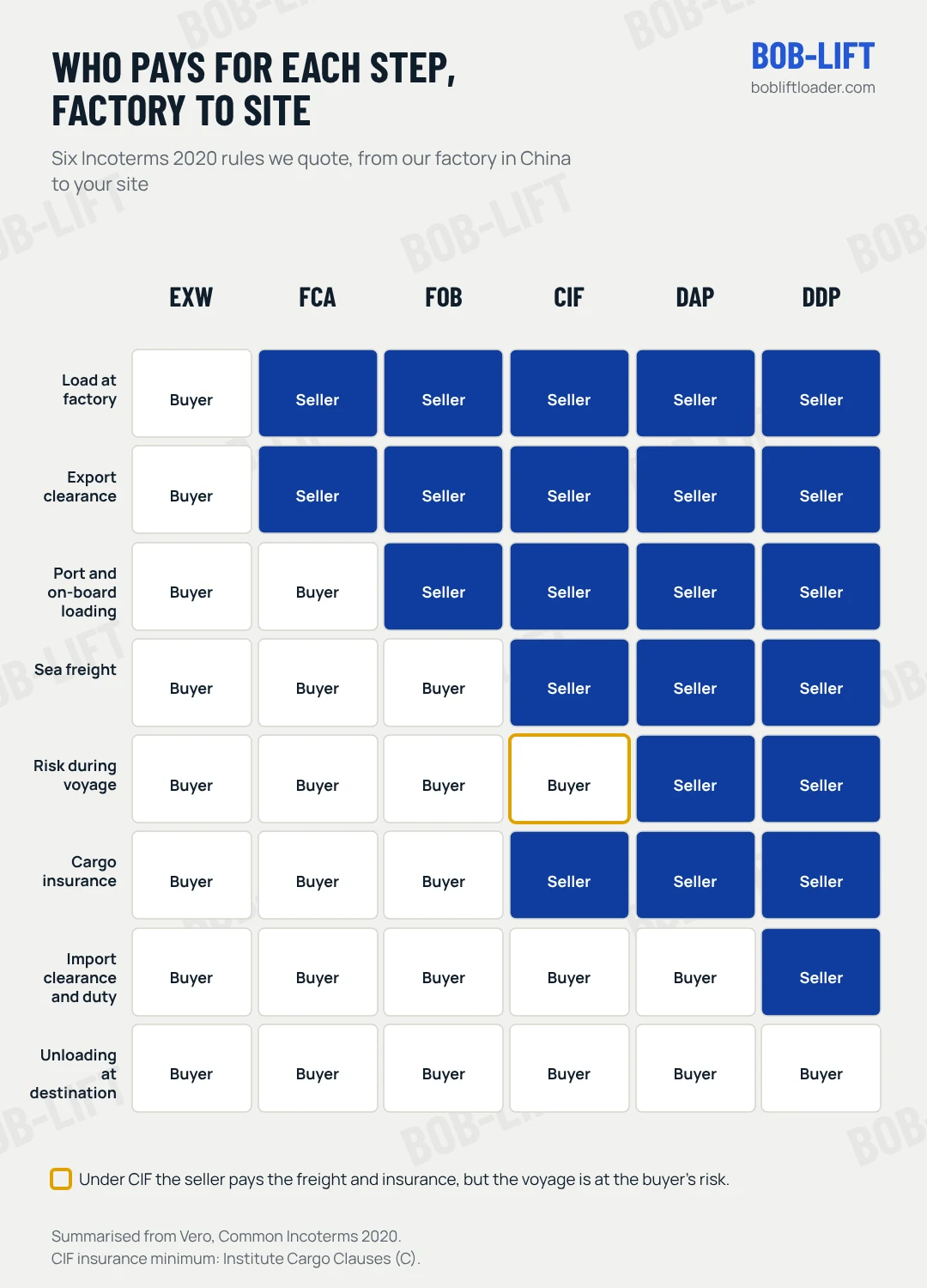
- EXW (Ex Works) means the goods are made available at our factory. The seller does not load them or clear them for export [3], so you need a forwarder in China.
- FCA (Free Carrier) means the seller loads your carrier’s truck at our factory, or delivers to a named terminal, and clears export [3].
- DAP (Delivered at Place) means the seller carries the goods and the risk to a named place in your country, ready for unloading; you clear import and pay duty [3].
- DDP (Delivered Duty Paid) means the same as DAP, except that the seller also handles import clearance and duty, the maximum obligation for a seller [3]. Whether we can quote DDP depends on the destination, so ask first.
How the trade term changes your import duty
The trade term decides who pays the freight, not the value your customs service charges duty on, which depends on the country:
| Importing into | Duty is charged on | What that means for FOB vs CIF | Legal basis |
|---|---|---|---|
| United States | The price paid, excluding international freight and insurance | Same duty base either way; with CIF, the freight and insurance are taken off | 19 U.S.C. 1401a(b)(4)(A) [4] |
| Canada | The price paid, less transport and insurance from the place of direct shipment | Same duty base either way, roughly the FOB value | Customs Act s. 48(5); CBSA Memorandum D13-3-1 [9] |
| Australia | Customs value excluding freight and insurance from the place of export | Same duty base; 10% GST is then charged on customs value + duty + freight and insurance | Customs Act 1901, sections 154 to 161L [7]; GST [8] |
| European Union | Price plus transport and insurance up to the EU border | Freight is added even when you buy FOB, so the base is roughly the CIF value | Union Customs Code (EU) 952/2013, Article 71(1)(e) [5] |
| United Kingdom | Price plus delivery costs up to the place the goods enter the UK | Same as the EU: roughly the CIF value either way | HMRC customs valuation guidance [6] |


A simple example shows the effect. Take a machine with an FOB value of 100 (an index, not a price), freight and insurance of 12 to your port, and a 2% duty rate. All three numbers are assumptions; look up your own tariff rate.
| United States, Canada, Australia | European Union, United Kingdom | |
|---|---|---|
| FOB value (index) | 100 | 100 |
| Freight and insurance to your port (assumed) | 12 | 12 |
| Value duty is charged on | 100 | 112 |
| Duty at an assumed 2% rate | 2.00 | 2.24 |
Two practical points follow. If you import into the United States, Canada or Australia on CIF terms, keep the freight and insurance shown separately on the invoice or freight bill, so customs can take them off the price. If you import into the European Union or United Kingdom on FOB terms, keep the freight invoice too, because customs adds it to the price. In Australia, the 10% GST is charged on a value that includes the freight and insurance [8], so freight still affects your tax bill there. The next example uses the same index figures and an assumed 5% duty rate.
| Australian import (index figures) | Amount | Rule |
|---|---|---|
| Customs value (roughly the FOB value) | 100.00 | Excludes international freight and insurance [7] |
| Customs duty at an assumed 5% rate | 5.00 | Charged on the customs value |
| International freight and insurance | 12.00 | Added for GST only |
| Value of the taxable importation | 117.00 | Customs value + duty + freight and insurance [8] |
| GST at 10% | 11.70 | 10% of the value of the taxable importation [8] |
| Duty and GST together | 16.70 | Payable at import, before any GST credit |
The freight of 12 adds 1.20 to the GST whichever term you buy on, because Australia taxes the landed value. If you are registered for GST, ask your accountant whether it can be claimed back as an input tax credit.
Which should you choose?
- You have a forwarder with good container rates: buy FOB, or FCA for the risk point described above. You control the booking, the transit time and the insurance.
- This is your first import: ask for both FOB and CIF to the same port. The difference is the seller’s freight and insurance price, which you can check against a forwarder quote. Then ask which destination charges the CIF price includes, because import clearance, duty and delivery to site remain yours.
- You want one price to your yard: ask for DAP to a named address. Add your own import duty, tax and unloading.
- You are comparing several factories: put every quote on the same rule and the same named place before comparing prices. Our guide to comparing Alibaba mini skid steer listings walks through that line by line.
Freight per machine also depends on how many machines fit in one container, so the same container rate under FOB or CIF can mean very different costs per machine. The counts below come from our mini skid steer container loading guide and mini dumper container packing guide, which explain how each model is secured.
| Model | Type | Rated load | Machine weight | Per 20GP | Per 40HQ |
|---|---|---|---|---|---|
| BL-T360-H | Tracked mini skid steer, stand-on | 200 kg | 650 kg | 6 | 30 (on racks) |
| BL-S750-H | Wheeled mini skid steer, stand-on | 400 kg | 1,000 kg | 6 | 22 (on racks) |
| BL-T1000-H | Tracked mini skid steer, stand-on | 500 kg | 1,250 kg | 4 | 10 (on racks) |
| FC10, FY15 | Wheeled mini dumper | 1,000 kg, 1,500 kg | 800 kg, 830 kg | 4 complete, 6 taken apart | 8 complete, 12 taken apart |
| FY20-2 | Wheeled mini dumper | 2,000 kg | 900 kg | 2 complete, 3 taken apart | 4 complete, 6 taken apart |
| FY30, FY40 | Wheeled mini dumper | 3,000 kg, 4,000 kg | 2,200 kg, 2,400 kg | 1 | 3 complete, 5 taken apart |
| FY50 | Wheeled mini dumper | 5,000 kg | 2,600 kg | 1 | 3 |
A 40HQ of BL-T360-H loaders spreads one freight charge over 30 machines, while a 40HQ of complete FY50 dumpers spreads it over 3. With an assumed container freight of 30 (an index, not a rate), that is 1 per loader but 10 per dumper. Space, not weight, sets these limits: 30 BL-T360-H weigh 19,500 kg, under the 28,600 kg maximum payload Hapag-Lloyd lists for a 40-foot high cube, according to our container loading guide. When you compare an FOB quote plus your own freight with a CIF quote, divide both freight figures by the same machine count.
What else to put in the contract
Whatever rule you choose, write it with its version and named place: FOB followed by the Chinese port of loading and “Incoterms 2020”, or CIF followed by your port, for example “CIF Rotterdam Incoterms 2020” for a buyer in the Netherlands. Then add the points the rule itself does not settle:
- Insurance level on CIF: clauses (A), insured value and the currency of any claim.
- Destination charges on CIF: which, if any, are prepaid.
- Shipping schedule: the ship date or the latest date the goods are handed over.
- Documents: commercial invoice, packing list, bill of lading and certificate of origin. Our mini skid steer import checklist covers the US engine certificate as well.
- Inspection before loading: who inspects, and when. Our pre-shipment inspection checklist lists what to check.
Our own terms are a minimum order of one machine, payment by T/T and a 12-month warranty on the whole machine. Our mini dumper factory buying guide covers lead times and shipping for dumpers, and the mini skid steer buying guide does the same for loaders.
Frequently asked questions
Is FOB or CIF better for the buyer?
FOB gives the buyer control of the shipping line, the transit and the insurance; CIF is simpler for a first import. Neither moves the risk point, which is on board the ship in China under both.
Does a CIF price include import duty?
No. CIF ends at your port of destination. Import clearance, duty and tax are the buyer’s under CIF; only DDP puts them on the seller [3].
Who pays the duty on the freight?
In the European Union and United Kingdom, freight and insurance to the border are part of the duty base whatever the term [5] [6]. In the United States, Canada and Australia, international freight and insurance are excluded from the customs value [4] [9] [7].
Can I still use Incoterms 2010?
Yes, if both parties agree and the version is stated in the contract and documents, according to the US International Trade Administration [2]. Two changes from 2010 to 2020 matter for machinery buyers: the CIP insurance minimum rose from Institute Cargo Clauses (C) to Institute Cargo Clauses (A) while CIF stayed at (C) [3], and DPU (Delivered at Place Unloaded) replaced the 2010 rule DAT, adding the seller’s duty to unload [2]. We quote on Incoterms 2020.
About these sources
The Incoterms descriptions come from the ICC [1], the US International Trade Administration [2] and the Incoterms 2020 guide published by the cargo insurer Vero [3]. The customs valuation rules are quoted from 19 U.S.C. 1401a [4], Article 71 of the Union Customs Code [5], HMRC [6], the Australian Border Force [7] [8] and CBSA Memorandum D13-3-1 [9], all read on 21 November 2026. Our trade terms, container counts and warranty come from our own sales terms and product pages. The duty example uses index numbers and an assumed rate, not our prices. This guide is general information, not legal or tax advice. Read more about us and our factory.
Get a quote on the term you need
Tell us the models and quantity, your destination port or address, and the trade term you want. We reply with a quotation on that term, the container plan and the documents we supply. Send us your enquiry.