


A mini skid steer burns roughly 0.5 to 2.6 litres of diesel an hour, depending on engine size and how hard it works. Our 18.6 kW BL-T750-H uses about 1.25 L/h in typical skid-steer work and about 2.60 L/h in hard, continuous loading. A single-cylinder 7.6 kW diesel uses about 0.5 to 1.1 L/h, and the petrol versions burn about twice as many litres for the same work.
These figures are our estimates for the nine mini skid steers we build at our factory in Xuzhou, China. We worked them out with the structure of the US Environmental Protection Agency’s NONROAD emissions model [1], which multiplies rated engine power by how hard the engine works and by a rate per unit of work [2]. In place of an emission rate, we use EPA’s figure for the fuel an engine burns per unit of work. We have not run fill-to-fill tests on every model, so treat them as planning figures and check them against your own fuel records.
Key takeaways
- Typical diesel use is 0.5 to 1.25 litres an hour across our range, rising to 1.1 to 2.6 L/h under hard, continuous loading.
- Engine power sets the ceiling. At full rated power our 18.6 kW diesels would burn about 5.43 L/h, but a skid steer rarely runs there for long.
- Petrol burns about twice the litres. EPA fuel rates give 0.60 L per kWh for small petrol engines against 0.29 L for diesel.
- Our 20 L tanks last a working day. The three-cylinder diesels run about 16 hours on a full tank at typical duty, or about 8 hours of hard loading.
- Measure your own rate with a fill-to-fill log over a week. Your jobs, attachments and operators decide the real number.
How much fuel does a mini skid steer use per hour?
The table lists every engine fitted to our nine mini skid steers. The three single-cylinder and three two-cylinder models can be ordered with petrol or diesel engines, so they appear twice. The BL-T750-H, BL-S750-H and BL-T1000-H are diesel only.
| Model | Engine | Tank | Typical duty (L/h) | Hard loading (L/h) | Full power (L/h) | Hours per tank, typical |
|---|---|---|---|---|---|---|
| BL-T360-H | 7.6 kW diesel | 5 L | 0.51 | 1.06 | 2.22 | 9.8 |
| BL-T360-H | 7.6 kW petrol | 5 L | 1.06 | 2.21 | 4.60 | 4.7 |
| BL-S390-C | 7.6 kW diesel | 5 L | 0.51 | 1.06 | 2.22 | 9.8 |
| BL-S390-C | 7.6 kW petrol | 5 L | 1.06 | 2.21 | 4.60 | 4.7 |
| BL-T390-C | 7.6 kW diesel | 5 L | 0.51 | 1.06 | 2.22 | 9.8 |
| BL-T390-C | 7.6 kW petrol | 5 L | 1.06 | 2.21 | 4.60 | 4.7 |
| BL-T460-H | 16.8 kW diesel | 10 L | 1.13 | 2.35 | 4.90 | 8.9 |
| BL-T460-H | 16.8 kW petrol | 10 L | 2.34 | 4.88 | 10.16 | 4.3 |
| BL-S490-C | 16.8 kW diesel | 10 L | 1.13 | 2.35 | 4.90 | 8.9 |
| BL-S490-C | 16.8 kW petrol | 10 L | 2.34 | 4.88 | 10.16 | 4.3 |
| BL-T490-C | 16.8 kW diesel | 10 L | 1.13 | 2.35 | 4.90 | 8.9 |
| BL-T490-C | 16.8 kW petrol | 10 L | 2.34 | 4.88 | 10.16 | 4.3 |
| BL-T750-H | 18.6 kW diesel | 20 L | 1.25 | 2.60 | 5.43 | 16.0 |
| BL-S750-H | 18.6 kW diesel | 20 L | 1.25 | 2.60 | 5.43 | 16.0 |
| BL-T1000-H | 17.8 kW diesel | 20 L | 1.19 | 2.49 | 5.19 | 16.7 |
Typical duty uses the EPA skid-steer load factor of 0.23; hard loading uses the rubber-tyre loader factor of 0.48 [2]. Full power is the theoretical maximum. Engine power and tank size come from our product pages on 20 November 2026.
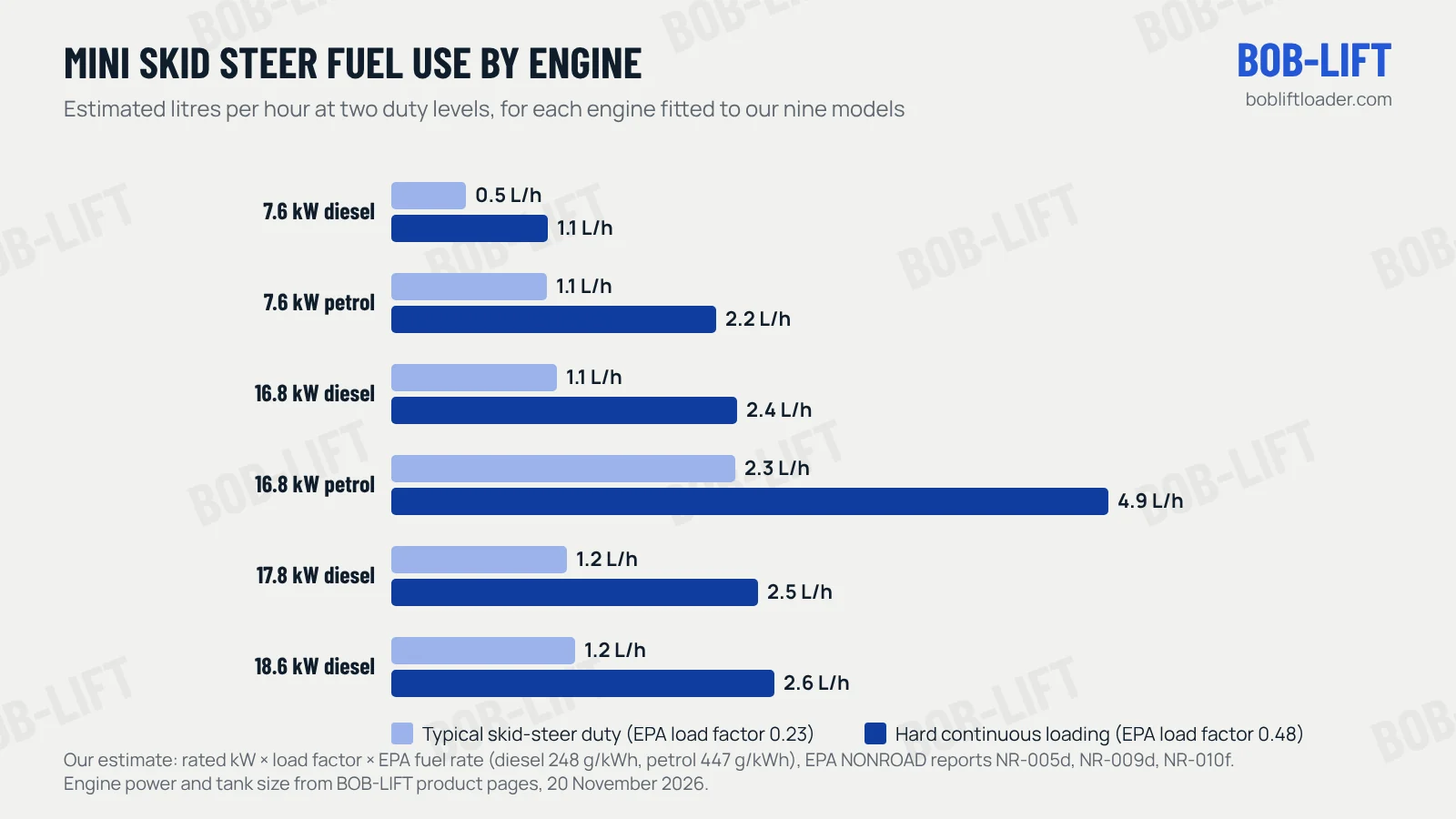

Engine options can change these figures. Our single-cylinder models also take a 7.9 kW Rato or a 9.92 kW Briggs & Stratton engine. Fuel use rises in step with power, so the 9.92 kW engine burns about 1.3 times the litres of the 7.6 kW figures above. The two-cylinder options sit between 15 and 17 kW, close to the listed 16.8 kW. Our mini skid steer specifications guide lists every engine option by model.
How the estimate works
Fuel use depends on how much work the engine actually delivers, not simply on its size. The EPA method separates that into three quantities, each of which you can check for your own machine:
- Rated power is the maximum output the engine manufacturer guarantees, in kilowatts, as printed on the specification sheet.
- Load factor is the average share of rated power the engine delivers over a realistic work cycle. On EPA transient test cycles, a skid-steer loader averaged 0.23 and a rubber-tyre loader 0.48 [2].
- Brake-specific fuel consumption is the mass of fuel an engine burns for each unit of work it delivers at the flywheel, usually shortened to BSFC [3]. EPA publishes one value for small diesel engines [4] and another for small four-stroke petrol engines [5].
| Fuel | EPA fuel rate | Fuel density | Grams per kWh | Litres per kWh |
|---|---|---|---|---|
| Diesel (engines up to 100 hp) | 0.408 lb/hp-hr | 7.1 lb/US gal (EPA) | 248 | 0.292 |
| Petrol (four-stroke, Class II) | 0.735 lb/hp-hr | 6.17 lb/US gal (our assumption, 0.74 kg/L) | 447 | 0.605 |
The diesel density is EPA’s own figure [4]. EPA’s petrol report gives no density, so we assume 0.74 kg/L, inside the 0.71 to 0.77 range for modern petrol [6].
Multiplying the three quantities together gives the hourly consumption.
Litres per hour = rated power (kW) × load factor × litres per kWh.
The worked example below applies the formula to our BL-T750-H, the tracked stand-on loader with the three-cylinder diesel engine and the largest tank in our range.
| Step | Typical duty | Hard loading |
|---|---|---|
| Rated power | 18.6 kW | 18.6 kW |
| Load factor (EPA test cycle) | 0.23 | 0.48 |
| Diesel per kWh | 0.2917 L | 0.2917 L |
| Litres per hour | 1.25 L/h | 2.60 L/h |
| Tank size | 20 L | 20 L |
| Hours per full tank | 16.0 h | 7.7 h |
EPA applies one diesel BSFC to every engine generation because it lacks the measurements to separate them [4], so a modern Tier 4 or Stage V engine may perform somewhat better than our figures. EPA also applies no transient adjustment to Tier 4 engines [4], which explains why our calculation uses the base rate without correction. Our specification sheets list the emission standards as EPA Phase 3 (petrol), EPA Tier 4 (diesel) and EU Stage V; the certificate that applies is the one for the engine you order.
How long does one tank last?
Tank capacity matters as much as consumption when you plan a working day. Our single-cylinder models carry 5 L, the two-cylinder models 10 L and the three-cylinder diesels 20 L, so the refuelling interval varies considerably across the range.


The diesel models typically complete a full shift on one tank. The petrol single- and two-cylinder models are the exception: at about 4.3 to 4.7 hours per tank in typical work, plan a refill around midday, and carry fuel in an approved container. Our mini skid steer rental guide covers how tank size affects a hire day.

Petrol vs diesel fuel use
For the same work, a small petrol engine burns about 2.07 times the litres of a small diesel. That follows directly from the EPA fuel rates in the table above: petrol engines of this size convert fuel to work less efficiently, and petrol is also the lighter fuel per litre [4] [6]. On our 7.6 kW loaders, typical duty works out at 1.06 L/h on petrol against 0.51 L/h on diesel.
One more point for petrol buyers. EPA’s model still uses a survey-based load factor of 0.58 for four-stroke petrol skid steers, against the test-based 0.21 it uses for diesel [2]. We use the same test-cycle duty levels for both fuels so the comparison is fair, but if you want a cautious petrol budget, plan on the hard-loading column. Our diesel vs gas mini skid steer guide covers starting, cold weather and fuel storage as well as fuel cost.
What makes a mini skid steer burn more fuel?
The load factor is where real jobs differ most. The same loader can operate near either end of the range in the table, depending on the application.
- Digging and pushing into piles. Bucket work against a face holds the engine near full power, which moves the loader towards the hard-loading figure.
- Hydraulic attachments. Augers, trenchers, brush cutters and snow blowers demand continuous hydraulic flow, so the engine operates at high speed for long periods with very little idle time.
- Long travel and slopes. Driving loaded up ramps or across a big site adds hours at high power without moving much material.
- Idling. A loader left running between loads still consumes fuel while delivering no useful work. Switching off during extended waits saves fuel and reduces recorded engine hours.
- Maintenance. A clogged air filter or dragging tracks make the engine work harder for the same job. Our skid steer maintenance checklist covers the daily and weekly checks.
Engine choice matters less within a class. On our three diesel models, every engine option sits between 17.1 and 18.6 kW, so the difference in fuel use between them is small. Our Kubota engine guide compares the three-cylinder options.
Mini dumpers: the same method
The same sum works for mini dumpers. EPA assigns diesel dumpers and tenders a load factor of 0.21 [2], close to the skid-steer figure, because most of their day is spent travelling light, waiting to be loaded and tipping. For hard hauling, such as long loaded climbs, we use the 0.48 loader figure as an upper estimate. The table applies both to our dumper range.
| Model | Engine | Typical duty, load factor 0.21 (L/h) | Hard work, load factor 0.48 (L/h) |
|---|---|---|---|
| BL-T500-HD | 4.8 kW petrol | 0.61 | 1.39 |
| FC10 | 12.1 kW diesel | 0.74 | 1.69 |
| FY15 | 13.2 kW diesel | 0.81 | 1.85 |
| FY20-2 | 17 kW diesel | 1.04 | 2.38 |
| FY20-4 | 27.5 kW diesel | 1.68 | 3.85 |
| FY30 | 37 kW diesel | 2.27 | 5.18 |
| FJZ30 | 37 kW diesel | 2.27 | 5.18 |
| FY40 | 40 kW diesel | 2.45 | 5.60 |
| FY50 | 65 kW diesel | 3.98 | 9.10 |
Engine power comes from our product pages on 20 November 2026; the BL-T500-HD is our only petrol dumper. Our mini dumper specifications guide lists payload, hopper size and dimensions for each model.
Budgeting fuel for a fleet
For a yearly budget, multiply the hourly rate by the hours you expect each machine to work. EPA’s activity data gives 818 hours a year for a diesel skid steer loader, with an in-use load factor of 0.21 [2]. The table applies both load factors to one BL-T750-H.
| Basis | Hours a year | Load factor | Litres a year |
|---|---|---|---|
| EPA in-use load factor for diesel skid steers | 818 | 0.21 | 932 L |
| EPA skid-steer test cycle | 818 | 0.23 | 1,021 L |
Multiply by your local fuel price and the number of machines to calculate an annual budget, and add a contingency for heavy attachment work. Rental fleets should also price fuel into the hire rate or refill policy, since a renter who returns the machine empty has used up to a full tank.
How to measure your own fuel use
A fill-to-fill log is the simplest way to replace our estimate with your own figure:
- Fill the tank to the brim and note the hour-meter reading.
- Work as normal for a week, or at least 20 engine hours.
- Fill to the brim again on level ground and note the litres added and the new hour-meter reading.
- Divide litres by engine hours. Repeat for different types of job to see how attachments change the rate.
Record the type of job with each fill. After a month you will understand which applications sit near the typical figure and which approach the hard-loading figure, and you can include realistic fuel costs in every quotation.
Frequently asked questions
What is a typical fuel consumption rate for a mini skid steer?
Our estimate is about 0.5 to 1.25 litres of diesel an hour in typical work and 1.1 to 2.6 L/h in hard, continuous loading, depending on the engine. Petrol versions use about twice as many litres.
How many gallons per hour does a mini skid steer use?
About 0.13 to 0.33 US gallons of diesel an hour in typical work, and 0.28 to 0.69 gallons an hour in hard loading, using the same EPA-based estimate (1 US gallon = 3.785 L).
How long does a full tank last on a mini skid steer?
On our diesel models, about 9 to 17 hours at typical duty and 4 to 8 hours of hard loading. Petrol versions of our small loaders run about 4 to 5 hours on a tank at typical duty.
Does a tracked mini skid steer use more fuel than a wheeled one?
Our tracked and wheeled versions share identical engines, so the hourly rate depends mainly on the application, the ground conditions and the operator rather than the running gear. We have not measured a difference between them, so monitor both types separately if you operate a mixed fleet.
Is a wheel loader more fuel-hungry than a mini skid steer?
Per hour, yes. A wheel loader has a bigger engine and its EPA test cycle runs at a load factor of 0.48 against 0.23 for a skid steer. Our mini skid steer vs wheel loader guide compares the two machines.
How we got these figures
Engine power, fuel type and tank size come from our product pages as published on 20 November 2026. Load factors and annual hours come from EPA report NR-005d [2]; diesel fuel rate and density from NR-009d [4]; petrol fuel rate from NR-010f [5]; the petrol density of 0.74 kg/L is our assumption within the published range [6]. The litres per hour are our calculations, rounded to two decimals; we have not measured them on each model, and real use varies with job, operator, attachment and climate. Read more about us and our factory.
Ask for a fuel-efficient mini skid steer quotation
Tell us your typical jobs, how many hours a day the loader will work and which fuel you can get on site. We will recommend an engine and tank size and reply with specifications and a quotation. Send us your enquiry.