


A letter of credit is a bank’s promise to pay the seller on your behalf, as long as the seller presents the shipping documents the credit asks for. The US International Trade Administration (ITA) calls it “a commitment by a bank on behalf of the applicant (importer) that payment will be made to the beneficiary (exporter)” [1]. Payment follows once the terms are met, “as evidenced by the presentation of specified documents”. For a buyer of mini skid steers or mini dumpers from China, it means you do not pay before shipment, and the seller does not ship on trust.
This guide explains how an L/C, also called a documentary credit, works on a machinery order. It covers the documents to call for, the dates to set and the cost compared with paying by T/T. It is written from our factory in Xuzhou, Jiangsu Province. Our standard payment term is T/T. If your bank or finance provider needs a letter of credit, tell us before we issue the proforma invoice, so the terms can be agreed in advance.
Key takeaways
- An L/C moves the payment promise from you to your bank. The bank pays against documents that comply with the credit, not against the machines themselves [1].
- Banks deal in documents only. They do not check the quality of the goods, so ask for an inspection certificate if you want a check before the bank pays [1].
- Under UCP 600, credits are irrevocable, the seller may have up to 21 days after shipment to present documents, and banks have up to five business days to examine them [3] [4].
- Set the dates around the production time. Our standard lead time is 8 to 30 working days, so the latest shipment date has to allow for it plus booking a ship.
- An L/C costs more and takes more work than T/T. The ITA calls it labour intensive and relatively expensive [1]; for a first order of one or two machines, a small T/T order can be the simpler test.
What is a letter of credit?
A letter of credit (L/C or LC) is a separate contract from your sales contract, a principle set out in Article 4(a) of UCP 600 [4]. The ITA puts it plainly: the banks “are not concerned with determining the quality of underlying goods” [1]. Their obligation to pay depends only on the documents complying with the credit, because “banks deal in documents only, not goods”. That is its strength and its limit. The seller gets a bank’s promise instead of yours. You get the assurance that payment will not leave your account until the documents show the goods were shipped as agreed [1].
Six parties can be involved.
| Party | Who it is in a machinery order | What it does |
|---|---|---|
| Applicant | You, the buyer | Asks your bank to open the credit and pays its fee [1] |
| Beneficiary | The manufacturer, for example us | Ships the machines and presents the documents; UCP 600 Article 2 calls it “the party in whose favour a credit is issued” [4] |
| Issuing bank | Your bank | Opens the credit and promises to pay against complying documents [1] |
| Advising bank | The seller’s bank in China | Tells the seller the credit has been opened and checks it is authentic [1] |
| Confirming bank | Usually the advising bank, if asked | Adds its own promise to pay if the issuing bank does not [1] |
| Nominated bank | Usually the seller’s bank | The bank where the credit is available, which examines the documents and pays or passes them on [1] |
The International Chamber of Commerce published the first Uniform Customs and Practice for Documentary Credits (UCP) in 1933 [4]. Most credits today are issued subject to its current version, UCP 600, published by the International Chamber of Commerce and in effect since 1 July 2007 [4]. China has been an ICC member since 1995 and is subject to UCP 600, and most Chinese commercial banks have the authority to issue letters of credit for imports and exports [5]. In the United States, most states have also adopted Article 5 of the Uniform Commercial Code, drafted in 1952 and revised in 1995 to follow UCP practice [4].
How a letter of credit works, step by step
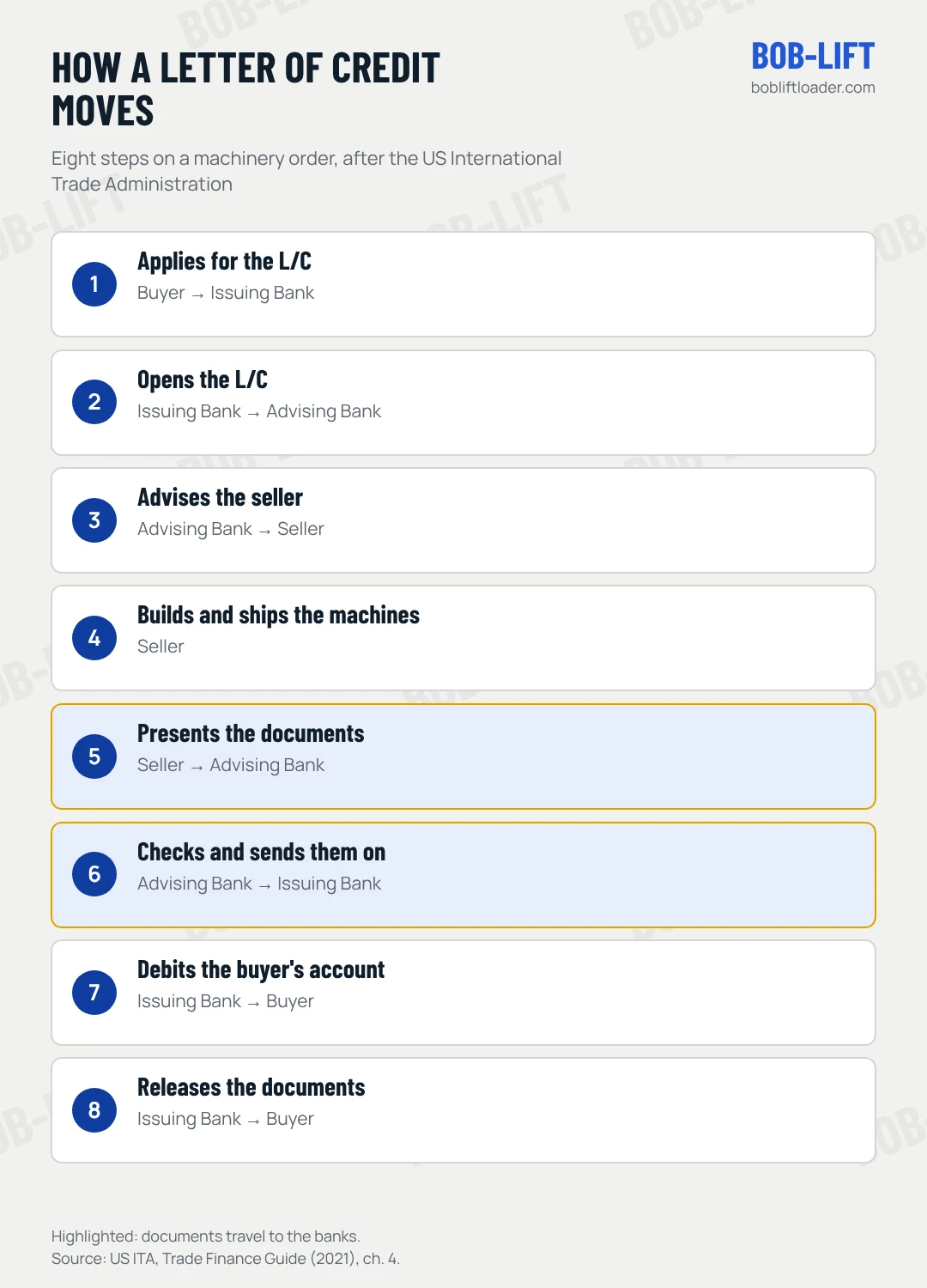
The ITA sets out an eight-step transaction [1]. On a machinery order it runs like this:
- You agree the sales contract with the seller, including payment by L/C and the documents required.
- You apply to your bank, which checks your credit and opens the L/C in favour of the seller.
- Your bank sends the L/C to the seller’s bank, which checks it is authentic and advises the seller.
- The seller checks the terms can be met, then builds and loads the machines.
- The seller, or its forwarder, presents the shipping documents to its bank.
- The seller’s bank checks the documents against the credit and sends them to your bank, which pays.
- Your bank debits your account.
- Your bank releases the documents to you, and you use the bill of lading to collect the goods and clear customs.
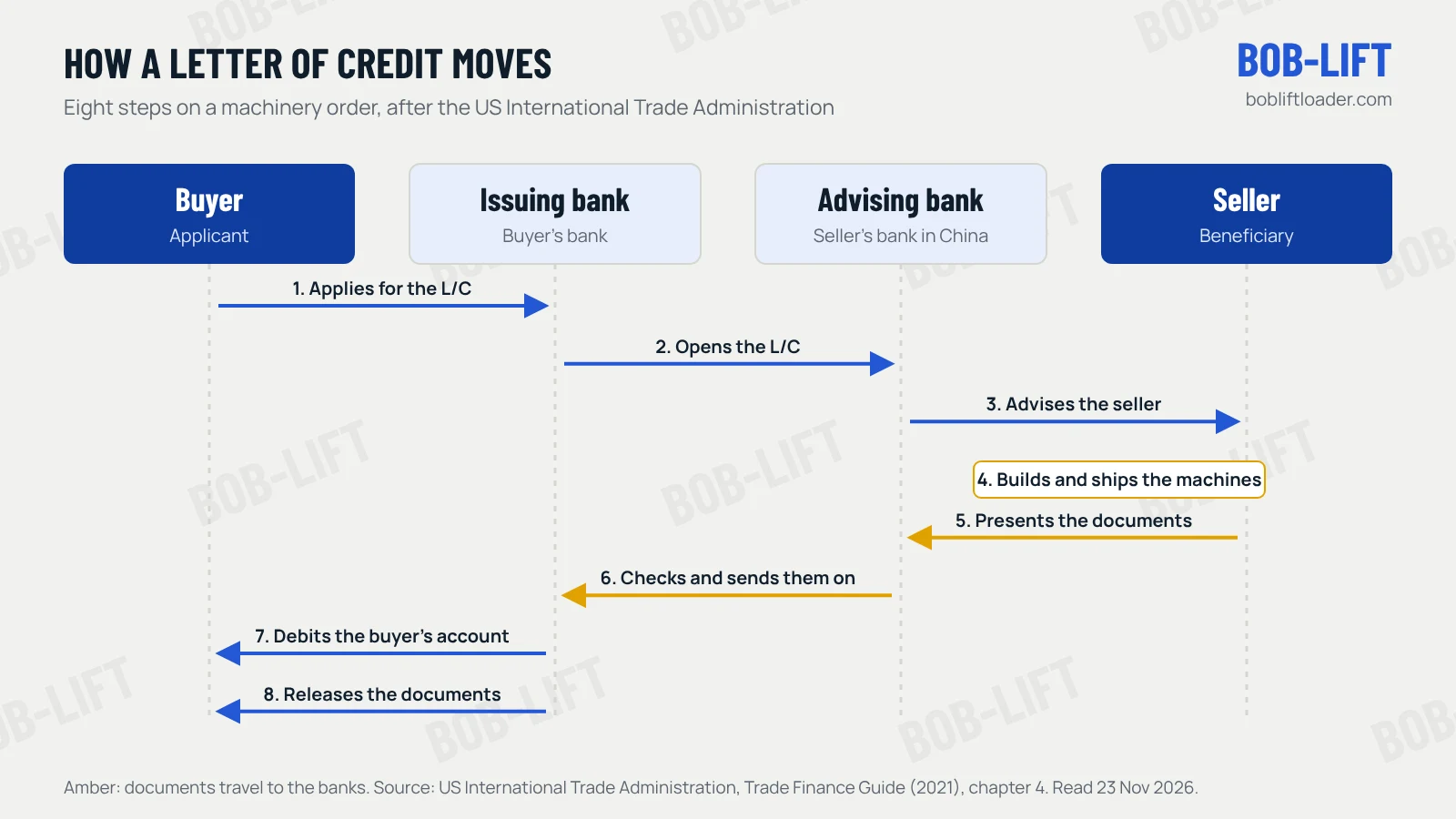
At step 4, read the L/C as soon as it is advised and ask for an amendment if any term cannot be met. Unless the credit says otherwise, it is irrevocable: it may not be changed or cancelled unless the buyer, the banks and the seller agree [1].
Which type of L/C to ask for
- Irrevocable. Under UCP 600, all credits are irrevocable, so the revocable type is increasingly obsolete [4].
- Confirmed or unconfirmed. A confirmed credit carries a second bank’s promise to pay, typically from a bank in the seller’s country. The ITA suggests exporters consider confirmation when they doubt the issuing bank’s credit standing or the importing country’s political or economic risk [1]. Confirmation adds a fee, which the contract should allocate.
- At sight or deferred. An at sight credit is paid once compliant documents are presented. A deferred or usance credit is paid after a set period, which gives you time to receive and sell the goods [4].
- Transferable, revolving and standby. A transferable credit can pass to a second beneficiary, in part if needed under UCP 600 Article 38 [3], and a revolving credit restores itself after each drawing [1]. A standby credit is a backstop, drawn only if a party defaults. Standbys usually follow ISP98, written by the Institute of International Banking Law and Practice and endorsed by the ICC Banking Commission. Under ISP98 Rule 5.01 the bank has 3 to 7 business days to examine a demand, and Rule 3.09 allows a standby to be renewed [3]. A single machinery order normally needs none of these.
Documents the credit should call for
The documents in the credit are your only control over what the bank pays for. List only what the seller can actually produce, and describe each one so it can be checked on paper. UCP 600 tolerates small differences between documents: data “need not be identical to, but must not conflict with” data in other documents or the credit [4]. A real conflict is a discrepancy. UCP 600 says nothing about the language of documents, so ICC practice points to ISBP 821 paragraph A21 [3]. If you need English documents, write that into the credit.
| Document | What the credit usually specifies | Where it goes wrong |
|---|---|---|
| Commercial invoice | Seller and buyer names, goods description, unit prices, total, trade term | A description or amount that conflicts with the credit |
| Packing list | Machines, attachments, weights and package count per container | Weights that differ from the bill of lading |
| Bill of lading | Full set of originals, made out to order or to the issuing bank, shipped on board, freight prepaid or collect | No on board date, a late shipment date, or the wrong consignee [7] |
| Certificate of origin | Issuing body and country of origin | Missing, or issued by a different body from the one the credit names |
| Insurance policy or certificate (CIF and CIP only) | Amount and risks covered | Cover below the amount the credit asks for |
| Inspection certificate (optional) | An inspection company, a date before loading and the checks made | Not asked for, so the bank pays on paperwork alone |
For the bill of lading, a credit normally asks for a full set of original, clean, shipped on board bills. Under UCP 600 sub-article 20(a)(ii), a bill presented under a credit must show the goods shipped on board a named vessel at the port of loading stated in the credit [7]. Pre-printed wording can do this, or a dated on board notation. UCP 600 Article 20 covers a port-to-port bill of lading. A multimodal or combined transport document falls under Article 19, which does not require an on board notation by default [7]. Our guide to the bill of lading for a machinery import explains order and straight bills, telex release and sea waybills.
If you want a check on the machines themselves, write it into the credit as a document. An inspection certificate from a named inspection company, dated before loading, turns a quality check into something the bank can verify. Our pre-shipment inspection guide lists what an inspector checks on a mini loader or dumper.
Dates to set: shipment, presentation and expiry
An L/C sets three dates, and they all have to fit around the production of your machines.
- Latest shipment date. The bill of lading must show an on board date on or before it. Our standard lead time is 8 to 30 working days, and the ship has to be booked too. Agree the production time first, then set the date.
- Presentation period. Under UCP 600 sub-article 14(c), the seller has up to 21 days after shipment to present the documents [3]. Original documents are required unless the credit says otherwise [3].
- Expiry date. The last day documents can be presented. It must come after the latest shipment date plus the presentation period.

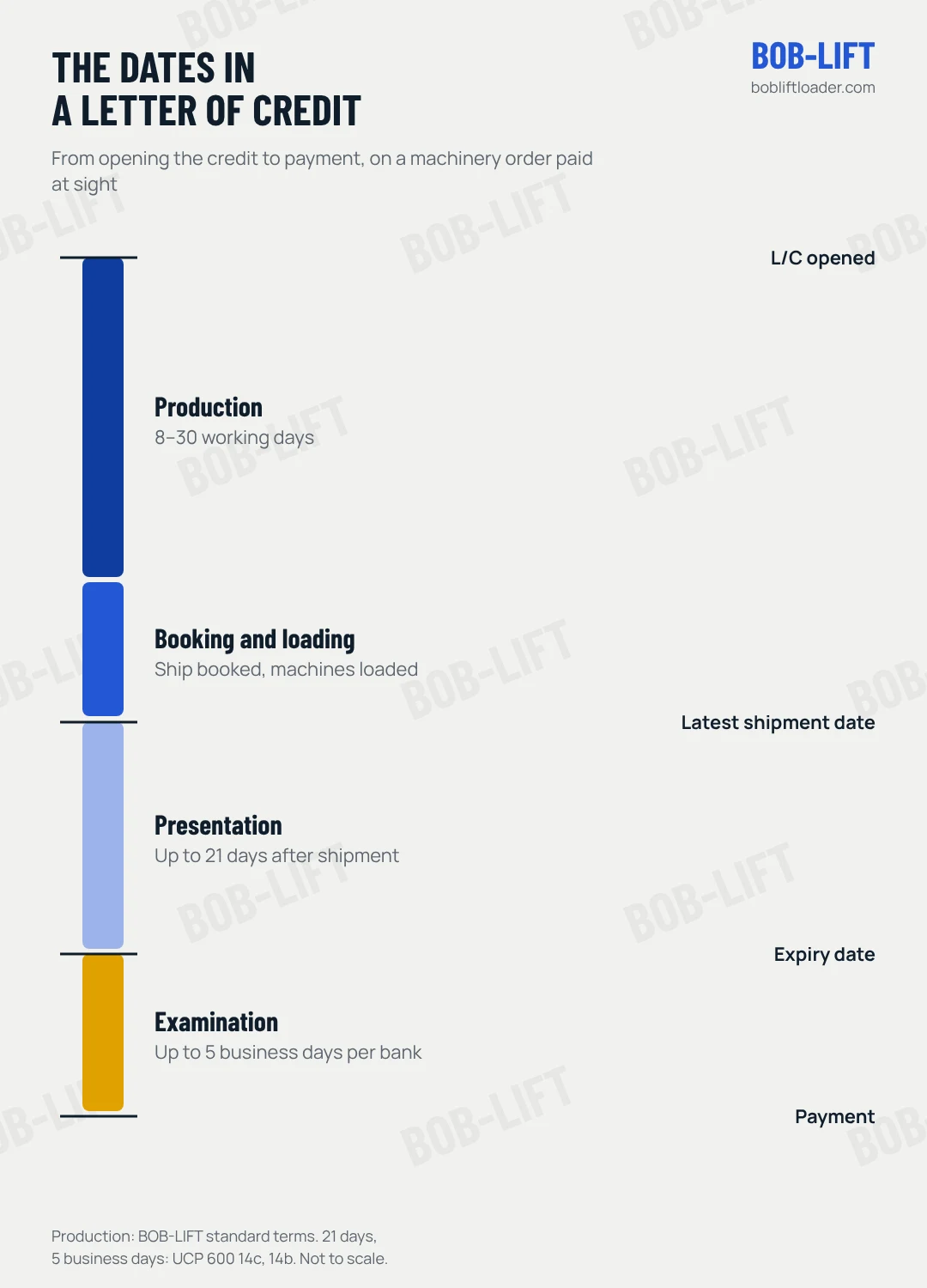
After presentation, banks have up to five business days to examine the documents under UCP 600 sub-article 14(b) [3]. Within those limits, payment on an at sight credit can come several weeks after the machines leave the port. The seller has up to 21 days to present, each examination takes up to five business days, and courier time between the banks comes on top. The seller finances the order for that whole period.
What happens if the documents do not match
If the documents do not comply, they are discrepant. The bank tells the beneficiary, and minor discrepancies can be fixed by presenting corrected documents within the time allowed [4]. Otherwise the bank can ask the applicant whether to accept the discrepancies. Documents presented after the time limits in the credit are discrepant too [4].
For a buyer, a discrepancy is a decision point. If the machines arrived as agreed and the discrepancy is a typing error, accepting it gets you your container. If it hides a real problem, such as a late shipment or a missing inspection certificate, it is your chance to stop payment. The ITA advises that L/C documents be prepared by trained professionals because they are “detailed and prone to errors and discrepancies” [2].
What an L/C costs compared with T/T
The ITA lists the drawbacks of an L/C as a labour-intensive process and relatively high transaction costs [1]. You pay your bank to open the credit, and banks will typically ask the applicant for collateral and charge a fee that is often a percentage of the amount [4]. The seller’s banks charge for advising and checking the documents, plus confirmation if it is added, and the sales contract decides who pays them. Amendments and discrepancies carry their own charges. Ask your bank for its tariff before you agree who pays which fee.
| T/T in advance | Letter of credit | Documentary collection | |
|---|---|---|---|
| Who promises payment | Nobody: the buyer pays first | The issuing bank, and the confirming bank if added [1] | Nobody: banks pass documents but do not guarantee payment [6] |
| When the buyer pays | Before shipment | When complying documents are presented, at sight or later | When the bank releases the documents |
| Do the banks check the documents? | No | Yes, against the credit [1] | No [6] |
| Cost | Bank transfer fees | Highest: fees at several banks [1] | Less than an L/C [1] |
| Paperwork | Light | Heavy: every document must comply | Moderate |
A documentary collection sits between the two. Banks exchange the documents for your payment but do not check them or guarantee payment, so it is cheaper than an L/C and is recommended only for established relationships [1] [6].
When an L/C makes sense for a machinery order
The ITA recommends letters of credit for higher-risk situations and new or less-established trade relationships [1]. For mini loaders and dumpers, that can mean a larger stock order for a dealership or a first order with a new factory, where the value justifies the fees. It also applies when a bank or finance provider funding the purchase requires one.
Our minimum order is one machine, so you can place a small T/T order, inspect the machine when it arrives and scale up once it meets your standard. Our guide to paying by T/T covers the deposit and balance split, and our FOB or CIF guide explains which trade term to name in the credit.
Frequently asked questions
Is a letter of credit safer than T/T for the buyer?
Yes, compared with paying by T/T before shipment. With an L/C, no payment is due until documents show the goods were shipped as agreed [1]. It does not prove the machines are in good condition, so add an inspection certificate if that matters.
Who pays the letter of credit fees?
The buyer pays the issuing bank for opening the credit [1]. Who pays the charges at the seller’s banks, for advising, checking documents and any confirmation, is a matter for the sales contract, so agree it before the credit is opened.
What is a confirmed letter of credit?
A credit to which a second bank, usually in the seller’s country, adds its own promise to pay. The seller is then paid by the confirming bank once it presents complying documents, even before the issuing bank reimburses it [1].
How long does a letter of credit take?
Opening it depends on your bank. After shipment, the seller has up to 21 days to present the documents, and banks have up to five business days to examine them [3].
Can I use a letter of credit for a single machine?
You can. The issuing bank’s fee is often a percentage of the amount covered [4], and the seller’s banks charge for their own work, so ask your bank for its tariff before you decide.
About these sources
- US International Trade Administration, Trade Finance Guide: A Quick Reference for U.S. Exporters, 2022 edition, chapters 2, 4 and 5.
- US International Trade Administration, Methods of Payment: Letter of Credit, trade.gov.
- ICC Academy, An Overview of UCP 600 and ISP98, 14 October 2025.
- Wikipedia, Letter of credit.
- US International Trade Administration, China Country Commercial Guide: Trade Financing, trade.gov.
- US International Trade Administration, Methods of Payment: Documentary Collections, trade.gov.
- ICC Banking Commission, Recommendations in respect of the requirements for an On board Notation, Document 470/1128rev final, 22 April 2010.
All sources were read on 23 November 2026. Our payment terms, minimum order and lead time are our own sales terms. This guide is general information, not legal or financial advice; ask your bank about its own fees and procedures. Read more about us and our factory.
Ask for a proforma invoice
Tell us the models and quantity you need, your destination port, the trade term and how you plan to pay. If your bank requires a letter of credit, say so in your enquiry so the terms can be agreed before the proforma invoice is issued. Send us your enquiry.