


A concrete buggy and a mini dumper do the same job: they carry wet concrete from the mixer or truck to the pour. This guide shows how many trips a cubic metre takes on each BOB-LIFT model, and when to choose tracks or wheels.
Key takeaways
- “Concrete buggy” and “power buggy” are US names for a small powered carrier that takes wet concrete from the mixer or truck to the pour. In the UK, a mini dumper or a tracked power barrow does the same job.
- Normal-strength concrete weighs about 2,240–2,400 kg per cubic metre. At 2,400 kg/m³, our 1,000 kg FC10 needs 3 trips per m³ and the 3,000 kg FY30 needs 1.
- On the 500 kg BL-T500-HD, the 0.2 m³ hopper fills before the weight limit, so plan on at least 5 trips per m³.
- Our dumpers range lists two models for concrete and small pours: the BL-T200-HJ mixes a batch in its 200 L drum, and the BL-T500-HD carries it in a tipping hopper. Both are 880 mm (34.6 in) wide.
- Rated load is the limit. Fill by weight, not to the rim.
What is a concrete buggy?
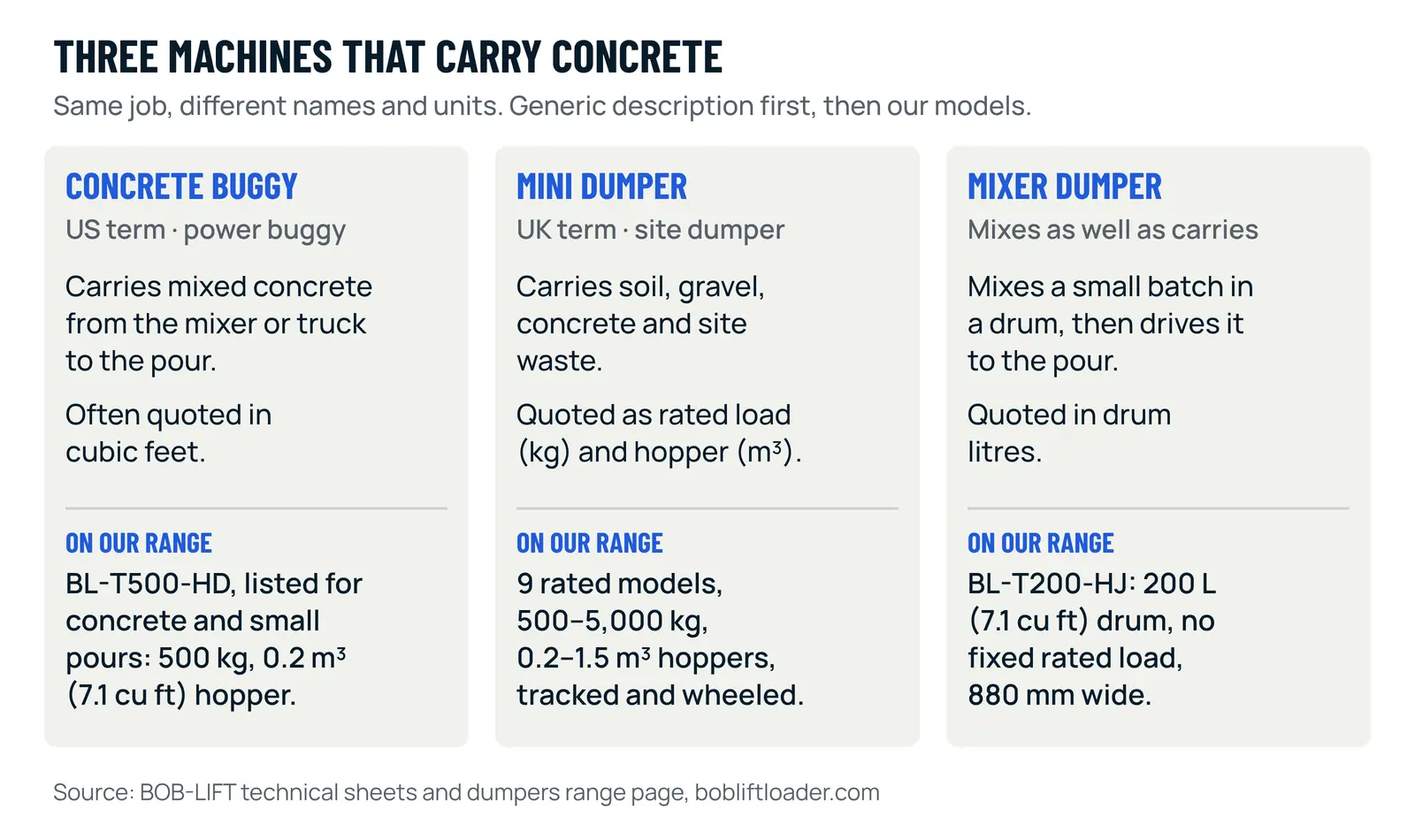
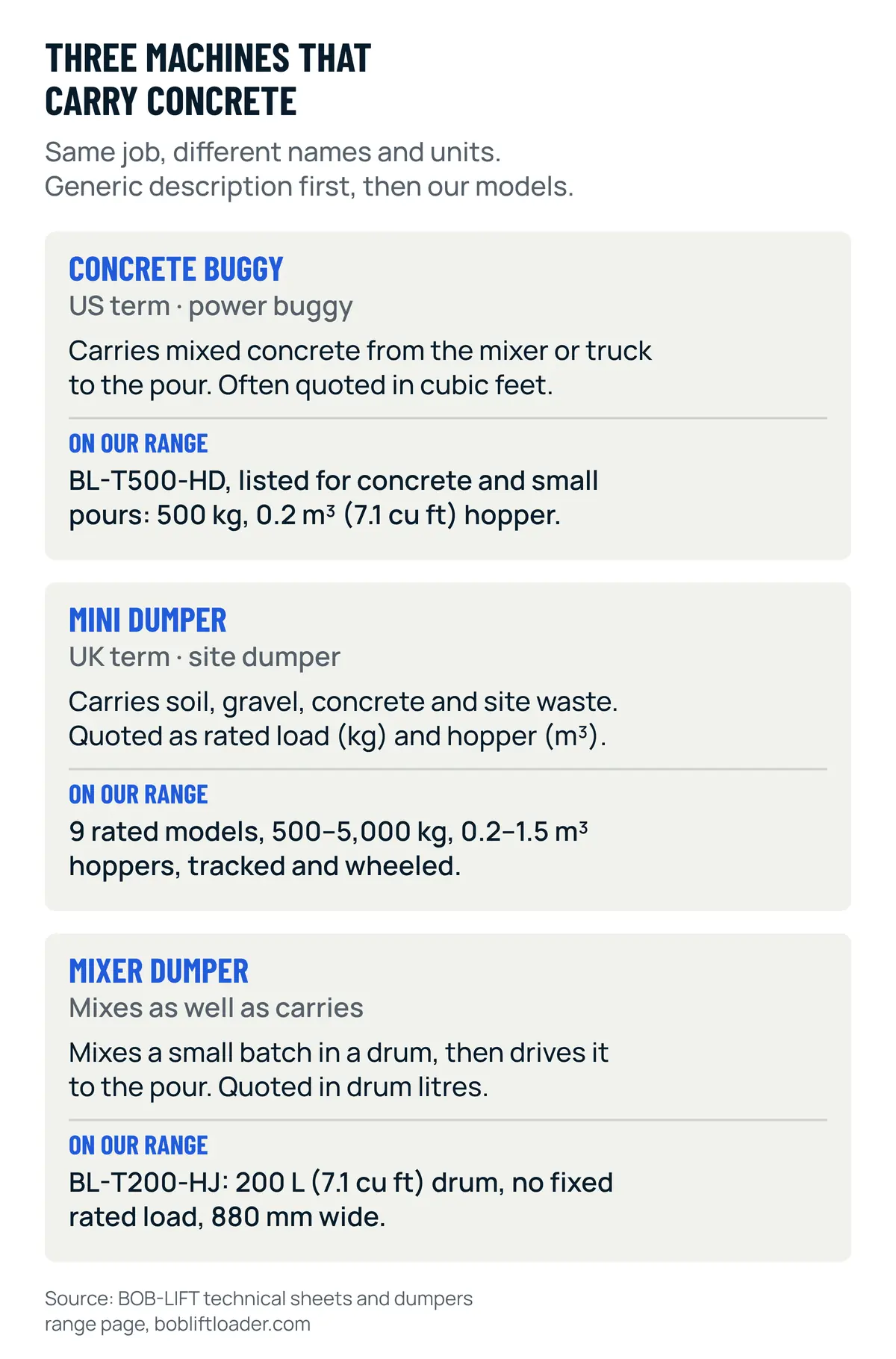
A concrete buggy is a small powered carrier with a hopper at the front. It moves wet concrete from the mixer or the ready-mix truck to the formwork, then tips it forward. “Power buggy” or “concrete power buggy” means the same machine, and some listings say “cement buggy”. These are mainly US terms. A tracked concrete buggy, sometimes listed as a track buggy, runs on tracks instead of wheels.
Outside the US, the same work usually goes to a mini dumper, also called a site dumper, or to a small tracked dumper often called a power barrow. The layout is the same: hopper in front, operator behind, forward tip at the pour. We call our machines mini dumpers, and none is sold as a dedicated concrete buggy. Our dumpers range page says mini dumpers “carry soil, gravel, concrete and site waste over ground a truck can’t reach”. For the smallest tracked machines, see our power barrow guide.
Concrete buggy vs mini dumper: what differs
The job is the same. What differs is how capacity is quoted and how big the machines get. US buggy listings often give capacity by volume, in cubic feet. A mini dumper is quoted by rated load in kilograms or tonnes, with hopper volume in cubic metres or litres.
| Feature | Concrete buggy (US usage) | Mini dumper (UK usage) | Our range |
|---|---|---|---|
| Capacity quoted as | Often volume, in cubic feet | Rated load (kg or t), plus hopper volume (m³ or L) | Rated load 500–5,000 kg; hopper 0.2–1.5 m³ |
| Main load | Wet concrete | Soil, gravel, concrete, site waste | Soil, gravel, concrete, site waste |
| Running gear | Wheels or tracks | Wheels or tracks | 2 tracked, 8 wheeled |
| Tipping | Forward, at the pour | Forward; swivel on some models | Wheeled: front tip, 45°, swivel optional. BL-T500-HD: 100°. BL-T200-HJ drum: 45° |
| Mixes concrete? | No, carries it | No, except mixer dumpers | Only the BL-T200-HJ mixer |
To compare a buggy listing with a mini dumper, convert the units. One cubic metre is 35.3 cubic feet, and one cubic yard is 27 cubic feet, or 0.765 m³. Our hoppers convert like this:
- 0.2 m³ (BL-T500-HD) = 7.1 cu ft
- 0.8 m³ (FC10, FY15) = 28.3 cu ft
- 1.0 m³ (FY20-2) = 35.3 cu ft
- 1.2 m³ (FY20-4) = 42.4 cu ft
- 1.5 m³ (FJZ30, FY30, FY40, FY50) = 53.0 cu ft
Volume is only half the answer. Concrete is heavy, so on most machines the rated load runs out before the hopper is full. The sizing section below shows the sums.
Our machines for concrete work
Our dumpers range page lists two models under “Concrete and small pours”: the BL-T200-HJ and the BL-T500-HD. In the page’s own words: “Mix a small batch in the tracked mixer’s 200 L drum and drive it to the pour, or carry it in a tipping hopper.”
BL-T200-HJ: mix and carry
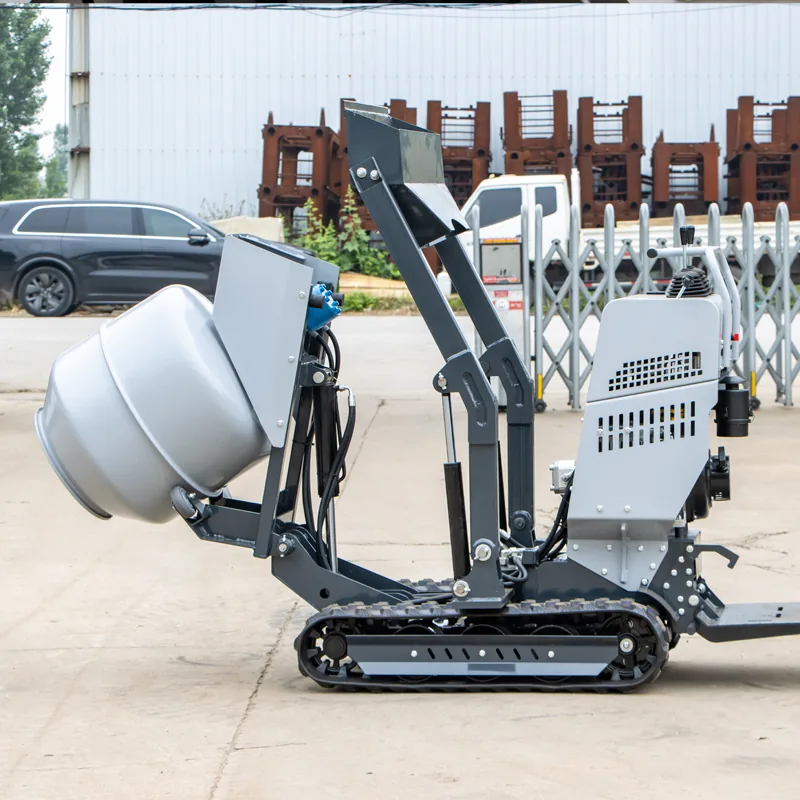
The BL-T200-HJ tracked mini mixer dumper has a 200 L drum fed by its own loading bucket. The drum tips hydraulically through 45° to pour. It is 880 mm wide on rubber tracks, weighs 465 kg, travels at up to 3 km/h and is rated for 20° slopes.
It is sold by drum volume, so it has no fixed rated load. As a rough guide, a load is about 200 to 400 kg, depending on the material. Choose it when the route is narrow or soft and the pour is too small to order ready-mix, or no ready-mix can be delivered.
BL-T500-HD: carry in a tipping hopper
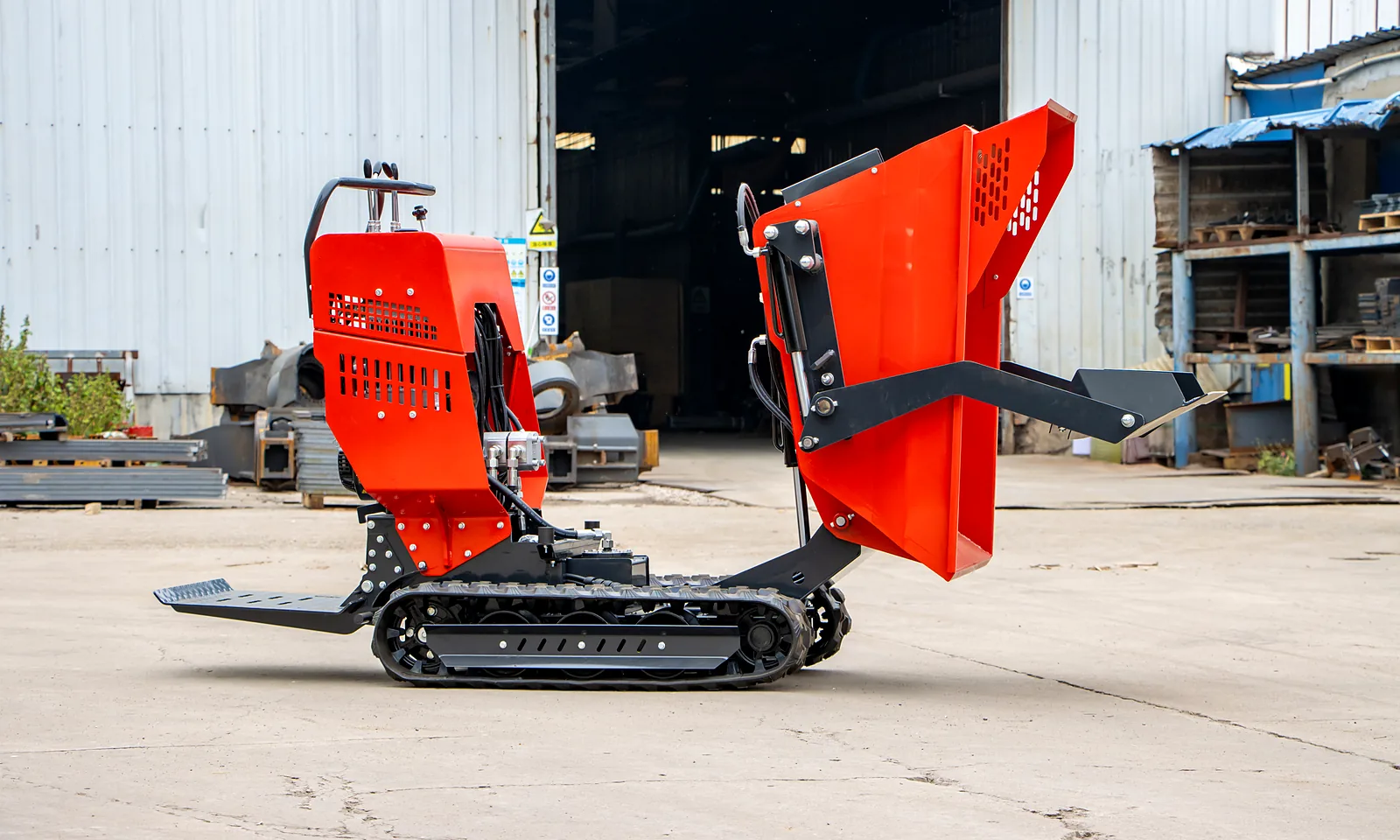
The BL-T500-HD is rated for 500 kg (1,102 lb) in a 0.2 m³ hopper with overall dimensions of 1,070 × 730 × 730 mm. It tips hydraulically through 100° and shares the mixer’s 880 mm width, 3 km/h top speed and 20° slope rating. It is the closest thing in our range to a tracked concrete buggy. It suits ready-mixed concrete, or concrete from a site mixer, that has to travel down a side passage or across a lawn.
Wheeled dumpers for larger pours
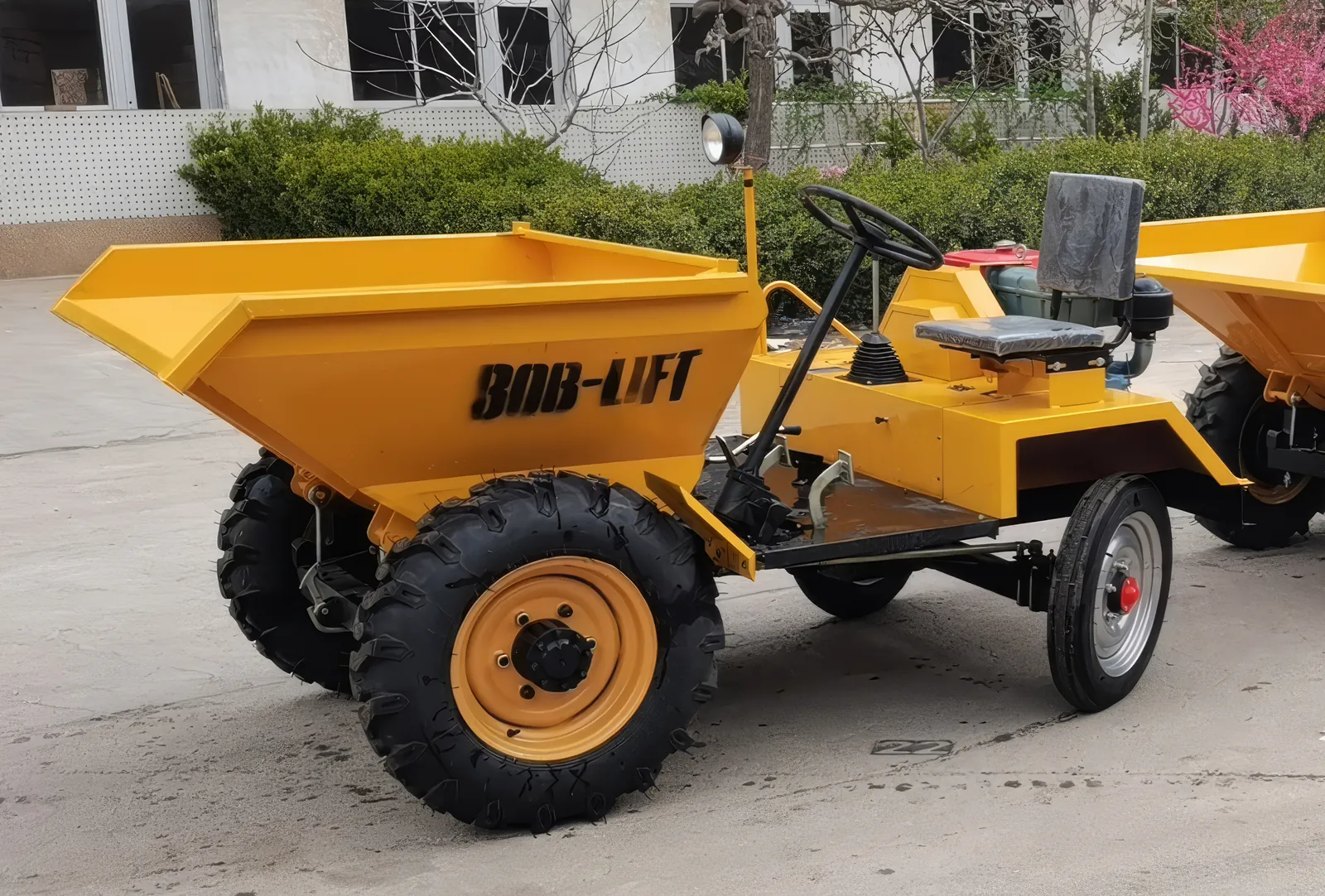
Our eight wheeled dumpers are not listed specifically for small pours, but our range page lists concrete among the loads mini dumpers carry. The entry model, the FC10, is rated for 1,000 kg (2,205 lb) with a 0.8 m³ hopper. It tips forward mechanically as standard, with hydraulic tipping as an option, and lists a dump height of 1,800 mm. It is 1,500 mm (59.1 in) wide and travels at up to 22 km/h.
Above it, the FY models and the FJZ30 tip hydraulically and are rated from 1,500 to 5,000 kg. The FY30 3 ton mini dumper, for example, carries 3,000 kg (6,614 lb) in a 1.5 m³ hopper. Our guide to site dumper sizes compares all the wheeled classes.
Sizing for a pour: how many trips per cubic metre?
Normal-strength concrete weighs 2,240–2,400 kg/m³ (about 140–150 lb/ft³), according to Engineering ToolBox. We use 2,400 kg/m³ so the figures stay on the safe side. On that basis, a cubic metre weighs about 2,400 kg (5,291 lb), and a cubic yard (0.765 m³) about 1,835 kg (4,045 lb).
Three steps give you the number of trips:
- Work out the pour volume. Multiply length × width × depth, in metres. A 3.0 × 2.4 m shed base, 100 mm deep, is 3.0 × 2.4 × 0.1 = 0.72 m³.
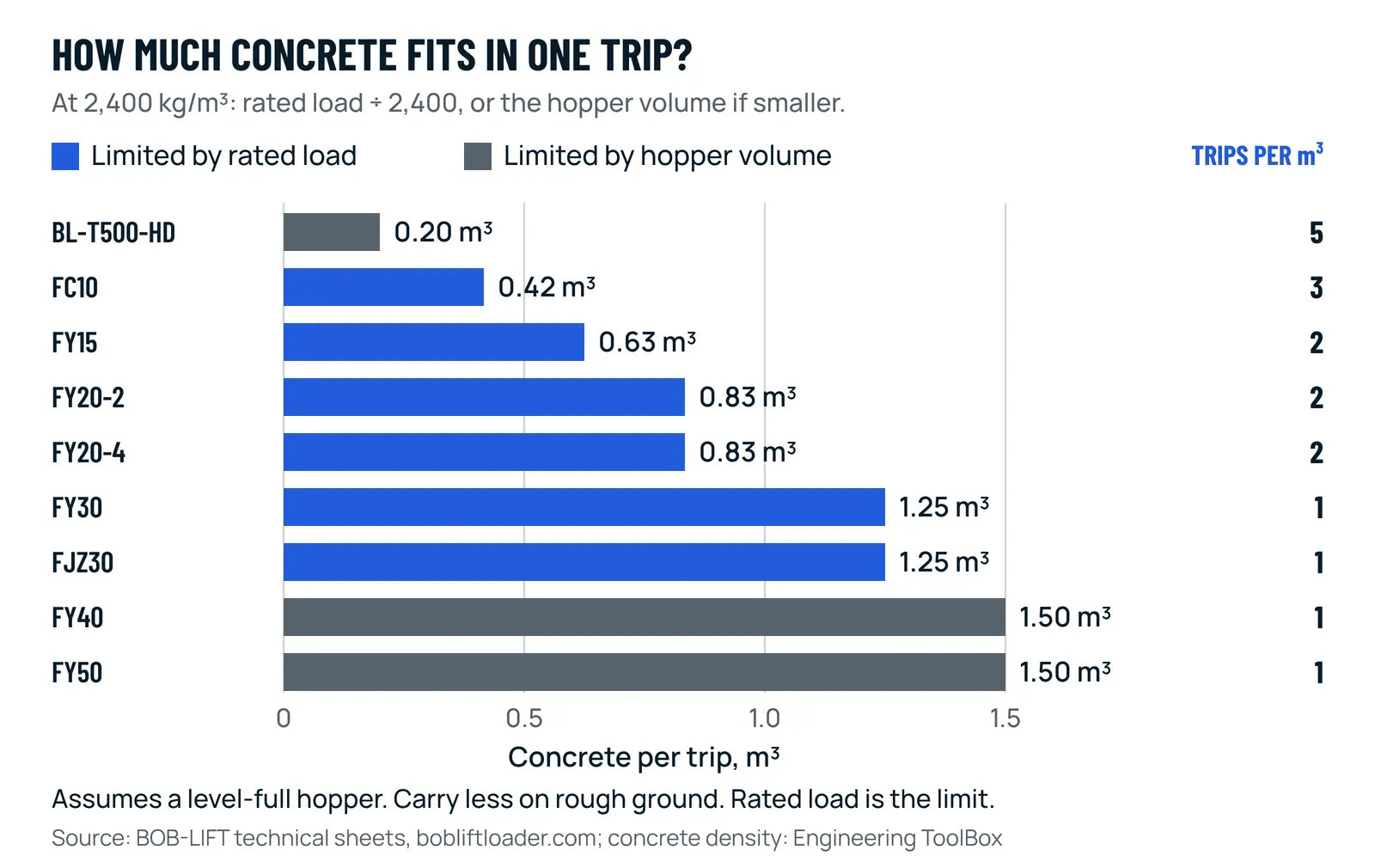
- Find the most one trip can carry. Divide the rated load by 2,400. If the hopper volume is smaller than the result, the hopper is the limit.
- Divide and round up. Pour volume ÷ concrete per trip = number of trips.
| Model | Rated load | Hopper | Concrete per trip | Limited by | Trips per m³ |
|---|---|---|---|---|---|
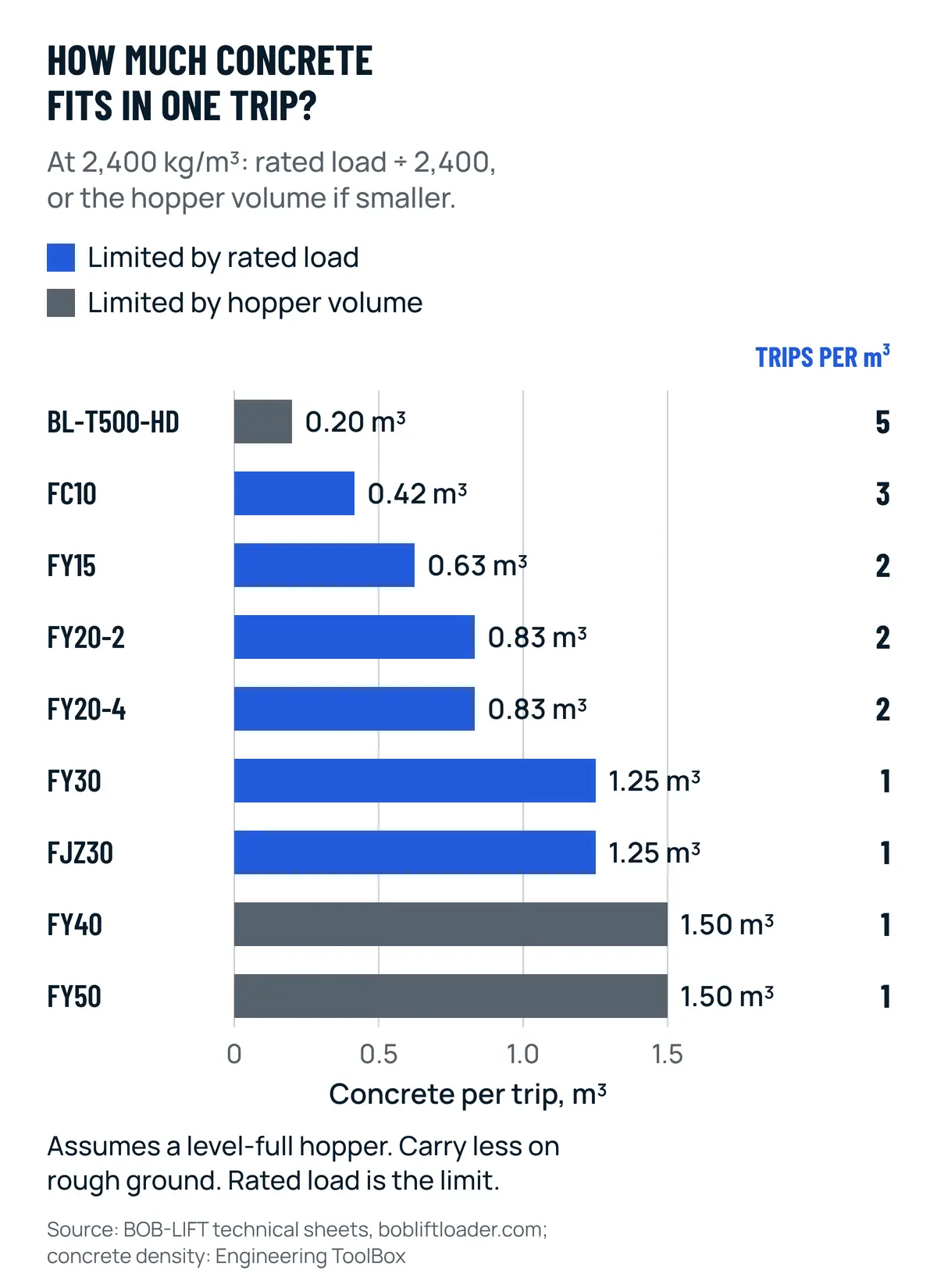
| BL-T500-HD | 500 kg | 0.2 m³ | 0.20 m³ (480 kg) | Hopper | 5 |
| FC10 | 1,000 kg | 0.8 m³ | 0.42 m³ | Rated load | 3 |
| FY15 | 1,500 kg | 0.8 m³ | 0.63 m³ | Rated load | 2 |
| FY20-2 | 2,000 kg | 1.0 m³ | 0.83 m³ | Rated load | 2 |
| FY20-4 | 2,000 kg | 1.2 m³ | 0.83 m³ | Rated load | 2 |
| FY30 | 3,000 kg | 1.5 m³ | 1.25 m³ | Rated load | 1 |
| FJZ30 | 3,000 kg | 1.5 m³ | 1.25 m³ | Rated load | 1 |
| FY40 | 4,000 kg | 1.5 m³ | 1.50 m³ (3,600 kg) | Hopper | 1 |
| FY50 | 5,000 kg | 1.5 m³ | 1.50 m³ (3,600 kg) | Hopper | 1 |
Rated loads and hopper volumes from our product pages, checked 15 October 2026. Concrete at 2,400 kg/m³, level-full hopper. Where the hopper is the limit (BL-T500-HD, FY40, FY50), leaving room below the rim can add trips.
For the 0.72 m³ shed base, the FC10 needs 0.72 ÷ 0.42 = 1.7, so 2 trips. The BL-T500-HD needs 0.72 ÷ 0.2 = 3.6, so 4 trips. The FY20-2 carries it in one, because 0.72 m³ is less than its 0.83 m³ limit.
The BL-T200-HJ works differently. Its 200 L drum is 0.2 m³, so a cubic metre takes at least 5 batches. If a batch weighs 400 kg, the top of our rough guide, that is about 0.17 m³ (400 ÷ 2,400), or about 6 batches per m³. Tell us your mix and we will confirm what suits the machine. Our mini concrete mixer truck guide shows the batch count for common small pours.
Treat every figure in the table as the most a trip should carry, not a target. The table assumes a level-full hopper, and wet concrete moves on rough ground and ramps, so leave room below the rim. Never top up a hopper because there is space left in it: the rated load is the limit.
Tracks or wheels for concrete jobs
Choose tracks for narrow or soft routes. Choose wheels for firm routes with room to spare beside the machine: the FC10 and FY15 are 1,500 mm wide and the largest models up to 1,800 mm, so a gate of about 1.5 m or less is tracked work. Both tracked models are 880 mm (34.6 in) wide on rubber tracks, travel at up to 3 km/h and are rated for 20° slopes. Our wheeled dumpers are 1,500 to 1,800 mm (59.1 to 70.9 in) wide and travel at 22 to 28 km/h.
Start with the route from where the concrete arrives to where it goes. A back-garden slab reached through a side gate and over a lawn is tracked work. A footing across a firm building site, with the truck parked at the gate, is wheeled work. There, speed matters, because the concrete keeps stiffening while it travels.
Check ground clearance too: 100 to 110 mm on the tracked models, against 200 to 250 mm on the wheeled ones. On slopes, our wheeled spec sheets give 21° as the theoretical maximum and recommend 18° or less in work. Our tracked vs wheeled mini dumper guide covers the trade-offs in full.
Tipping wet concrete
All eight wheeled dumpers tip forward through 45°. The FC10 does it mechanically as standard; the FY models and the FJZ30 tip hydraulically. The BL-T500-HD tips hydraulically through 100°, and the BL-T200-HJ tips its drum hydraulically through 45°.
The 100° tip on the BL-T500-HD turns the hopper past upright. Wet, sticky concrete then has a steeper slope to slide down than it would at 45°. Whatever the machine, position it so the load lands inside the forms before you tip.
For a strip footing or a trench fill beside the machine, a swivel side-tip hopper lets you drive along the line and tip sideways. It is an extra-cost option on every wheeled model. If you tip over a form, wall or skip side, check that its height is below the dump height, which runs from 1,800 to 2,700 mm on the wheeled range. Our guide to front-tip and swivel dumpers explains the choice in detail.
Wash out after the last load
Rinse the hopper or drum as soon as the last load is tipped, before any residue sets. Set concrete adds weight to every later load and takes up hopper space. Use the wash-out point your site provides, and keep the wash water out of drains.
Safe operation around the pour
Overturning is the biggest risk. The HSE dumpers page says over 60% of dumper deaths involve the driver being crushed when the vehicle overturns. A pour adds open edges, temporary ramps and a liquid load. Plan for each:
- Formwork and trench edges. Set stop blocks well back from the edge, as HSE’s site dumper sheet CIS52 advises, so the wheels or tracks stop before the ground gives way.
- Ramps and boards. Keep every ramp well inside the machine’s slope rating (20° maximum on our tracked models; 18° or less in work on the wheeled ones), and flatter still with a full load of wet concrete. Make it firm and wider than the machine, and drive straight up and down it.
- The load. Keep it even and below the rim. It must not block the driver’s view.
- People. Keep the pour crew out of the machine’s path and away from the tip point.
- Travel. Lower the hopper or drum fully before you move off.
- Seat belt. On a ride-on dumper with a roll-over protective structure, wear the seat belt, as HSE advises.
Operators need training for the machine they drive. Our dumper ticket guide covers what that involves in the UK.
Frequently asked questions
What is a concrete buggy used for?
A concrete buggy carries wet concrete from the mixer or ready-mix truck to the pour, where a truck chute or pump cannot reach. Typical jobs are slabs, footings, paths and post holes behind houses, in back gardens and in tight corners of a site. It replaces many wheelbarrow trips with fewer, larger loads.
How much concrete does a power buggy carry?
It depends on the model’s rated load and hopper volume. On our range, the most concrete per trip runs from 0.2 m³ on the 500 kg BL-T500-HD to 1.5 m³ on the FY40 and FY50, at 2,400 kg/m³. Divide the rated load by 2,400 to find the limit, and use the hopper volume if it is smaller.
Is a mini dumper the same as a concrete buggy?
They do the same job under different names. “Concrete buggy” is the US term, and US listings often give capacity in cubic feet. “Mini dumper” is the UK term, quoted by rated load in kilograms and hopper volume in cubic metres. Mini dumpers also carry soil, gravel and site waste.
Can a mini dumper mix concrete?
A standard hopper dumper cannot; it only carries. Our BL-T200-HJ is a mixer dumper: its loading bucket fills a 200 L drum, which mixes the batch and tips it at the pour. If you already run a mini skid steer loader, a concrete mixer attachment is another way to mix small batches on site.
Choosing a carrier for your pour
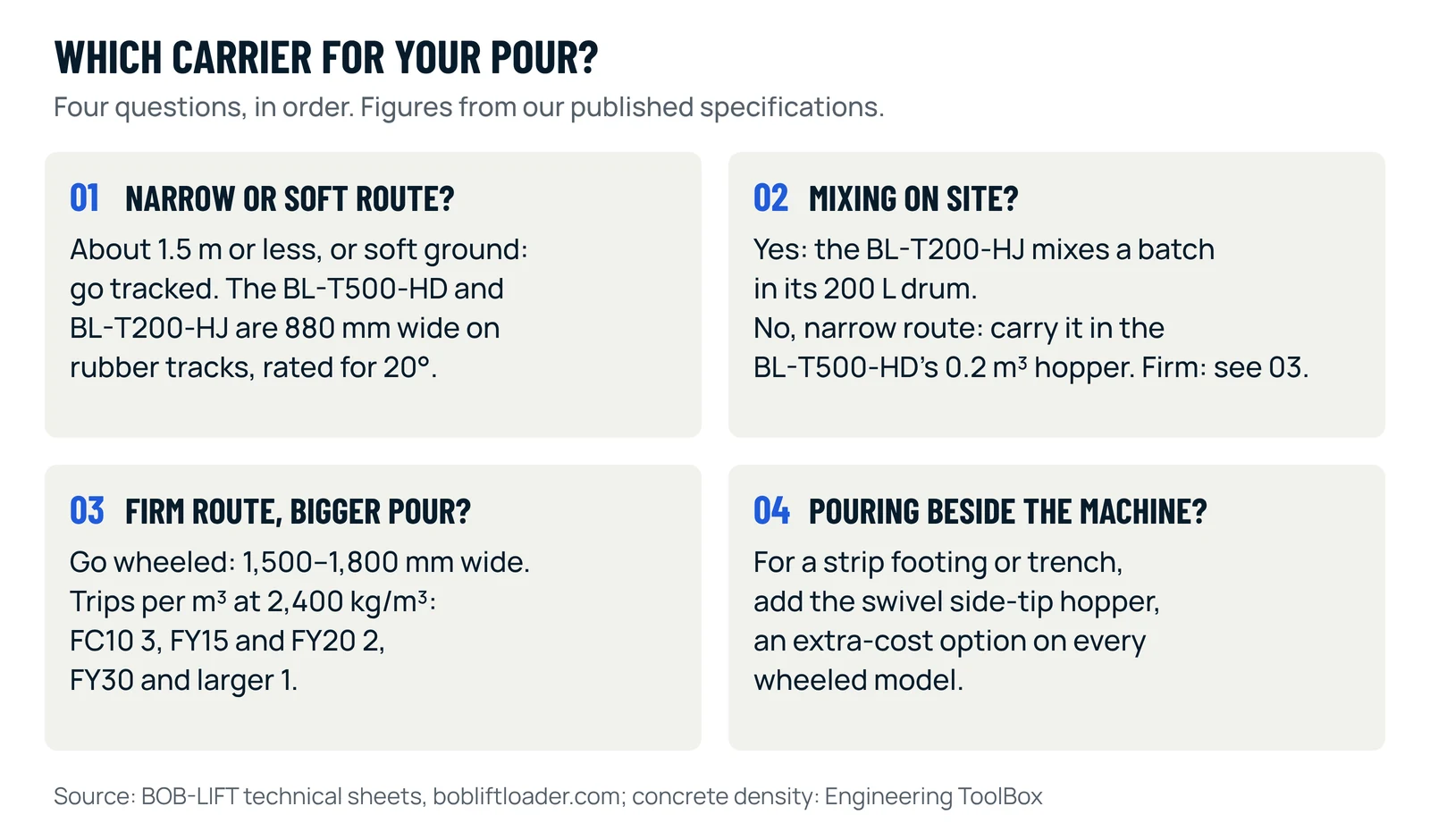
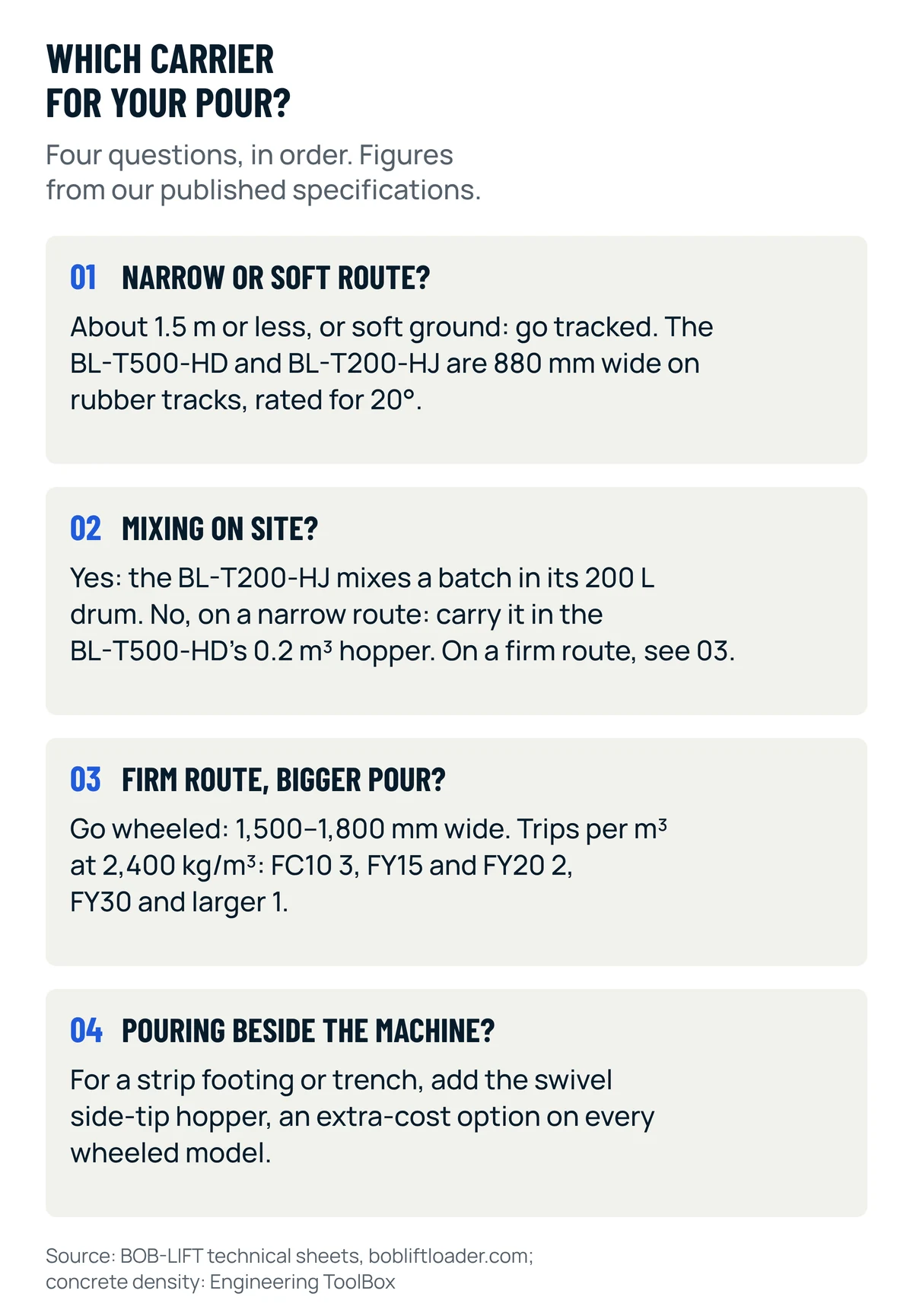
Start with the route, then the pour size. Through a narrow gate or over soft ground, choose the 880 mm BL-T200-HJ to mix on site or the BL-T500-HD to carry. On a firm site with a bigger pour, use the trips table to size a wheeled dumper, and add the swivel hopper if you pour beside the machine.
Compare every model on our mini dumper range page and see the models we suggest for building sites. Then send us the pour volume and a few photos of the route, and our team will suggest the machine to match.