


A used mini skid steer is a good buy when the hours are documented, the hydraulics hold a load, the tracks or tyres have life left and the engine still carries its emission label. If any of those four checks fails, the money you save up front usually goes into repairs. A new machine from the factory costs more on the day. In return, you choose the engine and attachments, you get a 12-month whole-machine warranty, and nobody has run it hard before you.
This guide is for contractors, landscapers, farmers and rental yards in the United States weighing a used mini skid steer against a new one. It gives a 12-point inspection you can do in about an hour, the emission rule that catches people who import a used machine, and a plain comparison of when each choice makes sense. We build nine mini skid steers at our factory in Xuzhou, China, so we cover the new side from our own mini skid steer range. We do not sell used machines, and the checklist below works on any brand. You can read more about our company and factory, or contact our team with questions.
Key takeaways
- Check the hour meter against the service records, then test for lift-arm drift with a loaded bucket. Drift points to worn cylinder seals or valves.
- Pin and bushing play at the lift arms and the quick-attach plate is normal wear, but cracks around the plate or welded repairs on the frame are a reason to walk away.
- Look for the engine’s emission label. Removing or disabling emission controls is prohibited under 40 CFR 1068.101 [1].
- Importing a used diesel machine without a certificate of conformity is generally prohibited for engines built after the federal dates [2].
- New from our factory: 200 to 500 kg rated load, EPA Tier 4 engines, 12-month warranty, one-machine minimum order and dispatch in 8 to 30 working days.
Is a used mini skid steer worth buying?
Yes, if the machine passes an inspection and the seller can show where it has been. A used mini skid steer is a compact loader that someone has already owned and put to work. It works its hydraulics, tracks and pins hard. So its condition depends far more on how it was used than on its age. Two machines with the same hours can be very different: one moved mulch on a lawn, the other broke concrete with a hammer every day.
The safe way to buy used is to treat the seller’s description as a claim and check each part of it yourself. If the seller will not let you start the machine cold, lift a load or look under the covers, that tells you enough.
The 12-point used mini skid steer inspection
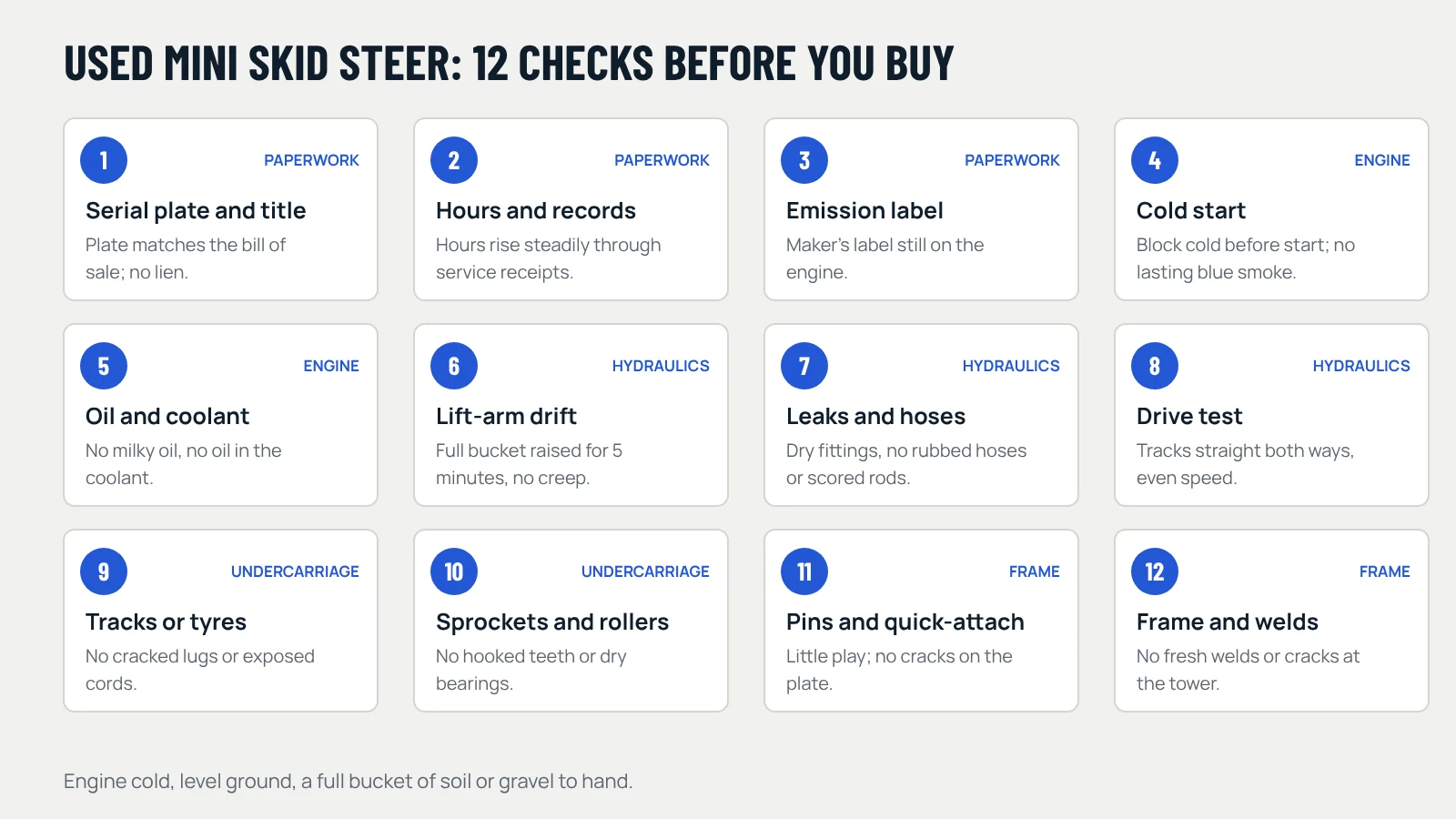
Do these checks with the engine cold, on level ground, with a full bucket of soil or gravel available. Wear gloves and eye protection. Keep your hands away from pressurised hoses, and check for leaks with a piece of cardboard, not your fingers.

Paperwork and identity
- Serial plate and title. Match the serial number on the frame plate with the bill of sale, and ask for proof the seller owns it outright. A machine that was financed may still carry a lien.
- Hour meter and service records. Hours should rise steadily through oil change and filter receipts. A low reading with a worn seat, pedals and grab handles suggests a replaced meter.
- Emission label. The engine should carry the maker’s emission control label, with the engine family name. A missing label makes the machine harder to resell and register for some jobs.
Engine
- Cold start. Feel the engine block before the seller runs it. A warm block hides hard starting. Watch the exhaust: a little smoke at start-up is normal on a diesel, but blue smoke that stays means the engine is burning oil.
- Oil and coolant. Milky engine oil or oil in the coolant can mean a head gasket problem. Check the air filter housing for dust past the filter.
Hydraulics
- Lift-arm drift. Drift is the slow fall of raised lift arms with the controls in neutral. Raise a full bucket to about waist height, switch off and watch the arms for five minutes. If they creep down, the lift cylinders or valve are leaking inside.
- Leaks and hoses. Look for wet fittings, cracked hose covers and rubbed spots where hoses touch the frame. Check the cylinder rods for scoring or rust, which wears the seals.
- Drive test. Drive straight across flat ground in both directions. A machine that pulls to one side, or is slow in one direction, may have a worn drive motor or pump.
Undercarriage and frame
- Tracks or tyres. On rubber tracks, look for cracks across the lugs, missing lugs and exposed steel cords. On tyres, check tread depth and sidewall cuts.
- Sprockets, idlers and rollers. Sprocket teeth worn to hooked points chew through new tracks. Spin the rollers by hand where you can and listen for dry bearings.
- Pins, bushings and quick-attach. Rock the bucket and lift arms by hand and feel for play. Check the quick-attach plate and its locking pins for cracks, bending and welds.
- Frame and welds. Look under the lift arms and around the loader tower for cracks or fresh welds and paint. A repaired frame can hide an overload or a rollover.
The emission rule for used machines
For a machine already in the United States, the main rule is simple: leave the emission controls alone. Under 40 CFR 1068.101(b)(1), no one may remove or render inoperative any emission control device or element of design installed on an engine, before or after it is sold [1]. A seller who has “deleted” parts of the system has sold you a problem, so compare the engine with its label and manual.
Importing a used machine is stricter. A certificate of conformity is the document the EPA issues for an engine family that meets its emission standards. The federal definition of a new nonroad diesel engine says that an imported engine with no certificate of conformity at the time of import counts as new if it was built on or after the dates in the rule’s table. The same definition adds that importing such an engine, or equipment containing one, is generally prohibited [2]. The import rules in 40 CFR 1068.301 say engines and equipment you import must be covered by a certificate of conformity, apart from limited exemptions, and that you complete the EPA declaration before importing [3]. So a cheap used loader from overseas with an uncertified engine may not clear customs at all.
A new machine from us arrives with an engine that carries its maker’s certificate, and you can check any engine family against the EPA’s public engine certification data [4]. Our EPA and customs checklist for importing from China walks through the declaration and label photos step by step.
Used or new: which suits your job?
Price is only one line in the decision. The table compares the points that usually decide it. We do not publish prices, so ask for a quotation and set it against the used machines you are looking at.
| Point | Used mini skid steer | New from our factory |
|---|---|---|
| Hours and history | Depends on the records; often unknown | Zero hours, tested before dispatch |
| Warranty | Usually sold as is, unless a dealer adds cover | 12 months on the whole machine |
| Availability | Today, if one is for sale near you | Dispatch in 8 to 30 working days, then shipping time |
| Engine choice | Whatever is fitted | Petrol or diesel, with a choice of engine brands |
| Emission paperwork | Check the label is still there | EPA Tier 4 engine; certificate shared with buyers |
| Parts | Local dealer, if the brand has one | Original parts by model and serial number, shipped from China |
| Matching units | Hard to find several of the same model | One machine minimum; repeat orders built to the same spec |
A used machine makes sense when you need one loader this week, a local dealer stocks parts for that brand, and the inspection above comes back clean. A new machine makes sense when you will run it every day, want a warranty, need a particular width or engine, or plan to buy several of the same model, for example for a rental fleet. Our guide to what to check on a Chinese mini skid steer covers the questions to put to any factory.
What you get with a new BOB-LIFT mini skid steer
We build five stand-on and four seated mini skid steers, rated from 200 to 500 kg. Machine weights run from 650 kg for the BL-T360-H to 1,250 kg for the BL-T1000-H. Every loader engine is listed on our sheets as EPA Tier 4 / EU Stage V, with petrol or diesel options depending on the model.
| Model | Operator | Running gear | Rated load | Machine weight | Width |
|---|---|---|---|---|---|
| BL-T360-H | Stand-on | Rubber tracks | 200 kg | 650 kg | 930 mm |
| BL-T460-H | Stand-on | Rubber tracks | 300 kg | 730 kg | 1,090 mm |
| BL-S750-H | Stand-on | Wheels | 400 kg | 1,000 kg | 985 mm |
| BL-T750-H | Stand-on | Rubber tracks | 410 kg | 1,100 kg | 985 mm |
| BL-T1000-H | Stand-on | Rubber tracks | 500 kg | 1,250 kg | 960 mm |
| BL-S390-C | Seated | Rubber tyres | 260 kg | 650 kg | 959 mm |
| BL-T390-C | Seated | Rubber tracks | 250 kg | 750 kg | 955 mm |
| BL-S490-C | Seated | Rubber tyres | 250 kg | 850 kg | 1,089 mm |
| BL-T490-C | Seated | Rubber tracks | 250 kg | 950 kg | 1,089 mm |
Use new specifications as a yardstick
When a used listing gives a lifting capacity, hydraulic pressure or dump height, compare it with a new machine of the same size. A used loader that cannot lift close to its listed figure in the drift test is worn. These are the figures for our nine models when new.
| Model | Lifting capacity | Bucket | Hydraulic pressure | Engine power | Max dump height |
|---|---|---|---|---|---|
| BL-T360-H | 300 kg | 0.15 m³ | 17 MPa | 7.6 kW | 1,340 mm |
| BL-T460-H | 375 kg | 0.15 m³ | 17 MPa | 16.8 kW | 1,340 mm |
| BL-S750-H | 450 kg | 0.15 m³ | 18 MPa | 18.6 kW | 1,700 mm |
| BL-T750-H | 525 kg | 0.15 m³ | 18 MPa | 18.6 kW | 1,826 mm |
| BL-T1000-H | 650 kg | 0.19 m³ | 20 MPa | 17.8 kW | 1,522 mm |
| BL-S390-C | 290 kg | 0.1 m³ | 16 MPa | 7.6 kW | 1,376 mm |
| BL-T390-C | 300 kg | 0.1 m³ | 16 MPa | 7.6 kW | 1,404 mm |
| BL-S490-C | 350 kg | 0.1 m³ | 16 MPa | 16.8 kW | 1,382 mm |
| BL-T490-C | 350 kg | 0.1 m³ | 16 MPa | 16.8 kW | 1,402 mm |
Before each loader leaves the factory we run three checks: the hoses and tanks are inspected, the engine is started and every function and the travel drive are tested, then the machine is checked for leaks and cooling, and the hoses are checked again. You can order one machine, pay by T/T and buy on FOB, CIF, EXW, DDP, FCA or DAP terms. After delivery, send us the model, serial number and a photo or video of a problem, and our team will guide the fix remotely and ship the parts. We also keep a list of original wear parts you can order with the machine. See our mini skid steer parts guide for what to keep on the shelf.
After you buy: the first 50 hours
Whichever way you go, change the engine oil and filters early and check every hose clamp and track tension after the first days of work. On a used machine this gives you a known starting point. On a new one it clears the running-in deposits. Our mini skid steer maintenance checklist lists the daily pre-start checks, the engine and hydraulic service items and the running gear inspection.
Frequently asked questions
How many hours is too many on a used mini skid steer?
There is no single cut-off. Hours tell you less than the service records and the inspection. A machine with more hours, regular oil changes and no lift-arm drift can be a better buy than a low-hour machine with no records and worn pins.
What is the most expensive part to replace on a used mini skid steer?
On most machines, the engine, the hydraulic pump and drive motors cost the most, followed by a full set of rubber tracks. That is why the cold start, the drift test and the drive test matter most.
Can I import a used mini skid steer into the United States?
Only if its engine is covered by an EPA certificate of conformity or qualifies for a limited exemption. An uncertified engine built after the federal dates counts as new on import, and importing it is generally prohibited [2].
Do you sell used or refurbished mini skid steers?
No. We only build and sell new machines from our factory in Xuzhou, China, with a 12-month warranty on the whole machine.
How fast can a new one arrive?
We dispatch in 8 to 30 working days, depending on the model and order size, and then the container is at sea. A 40HQ container carries 10 to 30 of our loaders on steel racks; our container loading guide gives the count for each model.
About these sources
Machine figures, warranty, build times, factory tests and trade terms come from our own specification sheets and factory terms, checked on 8 November 2026. The emission and import rules are quoted from the Electronic Code of Federal Regulations [1]–[3], and engine certificates can be checked in the US EPA database [4], all read on 8 November 2026. The inspection checklist is general guidance for buyers, not a substitute for a mechanic’s inspection.
Ask for a quote on a new mini skid steer
Tell us the job, the width you need, petrol or diesel, the attachments and the number of machines. We will reply with the specification sheets, the engine certificate, the build time and a quotation on your trade terms. Send us your requirements.
Sources: [1] 40 CFR 1068.101, General prohibitions; [2] 40 CFR 1039.801, Definitions (new nonroad engine); [3] 40 CFR 1068.301, General provisions for importing engines/equipment; [4] US EPA, engine certification data.