


T/T payment means paying by telegraphic transfer. It is an electronic bank transfer from your business account to the seller’s, usually sent over the network of the Society for Worldwide Interbank Financial Telecommunication (SWIFT) [3]. For mini skid steers and mini dumpers from China, T/T is the standard way to pay. A deposit starts production, and the balance is paid before the machines ship. Once the money arrives it is hard to get back, so the protection has to come from the order terms, not from the payment method.
This guide is for dealers, hire fleets and contractors placing a first order with a Chinese manufacturer, written from our factory in Xuzhou, Jiangsu Province. Our own terms are simple: a minimum order of one machine, payment by T/T and a 12-month warranty on the whole machine.
Key takeaways
- T/T is an international bank wire. T/T, TT, telex transfer and SWIFT transfer all describe the same kind of payment [3].
- Paid before shipment, T/T is cash in advance. The US International Trade Administration calls it the most secure method for the exporter and the least attractive for the buyer [1] [2].
- Most machinery orders split the payment into a deposit with the order and a balance before loading or against a copy of the bill of lading. The split is a contract term, so get it on the proforma invoice.
- Choose OUR or SHA on purpose. Under SHA, bank fees can be taken from the payment, so the seller may receive less than you sent [4].
- Never pay new bank details from an email alone. The FBI counted US$55.5 billion in exposed losses to business email compromise between October 2013 and December 2023 [6].
What does T/T payment mean?
A telegraphic transfer is an electronic transfer of money between banks. You may see it written as TT or T/T, or called a telex transfer [3]; the name comes from the telegraph and telex systems banks once used. Today an international T/T normally travels over SWIFT, the messaging network that connects banks in different countries.
In machinery trade, “T/T” on a quotation means the seller expects a bank wire, not a letter of credit, a card payment or an escrow service. “100 percent T/T in advance” means the full amount before shipment. A split such as “30 percent T/T deposit, 70 percent before shipment” means a deposit with the order and the balance once the machines are built. The percentages are a commercial term between buyer and seller, so the only split that counts is the one written on your proforma invoice and contract.
A SWIFT transfer is not instant. Wise, the money transfer company, puts it at around 1 to 6 days depending on the transfer type [3]. Allow for that when a balance has to arrive before a booked ship date.
How T/T compares with other payment methods
The US International Trade Administration describes five primary methods of payment in international trade. It sums up the tension in two lines: “For exporters, any sale is a gift until payment is received,” and “for importers, any payment is a donation until the goods are received” [1]. Each method moves that risk between the two sides.
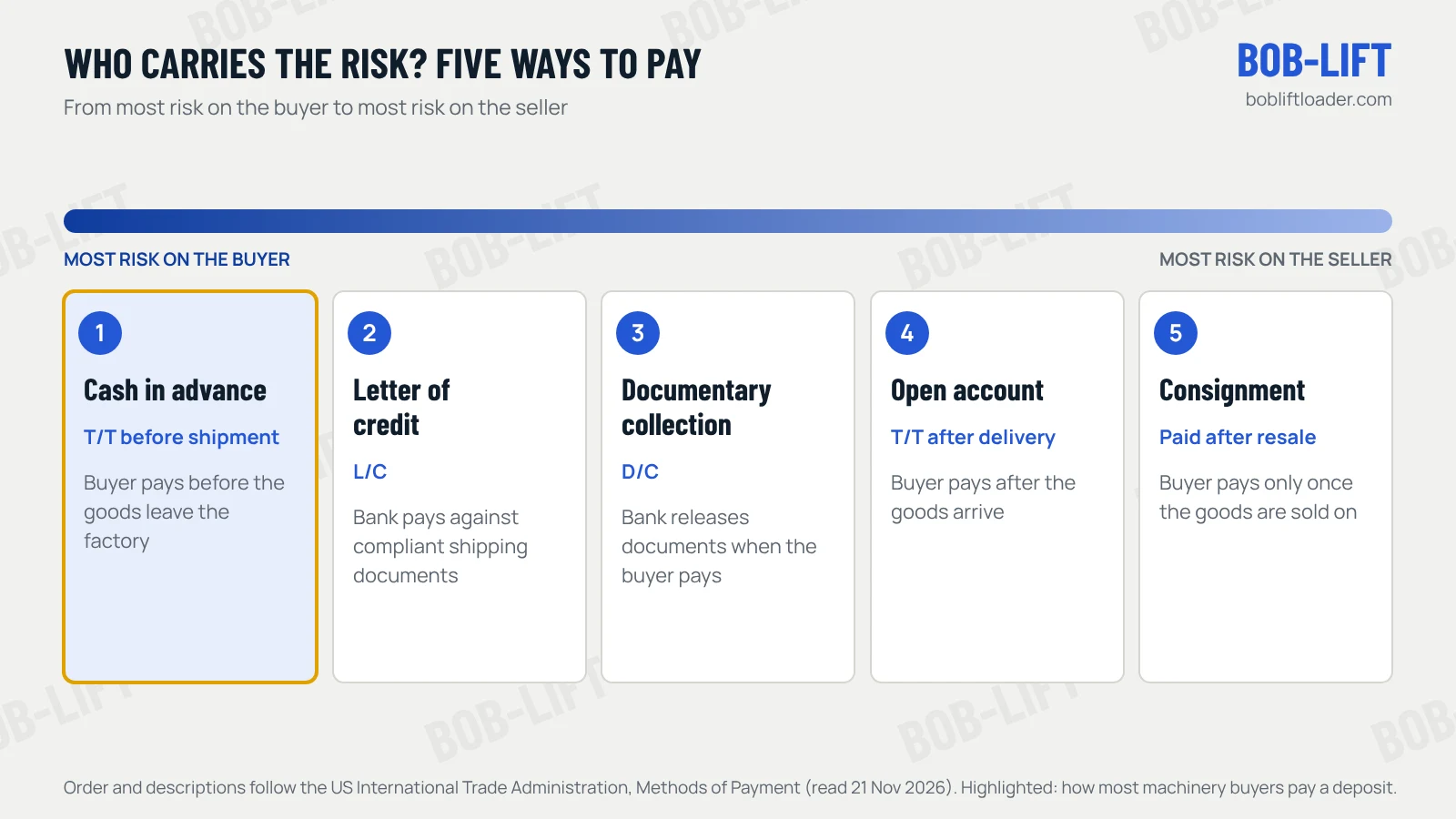

A T/T paid before shipment is cash in advance. The International Trade Administration calls a wire transfer “the most secure and preferred cash-in-advance option for exporters”. It adds that paying in advance is “the least attractive option for the buyer, because it creates unfavorable cash flow” [2] [1].
A T/T can also be used on open account, with the buyer wiring the money after delivery. Open account is “one of the most advantageous options to the importer in terms of cash flow and cost”. It is also one of the highest-risk options for the exporter [1].
How the deposit and balance usually work
For a machinery order, a T/T is usually split into two payments tied to stages of the order. The common patterns are:
- Deposit with the order, balance before loading. The factory builds the machines after the deposit arrives and loads them once the balance is paid. You or your inspector can check the machines before you send the balance.
- Deposit with the order, balance against a copy of the bill of lading. You pay the balance once the goods are on board and you have seen a copy of the bill of lading. The original bill, which you need to collect the container, is released after payment.
- Full payment in advance. Common for a single machine, spare parts or a small sample order, where two payments would cost more in bank fees than they save in risk.
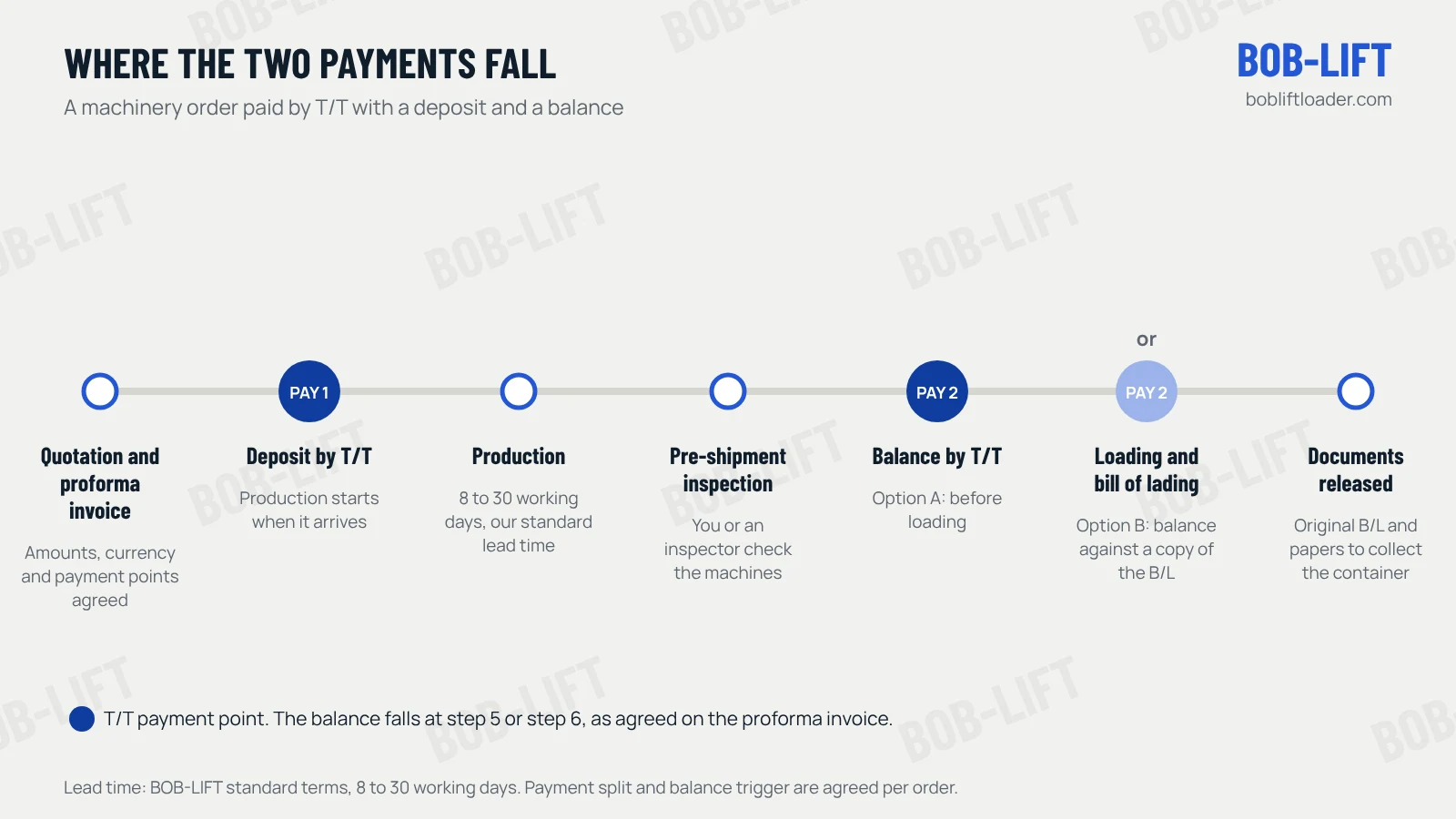
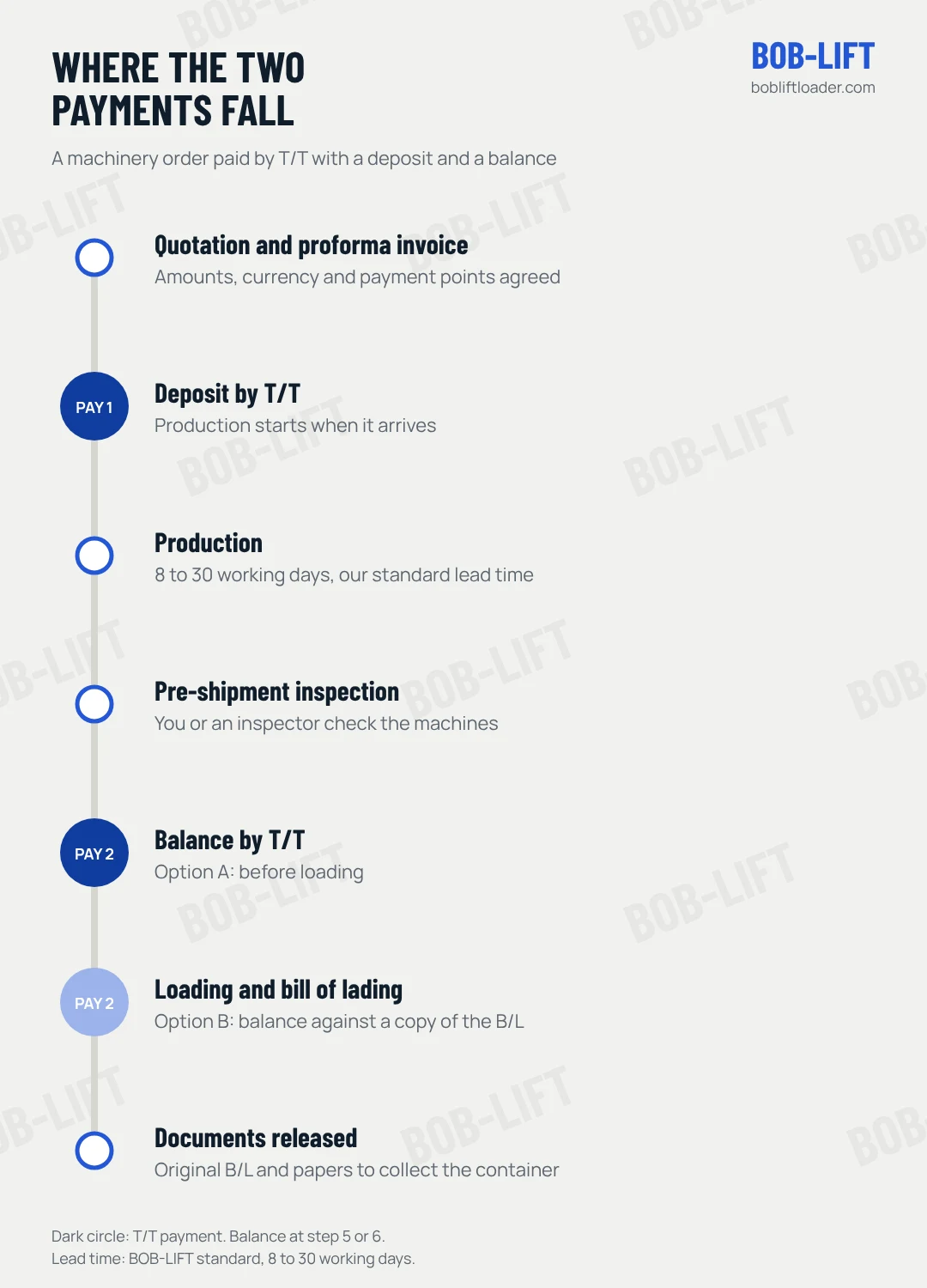
Our standard lead time is 8 to 30 working days, so a deposit is usually tied up for a few weeks before you can inspect the machines. As a worked example, take an order worth US$20,000 on a 30 percent deposit. The deposit is US$6,000; if it is sent on Monday 30 November and takes 3 bank days to arrive, production starts on Thursday 3 December. After 8 to 30 working days of production, the machines are ready for inspection between mid-December and mid-January. The US$14,000 balance then falls due, before loading or against the bill of lading copy. Whatever the split, make sure the proforma invoice states three things for each payment: the amount, the currency and the event that makes it due. If a balance is due “before shipment”, agree whether that means before loading at the factory or before the ship sails, because the two can be days apart.
Tie the balance to an inspection you can act on. Our pre-shipment inspection checklist lists what to check on a mini loader or dumper before the balance is paid, by your own staff or a third-party inspector. Where the risk passes after loading depends on the trade term, which our FOB vs CIF guide explains.
Bank details to check before you send a T/T
Wise lists the details an international transfer needs [3]. They are the recipient bank’s SWIFT/BIC code, the recipient’s full name or business name, the amount and currency, and a payment reference. For a factory order, check each one against the proforma invoice before the payment leaves your bank.
- Beneficiary name: the full legal name of the company on your contract, for us Xuzhou BOB-LIFT Construction Machinery Co., Ltd., never a person’s name.
- Account number, bank name and SWIFT/BIC code: copied from the proforma invoice, then confirmed by phone or video call.
- Currency and amount: as on the proforma invoice, usually US dollars, plus any bank charges you agreed to cover.
- Payment reference: the proforma invoice number, so the payment can be matched to your order.
The beneficiary name matters most. Pay the company named on your contract, into an account held in that company’s name. A request to pay a different company, an individual or an account in a third country is a reason to stop and verify, however plausible the explanation.
Bank charges: OUR, SHA and BEN
An international wire can pass through one or more intermediary banks before it reaches the seller’s bank, and each may take a fee. The charge option you choose tells the banks who pays.
Revolut Business explains the difference [4]. With OUR, “all fees, including intermediary and receiver bank fees, are paid upfront”. With SHA, fees are split and charged after the transfer, which “can result in recipients getting less than the amount sent”. Wise lists the same three options, with BEN meaning the beneficiary pays [3].
A short payment is a nuisance on a deposit and a problem on a balance, because the order may wait while the difference is settled. Agree with the seller which option to use before the first payment, and if you use SHA, ask whether the seller expects you to add an amount for fees.
Proof of payment: the MT103
An MT103 is the standard SWIFT payment message the sending bank generates for an international wire [5]. It records the key details of the transfer, including the payment reference. Send it to your supplier if a payment has left your account but has not arrived. Aspire, a business account provider, notes that many traditional banks do not issue the MT103 automatically. It is usually available within 1 to 2 business days after the transfer [5]. Ask your bank for it, or for its equivalent payment confirmation, each time you pay.

T/T timings to plan around
Each step of a T/T order has its own clock. Put these timings into your cash-flow plan before you confirm the order.
| Step | Typical time | Source |
|---|---|---|
| International SWIFT transfer arrives | Around 1 to 6 days, by transfer type | Wise [3] |
| MT103 available from your bank | Usually 1 to 2 business days after the transfer | Aspire [5] |
| Production after the deposit arrives | 8 to 30 working days | Our standard lead time |
| L/C documents presented after shipment | Up to 21 days | UCP 600 [7] |
| Bank examination of L/C documents | Up to 5 business days | UCP 600 [7] |
Protect your T/T from invoice fraud
Business email compromise is fraud in which the buyer receives a genuine-looking email, often from a hacked or look-alike address, saying the seller’s bank account has changed. The money goes to the criminal’s account.
The FBI’s Internet Crime Complaint Center counted 305,033 domestic and international incidents and US$55,499,915,582 in exposed losses between October 2013 and December 2023. It also reported a 9% increase in identified global exposed losses from December 2022 to December 2023 [6].
- Verify any change of bank details on a second channel. The FBI advises using “secondary channels and/or two-factor authentication to verify requests for changes in account information” [6].
- Check the sender’s address letter by letter. Look-alike domains differ by one character.
- Send a small test payment to a new account and confirm by phone that it arrived before sending the full amount.
- Act fast if something goes wrong. The FBI’s first step is to contact your bank immediately and request a recall of the funds [6].
If you receive an email that says our bank details have changed, do not pay it. Call or WhatsApp us on the numbers shown on this website and confirm with someone you have spoken to before.
T/T or letter of credit?
A letter of credit (L/C) is “a commitment by a bank on behalf of the buyer that payment will be made to the exporter”, in the words of the International Trade Administration [1]. The bank pays when the documents meet the terms of the credit. Most letters of credit follow UCP 600, the rules for documentary credits issued by the International Chamber of Commerce. The current version formally commenced on 1 July 2007 and is the sixth revision since the rules were first issued in 1933 [8]. Under UCP 600, the beneficiary may have up to 21 days after shipment to present documents, and banks have up to 5 business days to examine them [7].
An L/C protects the buyer better than an advance T/T, because the bank pays only against compliant shipping documents. The price is bank fees on both sides, more paperwork and the risk that a small discrepancy in a document delays payment and shipment. For an order of a few mini loaders or dumpers, those costs are large relative to the order, which is why T/T with a deposit is the norm. Our standard term is T/T. If your bank or finance provider requires another method, raise it before the proforma invoice is issued.
How to start an order with a small first payment
The simplest way to limit T/T risk with a new supplier is to start small. With a minimum order of one machine, you can place a trial order, inspect it on arrival and scale up once the machine and the paperwork meet your standard. Dealers comparing several factories can check quotations line by line with our guide to comparing Alibaba mini skid steer listings. Our mini skid steer dealer guide covers how stock orders are usually placed.
Until 31 December 2026, a small deposit can also hold an order you plan to place later. Under our year-end offers, the deposit counts double against the order when you place it: US$500 counts as US$1,000 on an order of US$5,000 to 15,000, US$700 as US$1,400 on US$15,001 to 30,000, and US$1,000 as US$2,000 above US$30,000.
Frequently asked questions
Is T/T payment safe for the buyer?
The transfer itself is a normal bank payment. The risk is that you pay before you receive the goods, which the International Trade Administration describes as the least attractive position for the buyer [2]. Reduce it with a deposit and balance split, an inspection before the balance, a verified beneficiary account and a small first order.
What does a 30 percent T/T deposit and 70 percent balance mean?
You pay 30 percent of the order value by bank transfer to start production. The remaining 70 percent is due when the event named in the contract happens, usually before loading or against a copy of the bill of lading. The percentages vary by supplier and order.
How long does a T/T payment take to arrive?
An international SWIFT transfer typically takes around 1 to 6 days [3]. Intermediary banks, cut-off times and public holidays in either country can add time, so send a balance a few days before it is due.
Is T/T the same as a wire transfer?
Yes. T/T is the trade term for an international wire or SWIFT transfer [3].
Can I cancel a T/T payment?
Once the money has reached the beneficiary’s account, the beneficiary has to agree to return it. If you suspect fraud, contact your bank at once and ask it to recall the funds [6].
About these sources
- US International Trade Administration, Methods of Payment, trade.gov.
- US International Trade Administration, Cash-in-Advance, trade.gov.
- Wise, Telegraphic Transfer (T/T Payment): Everything You Need to Know, last updated 5 March 2026.
- Revolut Business Help, Fees on SWIFT Transfers.
- Aspire, What Is a SWIFT MT103 Document?, 6 May 2025. Aspire is a business account provider.
- FBI Internet Crime Complaint Center, Business Email Compromise: The $55 Billion Scam, Alert Number I-091124-PSA, 11 September 2024.
- ICC Academy, An Overview of UCP 600 and ISP98, 14 October 2025.
- Wikipedia, Uniform Customs and Practice for Documentary Credits.
All sources were read on 21 November 2026. Our payment terms, lead time and warranty are our own sales terms. This guide is general information, not legal or financial advice; ask your bank about its own fees and procedures. Read more about us and our factory.
Ask for a proforma invoice
Tell us the models and quantity you need, your destination port and the trade term you prefer. We reply with a quotation; once you confirm, the proforma invoice sets out the amounts and payment points for your T/T. Send us your enquiry.