


No, there is no single universal quick attach plate for mini skid steers. ISO 24410 standardises the mounting frame for full-size skid steer attachments, but it acknowledges that small skid steers can need a different width. On our own range, the plate is identical on every loader of one model, yet its dimensions differ between models. Consequently, before you buy a mini loader for attachments you already own, measure six dimensions on one of those attachments and send them with the model you want. We then check whether the plate can be made to match.
This guide is for contractors, landscapers, rental companies and equipment dealers who already own mini loader attachments, or who intend to buy attachments from a local supplier. It explains what the plate does, what the two international standards on quick couplers require, which measurements matter, and how to confirm that an attachment is properly locked. Machine figures come from our specification sheets and the answers of our skid steer team in Xuzhou. You can read more about our company and factory.
Key takeaways
- Google Keyword Planner shows about 110 searches a month in the US for “mini skid steer quick attach plate” and 140 each for “adapter plate” and “attachment plate”. Another 90 search for “mini skid steer quick attach” and 70 for “mounting plate” [1]. Buyers are asking whether tools will fit.
- ISO 24410:2020, the 2nd edition that replaced ISO 24410:2005, gives dimensional limits for the attachment mounting frame of skid steer loaders. It says small skid steers can have a different width requirement, and that other coupler styles are not interchangeable with it [2].
- ISO 13031:2016 sets the safety rules for quick couplers on earth-moving machinery. Under it, a coupler that holds the attachment by friction alone is not permitted [3].
- On our 9 mini skid steers, from the 930 mm wide BL-T360-H to the 500 kg BL-T1000-H, the plate is the same across one model and differs in size between models. Plates do not swap between models.
- For attachments you already own, send 6 measurements, 3 photos and the tool’s weight and oil needs. We check the plate and the hydraulics before you order; our loaders are rated 200–500 kg (441–1,102 lb) and run at 16–20 MPa.
What is a mini skid steer quick attach plate?
A quick attach plate is the steel plate on the front of a skid steer’s lift arms that every bucket and tool hooks onto. ISO calls it a quick coupler. ISO 13031 notes that the same part is also called a “quick hitch” or an “attachment bracket” [3]. In short, it lets the operator release one attachment and collect the next in minutes, instead of knocking out mounting pins with a hammer.
An attachment mounting frame is the matching part on the back of each tool. It has a lip along the top and locking slots near the bottom. To connect, the operator tilts the plate forward, drives in and raises the arms slightly, so the plate’s top edge slides under the lip. Then the plate rolls back against the frame and the locking pins pass through the slots. On the BL-S750-H plate, that takes 2 hand levers, 1 on each side.
The photo at the top of this page shows the plate on our BL-S750-H. It is a wheeled stand-on loader with a 400 kg (882 lb) rated load and 18 MPa (180 bar) hydraulics. Its engine is a Laidong 385B (18.6 kW), Yanmar 3TNV80 (18.4 kW) or Kubota (18.5 kW). Each of its levers has a return spring, and above the plate sit the tilt cylinder and the auxiliary hydraulic couplers with red dust caps. In ISO 13031 terms, a coupler whose locks are worked by hand at the coupler is a manual quick coupler. A coupler worked from the seat by hydraulic or electric power is a powered quick coupler, and the standard also defines a 3rd, mixed type that locks from the seat but releases by hand [3].
Is there a universal mini skid steer plate?
Not one you can rely on. The so-called universal plate on full-size skid steers comes from a dimensional standard, and that standard deliberately leaves room for smaller machines to differ. ISO 24410 “provides for the interchangeability of attachments on skid steer loaders” by setting dimensional limits for the attachment mounting frame [2]. The 2020 edition replaced the 2005 first edition. It added safety requirements, an annex on how the coupler works, and width dimensions for narrow skid steer loaders.
Three notes in the standard matter for mini loader buyers [2]:
- Skid steers can use other styles of quick coupler, but those are not interchangeable with attachments built to the standard.
- Couplers on small skid steers and some compact tool carriers can have a different width requirement. The narrow-loader widths are in an informative annex.
- The standard gives dimensions for the frame on the attachment, not for the coupler itself, because those depend on the coupler design.
- The coupler linkage should give at least 5° of rollback beyond vertical with the arms at their lowest, but smaller skid steers and compact tool carriers may have less.
In practice, therefore, two mini loaders advertised as “universal” can still differ in width, lip profile or locking position. For example, a frame built for one maker’s narrow stand-on loader may not match the width or lock spacing of another maker’s plate. That is why we answer the compatibility question model by model, from measurements rather than from a label.
Skid steer quick attach dimensions: what is published
The full-size skid steer quick attach interface has standard dimensions, but they sit inside paid standards rather than in a free public table. SAE J2513, issued in June 2000 and cancelled in May 2008, set the dimension requirements for the attachment bracket and attachment interface on skid steer loaders with an operating mass of 4,500 kg (9,921 lb) or less [5]. Its scope already said that narrow skid steer loaders may be too narrow to comply, and it left the locking system to each manufacturer. Today, ISO 24410:2020 carries the dimensional limits for the attachment mounting frame [2].
So a single figure quoted online for “skid steer quick attach dimensions” is usually one person’s measurement of one plate, not the rule. For a mini loader, the dimensions that count are the ones on your own attachment frame. The table sets out how the two worlds differ.
| Point | Full-size skid steer (ISO 24410, formerly SAE J2513) | Mini skid steer, stand-on or narrow seated | Our 9 models |
|---|---|---|---|
| Machines covered | Operating mass up to 4,500 kg (9,921 lb) under SAE J2513 | Narrow loaders, which both standards allow to differ | 650 to 1,250 kg (1,433 to 2,756 lb) machine weight |
| Frame width | Set by dimensional limits in the standard | Set by each maker; ISO 24410 gives narrow-loader widths in an informative annex | Plate size differs by model; body width 930 to 1,090 mm (36.6 to 42.9 in) |
| Locking | Wedge-type engagement that meets ISO 13031 | Hand levers or pins, varies by maker | 2 hand levers on the BL-S750-H plate, 1 on each side |
| Swap attachments? | Yes, between frames built to the standard | Not by default | Yes within one model, no between models |
| Drawings published? | In the paid standard | Rarely | No; we check from your measurements |
How our plates differ between models
Our skid steer team states the rule simply. The quick-attach plate is identical on every loader of one model, so attachments swap freely across a fleet of that model. Between models, however, the plate is a different size, so an attachment made for a BL-T360-H plate will not fit a BL-T1000-H without modification. If you already own attachments, send us their mounting dimensions and we check whether the plate can be made to match.
The table lists the nine loaders on our mini skid steer loaders page with the figures that limit any attachment: rated load, hydraulic pressure and width. Rated loads run from 200 kg (441 lb) to 500 kg (1,102 lb), and pressure from 16 MPa (160 bar, about 2,320 psi) to 20 MPa (200 bar, about 2,900 psi).
| Model | Drive | Operator | Rated load | Hydraulic pressure | Body width | Standard bucket |
|---|---|---|---|---|---|---|
| BL-T360-H | Tracks | Stand-on | 200 kg (441 lb) | 17 MPa (170 bar, 2,470 psi) | 930 mm (36.6 in) | 906 mm (35.7 in) |
| BL-T460-H | Tracks | Stand-on | 300 kg (661 lb) | 17 MPa (170 bar, 2,470 psi) | 1,090 mm (42.9 in) | 1,100 mm (43.3 in) |
| BL-T750-H | Tracks | Stand-on | 410 kg (904 lb) | 18 MPa (180 bar, 2,610 psi) | 985 mm (38.8 in) | 1,270 mm (50.0 in) |
| BL-S750-H | Wheels | Stand-on | 400 kg (882 lb) | 18 MPa (180 bar, 2,610 psi) | 985 mm (38.8 in) | 1,270 mm (50.0 in) |
| BL-T1000-H | Tracks | Stand-on | 500 kg (1,102 lb) | 20 MPa (200 bar, 2,900 psi) | 960 mm (37.8 in) | 1,240 mm (48.8 in) |
| BL-S390-C | Wheels | Seated | 260 kg (573 lb) | 16 MPa (160 bar, 2,320 psi) | 959 mm (37.8 in) | 1,050 mm (41.3 in) |
| BL-T390-C | Tracks | Seated | 250 kg (551 lb) | 16 MPa (160 bar, 2,320 psi) | 955 mm (37.6 in) | 1,050 mm (41.3 in) |
| BL-S490-C | Wheels | Seated | 250 kg (551 lb) | 16 MPa (160 bar, 2,320 psi) | 1,089 mm (42.9 in) | 1,150 mm (45.3 in) |
| BL-T490-C | Tracks | Seated | 250 kg (551 lb) | 16 MPa (160 bar, 2,320 psi) | 1,089 mm (42.9 in) | 1,150 mm (45.3 in) |
We do not publish auxiliary flow figures. Flow differs from model to model and sets how fast a powered tool runs, so we confirm it for each tool when we quote. Our guide to 26 mini skid steer attachments explains which tools need the auxiliary lines and which mount on the plate alone.
Six measurements to send us
Take the measurements from the attachment, not from your previous loader, because the mounting frame is the component that has to fit our plate. Use millimetres or inches, and measure one representative frame carefully rather than several frames roughly.
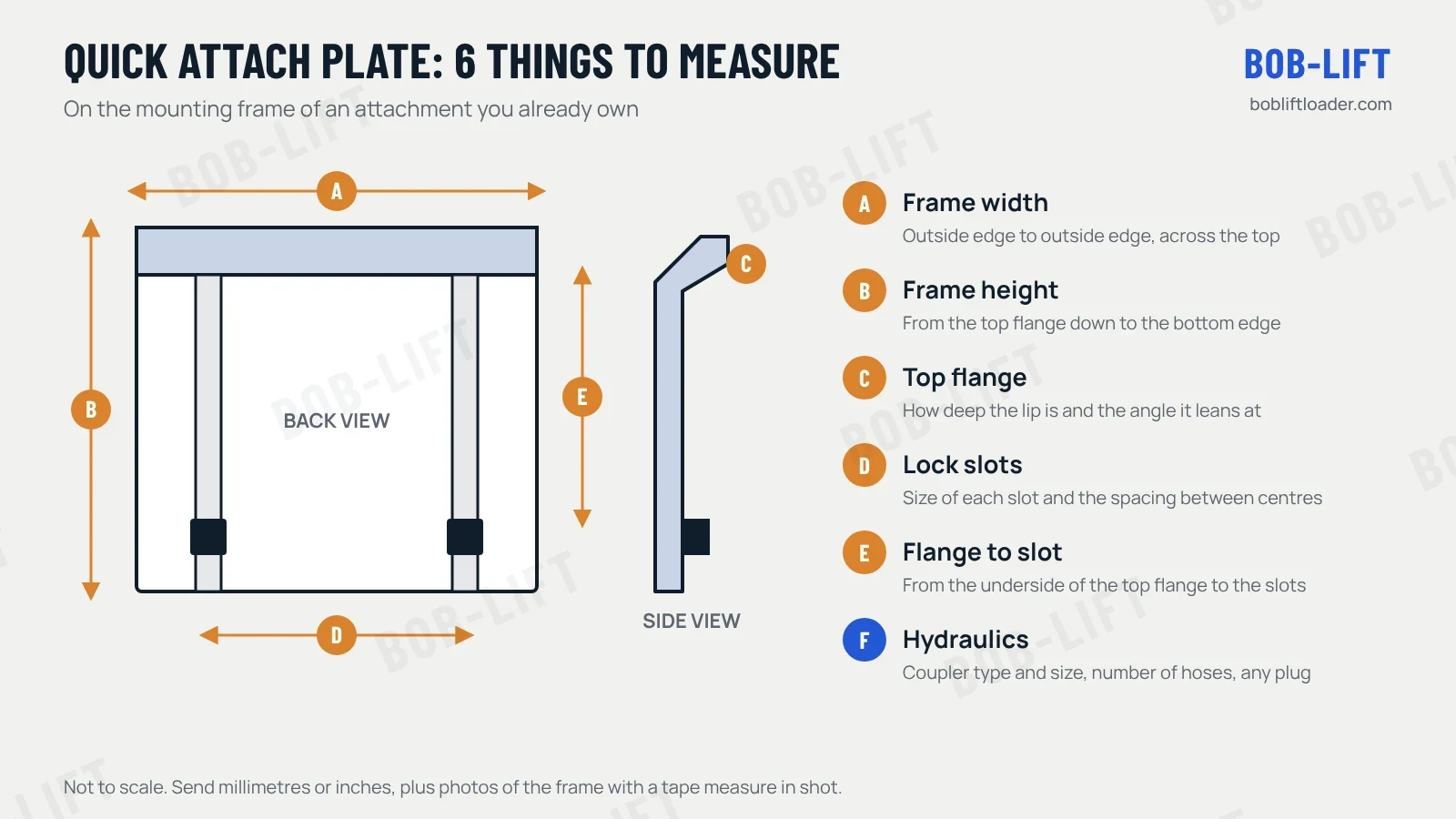

- A, frame width: outside edge to outside edge, measured across the top. This is the first figure that rules a tool in or out; our loader bodies run from 930 mm (36.6 in, BL-T360-H) to 1,090 mm (42.9 in, BL-T460-H) wide.
- B, frame height: from the top of the lip down to the bottom edge of the frame.
- C, top flange: how deep the lip is and the angle it leans at. A side photo with a square or protractor helps here.
- D, lock slots: the size of each slot or hole, and the spacing between their centres.
- E, flange to slot: the distance from the underside of the lip down to the slots. Together with C, it decides whether the locks can reach.
- F, hydraulics: the coupler type and size on the tool’s hoses, the number of hoses, and any electric plug.
Measure lengths to the nearest 1 mm (about 0.04 in) and the lip angle to the nearest 1°. In total, a complete fit request holds 6 measurements, 3 photos, 1 weight, 2 hydraulic figures (flow and pressure) and 1 BOB-LIFT model name.
| Item in your fit request | What to record | How precise |
|---|---|---|
| A, B, D, E | Frame width, frame height, lock slot size and spacing, flange to slot | Nearest 1 mm (0.04 in) |
| C | Lip depth and lip angle | Nearest 1 mm (0.04 in) and 1° |
| F | Coupler type and size, number of hoses, any electric plug | As marked on the fittings |
| Weight | Attachment weight | kg or lb from the nameplate |
| Oil | Flow and pressure the tool needs | From the nameplate or manual |
| Photos | Front, back and side of the frame, tape measure in view | 3 photos |
| Loader | The BOB-LIFT model you plan to buy | 1 model name |
Also send the attachment’s weight and the oil flow and pressure on its nameplate or in its manual. Weight matters because a tool heavier than the standard bucket leaves less of the rated load for material. Our article on mini skid steer lift capacity shows how the rated load is set.

Fitting attachments you already own
The sequence matters: measure, photograph, then specify the loader. Each step answers a question we would otherwise have to ask you, so the check goes faster.

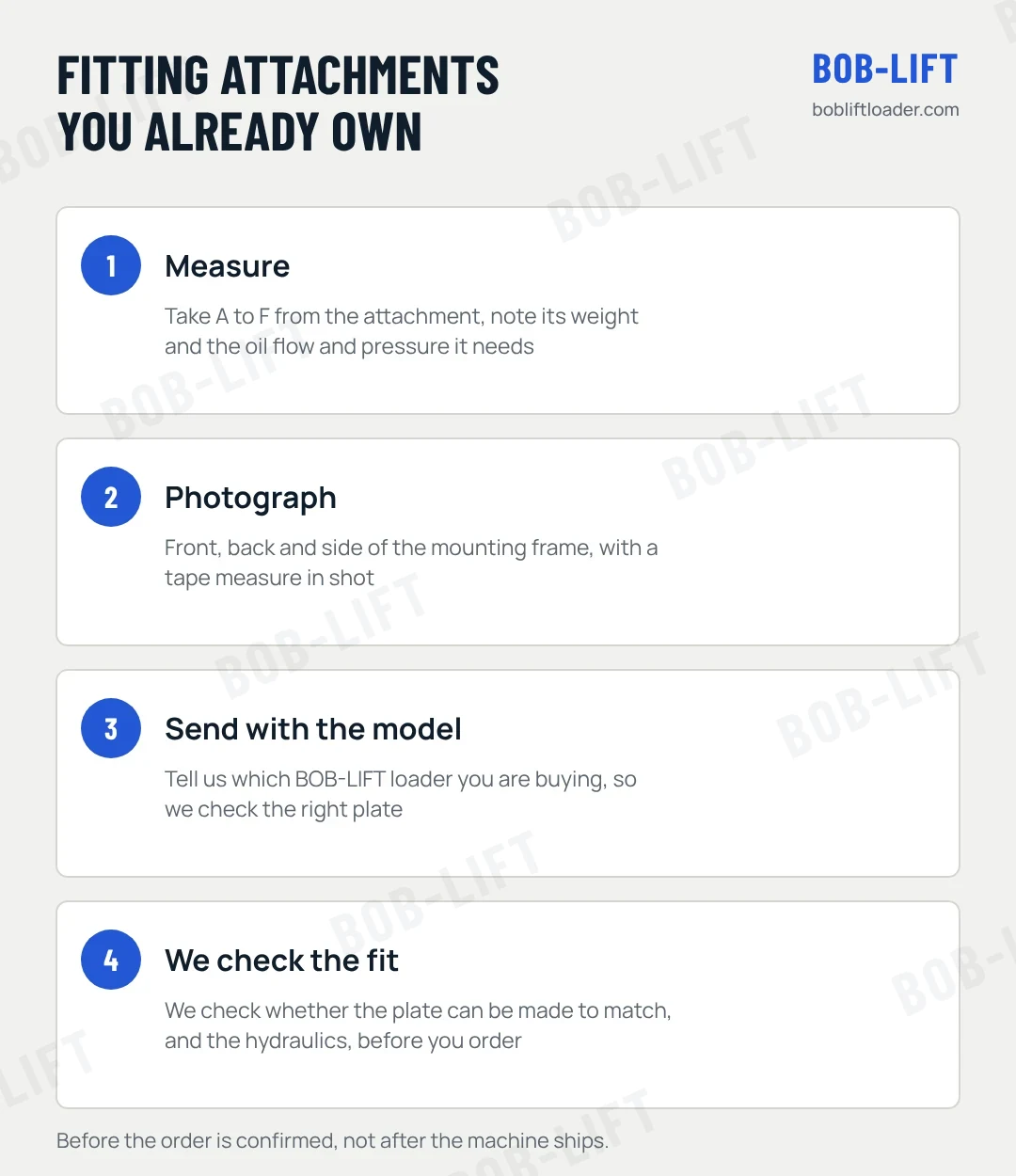
First, take measurements A to F from one attachment, and note its weight and hydraulic requirements. Next, photograph the front, back and side of the mounting frame with a tape measure visible. Then tell us which of our loaders you plan to buy, because each model has its own plate. Finally, we check whether the plate can be made to match and whether the auxiliary hydraulics suit the attachment, such as an auger that needs a particular oil flow. Once that is agreed, it goes into the order, so you can confirm it again in a pre-shipment inspection.
If the plate cannot be matched, you still have two routes. You can buy the tools with the loader, already matched to its plate and hydraulics. Alternatively, you can ask a local fabricator about an adapter. An adapter plate is a steel frame that bolts or couples between two different plate styles. It adds weight and moves the tool forward, so it leaves less of the rated load for the material. Ask the adapter maker for its weight before you decide.
How to check the lock every time
An attachment that is not fully locked is the principal hazard of any quick coupler. On 29 September 2022 in Kentucky, a 46-year-old operator raised the lift arms of a skid steer carrying a twin-fork attachment with a gravel bucket. He left the cab and was under the attachment when it separated from the arms and fell on him. NIOSH’s FACE report lists 4 contributing factors, and bypassing equipment safety features is the first [4].
ISO 24410 also asks for contact in each of the 3 zones between coupler and frame in every operating mode. It says the wedges or pins of the coupler must engage the attachment frame at their contact surfaces when the tool is properly connected. It also requires a skid steer coupler to meet the ISO 13031 rules for a wedge-type engagement system [2]. On site, that becomes a habit of four checks:
- Both levers are fully in the locked position, not halfway.
- Both locks are visible through the slots on the attachment frame. Walk round and look, because one side can lock while the other does not.
- With the tool just off the ground, tilt it forward and press it lightly down. If the bottom of the frame moves away from the plate, it is not locked.
- Never stand or reach under a raised attachment, and lower it before you leave the controls.
Locking pins on the plate are regular wear parts, so check them for wear at each service. For spares, see our mini skid steer parts and spares kit guide, and train every operator on the lock check from the manual.
Frequently asked questions
What are the standard skid steer quick attach dimensions?
They are set in ISO 24410:2020, and before that in SAE J2513, which covered skid steers of up to 4,500 kg (9,921 lb) operating mass [5]. Both are paid standards, and both allow narrow loaders to differ. A mini loader plate therefore has no single standard size, so measure your attachment frame and send us the six figures.
What is a mini skid steer mounting plate?
It is another name for the quick attach plate: the steel plate on the lift arms that every bucket or tool locks onto. ISO 13031 calls the same part a quick coupler, quick hitch or attachment bracket [3].
Are mini skid steer quick attach plates universal?
No. ISO 24410 covers the full-size skid steer frame and notes that small skid steers can need a different width [2]. Mini loader plates vary between makers, and on our range they vary between models too. Check the plate against your tool’s measurements, not a label.
Will attachments from another mini loader fit your machines?
Sometimes, but not by default. Send us the six measurements, photographs and the model you want. Our team checks whether the plate can be made to match before you order, and tells you clearly if it cannot.
Can I move attachments between two of your models?
Only between loaders of the same model, because the plate is identical within one model and differs in size between models. For example, 4 BL-T750-H loaders can share 1 set of attachments, while a fleet of 2 BL-T750-H and 2 BL-T360-H loaders needs a set for each model, or a matching check from us.
Do you publish your plate dimensions?
No. We check the fit from your attachment’s measurements instead, because each of our 9 models has its own plate and the details depend on your order.
Does an adapter plate reduce what the loader can lift?
Yes. It adds its own weight and moves the load forward, away from the machine. Both leave less of the rated load for the material, so confirm the tool and adapter weights first.
About these sources
Search volumes come from Google Keyword Planner for the United States [1]. The standard quotes come from the ISO 24410:2020 and ISO 13031:2016 previews, read on 11 November 2026 [2] [3]. The incident summary comes from the NIOSH Kentucky FACE Report 22KY083, published on 28 March 2023 [4]. The SAE J2513 scope was read on SAE Mobilus on 16 November 2026 [5]. Machine figures come from our specification sheets, and the plate rule comes from our skid steer team. This guide is general information; follow your loader’s and attachment’s manuals.
Ask about your attachments
Tell us the loader model you want, the attachments you already own and the six measurements for each. We will check the plate and the hydraulics and reply with the specification sheet and a quotation. If you are still choosing the loader, start with our nine mini skid steer models. Send us your requirements.
Sources: [1] Google Ads, Keyword Planner. [2] ISO 24410:2020, Earth-moving machinery: coupling of attachments to skid steer loaders. [3] ISO 13031:2016, Earth-moving machinery: quick couplers, safety. [4] NIOSH, Equipment Operator Crushed by Skid-Steer Attachment, Kentucky FACE Report 22KY083. [5] SAE J2513, Earthmoving Machinery: Coupling of Attachments to Skid Steer Loaders (cancelled May 2008).